studiot
Senior Members
-
Joined
-
Last visited
Everything posted by studiot
-
Agreed. You need to be careful in your specification of 'an event' I think my two dice example shows this better than the horses. Ways of getting 7 | 6 +1 8 | 4 + 4 ; 5 + 3 ; 6 + 2 9 | 5 + 4 ; 6 + 3 10 | 5 + 5 ; 6 + 4 11 | 5 + 6 12 | 6 + 6 Sorry for the presentation Why does neither Tab nor repeated spaces work in this blighted editor ? So the probabilities are definitely not equal for these outcomes.
-
Glad I'm getting you the think further. You are not wrong but not completely right either. I've been fitting a new front door lock today but I have some more detail in mind for tomorrow, after my next bread baking session. So look in again tomorow evening.
-
There may be some truth in what you are showing, but it isn't quite right either. What do you mean by 'exert gravity' ? Gravity is a two way process. One object exerts a gravitational force on another body and the other body responds by exerting a gravitational force on the first body the is equal in magnitude but opposite in direct. So the Earth pulls on the Moon and the Moon pulls back on the Earth. It is the same with a ball that you throw up in the air. The force is the same in both directions. But since the Earth is so much bigger than the ball the effect of that force is so much smaller on the Earth than the ball and we simply consider the effect of the Earth force on the ball. Does this help for a start ?
-
Thank you. You might like to know that the equations you are struggling with concern the Principle of Action and the Calculus of Variations and some formidable Mathematics. The three quantities connected in your equations all have the same physical dimensions - that of Action, or ML2T-1 This is why I asked about angular momentum (also called moment of momentum) which has the same dimensions as Action, as does Planck's Constant. Calculations are done in what is known as Phase Space. So your answer to my question is incorrect, as the above equations do connect through dimensional analysis. As above they also connect Relativity and QM Instead of wallowing around why not try asking us some questions ? Also have a look at this Dutch website - the author does a good job with little or no mathematics but some rather good animations to discuss this subject. https://cleonis.nl/physics/phys256/stationary_action.php
-
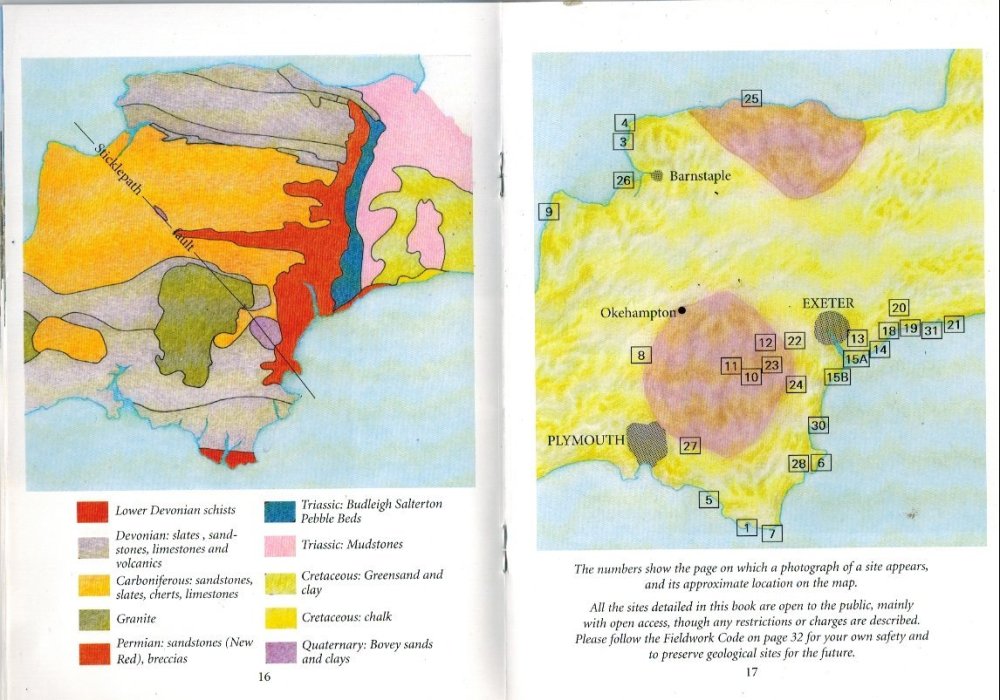
Could you not be simply matter of fact if you can't be more civil ? There is nothing I can find in the article you posted at variance with my line of reasoning. However I cannot find reference to the Killerton lamprophyres, which are actually in Devon. That may be because the article is behind a paywall I can't access and the pictures are to small to read the small print. Nor can I find reference to the Sticklepath fault which runs right through both the Culm measures, which are not part of Dartmoor or Exmoor, and the Dartmoor granite outcrop, and thus clearly postdates both. The Sticklepath fault is a strike-slip fault with a mximum horizontal displacement ca 10km. Here is what I consider a more appropriate map for the discussion posted in my OP. Exmoor and Dartmoor are shown in brown on the right hand map. The left hand map shows the broad brush geology, and clearly shows the granite intrusion in khaki. The devonian old red sandstone is shown in grey, and yes the north devon sandstone is older than the south devon, and of different composition, but both are of devonian age. Botht Old red sandstone and the Culm measures carry on westward into Cornwall, and somewhat eastwardinto Somerset, where they are bounded by rocks of Permian age (the new red sandstone). This in turn is bounded by the triassic / jurassic and then the cretaceous as the map procedes into Dorset. The extreme southern tip of Devon (Start Point) is shown as Devonian Schist. This is interesting because schist is sedimentary material that has been metamorphosed by both heat and pressure to the point of remelting and recrystallisation. If that has happened to the Dartmoor granite the result would be gneiss.
-
I don't know if this post was in response to me, but I am not a physicist. I am a (retired) mathematician and I have been looking at the mathematics you posted. Being also a careful mathematician I told you what I could pretty definitely identify and what I could not. So is asking what the letter t stands for in a mathematical expression posted by you offensive or why are you having so much difficulty simply saying "t is ......" ?
-
Yes of course, but AI is costing everyone so much money and other planetary resources because the promoters tell us it is better than the old ways. But is it really ?
-
+1 +1 Sorry I still find both you and your AI are missing the point. Your AI failed to offer the most important points concerning age and made a big bobo about Dartmoor. The pluton was intruded into the country rock at the time and ended up with 1 - 2 kilometres of sedimentary deposit above it. I.E. it was buried. The covering of sedimentary rock subsequently eroded away; much of the detritus was deposited elsewhere as new sedimentary rock, leaving the granite exposed and itself eroding. Dartmoor itself is basically the granite intrusion. Other processes created nearby basins and troughs which accepted some of the resultant sediment. But they are not part of Dartmoor As Inow said - you have to be careful accpting answers from AI and I would add you should not receive inconsistent answers by putting in modifications of the question. The last is a devil's incentive to go on changing the question slightly until you receive an answer you like and can then claim it is the 'correct' one.
-
Well I know what 2pi is and I know what G is and I assume c is the conventional speed of light. But what is t please in your strict UBD ?
-
I would be most interested to learn how angular momentum connects relativity and quantum mechanics.
-
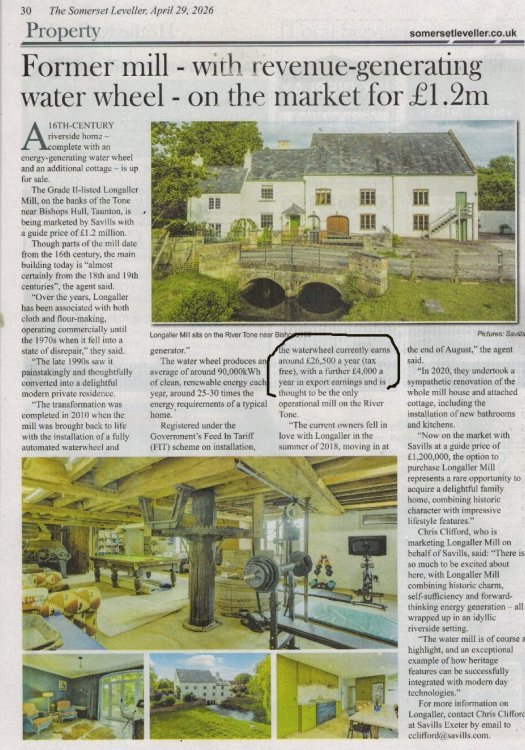
It is sometimes forgotton that the first industrial revolution was hydro powered. I have long advocated rethinking and returning to the many smaller schemes that prexisted the steam age. So I was glad to read this article below. For those who are from further away about 1/3 of Somerset, the county is famous for 'The Levels' - a low lying area similar to the dutch polderland, that once protected King Alfred from the Vikings. Hence the newspaper title.
-
Well this is the first post you have made that I can actually understand. I am not very interested in matters long ago or long into the future or far away or inaccessibly large or small as I do not think we have anywhere near enough information to gain access to these extremes. Further I have seen hypotheses come and go so many times that I have lost interest. I can however appreciate a rational sequence of presentation. If we are going to postulate a big bang, cmb, inflation and later processes certain things follow. For cmb to arise, moving charged particles are necessary. For motion to exist, both space and time are necessary. For plasma to arise charged particles are again necessary. But an explanation of why and how they combine to form primitive atoms is necessary. and so on.
-
If the interior of the loaf is not being fully cooked by the time the exterior is sifficiently crisp try various methods to improve the heat flow to the interior. 1) Smaller loaves. 2) Long loaves of smaller cross section. 3) Perhaps you are just adding too much water. I like to start with a dough slightly too dry and add a little extra moisture when forming it into dollops to go into the baking vessels by dipping the dollop in a small amount of water. This can be repeated as necessary.
-
Of course it's gibberish, which is why the OP can't or won't put forward any relationship between Physics and Geometry to explain the thread title.
-
Is it not possible for all six horses to be disqualified for some reason? Then there would be no winner. Or what if there was a dead heat ? This is of course different from the die which must come down on one of its six faces. But what about my two dice version ? Are the probabilities of getting a spot sum of 10, 11, 12 equal or equal to 1 in 6 ? There are six possibilities here namely 7, 8, 9, 10, 11, 12. I think you will find that is why @joigus introduced the idea of a frequency distribution.
-
Sorry to inform you that this is a wholly inadequate definition. It is correct for a fair die, but not if the die is loaded. It is not even correct for the sum of the dots on two fair dice rolled together. Further consider a horse race of six novice horses. (novice indicate that the horse has never won) So how do you assign probabilities before the race ? Worse the total outcomes must now be greater than six to account for events such as not finishing, disqualification etc. Paradoxically, only Bayesian methods offer the one in six equal probabilities as a starting point.
-
It is difficult for me to understand why you think Physics has any sway over (Geometry) that is basically a part of Mathematics, which is a theoretical subject in its own right and would still contain all the discovered maths and the yet undiscovered maths whether or not the universe we inhabit conforms to current Physics doctrine or to any other doctrine. Physics makes great use of some mathematics, but no use at all of other mathematics. Further other physical sciences employ non mathematical reasoning in addition to mathematical reasoning.
-
Never seen that, is the page that appears pretty ? I do find however that Google often offers a list of similar queries and It can be quite productive to try (in a new tab) some or all of these.
-
No I was referring to your original post#1, and asking if (any) of the events had ever occurred, hence the reference to F = 0 as I don't see how any of them can have occurred, given their imprecise specification. No apology needed, I need to try and make myself clearer. Try this. If an event has never occurred how does a frequentist define its probability and what does he mean ?
-
I have already agreed that the term random can be problematic even to the point of producing paradoxes. One consideration is this. What do you mean by the frequentist definition:- the probability of an event E, p(E) = F/ N , where N is the total number of trials and F is the number where the outcome is E. Has any outcome ever occurred for the scenario you originally described or is F = 0 ?
-
All of them. None have considered the issue of lattice defects I mentioned.
-
But the answer, deep or shallow, is stil wrong.
-
I think you are missing the point. My example reinforces the point that AI hasn't the first clue about what you are asking. All it returns is a probability based on human writings on the subject. The dating examples I gave will return a range of values since humans themselves do not agree on the exact figures. But consider Now you and I know this is not correct as there is no exact formula, due to the inevitable presence of lattice defects, but we use it and do not bother to mention the lattice defects. And since humans know this but never bother to mention it, the probability of AI picking it up is vanishingly small.
-
Thank you yes I've seen the search results and it strikes me that this is an example of yet another person (not you) too lazy to create proper terminology for their new idea, so they pinch an older term and try to redefine it. Nevertheless you have provided the forum with a fruitful source of discussion so +1. You concentrate on 'sesquation', but what about quotation ? I would say this provides a far more controvertial redefinition of a word, wouldn't you ?
-
I originally had Here is one big big probem with AI You may get a different answer every time you ask. Would you be happy if the AI answered anything other than 360 to the question "How many deci inches in a yard ?" I used to use Goof-gle as a quick way to get reasonably reliable numeric data instead of looking it up properly when I wanted say the radius of the earth for a calculation, or perhaps the speed of sound in air at 0oC. But it seems I can't rely on consistent answers any more.