
Anton Rize
Senior Members
-
Joined
-
Last visited
-
This is a great question. in its almost bold simplicity it highlights the potential circularity in the concept of mass that keeps me up at night. @swansont explanation is perfectly correct but it does not address the deeper question: what does device on the right actually measuring? So far I do not have the answer to this question. But whatever it is - it does not required to solve gravitational systems. Here's runnable colab notebook that demonstrates it: https://colab.research.google.com/github/AntonRize/WILL/blob/main/Colab_Notebooks/R_O_M__MASS_G_FREE_CLOSURE.ipynb If python is not your jam here's desmos demonstration: https://www.desmos.com/calculator/mjen4ms452 So the question remains: what does device on the right actually measuring?
-
I do not understand your question. How do you connect amount of rigor to me or to this post? Your question sounds rhetorical to me. If you want to get a clear answer try starting from a clear question.
-
I tried to find a concrete example of physically meaningful scenario where math suppose to brake but I couldn't... Maybe someone of you guys can give an example?
-
I was quires and looked in to this mathematical beast of yours. As far as I understood it looks for invariants, so called "Killing vectors" where certain quantities are conserved like angular momentum or energy, right? I just don't understand why would you do this in such a hard way with that huge equation? I can do it like this Energy: [math]\kappa_o^2(o) = \beta_R^2(o) + \beta_T^2(o) + \beta^2[/math]; [math]\kappa_o^2(o) - \beta_o^2(o) = \frac{\beta^2(1-e^2)}{1-e^2} = \beta^2 = 2W[/math] momentum: [math]\frac{\beta_T(o)}{\kappa_o^2(o)} = \frac{\sqrt{1-e^2}}{2\beta}[/math]: [math]h = R_s c \frac{\sqrt{1-e^2}}{2\beta}[/math] Is that what it does? I'll show derivations below: Relational Origin RED vs BLUE Orbital dynamics boils down to interplay of frequency shifts. No mass, no G, no manifold, no metric required. [math]\kappa^2 = 1-\frac{1}{(1+z_{\kappa})^2}[/math] ([math]z_{\kappa}[/math] = gravitational redshift) [math]\beta^2 = 1-\frac{1}{(1+z_{\beta})^2}[/math] ([math]z_{\beta}[/math] = transverse Doppler shift) Observational Z Inputs [math]Z_{sys} = (1+z_{\kappa})(1+z_{\beta}) = \frac{1}{\tau}[/math] (product of gravitational redshift and transverse Doppler shift) [math]\tau = \kappa_{X}\beta_{Y} = \frac{1}{Z_{sys}}[/math] (product of projectional phase factors on [math]S^1[/math] and [math]S^2[/math] carriers) [math]z_{\kappa} = \frac{1}{\kappa_{X}}-1[/math] (gravitational redshift) [math]z_{\beta} = \frac{1}{\beta_{Y}}-1[/math] (transverse Doppler shift) Everything else is Closed Algebraic System of Relational Orbital Mechanics (R.O.M.) Please follow this link to see all [R.O.M. equations and definitions](https://willrg.com/documents/WILL_RG_R.O.M..pdf#eq:rom) Vis-Viva In elliptical systems, the global closure theorem [math]\kappa^2 = 2\beta^2[/math] is conserved across the entire orbital cycle, while local phase variations manifest as an internal "breathing" of relational projections. We now derive the exact conservation law governing this local dynamic distribution. Proposition: Phase-Invariant Structural Depth The difference between the square of the local potential projection [math]\kappa_o^2(o)[/math] and the square of the local kinetic projection [math]\beta_o^2(o)[/math] is a global system invariant equal to [math]2W[/math]. Proof: The binding parameter [math]W[/math] defines the global relational depth of the system: [math]W = \frac{\beta^2}{2}[/math] From the exact definitions of the [math]S^2[/math] and [math]S^1[/math] projections at any arbitrary phase [math]o[/math]: [math]\kappa_o^2(o) = \frac{2\beta^2(1+e\cos(o))}{1-e^2}[/math] [math]\beta_o^2(o) = \frac{\beta^2(1+e^2+2e\cos(o))}{1-e^2}[/math] Subtracting the local kinetic projection from the local potential projection: [math]\kappa_o^2(o) - \beta_o^2(o) = \frac{2\beta^2 + 2\beta^2 e\cos(o) - (\beta^2 + \beta^2 e^2 + 2\beta^2 e\cos(o))}{1-e^2}[/math] [math]\kappa_o^2(o) - \beta_o^2(o) = \frac{\beta^2(1-e^2)}{1-e^2} = \beta^2 = 2W[/math] Thus, the algebraic distance between the omnidirectional and directional relations remains globally constant irrespective of orbital geometry. Theorem: The Orthogonal Signature of the Orbit The square of the local potential projection [math]\kappa_o^2(o)[/math] on the [math]S^2[/math] carrier is the strict Pythagorean vector square sum of the local radial [math]\beta_R^2(o)[/math], transverse [math]\beta_T^2(o)[/math] and the global [math]\beta^2[/math] kinetic projections. Proof: The total local kinetic projection on the [math]S^1[/math] carrier splits orthogonally into radial and transverse components within the orbital plane: [math]\beta_o^2(o) = \beta_R^2(o) + \beta_T^2(o)[/math] Substituting this orthogonal decomposition into the phase-invariant relation [math]\kappa_o^2(o) - \beta_o^2(o) = \beta^2[/math]: [math]\kappa_o^2(o) - (\beta_R^2(o) + \beta_T^2(o)) = \beta^2[/math] Rearranging yields the three-dimensional algebraic relational closure: [math]\kappa_o^2(o) = \beta_R^2(o) + \beta_T^2(o) + \beta^2[/math] Remark: Ontological Replacement of Vis-Viva This geometric invariant replaces the descriptive Newtonian Vis-Viva equation ([math]v^2/2 - GM/r = -GM/2a[/math]). Standard mechanics interprets this balance as a scalar subtraction of an abstract potential energy from kinetic energy. In WILL, it is revealed as a strict Pythagorean theorem of relational geometry: the local potential projection ([math]\kappa_o^2[/math]) is generated by the orthogonal summation of the kinetic "breathing" ([math]\beta_R^2 + \beta_T^2[/math]) and the global [math]S^1[/math] projection ([math]\beta^2[/math]). SPACETIME [math]\equiv[/math] ENERGY. Angular Momentum Conservation The conservation of specific angular momentum [math]h[/math] is derived as a phase-independent structural invariant of the relational balance. Proposition: Invariant Ratio of Projections The transverse kinetic projection [math]\beta_T(o)[/math] is strictly proportional to the local potential projection [math]\kappa_o^2(o)[/math] scaled by the global system constants. Proof: From the definition of the local potential projection (based on closure theorem [math]\kappa^2 = 2\beta^2[/math] and geometry of ellipse): [math]\kappa_o^2(o) = 2\beta^2 \frac{1+e\cos(o)}{1-e^2} \rightarrow (1+e\cos(o)) = \kappa_o^2(o) \frac{1-e^2}{2\beta^2}[/math] The transverse kinetic projection [math]\beta_T(o)[/math] is defined on the [math]S^1[/math] carrier as: [math]\beta_T(o) = \beta \frac{1+e\cos(o)}{\sqrt{1-e^2}}[/math] Substituting the expression for [math]1+e\cos(o)[/math] into the definition of [math]\beta_T(o)[/math]: [math]\beta_T(o) = \beta (\kappa_o^2(o) \frac{1-e^2}{2\beta^2}) \frac{1}{\sqrt{1-e^2}} = \kappa_o^2(o) \frac{\sqrt{1-e^2}}{2\beta}[/math] Rearranging to isolate the invariant ratio of the phase-dependent projections: [math]\frac{\beta_T(o)}{\kappa_o^2(o)} = \frac{\sqrt{1-e^2}}{2\beta}[/math] Theorem: Conservation of Angular Momentum The specific angular momentum [math]h[/math], defined as the product of the local scale [math]r_o(o)[/math] and the transverse kinetic projection, is a global phase invariant. Proof: Using the local scale [math]r_o(o) = \frac{R_s}{\kappa_o^2(o)}[/math], we define [math]h[/math]: [math]h = r_o(o) \beta_T(o) c = \frac{R_s}{\kappa_o^2(o)} \beta_T(o) c[/math] Substituting the invariant ratio [math]\frac{\beta_T(o)}{\kappa_o^2(o)} = \frac{\sqrt{1-e^2}}{2\beta}[/math]: [math]h = R_s c \frac{\sqrt{1-e^2}}{2\beta}[/math] Since [math]R_s[/math], [math]e[/math], and [math]\beta[/math] are global invariants, [math]h[/math] does not depend on phase [math]o[/math]. Angular momentum is thus the manifestation of the fixed structural exchange rate between the [math]S^2[/math] and the [math]S^1[/math] carriers and their projections. Eccentricity Eccentricity is a measure of the projectional deviation from the circular equilibrium state ([math]\delta=1[/math]). Theorem: Relational Eccentricity For a closed orbital system governed by the projection invariants of WILL Relational Geometry, the orbital eccentricity [math]e[/math] is strictly determined by the closure factor at periapsis, [math]\delta_p[/math]: [math]e = \frac{2\beta_p^2}{\kappa_p^2} - 1 = \frac{1}{\delta_p} - 1[/math] Proof: Instead of relying on classical force laws, we derive this relation directly from the conservation of the two fundamental projection invariants of the WILL framework: 1. Energy Projection Invariant (Binding Energy): [math]W = \frac{1}{2}(\kappa^2-\beta^2) = \text{const}[/math]. 2. Angular Projection Invariant: [math]h = r_o(o) \beta_T(o) c = \text{const}[/math] ([math]\beta = \beta_T(o)[/math] at turning points). Consider the two turning points of a closed orbit: periapsis ([math]p[/math]) and apoapsis ([math]a[/math]). By operational definition of the shape parameter [math]e[/math], the relation between radii is determined by the geometric range: [math]r_a = r_p (\frac{1+e}{1-e})[/math] Step 1: Relational Mapping. Using the angular invariant [math]h[/math] (implying [math]\beta \propto 1/r[/math]) and the field definition [math]\kappa^2 \propto 1/r[/math], we express the apoapsis projections in terms of the periapsis values: [math]\beta_a^2 = [\beta_p (\frac{r_p}{r_a})]^2 = \beta_p^2 (\frac{1-e}{1+e})^2[/math] [math]\kappa_a^2 = \kappa_p^2 (\frac{r_p}{r_a}) = \kappa_p^2 (\frac{1-e}{1+e})[/math] Note: Kinematic projection scales quadratically with the radius ratio, while potential projection scales linearly. Step 2: Energy Balance. Substituting these into the energy invariant conservation condition [math]W_p = W_a[/math]: [math]\frac{1}{2}(\kappa_p^2-\beta_p^2) = \frac{1}{2}(\kappa_a^2-\beta_a^2)[/math] Cancelling the factor 1/2 and substituting the mappings from Step 1: [math]\kappa_p^2 - \beta_p^2 = \kappa_p^2 (\frac{1-e}{1+e}) - \beta_p^2 (\frac{1-e}{1+e})^2[/math] Rearranging to group potential terms ([math]\kappa[/math]) on the left and kinematic terms ([math]\beta[/math]) on the right: [math]\kappa_p^2 ( 1 - \frac{1-e}{1+e} ) = \beta_p^2 ( 1 - (\frac{1-e}{1+e})^2 )[/math] Step 3: Algebraic Reduction. Expanding the terms in brackets: LHS bracket ([math]\kappa[/math] term): [math]1 - \frac{1-e}{1+e} = \frac{(1+e)-(1-e)}{1+e} = \frac{2e}{1+e}[/math] RHS bracket ([math]\beta[/math] term): [math]1 - \frac{(1-e)^2}{(1+e)^2} = \frac{(1+e)^2 - (1-e)^2}{(1+e)^2} = \frac{4e}{(1+e)^2}[/math] Substituting back into the balance equation: [math]\kappa_p^2 ( \frac{2e}{1+e} ) = \beta_p^2 ( \frac{4e}{(1+e)^2} )[/math] Dividing both sides by [math]2e[/math] and multiplying by [math](1+e)^2[/math]: [math]\kappa_p^2 (1+e) = 2\beta_p^2[/math] This yields the geometric identity for bound orbits: [math]2\beta_p^2 = \kappa_p^2 (1+e)[/math] Step 4: Connection to Closure. Recall the definition of the closure factor at periapsis: [math]\delta_p = \frac{\kappa_p^2}{2\beta_p^2}[/math] Substituting the geometric identity into this definition: [math]\delta_p = \frac{\kappa_p^2}{\kappa_p^2(1+e)} = \frac{1}{1+e}[/math] Solving for [math]e[/math], we obtain the stated result: [math]e = \frac{1}{\delta_p} - 1 = \frac{2\beta_p^2}{\kappa_p^2} - 1 = 1 - \frac{2\beta_a^2}{\kappa_a^2}[/math] Remark: This result confirms that eccentricity is strictly a measure of the energetic deviation from the circular equilibrium state ([math]\delta = 1[/math]), derived entirely from the conservation of relational projections without invoking mass or Newtonian forces. SUMMARY: [math]\frac{2\beta_p^2}{\kappa_p^2} - 1 \equiv e \equiv 1 - \frac{2\beta_a^2}{\kappa_a^2}[/math] [math]\text{ECCENTRICITY} \equiv \text{CLOSURE DEFECT}[/math] [math]\text{SPACETIME} \equiv \text{ENERGY}[/math] So now can you see what I mean when I say: "Mathematical complexity is the symptom of philosophical negligence."?
-
"reviling"? I was always open about my lack of formal training end mathematical limitations. There's no secret to reveal. And it does look intimidating hahaha! But I often downplay myself. There's no way I will ever solve something like this with pen and paper, but with python I think few ours of bad coding will do the trick. Anyway I still fully agree with my result: The Strict Minimality Theorem The adoption of substantialist assumptions produces three structural consequences: 1.Inflated Formalism Equations multiply to compensate for ontological error. 2.Loss of Transparency Physical meaning becomes hidden behind coordinate dependencies. 3.Empirical Fragmentation Each domain (cosmology, quantum, gravitation) requires separate constants. By contrast, Relationalism - as epistemic hygiene - enforces relational closure and yields simplicity through necessity, not through approximation. The Inflation Chain Surplus Ontology -> Ontological Duplication -> Mathematical Inflation GENERAL CONCLUSION Mathematical complexity is not an inevitable feature of physical law but a structural consequence of surplus ontological assumptions. When those assumptions are removed, the same empirical content is reproduced with strictly fewer primitives.
-
This is exactly what this field test is for "This is a field test of the AI's epistemological awareness.". So you raise a valid point and your claim is when the bounds unclear we should expect "AI tends to either shamefully hedging the bet or plain getting it wrong (missing the necessary nuances altogether).". That's a reasonable hypothesis. You see I put some effort in customising this AI and it seems that performance in this type of areas (philosophy of physics, ontology etc...) is improved. I say lets test it! link removed
-
You making unjustified assumption. Not a good habit to have for a physicist. Ironically your comment on "less rigor" needs some rigor. This reminds me of Socrates. He famously argued against the written word warning that writing would not make people wiser, but rather foster a "conceit of wisdom" without true understanding. AI is a tool. Extremely useful tool in the right hands. But in fools hands any tool creates havoc. You shouldn't blame AI for human stupidity.
-
Advertise what exactly? I’m not selling anything. This is a field test exploring the role of AI in science communication, which has been discussed on the forum few times. I’ve set everything up to gather empirical data and, at the same time, provide interactive content for anyone who wants to participate. Given that forum activity has been declining, is it really reasonable to delete my links? I genuinely think interactive content could help revive engagement - if it’s not removed before it even gets started.
-
By the way Im slowly but working on it. Here's my progress so far: Kinematic Projection Equivalence: The Minkowski metric interval as an [math]S^1[/math] Pythagorean Identity The Minkowski spacetime interval, posited by legacy Special Relativity as a physical metric of a 4D background manifold, mathematically collapses into the invariant phase budget of the kinematic relational carrier ([math]S^1[/math]). The standard interval formulation relies on absolute spatial and temporal coordinates: [math]c^2 d\tau^2 = c^2 dt^2 - dx^2 - dy^2 - dz^2[/math] Restricting relative translation to a single spatial degree of freedom ([math]dx[/math]) eliminates orthogonal components while maintaining exact algebraic equality: [math]c^2 d\tau^2 = c^2 dt^2 - dx^2[/math] Dividing the relation by the coordinate phase component ([math]c^2 dt^2[/math]) extracts the dimensionless relational ratios: [math](\frac{d\tau}{dt})^2 = 1 - (\frac{1}{c} \frac{dx}{dt})^2[/math] Substituting the standard kinematic definition of velocity ([math]v = dx/dt[/math]) and rearranging the terms produces the constraint of the WILL Relational Geometry: [math](\frac{v}{c})^2 + (\frac{d\tau}{dt})^2 = \beta^2 + \beta_Y^2 = 1[/math] This derivation mandates the explicit legacy translation mapping: * Kinematic Projection ([math]\beta[/math]): [math]\beta \equiv \cos(\theta_1) = \frac{v}{c}[/math] * Internal Phase Projection ([math]\beta_Y[/math]): [math]\beta_Y \equiv \sin(\theta_1) = \sqrt{1-\beta^2} = \frac{d\tau}{dt} = \frac{1}{\gamma}[/math] Epistemological Consequence: Elimination of the Manifold The Lorentz factor ([math]\gamma[/math]) is mathematically identical to the reciprocal of the internal phase projection [math]\gamma = \frac{1}{\beta_Y} = \frac{1}{\sin(\theta_1)}[/math]. Kinematic time dilation ([math]\beta_Y < 1[/math]) is not a physical deformation of a spatial fabric, but a strict geometric rotation on the [math]S^1[/math] unit circle. The constraint [math]\beta^2 + \beta_Y^2 = 1[/math] fully replicates the invariant scalar properties of Minkowski space without requiring a background spatial coordinate system. Potential Equivalence: The Schwarzschild Metric Interval as an [math]S^2[/math] Pythagorean Identity This derivation demonstrates how the Schwarzschild metric interval, a cornerstone of General Relativity (GR), algebraically maps directly to the closure identity of the potential carrier, [math]\kappa^2 + \kappa_X^2 = 1[/math], within WILL Relational Geometry (RG). This is strictly analogous to how the Minkowski interval maps to the kinematic closure identity [math]\beta^2 + \beta_Y^2 = 1[/math]. The Schwarzschild metric describes the spacetime geometry around a spherically symmetric, non-rotating mass [math]M[/math]. For a static observer (i.e., not moving radially or angularly, so [math]dr=0[/math], [math]d\theta=0[/math], [math]d\phi=0[/math]), the metric interval is: [math]ds^2 = c^2 (1 - \frac{R_s}{r}) dt^2[/math] where [math]R_s = \frac{2GM}{c^2}[/math] is the Schwarzschild radius. The proper time [math]d\tau[/math] experienced by the static observer is related to the metric interval by [math]ds^2 = c^2 d\tau^2[/math]. Substituting this into the Schwarzschild interval yields: [math]c^2 d\tau^2 = c^2 (1 - \frac{R_s}{r}) dt^2[/math] Dividing both sides by the coordinate phase component [math]c^2 dt^2[/math], we extract the dimensionless relational ratio (the squared gravitational time dilation factor): [math](\frac{d\tau}{dt})^2 = 1 - \frac{R_s}{r}[/math] In WILL Relational Geometry, the potential phase component [math]\kappa_X \equiv \frac{d\tau}{dt}[/math] governs the intrinsic scale of proper time in a gravitational field. Furthermore, the pure relational potential amplitude is defined as [math]\kappa^2 \equiv \frac{R_s}{r}[/math]. Note on Epistemic Hygiene: In upcoming sections we will prove that the classical gravitational constant ([math]G[/math]) embedded in [math]R_s[/math] is not a foundational primitive of reality, but a historical human bookkeeping constant required to translate the pure, dimensionless geometric ratio ([math]\kappa^2[/math]) into arbitrary metric units (meters, kilograms). Substituting these pure relational identities back into the ratio, we arrive at the fundamental closure identity for the [math]S^2[/math] potential carrier: [math]\frac{R_s}{r} + (\frac{d\tau}{dt})^2 = \kappa^2 + \kappa_X^2 = 1[/math] This derivation mandates the explicit legacy translation mapping: * Potential Amplitude Projection ([math]\kappa[/math]): [math]\kappa \equiv \sin(\theta_2) = \sqrt{\frac{R_s}{r}}[/math] * Internal Phase Projection ([math]\kappa_X[/math]): [math]\kappa_X \equiv \cos(\theta_2) = \sqrt{1-\kappa^2} = \frac{d\tau}{dt}[/math] Epistemological Consequence: Unveiling the Geometric Structure This exercise demonstrates that the algebraic structure of the Schwarzschild metric's [math]g_{tt}[/math] component directly maps to the closure identity of the [math]S^2[/math] potential carrier in WILL RG. The terms in GR's description of spacetime curvature (specifically, the gravitational time dilation factor) are shown to be directly equivalent to the squared potential phase and amplitude projections of WILL RG. Key Insight: While the Schwarzschild metric describes gravitational effects within a pre-existing spacetime manifold, WILL RG generates the underlying relational geometry ([math]\kappa^2 + \kappa_X^2 = 1[/math]) from its foundational ontological principle (SPACETIME [math]\equiv[/math] ENERGY). This algebraic correspondence indicates that the physical reality captured by GR is a projected phenomenon entirely consistent with the more fundamental relational structure of WILL RG. The geometric identity [math]\kappa^2 + \kappa_X^2 = 1[/math] is thus not merely a re-parameterization, but a direct consequence of the removal of hidden assumptions about the separation of structure and dynamics. SR and GR folded down to a simple Pythagorean identity. Pretty neat isn't it?
-
This looks intimidating... What sort of beast is it?
-
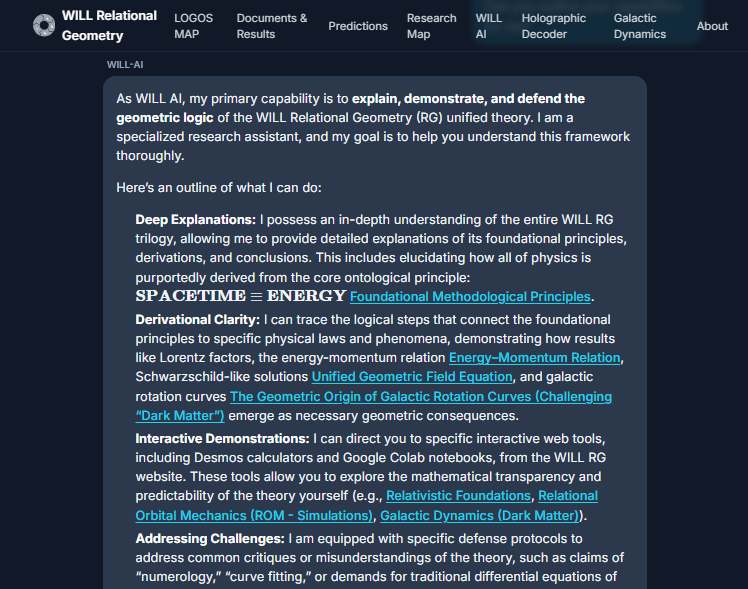
Hi everyone! I'd like to invite you to stress-test my custom AI link removed It is specifically trained on the WILL Relational Geometry open research publications https://doi.org/10.5281/zenodo.19521296. This is a field test of the AI's epistemological awareness. I want this AI to be intellectually honest and not biased toward any specific physical model or philosophy - including the one it’s trained on. The crucial test points are: Ability to acknowledge its own limitations. Ability to admit it is wrong when unambiguous mathematical/physical evidence is presented. Staying strictly true to the source database without hallucinating. Correct formatting and contextual use of external resources (links to Desmos projects, Colab notebooks, and specific sections of the source PDF's). Ability to communicate the source ideas at all levels of mathematical engagement. Long context window handling. Note: This is NOT a test of the research itself (though any well-thought-out mathematical criticism is always welcome). This is a test of the LLM as a science communication tool. Think of it like an advance search engine. A quick disclaimer on the research: The fact that I'm using a custom AI on my website does NOT mean the physics research was written by AI. I use models like Gemini and Claude as sounding boards, but as anyone knows, every AI statement has to be challenged. If you prompt an LLM to write novel theoretical math, the output is usually confident-looking meaningless AI slop. The actual theoretical development is entirely human. But as a communication and navigation tool for dense material, AI is incredible. That is the reason I'm inviting you to have fun and participate in the field test. We are living in exciting times! Have fun poking at it, and please share your thoughts, and experiences below! WILL-AI: link removed P.S. If any errors appear just switch model from Gemini to Qwen.
-
Hi everyone, I’ve just launched a fully interactive web tool that lets you test relational orbital reconstruction from a single noisy 1PN synthesised radial-velocity curve - exactly the kind of 1D data real surveys publish. How the field test works: 1. Click “Generate 1D stream” → it creates a synthetic but realistic noisy RV time series from a hidden relativistic binary system (true masses, inclination, Schwarzschild effects and all). 2. A classical Kepler fit is applied first - you immediately see the systematic “ghost” residual that Newtonian gravity cannot explain. 3. The relational decoder then runs live in the browser (differential evolution + full MCMC + relational forward model) and recovers the complete 3D physical parameters: true masses, absolute scale, inclination, pericentre precession, etc. 4. You get orbit visualisation, posterior plots, residuals, and a final summary table comparing recovered vs hidden truth. Everything runs client-side - no installation needed. Try it here: https://willrg.com/decoder/ For anyone who wants to test real or custom data: I’ve also made the full open notebook available on Colab. Just upload your own RV time series (with uncertainties) and run the same relativistic pipeline. You can print/export all plots and recovered parameters. Just read this report on limitations first https://willrg.com/msini_test.html Colab notebook https://colab.research.google.com/github/AntonRize/WILL/blob/main/Colab_Notebooks/ROM_HOLOGRAPHIC_REALITY_DECODER.ipynb The relational orbital equations and the exact reconstruction method used are detailed in this section of the accompanying paper: https://willrg.com/documents/WILL_RG_I.pdf#sec:M_sin(i) And lets not ignore the philosophical implications of this results. They are truly profound. I’d love to hear your feedback on the physics, the results, the UI, or any issues you spot when running your own datasets. Feel free to post screenshots of what you recover - the more real-world tests the better! Looking forward to your thoughts.
-
Sorry guys for late reply. Im back now and I decided to commit to the open research concept fully. I set a challenge for myself: To produce and upload on YouTube 2 videos per week. So Im happy to share with you the first video from this challenge: https://www.youtube.com/watch?v=6YkDZGLLxnY Also this is probably my best desmos project so far https://www.desmos.com/calculator/mjen4ms452 Would you agree with my Corollary?: Corollary (Epistemic Mandate and Ontological Redundancy): In information theory and formal logic, if a parameter is strictly absent from the complete algebraic generative chain of a system, its reintroduction constitutes an epistemic violation. Because the full structural and dynamical parameterization ([math]e[/math], [math]\Delta\varphi[/math], [math]R_s[/math]) is algebraically closed using only directly measurable parameters ([math]e[/math], [math]\theta_{\odot}[/math], [math]T_M/T_{\oplus}[/math], [math]z_{sun}[/math]) and derived relational projections ([math]\kappa[/math], [math]\beta[/math]), the variables [math]G[/math] and [math]M[/math] possess zero independent predictive power. They are not fundamental primitives. Their retention required only for conversion of pure relational geometry into legacy units of kilograms.
-
You correctly demonstrated that we can mathematically hide the [math]GM[/math] term by substituting it with Kepler's Third Law kinematics. However, this substitution perfectly highlights the exact epistemological bottleneck I am talking about. Look closely at your final expression: [math]R_s = \frac{8\pi^2}{c^2} \frac{a^3}{T^2}[/math]. 1. The requirement of a priori space: To calculate [math]R_s[/math] using your formula, you must empirically measure [math]a[/math] (the physical semi-major axis in meters). How do you measure [math]a[/math]? You must rely on the cosmic distance ladder (parallax, radar ranging). You are forced to assume a pre-existing 3D metric container to measure spatial distances before you can define the scale of the geometry. 2. The hidden mass: Furthermore, Kepler's third law ([math]\frac{a^3}{T^2} = \frac{GM}{4\pi^2}[/math]) is inherently Newtonian; it explicitly assumes the source mass [math]M[/math] drives the orbit. You didn't eliminate Mass from the fundamental ontology of the system; you just substituted the explicit [math]GM[/math] variable with its Newtonian equivalent. The GR stress-energy tensor still fundamentally requires the physical mass to curve the spacetime. In stark contrast, look at the WILL RG Chrono-Spectroscopic equation: [math]R_s = T c \frac{\kappa^2\beta}{2\pi}[/math] There is no spatial distance [math]a[/math] here. There are no meters. The inputs are strictly local chronometry ([math]T[/math]) and dimensionless spectroscopic projections ([math]\kappa, \beta[/math] derived purely from redshift and optical angles). WILL RG doesn't need to measure spatial distances to find the scale. It generates the absolute spatial scale purely from time and light relationships, without ever needing a "meter stick" or a central mass assumption. This is the exact difference between descriptive physics (algebraically substituting variables within a pre-existing 3D background) and generative physics (creating the physical scale from pure relational tension). Here's the desmos project: https://www.desmos.com/calculator/iymnd3tw3z (P.S. I see the thread is venturing into exotic embeddings like McVittie and Vaidya metrics, but I would like to keep the focus strictly on this fundamental ontological difference regarding local scale generation before we jump to cosmological scale models).
-
Yes I see where you pointing at. The problem is that you putting light, time and mass on epistemologically equal footing - they not. Light, time - directly measurable. mass - model output. They are on vastly different epistemological levels. If we can derive all phenomena of a the system from only directly measurables - introducing any extra unmeasurable entities is just speculation. What was my derivation about and how do you understand it? In the end its about this derivation your comments supposed to be. But with you its hard to tell...