
studiot
Senior Members
-
Joined
-
Last visited
Everything posted by studiot
-
If swansont is just 'not sure' - +1 I am still completely flummoxed as to your meanings on the same points.
-
Yes the one and a half centenary. My Oxford English has sesquicentennial Also sesquialtera (music) sesquioxide (chemistry) sesquiplane (aero engineering) sesquiterpene (chemistry) sesquitertia (maths) sesquipedal (organ music) Being a musical dunce I have no idea what a hemiola is.
-
Simply asking Google three questions. Intelligent No ?
-
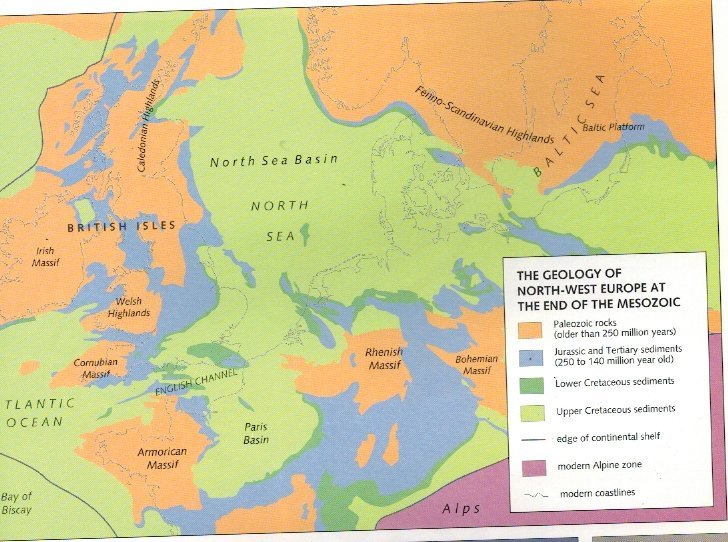
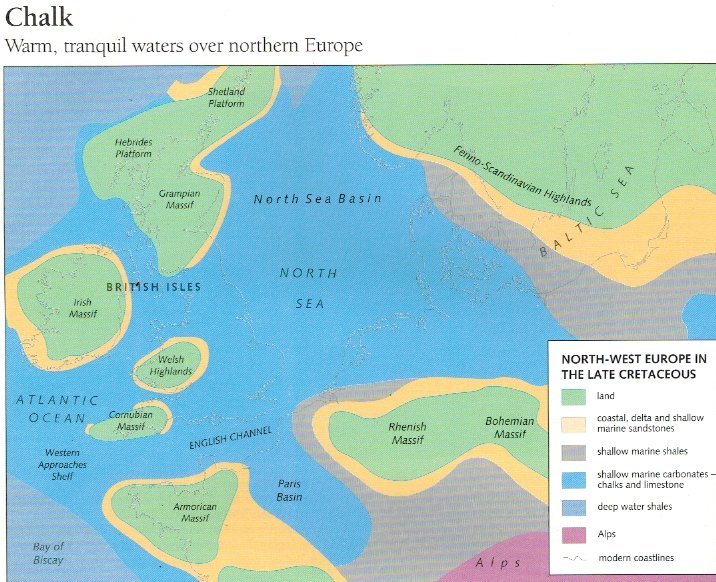
Just to finish of our Dorset discussion. When looking back into the past it is common to draw outlines of present day land masses such as the British Isles onto the map of a previous time. Indeed the ones I have post feature these. There are a few things to remember about this. Continental drift, faulting and other modes of earth movement means that the land that is there now ( at a given location) will not have been there is the past. Parts of the land that is demarcated as containing the British Isles may have been land at the time on the presented map, but later submerged under water (fresh or salt) in part or in whole. This is the case with Dorset and Somerset. That is how the present sedimetary rocks were formed. The difference between them is the timing of the formation, at least 200 million years, Somerset being the earlier formation. The following pictures show this clearly. The first one is around 100 million years ago and shows the parts of the British Isles that were actually land at the time. The island of Cornubia is Mercator's original name for the SW peninsula (Cornwall, Devon and West Somerset) and is formed from earlier sediments, and intruded granite. The second is after 35 million years of sedimentary deposition first the lias and limestone followed by the chalk in East Somerset and Dorset. 45, so about 65 million years go when there was also some uplift due to the start of the Alpine orogony.
-
Perhaps @exchemist or @sethoflagos will tell us about the use of sesqui in music ( I have just discovered it is important there) or Chemistry.
-
All of us ? Please speak for yourself not for others. I read this when you first posted it but didn't understand what you were trying to say, and still don't. A couple of days ago I watched an interesting PBS America broadcast which arts the rise if America, China and Russia in 3 sessions. They go right back to the beginning in each ase and end bang up to date. In Russia's case they start when there was a unkranian state but Moscow didn't exist. Interesting the origin of the Rus.
-
Hi, Paul, thanks for the info. I was not familiar with that book, but I have downloaded a pdf of what is probably the first edition. It seems very similar to the approach in the Schaum's Outline Series, are you familiar with these ? Definitely exam driven, each chapter consists of a few basic statements / governing principles / governing equations , without explanation. Followed by plenty of specific worked examples using those statements. Followed by some practise questions. So designed to be used in conjunction with a teacher/ tutor / lecturer who explains the statements in the first place. It is these explanations I am trying to provide for you, slanted to the fact that you have only basic maths. The book gaily assumes you are happy with the resolution of forces into components and the combination of components, which is what I am working towards. How did you get on with my catapault analogy ?
-
Well I have heard of 'sesqui...' in mathematics Sesqui comes form the Latin 'sesqui ' meaning one and a half. For instance you have sesquilinear forms and antilinear maps. For two variables on a complex linear space, one can be linear and the other antilinear or sesquilinear. These devices appear in quantum mechanics amongst other places. The sesqui prefix is also used in Chemistry to descibe a mixture containing two kinds of radicals in the proportions 2 : 3 But I have never heard of quotation spaces. Perhaps you mean quotient spaces in higher algebra ?
-
The saddest part of all this is that gulls are now a 'protected species in the UK and you are no longer allowed to defend your lunch by force on pain of prosecution. Apparantly there are not enough of the b****y things.
-
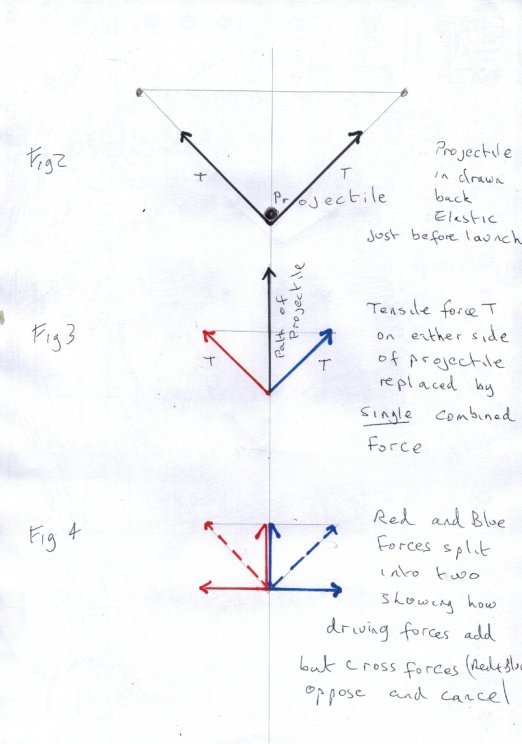
Consider a catapault or bow and arrow. We finally come to figs2 to 4 This shows the path of the projectile down the middle of the page and the elastic or bowstring at right angles across this line. This model provides us with a non mathematical intuitive guide to combining or splitting forces. In Fig 2 common experinece tells us that the tension in the string or elastic must be the same either side of the projectile, in order for the projectile to fly true down its middle path. Equally it tells us that there can be only one force acting on the projectile as there is only one path. So we deduce that the two tension forces can be replaced by an equivalent single force as shown in Fig 3 So if we can combine two forces to a single one we can also go the other way and replace a single force by two (suitable) forces. In Fig 4 I have shown this split done for each of the two tension forces, now shown dashed and red and blue. Hopefully it is immediately obvious that the red and blue cross forces at right angles to the path are equal and opposite so cancel each other out. This leaves the red and blue forces both pointing in the same direction along the flightpath so reinforcing each other or adding up. Such a splitting is called resolving into components so each (red and blue) force is resolved into two components, one along the flightpath and one at rightangles to it. We use this technique over and over again in mechanics. It works for forces but cannot be done for stresses - but we will come to that.
-
I agree with exchemist the BBC article is too poor to properly see what is going on but I suspect the current river/stream is what is called a misfit river/stream, especially considering its location in a formerly glaciated part of Wales. I see Google no longer give a link to it's search so I suggest you put this term into google. The Wiki article is also poor. Misfit rivers are well known for changing their course. It could be useful to know what is the title and author of this book. I might even have a copy. Books on structures, theory of structures, mechanics of structures etc tend to concentrate on the loadings applied to the structure and the deflections (of the structure as a whole) that result from these loadings. Books on mechanics of materials, strength of materials, elasticity, plasticity tend to concentrate on the internal forces and stresses generated in structural elements as a result of the loadings and how these internal forces and stresses are transferred from one structural element to another, for instances in reinforced concrete how they are shared between the steel and the concrete. There is much overlap between the subjects To press on with my explanations, which should be a help in reading this stuff;
-
I think I can probably get closer than Weston, although I can thoroughly recommend a visit to the helicopter museum, since I went to Loughborough University in the sixties. There were a lot of students from Marconi in those days.
-
Perhaps if you drew a few diagrams it might help clarify what you are actually talking about and, dare I say it, put in a few numbers/calculations. Gibbs phenomena are not 'artifacts' or jumps but can easily be demonstrated in the physical world, as can their development and growth. Furthermore the calculations accord exactly with observation. The interesting thing about the Gibbs is that the generating pulse function (which does contain jumps) takes you out of the domain of linear definition for fourier series and generates something which is genuinely emergent in the mathematics.
-
You must have gone to the same junior school I did. +1 Although we also passed round a piece of pape ( we couldn't afford card) with PTO writtten on both sides. This leads to the same infinite loop more clearly than the truth value as it is easier to demonstrate that PTO has no truth value, but it is also correct for the statement you referred to.
-
But what is 'the question' . You wrote If you choose an answer to this question..... But you never defined what the question was. If you happened to choose a random answer C you could be correct as C was 0 if the assigned answer was 'none of these'. This is (thankfully) becoming common in multiple choice questions.
-
I'm flattered but It was coming from Wyndham really (did you recognise the Triffid man ?). He had such a great imagination, and I believe it was his first novel.
-
Whilst I don't have any problem with mathematical handling of infinities so I can't agree with your initial claims about 'blowing up' , I would agree they need special treatment. Have you studied Gibbs phenomenon ? These provide a good example, that is easier to study than say Dirac delta functions as they do not require extended methods of integration and measure theory to handle.
-
Yes agreed. But from what you said, that isn't the case here. The chooser is not being asked to assign probabilities, she is being asked to pick A, B, C or D at random full stop. And remember that any random variable can have any value between 0 and 1.
-
+1 Have you ever read 'Chocky' by John Wyndham ? A most imaginative book (only 150 pages) and well ahead of its time.
-
+1 But remember it is not the whole ocean that supports these organisms, only the very top layer and only over parts of the ocean surface.
-
It is only Bayesian if a priori probabilities can be assigned. This cannot be done with Pearsonian probabilities. One other piece of information not supplied to the chooser of random A, B, C or D is that the assigned probabilities must add up to 1. Pearson has no such requirement as all he is assigning is the probability that A, B, C, or D is 'correct' without any knowledge of the 'right answer', or even if any one of them is 'correct'. A better way to analyse this is to consider the probability of being wrong, not right
-
OK so you are still with the program. 😀 Remember that structural mechanics is mostly about statics, so don't get to bogged down in frameworks, which an older book will probably be mostly about. Some stress related comments I have been holding back might be helpful in your reading. It is tempting to say that Stresses are internal forces due to applied loads and that it is impossible to apply external stress. Furthemorer strains are the results of the stresses and thus indirectly the results of the external loading. This is how the subject is often taught. Unfortunately Nature refuses to fit in to the human preconception and desire to categorise everything into neat little boxes. So although this is a good rough guide Nature provides for a mechanism to apply an external stress , and a way to have internal stress without strain (particularly applicable to geology) and strain without stress. A good way to think of stress is as I started with the bouyancy diagram, remember I said there is a lot more to this simple example than old Archie got out of it. So, for the moment, think of stress as a distributed force (where its action is distributed along a line or over an area or through a volume) rahter than having a single point of action. But just be ready for nature to bite us in the arse again when we come to consider forces at right angles to the normal force.
-
Snouts. These are not bilateral and not every creature has one or if they do uses it for digging. In fact you have pointed out one particular similarity, but said nothing about the many many difference between creatures. Why do some have fur, some have skin, some have olfactory senses in the nose , other elsewhere, some have eyes, some are blind, some have very hollw bones because they fly (talking about bilateralism, bilaterism is good for flying things and most swimming things, although I understand from D Attenborough that there are some fish that lie one one side only on the bottom and are not bilateral. There was a recent popsci book that explains all this, I will post a reference when I can remember it.
-
This is a version of the Monty Hall or Newcomb problem. If you choose A, B, C or D at random, There are no a priori probabilities. These can only be assigned if the chooser has no knowledge of any values assigned to A, B , C or D. You can't conbine Bayes probabilities and Pearson probalities.
-
It's good that you are talking the time to think about what has been said. I look forward to your thoughts when they arrive. +1 Another point to add into your cogitation. Simultaneity, what do we mean by it ? If we mean that the temporal distance between two points in space or spacetime is exactly zero then there is a problem to overcome. Never mind foliations, branes and other exotic maths. The issue is simply that of the metric, since the question implies a coordinate system The first and most fundamental axiom of any distance function (metric) is that If D(a, b) is a function defining the distance between two points in a coordinate system then D(a,b) = 0 if and only if a = b