studiot
Senior Members
-
Joined
-
Last visited
Everything posted by studiot
-
Thank you Markus but I don't have a smartphone. However a second issue has arisen. As I can often only access the site intermittently I often used to compose longer posts a bit at a time (but not actually post them until I was ready) and use the memory function in the input editor to restore what I had already done. This has worked well for years, even into the new host era. But suddenly over the last few days I find that when I log on again it is all gone. As has happened with a particularly complicated post I am trying to do in the liquid fracture thread. Part of the trouble is that the system is logging me out in the middle of typing into the box. If I am logged in and typing why is the system able to log me out ? Since I first started the mechanics of the system here has become steadily more and more user unfriendly, whilst the people have remained constantly friendly.
-
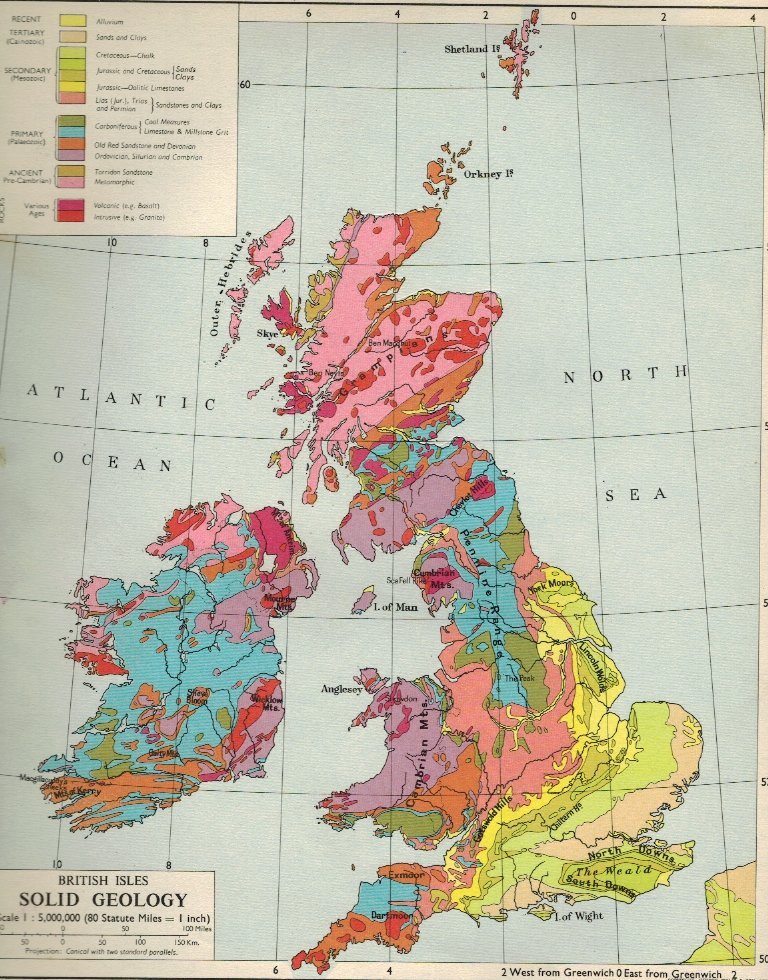
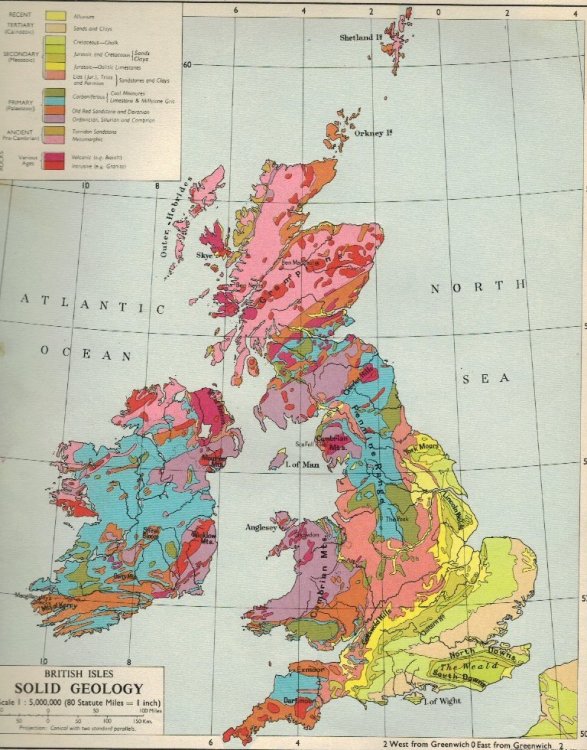
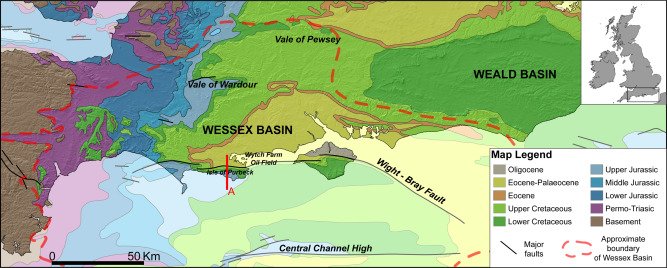
Questions / Comments like these are great since they halp me see what you made of my previous ramblings.. OK so compare and contrast the geology of Dorset with that of Somerse/Devon. The first and most startling thing is perhaps that when Devon / Somerset was being formed Dorset did not exist ! Here is a map of UK Geology today. The first thing to notice is the the colours representing diffent rock eras or periods run in diagonal stripes (of variable width) from South West to North East. What is important is that these stripes are getting younger (more recent as you go at right angles to the first direction ie from North - West to South East. The bright yellow stripe (this represents Jurassic rocks) runs from the Somerset and Devon border with Dorset diagonally up through the Midlands, across the Humber and runs out into the North Sea via the North York Moors. This includes the limestones of the famous 'Jurassic Coast' and the Lias of Somerset. The Khaki stripe represents the transition from the the Jurassic into the younger Cretaceous and the proper green the full on Cretaceous ~ Chalk. The next map shows that Dorset lies firmly in the Western end of the so called Wessex basin. It is worth noting at this stage that the Wessex Basin extends well into the English Channel so the larger part of it is under water. To understand how all this came about it is necessary to go back to the formation of the earth 4600 million yars ago (MYA). But then move very quickly forward as the British Isles themselves did not exist until a couple of hundred million years ago and that all the areas South East of the the yellow triassic band have been created since 280 million yeas ago. That is the chalk and clays of the Home counties and East Anglia. I will explain this next time in more detail, but I am also aware that I haven't finished my explanation of loads, forces and stresses. I will do that after. So keep the questions and comments coming as feedback.
-
Surface tension is part of a select set of pairs of quantities, one intensive, one extensive, whose product has the dimesnions of energy. Others include Magnetic Field H and magnetic momentM Electromotive Force F and Charge Q Pressure P and Volume V Tension T and distance L Temperature Theta and Emtropy S. It is this last one I like to use to explain entropy simply.
-
I'm glad you mentioned this because, it brings in the difference between the FLT system of dimensions, and the MLT system. Many say that FLT is more convenient and fundamental as energy is independent of time in the FLT system as it has dimensions FL.
-
I suppose that must depend on what you mean by 'number theory' ? The calculus of observations Whittaker and Robinson ? Approximation Theory and methods Powell ?
-
Thank you for looking into it. This is the thread My reply is particularly memorable since this was the first time ever that the new host/software allowed me to select a short passage to quote. ie the select quote function actually worked. I spent somnething like half an hour composing the text, then was called away. Needless to say I was logged out when I returned, but my text was recoverable in the usual fashion after logging back in. I added a few more words, uploaded the sketches and pasted them into the reply text, where I watched them appear. I watched the reply appear in the thread upon submission. When I returned a few hours later there was no evidence of my post, so I tried to recover it again in the input box, but it did not reappear there either.
-
I posted a response to Imagine This' thread between 1330 AND 1400 GMT today but it has disappeared .
-
Well Chester has the arcades similar to those shown in Poznan, as does La Rochelle in France. Chester has also just been voted The Uk's most welcomeing city. https://www.chester.ac.uk/about/news/articles/new-rankings-hailed-as-chester-named-most-welcoming-uk-city-and-makes-global-top-ten-/ As can be seen from the second picture they galleries are two level.
-
I didn't know it was somebody's specialist technical term, so thank you. +1
-
This is why it is good to have a wide variety of backgrounds in the membership. I would agree with exchemist that the photos in the original article would only be liquid column separation if they were of actually burst pipes. But this is not at all clear. This article is a good summary of our knowledge of LCS, including the equations Seth mentions. https://www.researchgate.net/publication/228851496_Water_hammer_with_column_separation_a_review_of_research_in_the_twentieth_century
-
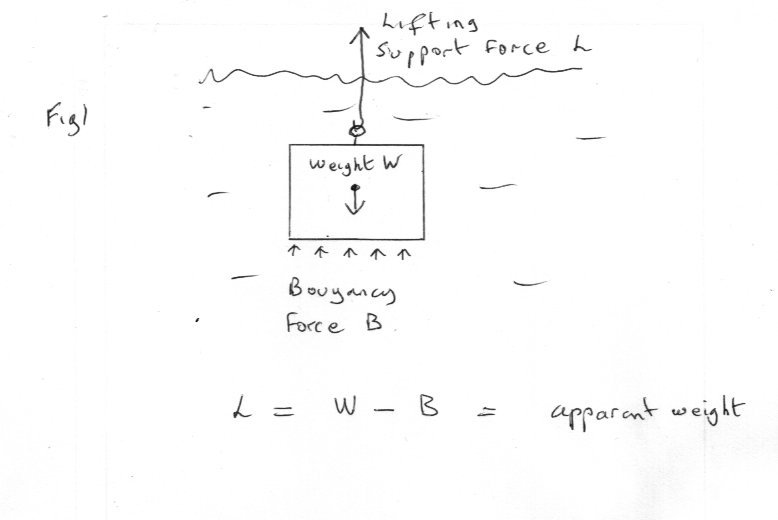
You have been busy, which is good, but I hope that all will be made clear in due course as we go along. There are gaps and some slight misconceptions in what you have picked out so don't range too far ahead. Unfortunately events today cut my good intentions rather short so I only got as far as sketching fig1, which describes Archimedes arrangement. So Fig 1 describes Archimedes principle as you have found out. It shows a heavy (non floating) cubical block (that does not absorb water) dunked in a bucket of water. But it also shows us a whole lot more if you know where to look. A Force is defined to act along a particular line and at a particular point, known as the point of application. This is demonstrated by the support rope providing the lift force. The rope is attached to the block at a particular point on the top by a hook. But I have shown the bouyancy force as 'made up of' a lot of small forces spread over the whole base. This is called pressure or a pressure force. There is a rule that says all these little forces may be added up and replaced by one total combined force B, which does act along a single line. Furthermore B acts upwards as shown, which leads to Archimedes equation. Looking deeper we note that both the lifting force, L, and the bouyancy force, B, are external to the block. Forces my be external or internal. The application of external forces leads to internal forces. We also see that both L and B are acting at right angles to the block. Physicists have borrowed the mathematical term 'normal' to describe this right angle condition. So L and B are normal external forces to the block. Further L is a pull and B is a push. There is also a rule that says that foces at right angles to a given force can have no effect on it. There is always a direction at right angles to a normal force. We will see in the next sketches how such forces at right angles to the normal act and learn that they are the forces of friction or shear, and how they work in principle. We will also see how external forces in one body may be regarded as internal forces in another and how external forces generate internal forces.
-
What do Surrey and Bedford have to do with post war aviation history - an air show ? When I was in high school I used to take the dog past the Handley Page factory (now a museum). That was post war history. 'Small Beer' the industrial beer of steelworks and other places.
-
Not sure what you mean by brainwashing. Not even sure that other animals engage in Otto's 'reasoning'. That is what I meant by the difference between intuition and instinct. Some animals have been known to chew their own foot off to escape a trap. Less gory examples might be that different birds build different types of nests and beavers build all sorts of structures that benefit the environment. But do any of these examples involve reasoning - or are they just instinct ? Intuition, to me, seems to involve a form of reasoning where what happened in one instance is remembered and compared with and applied in a similar circustance on another occasion.
-
Since you didn't say which ones I am going to start at the beginning, but assume you have some intuitive idea as to what is meant by a force, commonly stated as a push or a pull. This is a good start, about where Archimedes was coming from, but we need expanded detail for modern consideration. The weight of an object is a force. You can use that force to exert a push on something, by standing the object on it, say a brick on a table. Or a pull on that something by hanging the object from it, by a string, Or you can develop what is called a turning moment by pulling on one side or the other, tipping a wobbly table with a pile of bricks. This third use of a force is not often included in the popular definition, but we will use it later as it is very important in landslips and soil failures. Archimedes realised that the weight of an object is lessened by immersion in water, though it regains its original weight when removed from the water. He had discovered what we now call the bouyancy force, which acts against the weight force of the object itself. Though he didn't think of it in that way, in doing so he had discovered the idea of a net or resultant force. This is what happen when two or more forces act on the same body. I haven't the time tonight to do any sketches, so having set the scene I will continue tomorrow to extend Archimedes to Terzaghi's soil loading equation (Which is actually very simple). We have also found out that we need to know more about how to apply a force and I will address that which will lead to the idea of stresses and strains. How are we doing ? Meanwhile if you watch the BBC Devon local website there is a short but good video of a landslide that occurred last weekend near Teighmouth. https://www.bbc.co.uk/news/england/devon
-
Youngs and Fullers were two competing breweries that faced each other across the river Thames.
-
Agreed, this is a property of sets not of set elements.
-
I have disagreed with Otto on several occasions, but on this one I cannot see why so many folks are addressing a different topic than what has been stated and clearly amplified by the OP. I think it important to distinguish between instinct and intuition in this case.
-
Unfortunately there are far too many quasi statistical 'arguments' created by those who do not properly understand the importance of an appropriate NH. Contentment is far too general, for instance, except for those statisticians shooting the breeze after 6 pints apiece. This is, after all, a Science forum and Psychiatry is, afer all, a scientific discipline. So is it unreasonable for me to expect a scientific discussion ? Otto seems to want to discuss the dangers of 'prejudging the issue', and I agree with him that there many examples in history, some serious some not so much, and that danger continues to this day.
-
But this has been posted in Psychiatry, not Politcs. And Psychiatry is a statistical subject, where such a thing as 'the Null Hypothesis' is defined.
-
Elsa the lion(ess) Indeed, and possible responses to any issue can be quite complex. But the starting point would normally be the recognition that there is an issue. Thank you for your measured response. This will make for a much better discussion.
-
I don't understand your question. Are you saying that misuse is the only human use of this process ? or Are you saying this is a danger of using this process ? Or what ?
-
Thank you +1. I didn't know this history, but lead contaminationhas a special interest for me as I found heavy lead contamination on steel motorway bridges in the UK during the 1990s. I was able to clean it off using a technique pionered to clean the roof and walls of the New York road tunnels.
-
If you want to understand all this, we need to start back 250 years before Christ, when a Greek gentleman made his famous utterance about Archimedes Principle. The interesting thing is that the importance of AP, in this context, was not enunciated until after Relativity, after QM and after Godel in 1936 when Terzaghi introduced the notion of 'effective stress'. So I am going to ask if you understand the notions of contact force, contact stress, and the classification into direct (also called normal) force and stress and (not indirect or abnormal) but tangential or shear force and shear stress, Liquid mechanical behavious is controlled by shear stress, as is soil and rock mechanics in regard to failures such as landslip, avalanche, slope stability and so on. Soils break due to shear failure in almost every case. If you are not sure about any of the terms please ask and I will include the necessary explanations in my next post. Conceptually it really is quite a simple subject ( mathematicians can always make it more hairy than it really needs to be) High stress is just not necessary. Did you manage to access the full paper by any chance ?
-
That's true. In fairness both mica and talc occur more often as minerals in some rock eg granite. The result of granite weathering creates many small mineral flakes that go twoards the clay soil. The South West batholith granite is vey coarse grained which leads to easy breakdown and the fine china clays of Cornwall and coarser clays in Devon. Somerset has a completely different geology with the sedimentary clays, sandstones and mudstones the result of run off from the edge of a former continental margin. There are almost no igneous rocks in Somerset an exmoore is sedimentary, unlike Dartmoor, Bodmin and the other cornish moors. Known examples of liquid fracture under gravity. Now contrast this with the behaviour of separation drops (fractured water stream) from a dipping/slow running tap
-
The difference is that clay is a soil, mica and talc are rocks. Clay has its peculiar properties due to a complex (electrostatic) interaction between soil water and the clay minerals, whcih carry charges. Graphite sheets themselves are of course basically electrically neutral, although intersheet forces are Van Der Waals electrostatic.