
John Cuthber
Resident Experts
-
Joined
-
Last visited
Everything posted by John Cuthber
-
The Daily Mail is not a newspaper. https://en.wikipedia.org/wiki/Daily_Mail#Wikipedia_determination_of_unreliability Is there another source for the story?
-
All of them, but not necessarily at the same time.
-
Like how many angels can dance on teh head of a pin.
-
If they had said "mass number" would you have been content? They didn't say it was. If I say my car can go over 100 MPH, I'm not claiming 200 In any event, the discovery (assuming it doesn't turn out to be a glitch in teh sampling or whatever) is interesting.
-
It looks to me like the North Korean media ; they broadcast the world cup final and pretend that the winner is NK.. They know that nobody outside their country is going to swallow it. They know everyone else laughs at them. But they are targeting their their supporters who will believe anything. And they don't care about the outside world. In that context, it makes perfect sense.
-
A yes; body language. https://www.facebook.com/watch/?v=1615756388457722

-
It's good, but it needs more accordion.
-
Somehow I was reminded of a rather unfair joke; Q What would you call 100 lawyers at the bottom of the ocean?" A An improvement
-
Trump's desire for Greenland, Gaza, Panama, Canada etc isn't some complex political plan. It's greed. There's a side order of bullying but the root is just that he wants it because he hasn't got it. Around here, J.C. MacSwell said it, and I'd like him to explain how Biden's causing inflation today.
-
Can you expand on that? Is time travel involved?
-
Looking back through this thread, I saw this. Covfefe!
-
Dear Mr President. Maybe the guy who thought launching a car into space was a good idea is not perfectly qualified to identify wasteful spending. Also, what do you plan to do when the other 50% of Americans discover that tariffs are paid by the citizens of the country which imposes them? And finally (for the minute), if America was too cold to hold your inauguration outside them you certainly don't want Greenland, it's f%^&*&ing freezing. Yours etc
-
Decency.
-
42 seconds in to this clip Trump says he was "saved by God so I can make America great again".
-
Just as a philosophical question for everyone; compared to being forbidden to mention the Tiananmen square murders, is that 1 better 2 worse 3 pretty much the same?
-
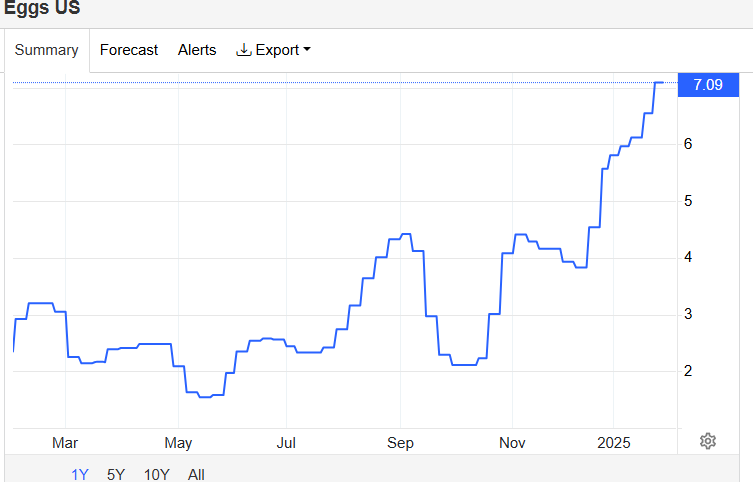
Would I, as a scientist, be allowed to say that egg prices are not dropping? From https://tradingeconomics.com/commodity/eggs-us
-
Space alien turns up in the US and says "please don't take me to your leader".
-
And potassium hydrogen tartrate is about ten times less soluble. (0.57 g/100 ml (20 °C)) So, we both agree 66% is very soluble. We both agree that 0.57% is a low solubility. So you should realise that when I am talking about something with a low solubility, I'm talking about potassium hydrogen tartrate rather than potassium sodium tartrate. Especially when I explicitly say so. I'm not certain what you mean by "" But the forum labels me as such; it wasn't ever a secret. And you guessed that I meant potassium sodium tartrate even though I said potassium hydrogen tartrate. And you did it even though I made the point that it's not very soluble, so I couldn't possibly have meant potassium sodium tartrate. Also, Re. Guess again. Plenty of reactions with water are violent, e.g. https://en.wikipedia.org/wiki/Bhopal_disaster
-
Would you like another guess? https://en.wikipedia.org/wiki/Potassium_bitartrate#History If a chemistry expert tells you something has a low solubility, then they are unlikely to be talking about something that's very soluble.
-
One possible problem you will face is that potassium hydrogen tartrate isn't very soluble. Another is that the process of dissolving sodium hydroxide in water can be violent, even without acids present. And your KOH is probably only about 85% pure- the rest is mainly water.
-
The rochelle salt lattice only really works with equal numbers of both cations (you can substitute some NH4 or Rb in place of K if you like).
-
Get well soon. It's the latent heat of evaporation.
-
You can do chemistry this way but it is horribly inefficient. It's difficult to maker perbromates (and amusing to look at old books "explaining" why they are impossible) One way to do it was to make a selenate with the right isotope of selenium, and wait for it to decay. https://en.wikipedia.org/wiki/Perbromate#Synthesis
-
It's a bit like that thing where they put lots of effort into eliminating smallpox. Total waste of time because you just don't see it anymore.
-
Is inflation what happens when people start to realise that money is intrinsically worthless?