studiot
Senior Members
-
Joined
-
Last visited
Everything posted by studiot
-
I wonder about the bases of your pots and pans. The instructions with my AGA ceramic hob are quite clear. You should only use pots and pans with a (ground) flat base. Pans with ridges or dimpled or other patterned bases are forbidden. I think this is because of what happens in the space between the hob and where the pan base does not touch. A slight overspill or dirt etc can cause superheated gas between the pan and the hob which can have a powerful erroding effect. As regards the hob itself, I was just looking at my grandmother's old welsh bakestone, made of cast iron. This has happily gone through more than a century of gas flame burning directly under it. The temperature of natural gas is about 2700oC and diesel is sbout 2000oC. So perhaps you should consider cast iron? A simple method would be to construct a support grid for an iron or steel plate and leave the plate free to expand and contract ie just resting on the grid.
-
Until Genady posted this I had never really thought about the issue. I just followed the rules. One very important thing that has come out of my share dealing example is this. It is no use whatsoever finding a single example of a quantity that can be measured/signed as positive or negative. You need two separate quantities. And these quantities must be connected by a multplicative connection.
-
Here is an example of what I mean Let us consider some deals on the stock exchange. Define Buying 3 shares as -3 shares Selling 3 Shares as +3 shares Selling a share at $5 above par as +$5 or $5 profit Selling a share at $5 below par as -$5 or $5 loss par is the same as face value. Now let us say consider 4 different deals assume that as soon as each deal is done the company redeems the share at face value. Deal 1) Sell 3 shares at $5 above face value That is +3 x +5 = +15 or $15 profit Deal 2) Sell 3 shares at $5 below par That is +3 x -5 = -15 or $15 loss Deal 3) Buy 3 shares at $5 above par That is -3 x +5 = -15 or $15 loss Deal 4) Buy 3 shares at $5 below par That is -3 x -5 = +15 or $15 profit Deal 4 is obviously the case of negative times negative makes positive. So it depends upon how you assign the plus and minus. Which is why mathematically they are called directed or signed numbers.
-
Look up scotch yoke actuators.
-
Hello. I am still assembling some of these other approaches, which contain cunning answers for you. Two points. Firstly the correct term is not 'negative numvers, but signed numbers. The signs have different significances in different situations. Secondly the cunning bit comes when you choose suitable combinations of situation so that you multiply two signed numbers.
-
Yes that's not a bad explanation (but not proof) for beginners. Consider a transformation T such that T2 (-1) = 1 We could also compare a transformation T2 (-1) = -1 The first transformation might actually be a reflection. The second one will be equivalent to introducing i. I said I needed to dig out some old books from the depths. Yes indeed htere are many approaches to this but we must remember two things. Firstly who are 'they' ? Years ago only children at a grammar school would have learned anything about negative numbers. In primary school great efforts were made to work only in the positive. So for instance the subtraction of 2092 from 3513 would be carried out as follows 2 from 3 leaves 1 9 from 1 won't go so borrow 1 (ten) and find 9 from 11 leaves 2 1 from 5 leaves 4 (or alternatively reduce the 5 to 4 and take zero from it) 2 form 3 leaves 1 Answer 1421 All done in the positive. These children would not have been introduced to graphs so there was no baclground for 'the number line' Grammar School started at age 11 - 13 . Most children did not go to grammar school. Those that went to a non grammar secondary school were often apprentices and schooled in the practical. So quite a number of introductory practical examples were developed for these. Grammar school children were introduced usually by Hall and Knight - first pub 1895 and still going strong in the second part of the 20th century. This has an algebraic development, less advanced than Birkhof and Maclean.
-
Well it should be remembered that an algebraic ring structure has two differnt definitionss, dependin which side of the atlantic you are on. But it should also be remembered that our construction of (formal) algebraic sturcutures are designed to relflect the convenient arithmetic structures we have found convenient for other purposes. It would actually be OK to define (-1) x (-1) = -1. That would still form a hemi group (or semigroup if you wish) under multiplication. However american practice requires there to be a unique non zero identity for multiplication, which would not be the case with -1. It is notable that Birkhoff and MacLane (american definitions) start off on page 1 with this subject and reach the crux of it by page 6 (so a bit much to post here as an extract) with 'the integers following 8 postulates. Definitely a bit much for 12 year olds I feel.
-
Great then I suggest you re-read page 1 as it contains much useful information. I'm sorry if you felt then that I was pushing alternative models or explanations. I did say that there are several models and suggested you stick to the basic one first. After all you introduced quantum gravity. GUT and TOE etc and I have trying to play these down.
-
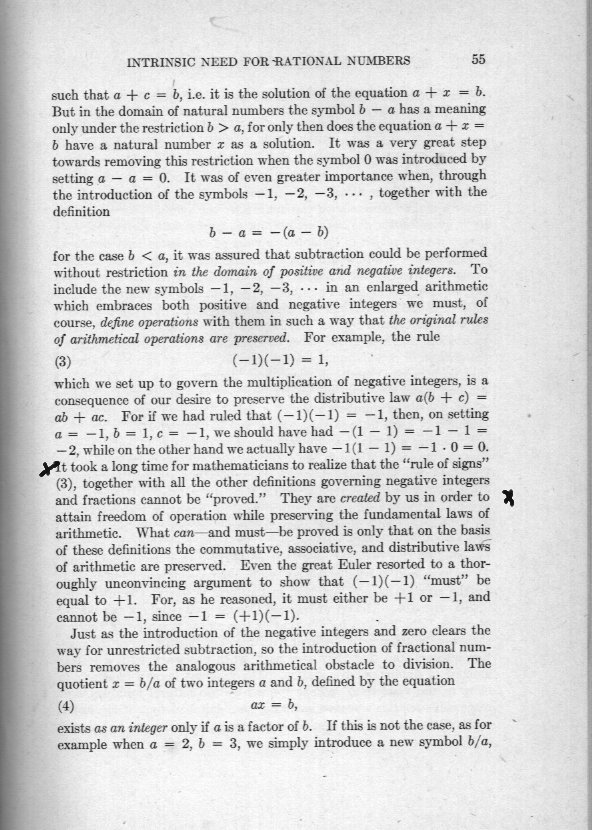
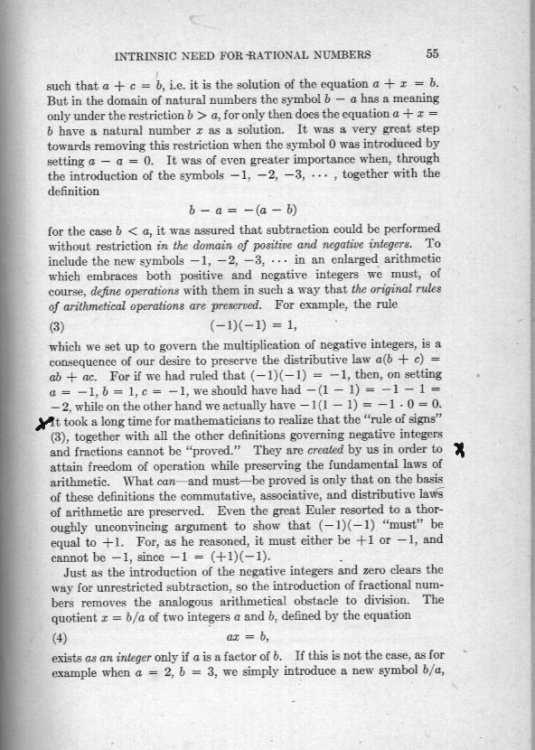
Well you have been disappointingly combative towards replies in this thread. I thought you wanted to discuss this excellent subject and I welcome the input and ideas from several others. Out of interest here is what Richard Courant the famous Mathematician and mathematical educator has to say on the subject: Note carefully he claims that it is impossible to proove that (-1) x (-1) = +1. I has to be defined that way.
-
Yes congratulations you have designed a folded scotch yoke.
-
In my opinion this thread has wandered way off topic in the last couple of years and for several of its 5 pages. I have been looking back over it and you don't seem to have progressed very far and I have some serious and fundamental comments to make about your diagram especially in the light of the one you posted recently on the previous page. After all this thread is called Basics of Gravity. So I would like you to think about several points before I post my comments. First and foremost you need to realise that the are two separate aspects of 'gravity'. The are the objects which cause gravity or the gravitational field or the gravitational potential. There are the effects of gravity on susceptible objects. Each aspect has its own terminology and, which are often confused between on aspect and the other. As to the causes the effects can be divided into two parts. The nature and distribution of the gravitational field outside the surface of a body. The nature and distribution of the gravitational field intside the surface of a body. Related to these categorisations are the terms Centre of Mass and Centre of Gravity which often coincide, but not always.
-
Yes they are also presented this way in the book, but you didn't ask about them.
-
Exactly the first approach in my last post. 😀
-
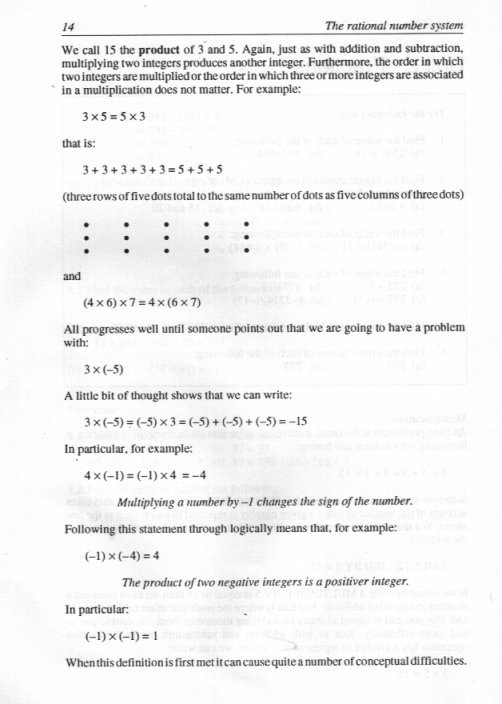
Thank you for posting this topic it made me stop and think. +1 My offering was taken from a mid 20th century book. Unfortunately my wife 'persuaded' me to let go some more modern elementary maths texts in favour of Music theory and Elementary Pharmaceutical Chemistry etc discarded by the younger generation. However I have one modern book left, but it was really aimed at adults. "Maths made easy for Science , Engineering and Business'. This presents analternative approach. I have yet to dig out my older texts such as Hall and Knight. Here also is another approach but requires an appeal to symmetry
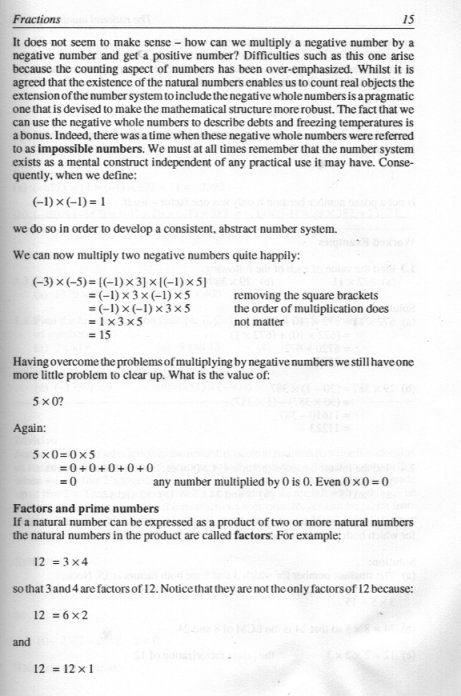
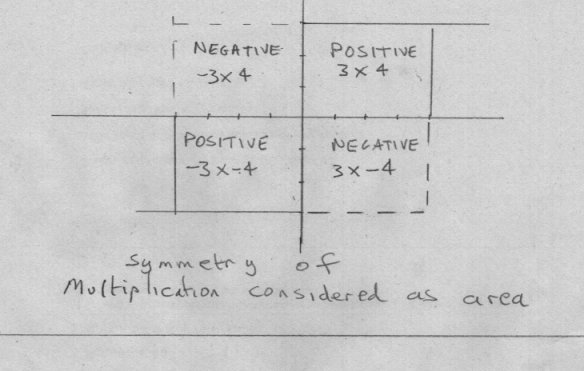
-
Do they have to be little ? I seem to remember it was presented as a rule rather than withe proof/justification. Here is a typical treatment with limited justification followed by Learn the rule it is easier.
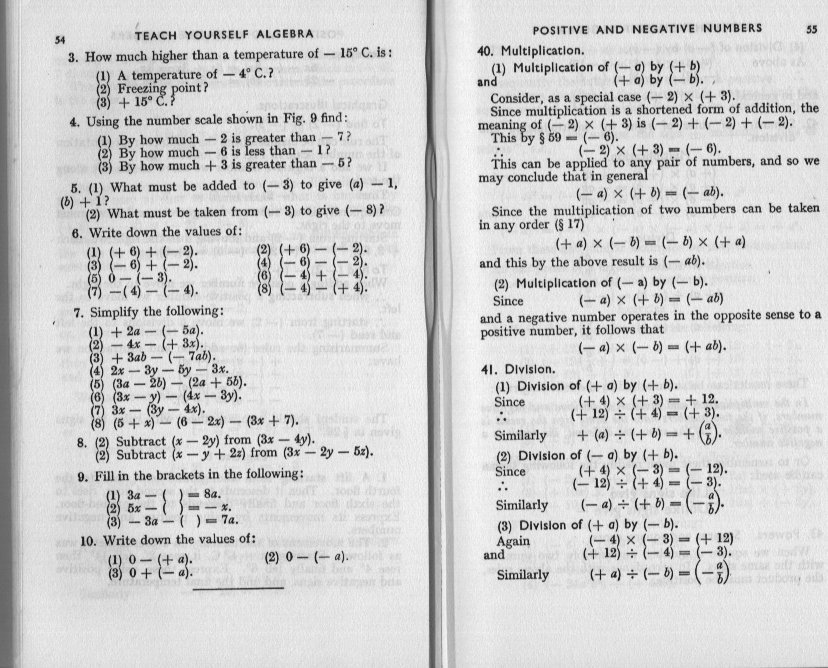
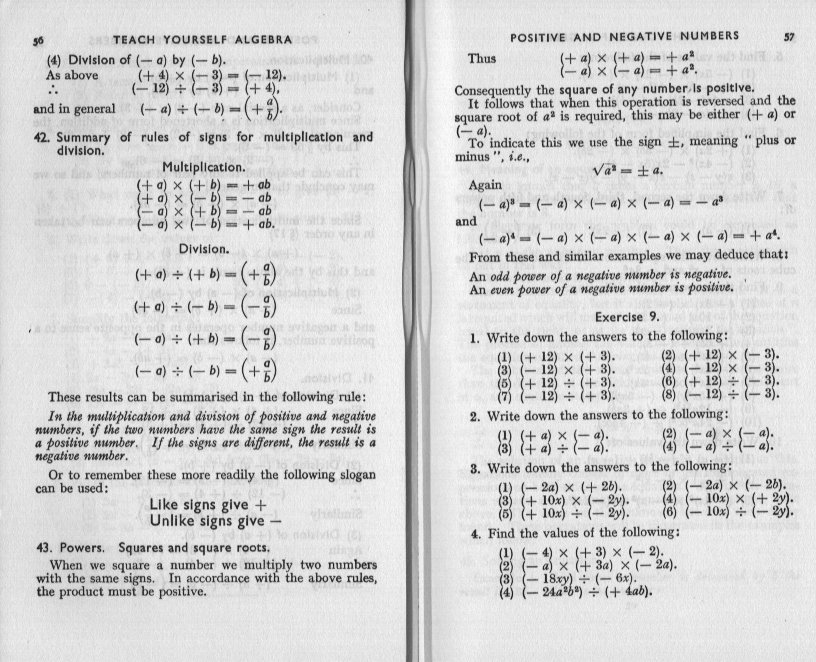
-
Pronunciation is a potential stumblig block in any foreign language. Some years back we were on holiday in the Canaries. We had a hire car for the holiday. Up in the hills we had a puncture. Finding a garage in a little place where only Spanish was spoken, I dug out my trusty phrase book. The similarity between pinctura (puncture) and pictura (respray) only came to light when they managed to ask What colour did we want?
-
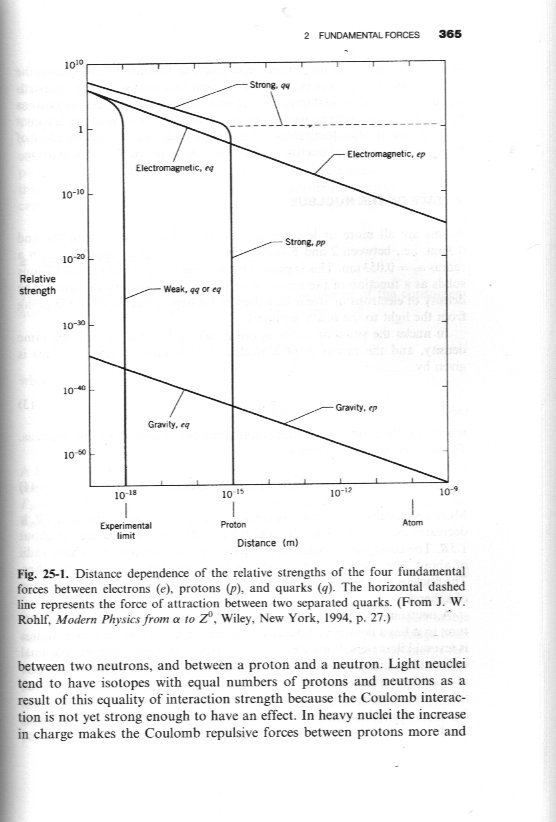
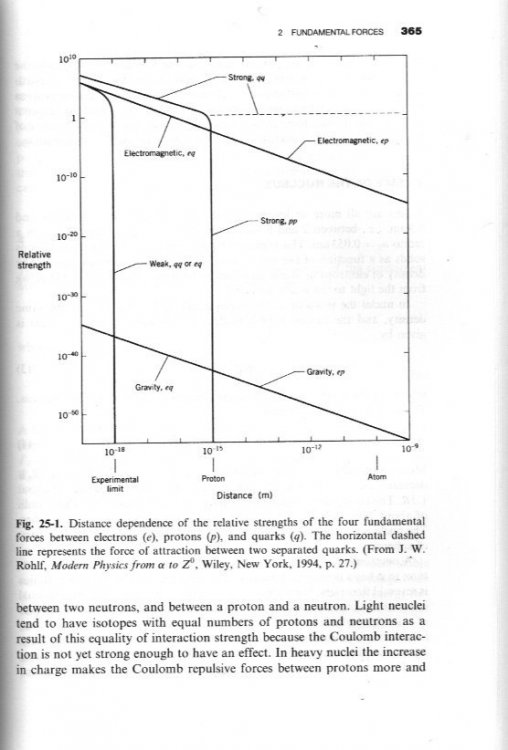
Not quite. The importance of range is shown here The atom is reckoned to be about 10-9 metres in diameter. https://en.wikipedia.org/wiki/Weak_interaction Does this help ?
-
By trying to change the subject from bias to assumptions. Do you not know the difference ? Before this, I was going to say your questions have been very well answered in detail but now I think dimreepr put it much better than I did.
-
I have to say that I am suprised and disappointed to see Professor Ferriera lending his name to that (rubbish my opinion) paper you found and swansont linked to. Perhaps he was the supervising Professor, I don't know, but the paper is not worthy of Oriel College Oxford. The only Mathematics it studies is taught 14 year olds. So I can't see how it can be in any way representative of Mathematics in Science.
-
I appreciate you are worried about the future, but consider this Do you have any concept of what 5 petawatts means ? And remember this is all day, everyday 7days a week 52 weeks year. Ask yourself how much energy and time it took for Man to build all the stuff in the SE United States, destroyed by recent storms in one day ? There is no shortage of energy available on the planet. There is no shortage of either the engineering knowledge or the financial resources to harness it. There is however, a great shortage of the political will to harness it. Think of projects like the TVA or the Hoover Dam, small beer compared to the energies in just that last hurricane. So if you really want to understand this how about answering the question in my last post so we can carry on without getting bogged down in extraneous arguments.
-
Answering a question with another question suggests challenge rather than cooperation. I chose this particular example because it demonstrates the very basics of work and energy which you must have to be able to discuss this subject effectively. These concepts and the answers your questions plus others would come out naturally in working through the mechanical principles of the example. Di you read the article and do you understand (simply as I described) how the system works? Do you wish to continue ?
-
Now that's discussion and I don't mean just because you agree with me. +1 So to answer your question fully you need a lot more context than you supplied. Further considerations might be. 'Bias in Scinece ?' So do you mean in The process and activity of Science ? The body of theory of Science ? The relationship between Science and other human activities ? or What?
-
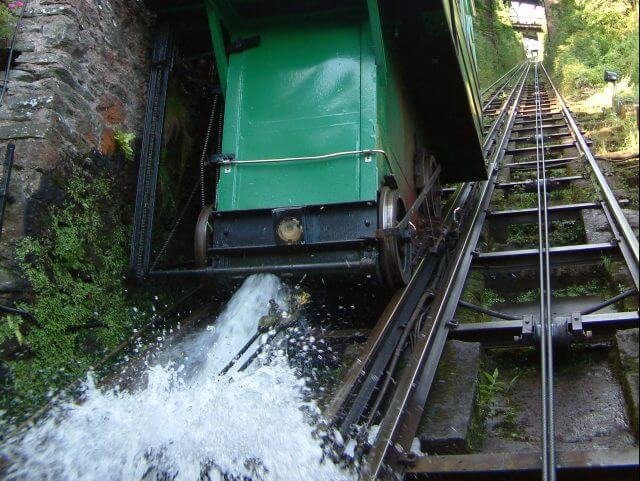
So if you vlike let us discuss 'energy' and renewable in the light of the Lynton railway. This is a cliffside railway with two matching cars suspended by a long cable over a big wheel at the top. Both cars have an underslung ballast water tank. The one at the top is filled from a natural stream up there. The extra weight sends the car downwards, pulling up the one from the bottom which has an empty tank. When the first car reaches the bottom and the second car reaches the top, the water is emptied from the full tnak and new water is added to the empty one and the cycle repeats. Here are some pictures https://www.cliffrailwaylynton.co.uk/about-the-railway/how-it-works/
-
I asked you before whether you thought bias was good, bad or indifferent. To which I received some evasive waffle platitude. In answer to one of your many posts alleging bias in science, not necessarily in this thread I tried to explain that bias can be deliberate. My example at that time was the transistor bias thae enables both you and I to make these postings. Another example of bias occurs when a dressmaker 'cuts on the bias' to achieve a particular effect with the fabric. They also use 'bias-binding' , bias facing, bias edging etc for other effects. So I say to you bias can be wanted and beneficial, or detrimental and unwanted or have no effect on the outcome.
-
It is worth noting that coin cell batteries perform two different functions and I cannot tell which one the play station uses. In some applications they battery is only there as a voltage source. The current drain is negligible. There will be little or no leakage at the end of this application. It is used to refresh the setting memory in computer apps (Bios) for instance. Other equipment use coin cells as a power source. The current flow generates the chemical reactions that produce the leakage products. For instance in kitchen scales, micrometers and so on.