
studiot
Senior Members
-
Joined
-
Last visited
Everything posted by studiot
-
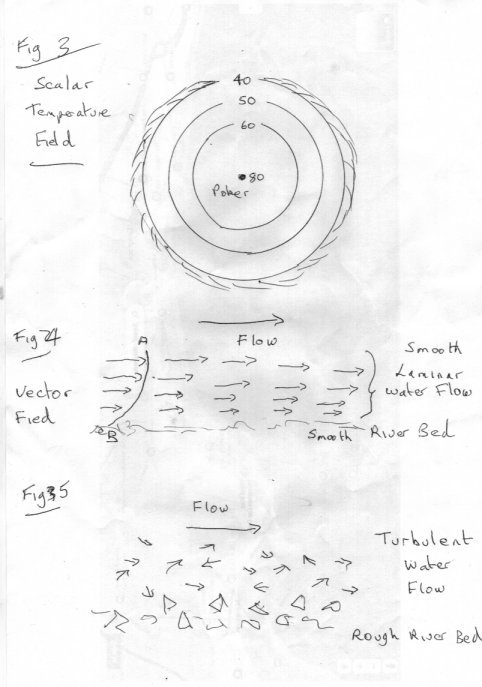
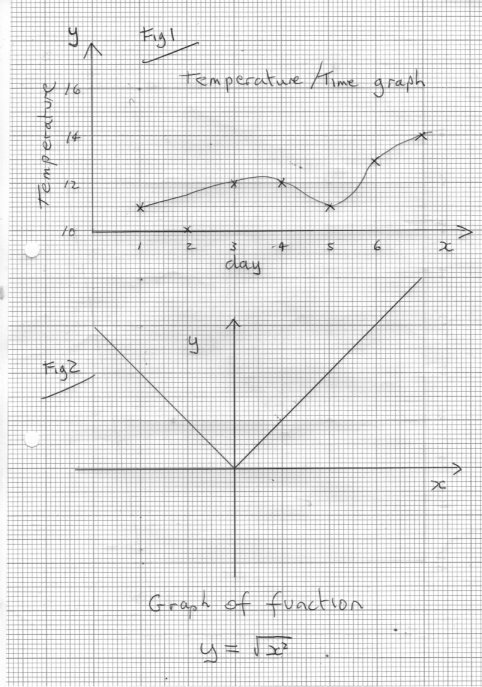
OK so scalars. I am going to use a different kind of fraction called decimal fractions as I am trying to avoid more complicated numbers such Every night I jog 1 mile for exercise. Or I jog 1.6 kilometres. The point is that the magnitude of the distance I run is the same whether I measure it in miles or kilometres. That is why I used value not magnitude for my first use of numbers. Two different numbers for the same magnitude. In fact we can convert mile to kilometres by multiplying by a scale factor or scalar. Kilometres = 1.6 x miles. In this case the scalar is a scalar constant, which means it is always 1.6. In this use of a scalar we call it a coefficient of the distance. Coefficients can be much more complicated than a simple numeric multiplier, but they always multiply the quantity of interest. Speaking of quantities, remember I quoted some temperatures outside my house ? Well I have drawn a graph of these for a few days. Fig 1 The graph has two axes conventionally called the X and Y axes. The Y axis give a daily figure for the temperature and the X axis tells us which day we are talking about. This was why I asked if you understood graphs. So please tell me if this is understood. In order to describe the physical quantity 'temperature' I require only to quote a single value on any one day. A physical quantity that require only one piece of information or magnitude to specify it is also called a scalar. So temperature is a scalar. But this time it has a different value on different days or it varies from day to day. So we call it a scalar variable Further we call temperature the dependant variable since its value depends upon the day. We call the day the independant variable since we can pick choose any day to suit us. This graph represents a function which connects a dependant variable to an independant variable. In Physics the independant variable is very often time and is also called the running variable. The function is The whole graph, including the dependant and independant variable axes and the plot of every value. The relationship between the dependant and independant variables is given by a table of values in the first case, but more commonly it is given by a formula or rule as in Fig 2. Fig 3 takes us back to temperature again. Here I am showing a plan view of a bucket of water into which I have stuck a hot poker. The concentric circles show contours of decreasing water temperature away from the central poker, just as we discussed contours before. A field is an region of space, like the bucket of water, where we can assign a quantity value to each and every point in it. In this case it is a temperature field and since temperature is a scalar it is a scalar field. Going back to distance, my nightly run goes around local paths at random. So it only has the magnitude of 1 mile. London is 150 miles east of me. This distance value has a second part - east, which specifies a direction. Quantities that have two parts are called Vectors. Most physical vectors have a magnitude and a direction. So distance can be a simple scalar as in my jogging, or it can be a vector as in the distance to London. You will come across other quantities that lead a double life like this such as velocity. In some circumstances we can place a vector at every point in some region of space, like with the temperatures in the bucket. Suprisingly such a placement is called a vector field. I have shown one such vector field in fig 4 concerning the flow of water in a river. The magnitudes of the flow (ie water speed) are given by the lengths of the arrows and the arrows themselves show the direction of flow. This sort of flow when everything is smoothly in step is called laminar flow and shows speed variation from top to bottom. Fig 5 shows what happens over a rough bed. The water turns turbulent and though the overall flow is still left to right, the water now moves up and down and sometimes even backwards as shown by the arrows. Also the even gradation of water speed is lost. Any questions ?
-
Quick response. I didn't do negative numbers - or many other types. I did just enough to open the door to my next bit which is half prepared and hopefully will help with many of the technalities Mordred is putting up. I'm glad you picked up on my 'difference between equality and identity' This and my other number operations, including inequalities, will be fleshed out a bit next. But remember that my goal is not to make you a good calculator -- Others will already have crunched the numbers for you. Yup that's good enough. We will come to scalars next. Welcome back. 😀
-
A further thought. I don't know if this model has an internal cooling fan or fans. These are computer type fans whcih ar not designed to be lubricated. They can sometime develop a rattle due to unbalance aused by dirt. The effect will slowly exacerbate itself as sloppy bearings wear. Sometimes cleaning is enough otherwise the solution to this to replace the worn fan I'm afraid. Rust/ corrosion on the case meantsw that exposed metal has become chemically active and must be passivated before other treatment. If the panel can be removed this cna be done with fine emery paper. If not a fibre glass pen can be used, obtainable from photographic and electronics retailers. Alternatively a small lick of chemical passivator can be painted on. Use phosphoric acid (jenolite) from auto repair places or concrete cleaner from builders merchants. or hydrochloric acid (drain cleaner). Do not use battery acid (sulphuric acid). Wear rubber gloves. After passivation the paint can be touched up with either clear varnish or the correct colour.
-
I've never looked inside a play station but I am assuming you want to lubricate the dvd mechanism ? Singer oil is a good light machine oil but tends to attract dirt and dust so is not really suitable as most parts will be self lubricating if clean. Firstly nylon or other plastic gears, worms etc should not be lubricated. Secondly parts should be cleaned before any lubrication, air dusters are good for this. Plastic slideways, door flaps etc can be lubricated with silicone spry lubricant and there may be one or two points where a tiny spot of silicone grease would help
-
It says exactly what I wrote in the clearest manner that I have come across. Which is true in one frame and one frame only. and Which is true in all frames and therefore invariant So the Wiki article makes a clear distinction between proper length and proper distance They are not interchangeable.
-
Did you not read the very clear Wiki article I referred to ? Proper length only exists in one frame; it has no meaning in other frames. So it can't be invariant. Proper distance, however is an invariant that exists in all frames.
-
You are misreading my point. Yes, but if you are told what its constituents are then you have more information than just the overall density. If the only information you have on a sample is its density it is impossible to determine the alloy. This was why I asked earlier about the spectroscopy part of the original OP picture. To date I have received no answer to this question or the very natural one of What else do you need ?
-
SG alone not going to be enough information. For instance looking at random in Lange Invar, Cyclops 17 and Ferro Nickel valve steel all have sgs of exactly 8.0. Yet they have very different compositions. Many others cluster in the region 7.8 - 8.2
-
This is why I said it's tricky and also why many authorities these days have veered away from the the categorisation 'proper'. Proper distance is an invariant in all inertial coordinates. You have defined proper length which exists in only one particular inertial system. https://en.wikipedia.org/wiki/Proper_length
-
But you said the ship is stationary in its own frame. So in which frame are the two planets 2Ly apart? The ships frame or the planets frame ? I'm questioning this because it is not as easy as you initially made out to explain this and parts of your explanation seem to me at variance with each other.
-
What would be most helpful would be to state plainly what measurements are needed to identify an unknow metal specimen. Ie what do you need to know to input into your 'algorithm' ?
-
Thank you for replying is such a prompt and friedly manner. +1 Yes these are the ones I had in mind as the basic ones that will lead to the mathematical Gas Laws as swansont mentions both as an explanation of what is going on and what the mathematical relationships are. Since you are keen, this is a good reliable site for answers to all sorts of questions, http://hyperphysics.phy-astr.gsu.edu/hbase/Kinetic/idegas.html But if you have any more questions don't hesitate to ask here. Important points for Chemists to note are that these assumptions are not exact for real gases and that some real gases are more ideal than others. However for many gases they are good enough in everyday temperatures and pressures. The inert gases (Helium, Argon, Xenon etc) are the nearest to ideal which is to be expected from assumption 3 as their molecules are monatomic. Polyatomic gases such as hydrogen, oygen and carbon dioxide are more reactive and less ideal. They are also not as 'spherical' but this assumption has less effect at everyday conditions. Another implied assumtion is that the molecules are all the same, that is we are dealing with a single gas, not a mixture.
-
Hello we really need more information to be able to help you. What do you mean by 'counting the assumptions' and where did that idea come from? What do you mean by every case ? What exactly are you using the kinetic theory to model ? Boyles ,Charles or Avogadros Law, the ideal gas law, or the mechanism of pressure etc. ?
-
Exactly so. An observer has to reckon things in his own frame. +1 He can't 'see' things at significant distance he has to calculate them, make allowance for the movements of observed events. So from the point of view of the ship frame, if the relative velocity between the ship and the departure planet is zero 1) The ship is at the departure planet and the destination planet is 2Ly away. 2) Therefore there is a point in space 1Ly that is halfway between the planets. 3) The ship rapidly accelerates to its cruising velocity and reckons the departure planet to be receeding at this velocity and the destination planet to be approaching also at this velocity. 4) The ship 'sees' the distance between itself and the departure planet growing and the distance between itself and the destination planet decreasing. So what does the ship reckon the distance is to the halfway point between the two planets ? Or have I misunderstood your scenario ?
-
Since you have transferred centrifugal force discussion from the Tyson thread to here, but not replied to my comments there, are you aware that D'Alembert's solution is a direct consequence of the Theorem of Virtual Work, which in turn can be deduced from Poinsot's theorem? Both have extensive use in Mechanics and other fields.
-
Like by the same person who offers to make you a millionaire in 4 minutes ? Let's be very clear. There are many sorts of 'injections' :- intra venus and intra muscular, intra dermal, intra occular to name but a few. Each one carries its own risks and special techniques, some are easier than others. Does your 4 step procedure cope with this. For instance what if the patient is on Clopidogrel ? On a lighter note, my wife used to teach injections. They used to practise on an orange for the manual ones.
-
Actually I should not have said polite. That was the wrong word, I'm sorry. I should have said sympatico or sympathetic towards others. I realised after I posted. Others have noted a genuine desire to learn which I applaud. +1
-
Archimedes was famous for using density to test the purity of the gold supplied to the King. Thank you so much for a much better reply in our discussion forum. Yesw I rather gathered that you were using modern computer algorithms to search a database of previously observed and tabulated values for a match when presented with a new sample. You and your team deserve full credit for the hard work to determine and tabulate such data. This of course is also true of colourimetry and spectroscopy more generally. And yes your method ranges much more widely than colourimetry. So well done.
-
Genady's first replies are often terse, like mine. That is because we do not want to waste time on those who are not listening. But like Marcus Hanke, his replies are usually on the money. So yes, you have the answers and so you might consider asking for the reasons more politely.
-
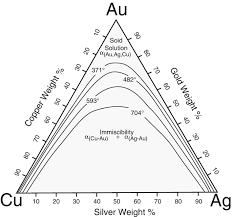
Thank you for this. How does this compare with the following 268 × 262 Does it identify the phases since there is no 'alloy' for the greater part of the ternary diagram.
-
What's the point of asking further questions since you have failed/refused to answer the first ones ?
-
Yes thanks. Hypothesised with no support other than a dodgy web report. Conditions in a diamond anvil are microscopic, although experimentsw with it have resulted in the discovery of new rock materials here on Earth. It is a good tool. So pure speculation. So what does the history of Mars have to do with desert conditions on Earth ? And in particular how did the reduction in magnetic field lead to a change in the martian atmousphere ? The atmousphere is held by gravity not magnetism. And currently at least, the martian atmousphere is greater than 95% carbon dioxide. For core comparison we have little data for mars, for Earth we have Iron 86% Hydrogen 0.06% Sulphur less than 2% How do these figures compare with the proposed iron - sulphur - hydrogen core for Mars? And what chemical reactions and composition percentages could lead to any magnetism or cessation of it ? My sources of Data are the Cambridge handbook of the Solar System, which has useful discussions of the composition of Earth's surface v Mars and the history of the martian magnetic field, which apparantly was once reversing like Earth's. and the The Cambridge Handbook of Earth Science Data.
-
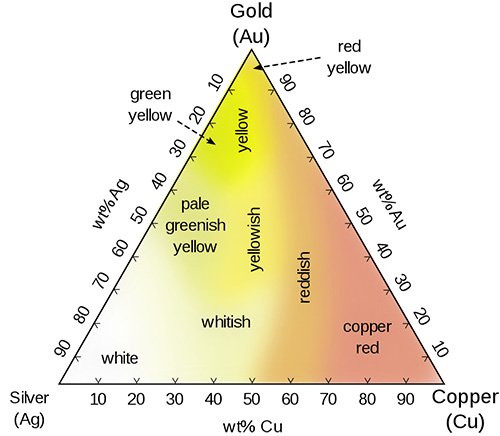
I see you appear to use spectroscopy. Can we compare with a simple ternary system eg copper/silver/gold, where colourimetry can be employed ?
-
Did you not understand my post ? I note that 'Orbital Mechanics' is listed as your favourite subject. Are you aware of this textbook ?

-
Pure speculation. And then again it may not. We don't really understand the mechanism of Earth's magnetic field, let alone that of any other world. I don't care what other people off site may think, I am supposed to be able to read what the poster and promoter thinks without leaving this site and you are not telling me. A powerful magnetic field from chemical effects ? Pure speculation. And then again it may not. We don't really understand the mechanism of Earth's magnetic field, let alone that of any other world. I don't care what other people off site may think, I am supposed to be able to read what the poster and promoter thinks without leaving this site and you are not telling me. A powerful magnetic field from chemical effects ?