studiot
Senior Members
-
Joined
-
Last visited
Everything posted by studiot
-
'All' is too bold a statement, which if true would have precluded many discoveries in Physics. For instance the discovery of the nucleus by Rutherford. Or the discovery of the pattern of reversing magnetic stripes in the rocks at the bottom of the atlantic by Morley, Matthews and Vine. There have been many such breakthrough experiments and insights in scentific history.
-
Totally agree, but more to the point, what is this 'reality' ? Surely we can only offer our best effort to measure something and say If you do this in this particular way you will find the following happens.......
-
Trying to be a smart alec about this is really counterproductive as well as being somewhat insulting. You clearly haven't read many of my posts or you would know that I don't subscribe to the string hypothesis. As a mathematician I would ask if you have any real idea what a field is because my idea is very different from yours and furthermore there are many posts in many thread here where I have explained my pov. What is there to 'explain'. Theory and observation have coincided ever since the idea of a speed limit was first mooted and Maxwell suggested that light travels at this speed from his equations. Well since mathematically warping is the wrong word no I don't. This leaves only one question that of action at a distance, which I agree with you has yet to be explained by any hypothesis.
-
What make you so sure there is more fundamental physics to discover ?
-
Hasn't this thread wandered way off topic. What does it matter to the headline question how the next breakthrough arrives ? Surely the question is about when it will happen.
-
Incident means incoming as in artillery shells aimed at you by the enemy. Although this is not wrong, it is not the whole truth. A vibrating object posseses energy by virtue of vibration, regardless of any other energy it may also possess. In order to vibrate the object must accept energy from somewhere. That energy can be delivered in two ways. Firstly By a single impulse such as plucking a guitar string once. If this happens the body will respond by vibrating at its natural resonant frequency. Secondly By a continuous input of energy at the resonant frequency or by series of pulses timesd to arrive (be incident) at the resonant frequency. I tried to describe this in my previous two examples. This is something quite different. It is actually called 'phase locking' or 'pulling of an oscillator' in electrical circuits. A biological examole would be the synchronisation of periods within groups of women living closely together.
-
Well I see you haven't visited for more than a month so perhaps you are not really interesed in your subject. I was going to ask if you were thinking of applying for some sort of applied physics course but looking at the widely spread sunject range of your postings I really can't guess where you are going with this. Have you never been to the doctor or the pharmacist ? My local district hospital has a department of medical (applied) physics. You won't get very far with MRI or tomography or Chemistry in general without physics. How about the Earth Sciences - oceanography, geophysics, etc. Or the rapidly developing biophysics. What about physics in art? There is significant overlap between the sciences in general and even other subjects like art for applied physics to apply to all sorts of activities other than engineering. Ring wearing engineers ? I know of an (electronics) engineer at Marconi, who lost a finger in a radar beam, due to wearing a ring.
-
Ok so a set is just an imaginary container we use to collect together items/objects of interest. The simplest mathematical set is just a list of the (mathematical) objects in it. These are called the members or the elements of the set. Since some sets are very large indeed (even Infinite) the list can be very long or even never ending. The next step up (mathematically) is to collect together objects with some property to cope with this because if we can specify the property we only need this specification to specify the set. We can do without the list. For example { The set of all even numbers} We write the set in between curly brackets. But mathematicians prefer formulae to words so we write {x : x = 2n where n is an integer} To read this we say to ourselves (The colon means 'such that') "The set of all x such that x = 2n where n is an integer" In fact we can shorten this using the set of all integers which is given the symbol Z {x:x=2n,∈nZ} Note some authors use Note some authors use a vertical line instead of a colon. [math]\{ x|x = 2n, \in nZ\} [/math] It is worthwhile knowing that there are some standard sets such as N the set of Natural or counting numbers Z the set of all integers (positive and negative) Q the set of all fractions R the set of all real numbers (decimal fractions) OK so we have some sets. That is all you need to know about sets to start with. Don't worry about all the stuff about Union, Intersection and so on. Now we can do three things We can consider actions from one set to another ie between sets themselves. We can consider actions between individual members of a set. We can increase the value of the set by creating a (mathematical) structure. We do this by specifying particular useful properties of the transactions between members as in 2. Now if you think about school arithmetic we learn how to add, subtract, multiply and divide. This gives us four rules, called Paeno's Rules of Arithmetic. Three very useful additional rules are that Every possible sum or product between members of our set are also members of our set. There are no members which are not a sum or product of other members. Each sum or product refers to exactly one other member. When we have a set that conforms to not only the ordinary rules of arithmetic but also those three rules we call our set a group. Now going back to actions between sets themselves. Sometimes both the source and target set are the same or the target set is a copy of the source set. A mapping connects elements of one set to elements of another by means of some rule or process or formula. If every connection of the mapping connects to a unique (one and only one) element in the target set well call it a function. When this connection rule is satified we can also construct an inverse function. So for instance 1 x 12 = 12 3 x4 = 12 2 x 6 = 12 So given 12 we cannot determine which of these to claim as the inverse of the multiplication. That should be enough to start with.
-
Ok so a set is just an imaginary container we use to collect together itmes/objects of interest. The simplest mathematical set is just a list of the (mathematical objects in it. Since some sets are very large indeed (even Infinite) the list can be very long or even never ending. The next step up (mathematically) is to collect together objects with some property to cope with this because if we can specify the property we only need this specification to specify the set. We can do without the list. For example { The set of all even numbers} We write the set in between curly brackets. But mathematicians prefer formulae to words so we write {x : x = 2n where n is an integer} To read this we say to ourselves (The colon means 'such that') "The set of all x such that x = 2n where n is an integer" In fact we can shorten this using the set of all integers which is given the symbol Z {x:x=2n,∈nZ} Note some authors use Note some authors use a vertical line instead of a colon. [math]\{ x|x = 2n, \in nZ\} [/math]
-
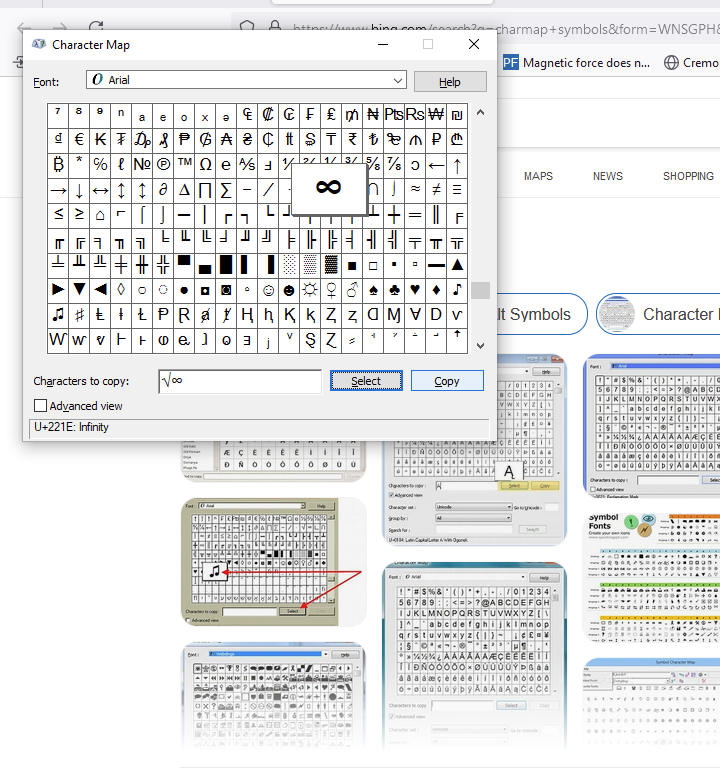
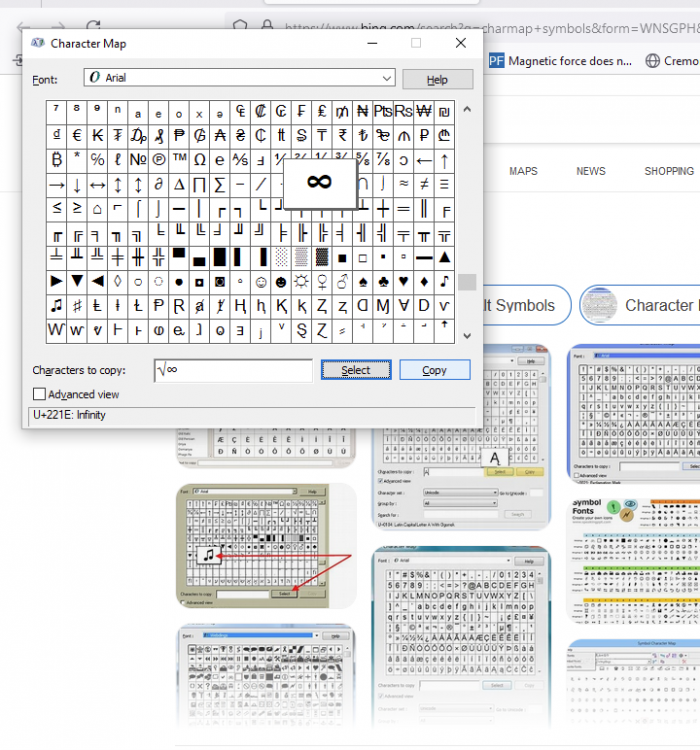
Just a little bit of help here. Charmap Many of the symbols used, including the square root sign, are not available on the ordinary keyboard but can be obtained using charmap if you are using Windows (any version) In later versions just type charmap into the query box and press return. Boxes like these should open up. https://www.bing.com/search?q=charmap+symbols&form=WNSGPH&qs=SC&cvid=0f0cbd2b7805469e9dcdfe1e8cfc51c4&pq=cgarmap&cc=GB&setlang=en-GB&nclid=74D28496F4DE45C06BECB76344916980&ts=1731258460021&wsso=Moderate You can then scroll up and down. Select a particular character Copy it and paste it into your text. Extra hint It often pays to select several special characters and paste them in and add one more step Delete the ones you don't want at any one place.
-
Did you also catch the bit about the forcing function ? A vibration can 'bang between hard stops, for example a car bonnet or a door or other fixed panel can bang in the wind again its restraints, alternately hitting one then the other. On oscillation reached the end of its travel naturally as it runs out of one energy (the energy of motion or kinetic energy) because the oscillation is transferring the KE to potential energy. In a system with not losses that cycle is repeated endlessly PE → KE → PE → KE...... In a system with energy losses, often due to friction, (called damping) the energy gradually leaves the system. Newton's cradle is not relly a simple oscillation it is actually quite complicated as one side is free to go as far as it likes, but the other side has a nearly hard stop.
-
Please make up you mind and also revise your terminology. x, y and z are not parallel they are orthogonal variables. That is why they are independant.
-
I wasn't suggesting you go self study those subjects, I was offering help with that. However it is laudable that you took the interest to look these up and also to indicate where I should start. +1 I have some apple trees to prune this afternoon ,but I will make a start when I have done that.
-
I don't think either the untimely demise of either Galois or Abel stopped their genius flowering. They had both achieved much before that. There were plenty of Frenchmen who started well but lost in one of the many french wars. I agree with that, But not this Depending upon your POV, rampant poverty is still true today.
-
Actually (pun intended) both were 'low church' middle class and fairly well to do. De Morgan studied under hamilton and Airy from at Trinity College Cambridge from the age of 16 whose main interest was economics (though Wiki has not picked up on that) Bayes main interest as a church minister.
-
Or simply went on to other things than Science, as with Bayes or DeMorgan. Of course there have been evil geniuses in the past like Cardinal Richlieu or Rasputin.
-
I think the point of my statistical comment was that without a proper statistical study you could be deceiving yourself.
-
You need to delve into set theory and group theory to discuss this. Are you ready for that ?
-
"Cometh the Hour Cometh the Man" you mean ? +1 However I counter you For every 'persuction' you could name i reckon I can match with an equally vile persecution from history that did not throw up (edit I should really say was not followed by) a Newton. For Instance the persection of the hugenots and the Cathars in France, the persecution of the general populace in ancient China that led to "The Water Margin", the persecution of the native americans following the advent of the europeans ...... But also a mathematical observation. Statistical variation would expect there to be 'clumps' of the occurrence of genius, not a continuous steady rate of incidence.
-
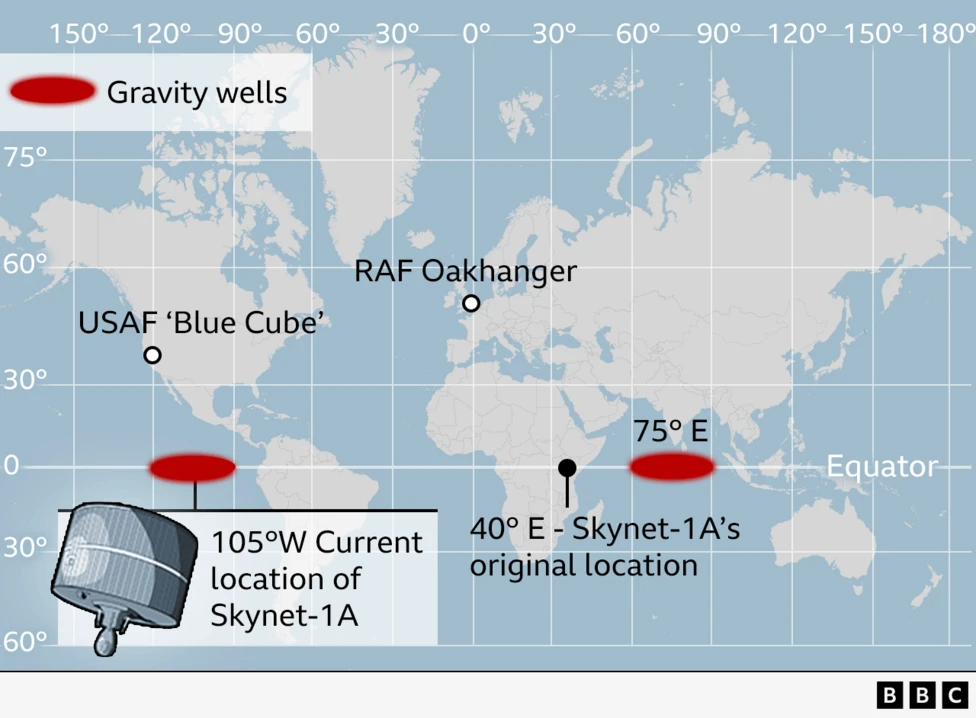
Somebody moved UK's oldest satellite, and no-one knows who or why https://www.bbc.co.uk/news/articles/cpwrr58801yo
-
Thanks. +1 That may work but not sure if my router will always assign the same local IP to the Nas unit.
-
Yeah it's suddenly all working perfectly again. No idea why though.
-
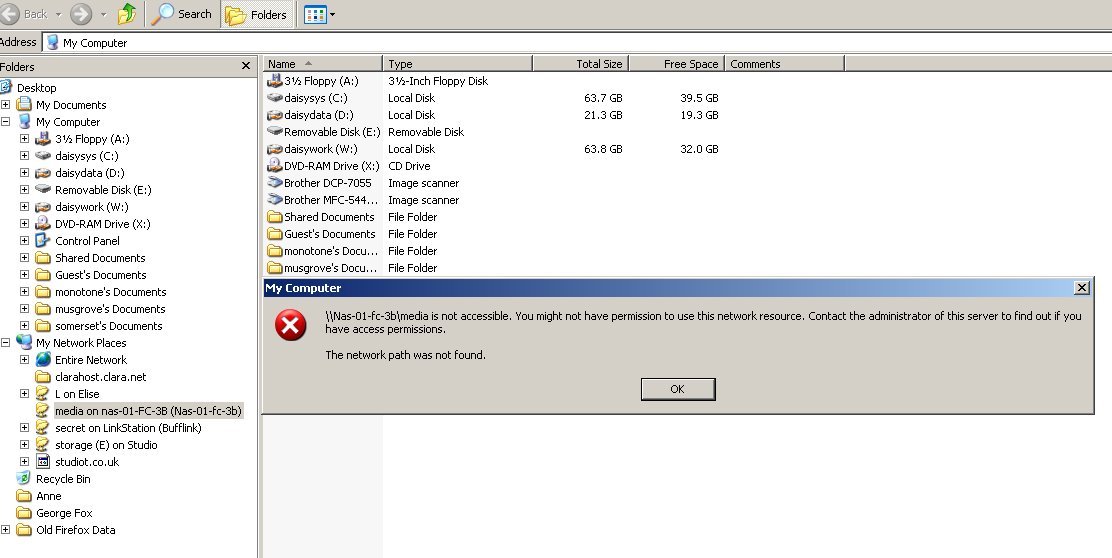
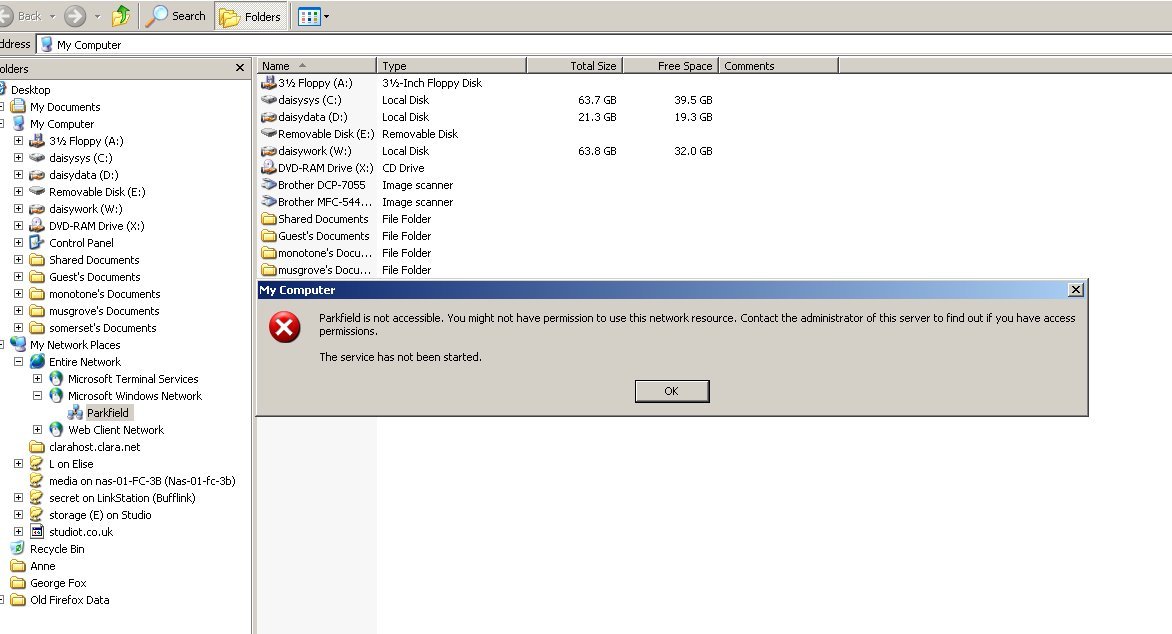
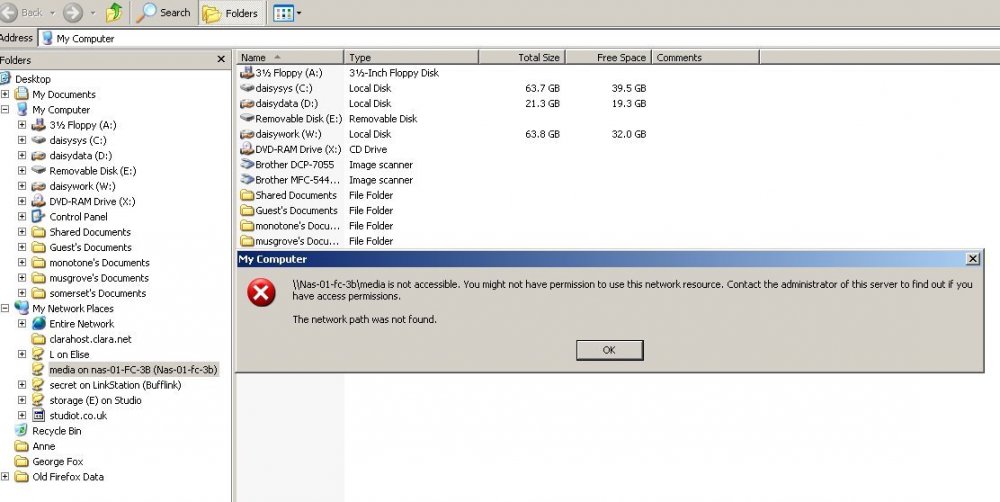
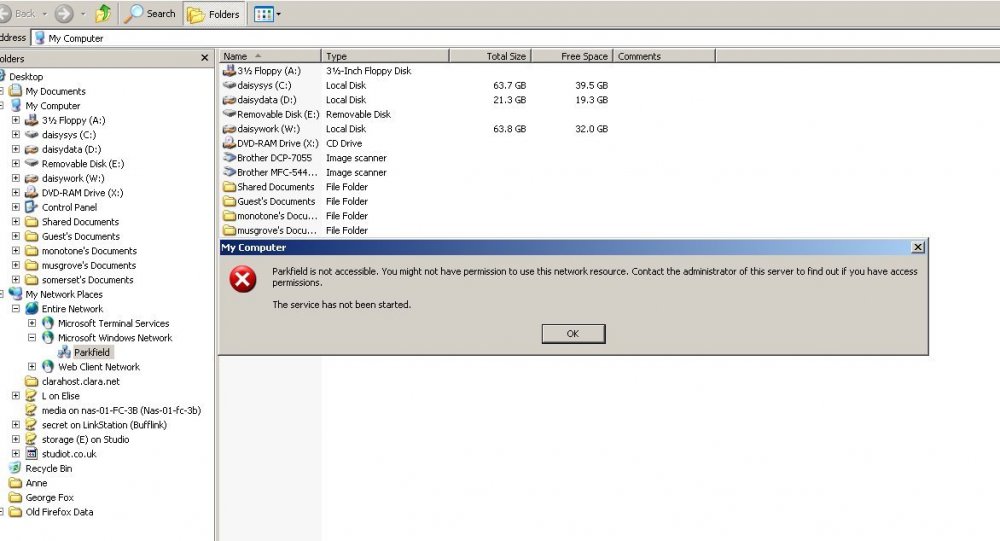
It has been working perfectly since around then. ~Except that I don't use firefox for this Why would I ? Here are a couple of screenshots from Windows explorer firstly the med on nas is indicated in the network places but reprts and error Attempting to open via the workgroup reports a second different error The account I am using is an administrator account but I have forgotton how to get the service or services running again or even which ones.
-
In what way do the foundations of Physics apply to Life ?
-
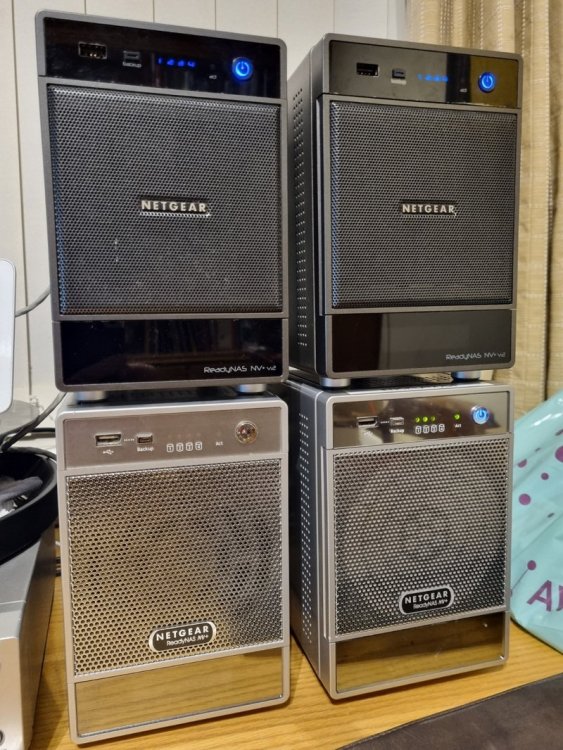
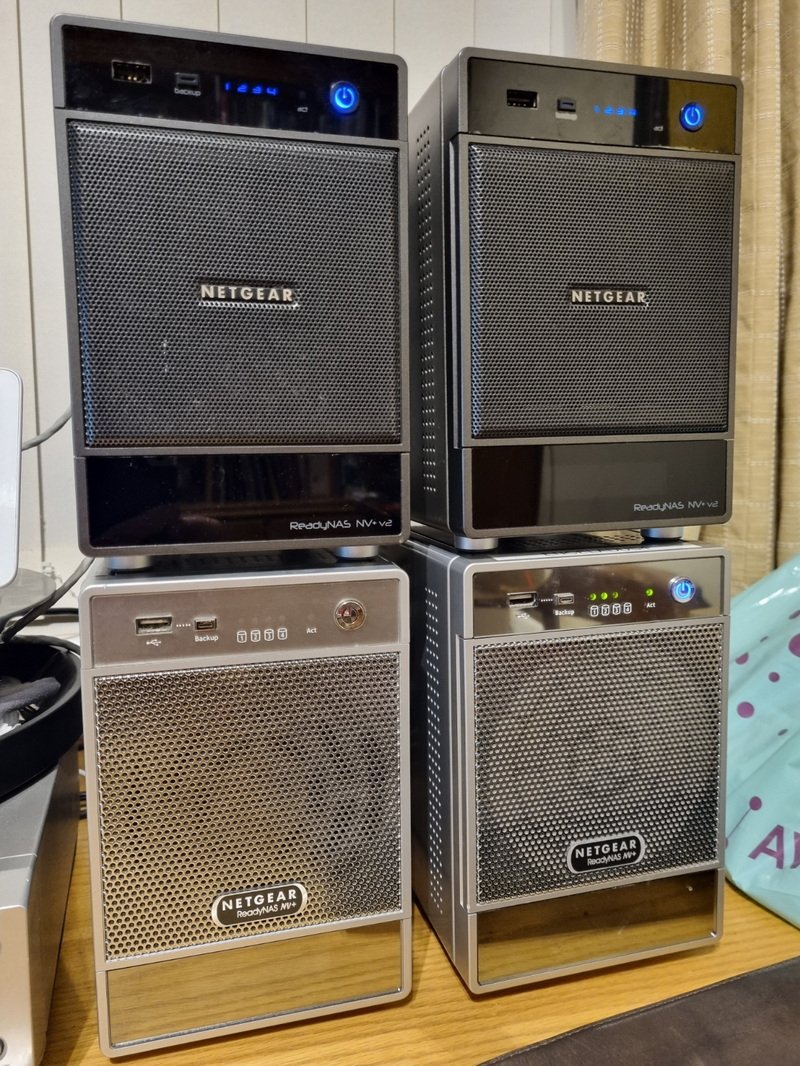
Thanks for the links and the interest. I have since found this but have not managed to fix it yet. https://www.gaasen.com/gaasen-blog/nas-servers/51-readynas/50-loss-of-access-to-readynas-admin My ReadyNas is the older type (NV+) as in the bottom two in the picture which is from the article.