
studiot
Senior Members
-
Joined
-
Last visited
Everything posted by studiot
-
This thread is about reading papers. However I am happy to see it extended to writng them as that is the other side of the coin and the discussion is quite good. I am reading a new book by a particle physicist at CERN called 12 experiments that changed the world. It starts off with Roengten Many work like this today for fear of being gazumped. So how exactly is an artificial dumbness going to produce a paper on any such work ? AI only knows what has been fed into it. I am responsible for a handful of papers, all of which contained original (though of much lower import) work. Ask AI "How to use the fifth quadrant when converting eastings and northing to bearingas and distance or vice versa ?"
-
Hear Hear. I don't know what they do nowadays but when I first went to grammar school back in the early 1960s we were issued with exercise books to write in. I was suprised to receive two exercise books in at least one subject (definitely History was one). We were supposed to write 'rough notes and working' in class in one book and put a 'fair copy' of any exercise essay in the other for marking. I suppose this was in part preparing us for that method CharonY mentions.
-
Are you thinking of Fermat's Last Theorem ? Wiles proved it in 2003. https://en.wikipedia.org/wiki/Wiles's_proof_of_Fermat's_Last_Theorem But I don't see why that was a joke.
-
Ahem, pardo n me. Just to avoid any misunderstanding; strong not string ?
-
Let us change my diagram from the axes of a graph to this little story. My girlfriend and I live on either side of a crossroads. Fig A shows that I live 4 miles down East road at the end of the arrow. Fig B shows she lives 1 mile along West Street at the end of the arrow. How far must I walk to visit her ?
-
Here is the link, plus some discussion elsewhere https://www.wolframphysics.org/index.php.en https://writings.stephenwolfram.com/2020/04/finally-we-may-have-a-path-to-the-fundamental-theory-of-physics-and-its-beautiful/
-
Thank you, that was very clear. +1
-
edit post
-
I don't know what you mean by 'discretized' but density has no meaning at the atomic and molecular scale. You need a sufficiently large sample to use a density model of composition, which is why I asked earlier about sample size. I am not aware of a satisfactory answer to this issue.
-
Back in the day in common with many students of technical subjects, I couldn't afford HiFi so I set about building my own. This led me to have a long term hobby interest in electronics. I used to buy technical magazines and had long loosing battle with them over the placement of advertisements. My view was (and still is) that I love and want advertisements. But in the right place. I used the articles and the advertisements in entirely dissimilar ways. The advertisements I went carefully through in case they offered something I wanted to buy, which I frequently did. But, unlike the articles, the advertisements went quickly out of date and I tore them out and threw them away to reduce paper storage. The articles I kept (and still have) as useful in the long term. So I tried to persuade publishers to separate articles and advertisements on separate pages as far as possible.
-
I see the original course (in pdf) I referenced is still available https://www.umsl.edu/~chickosj/c365/lectureNMR2.pdf 6 pages NMR2 through NMR7 https://www.umsl.edu/~chickosj/c365/lectureNMR7.pdf Are these any good ? You presumably know enough Chemistry to understand functional groups in substances that are being analysed ?
-
@bangstrom What you are doing is a good example of what swansont was gently warning you about. I have already indicated that I am having trouble correctly understanding what you mean and here you are crowing about using physics terminology quite differently from everybody else. And then you have the gall look down on me when I try to clarify what you are saying, I am reporting yours replies as discussing or arguing in bad faith.
-
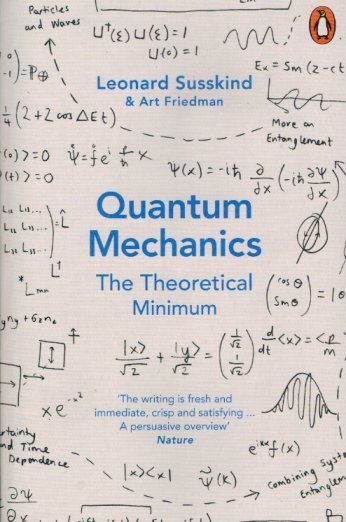
Since you are studying Physics, may I introduce you to this little book, whcih will answer all your questions and more. When working with a subject, even one I know well, I like to keep two (sorts of) books on the subject. A very basic book that explains things, including the maths, but is not too big and encyclopaedic. A treatise type book that works out all the special cases, wrinkles and details for when I need to delve deeply at a particular part of the subject. Susskind has written 3 titles covering much of Physics using of the first type of book and this is the one you need. It contains the whys and wherefores of quantum calculations, including useful tables of results, for entanglement, density matrices and compares with classical analogues, discussing the difference between quantum and classical versions.
-
A someone who suffers more than most from what you describe because I tend to write longer posts than most one liners, I fully sympathise. +1 Yes I have yet to find a proper answers and have posted pictures of what I see here. Nor can I tell how any of this is benefitting anyone, since the last thing I would ever do would be to buy something that pops up and interferes with something I am currently engaged in. And, of course, those with suitable ad blockers who thing everything in the garden is rosy so they will never see and therefore buy as a result of these adverts either. I would certainly hate loosing someone of your calibre over this.
-
This is what I mean by a derisory dismissive reply. What you understand by a dimensional constant is clearly not what I understand from the way you have already tried to use it. Here is my understanding of the meaning. I hope you will agree that miles (or any other distance) are not hours (or any other time). As every schoolboy used to be taught the distance walked is proportional to the time taken, at constant pace. He is then taught that this can be converted to an equation by introducing what is known as a constant of proportionality. Some proportional relationships are only used occasionally so the constant is just called the constant of proportionality. In the example case we use it so often that it is given a special name - the speed. In some cases the constant of proportionality is just a number because the two variables involved either have not dimensions at all or the same dimensions. But we have already agreed that variable distance is not the same as the variable time, So the constant of proportionality also performs a second duty. It 'converts' dimensions of time into dimensions of distance. In that case it can legitimately called a 'dimensional constant' and will be necessary even if the conversion is 1 hour walked converts to 1 mile covered. Note that I have used units rather than the more general dimensions, which brings us to our second point, which you clearly did not understand from you answer to my question which was to find out if we can usefully employ the standard dimensional notation. Nor did I mention " the inverse of LT". I mentioned L T-1 to the minus one which read the product of L and the inverse of T. And yes you did indeed mention the ratio of distance to time, or if you prefer the fraction distance over time. Anyway it is a remarkable and very useful fact that all the variables or quantities in Physics can be put in terms of a handful of basic ones. These are for Mechanics Mass M, Length L and Time T. We add to this Temperature (usually greek theta) , and a brightness or illumination measure for optics and a single electrical variable , formerly charge but now current density. So the dimensional constant has a suitable value to convert hours to miles or milliseconds to micrometre or whatever these are the units. It also has the dimensions to convert different types of physical variable. So speed has the dimensions of distance over time or L T-1 This makes the schoolboy equation distance = speed times time dimensionally correct since L = (L T-1) x (T)
-
You might like to compare with the Joule Thomson effect where cooling does take place this is a good pdf https://byjusexamprep.com/liveData/f/2021/12/joule_thomson_effect_76.pdf
-
A characteristic of the last thread and now this one is that you keep introducing new material and words that require a whole thread or two on their own. What exactly is a 'dimensional constant' ? And since you claim that there are other physical properties or quantities that have physical dimensions LT-1 please list them because I can't think of any. ? (LT-1 ; Are you familiar with this notation ?)
-
But what about them ?
-
I am finding this thread rather disappointing. For one thing I can't deteremine what it is about. Are we meant to be discussing Entanglement, the speed of light, action at a distance or what ? For another thing, if we are meant to be discussing entanglement it is rather distressing to be told that what happens before during and and after entanglement is irrelevant.
-
I really thought I was being clear. ...before and after... So before bond formation there are two electrons in separate obritals, each with two spin possibilities, making a total of four possible configurations. After the bond formation there is one orbital holding both electrons and the possible configurations reduce. And no , I do not think it is irrelevant, I think it is vitally important and demonstrates that our knowledge is not as limited as made out. It is important because the available combinations determine the probabilities.
-
@bangstrom Here is a question for you to think about in relation to knowable and unknowable states. Consider the formation of a covalent chemical bond : This involves the entanglement of two electrons. What are the possibilities for the states before and after the bond formation ?
-
Before launching ito some technical mathematics, let me ask you a question. How much do you know about matrices and complex numbers in general ? The density matrix is best studied in the first instance in connection with a very simple two state system (usually the spin states ). It can then be generalised to many pure states and what are called mixed states. Essentially the DM is a matric of real numeric coefficients with some rather special properties that applies to a system with finite number of states. It falls down for the potentially infinite count of states of Many Worlds.
-
I see you now have 5 posts under your belt as a new member. You will now have encountered the antispam measures, sadly necessary. I wonder if you have actually read the rules here, either about posting in general. Untested hypotheses belong in the speculations section, they are not pronouncements of authority for the main technical sections. When you read the antispam rules don't make the mistake of believing that you only have 5 posts. This applies only to the first 24 hours, after which further posts will be accepted again. In my first response I offered you some useful information linking your ideas to quantum theory I suggest you use this time to look them up. As well as Everett look up 'Something Deeply Hidden' by Professor Sean Carroll.
-
Then you will be able to explain the fault in my reasoning in my first response, rather than trying to change the subject.
-
I simply quoted your first line and noted that you contradicted yourself and then stated that this was the basis of your hypothesis. Why would I need to go further into it since you based your hypothesis on a self contradiction ?