
studiot
Senior Members
-
Joined
-
Last visited
Everything posted by studiot
-
Excellent question +1 I did read the article and I'm sorry but I think find it to be a load of wishful thinking without proper scientific scrutiny. Befor the quote phi selected we have this peach it suffers from the same lack of scrutinity of conservation of mechanical energy as The temperature of protoearth is estimated at 2300oK (NOAA) Are whatever 'minerals' that are stable at 2300oK also stable esp magnetically at 230oK ? As a matter of interest I did see a much more plausible 'evolution' of mineral structures into natural radio transmitters as a basis for a scifi story in the mid 1960s.
-
Excellent summary. +1
-
That's nowhere near the standard of silly mistakes I make. +1
-
Simplest way is to go to a Ford dealer (parts dept) and measure the hinge from a transit 150. I found plenty of drawings without dimensions on the web. You mkay also find another van and be able to measure the ground distances if they are relevant. Trying to use a photo as evidence of measurement is likely to tie anyone up in legal arguments about photgrammetry. This is because the actual point of the road vertically below the hing is difficult to locate on the photo and capable of significant argument, depending upon who is measuring it.
-
That article was all journalism and not enough substance (for me) to figure out what they were doing , let alone how they did it. Please also remember that a standing wave can also be modelled as two travelling waves going in opposite directions.
-
Yes of course there is, but direction of travel has quantum implications only sometimes. By this I mean that there is a quantum solution for a particle freely travelling in space in any direction the solution is the same unless of course the travel medium is not homogeneous and istropic. Normally we do not employ this solution because the quantum levels are so closely spaced that it is effectively a continuum. The direction of travel becomes important in the band theory of metals and semiconductors. As regards your question in time, Genady is correct that some solutions are time independent, such as the particle in the box or the potential well models of an electron in an atom or a crystal. But I don't see this has any relevence to travelling. Does this help ?
-
I think it is worth pointing out the difference between absorbtion and adsorbtion. Adsorbtion is the interaction at the surface or interface only. Absorbtion molecules of one material are incorporated into the body mass of the other. The distinction may bit a bit blurred with 'solids' such as sponges which have a very large internal surface area.
-
Good morning and welcome, Rao. Good first post. +1 One way to view the equations of mathematical physics or engineering systems is to dvide them into The equations of constitution or the constitutive equations, for a continuum also called 'the material description'. For example the equations of motion of the particles. The equations of compatibility. These are usually geometric constraints for example the continuity equation in incompressible flow. These are then solved as a set of simultaneous equations. It is not necessary to discretise or digitise all these equations, a mixed set will also do. If you would like to give us more details of you intended application we may be able to be more specific. There are also discrete phenomena which appear in the continuum model, such as water hammer, hydraulic jumps, vortices, sonic booms, water bores, etc. For example, fluid flows are often modelled by using finite element techniques. The mesh is calibrated against known values at the nodes and the actual equations set is replaced by simplere ones for the internodal spaces. So called hat functions (similar to dirac delta functions) are popular for this. the give 'pulses' which match the change of measured variable from one node to the next. There is not enough computing power on our whole planet to track the constitutive equations at the molecular level. For example there are about 1028 molecules in the fuel tank of for a Saturn V rocket.
-
Many thanks for trying to help. +1 Notes. The black notifications indicated only appear sometimes. They only appear when logging into Science Forums and remain for about 20 seconds then disappear. I have never found an actual message anywhere, either on the forums or in my email or on the pc. I have no idea who or what c-19 might be. I only get a notification that there is a new pm by email, not the text of the meessage. The last pm I received was on nov 5 and I read it so it is not new. The screenshot was taken on Dec 14 so more than amonth later.
-
This pdf article may well address what you are asking. It doesn't get any simpler but there is no heavy maths in it. Here is the first page
-
I don't follow the logic being presented. If the heat flux to space decreases with increasing concentration how does that lead to less warming since that basic chem eng equation: input = output + accumulation surely applies ? If the input remains constant, but the output decreases (heat flux to space) surely the accumulation (warming) must increase ? Well done for reading the graph correctly in that most of it is redundant. +1 For the last few million years co2 levels have been in the low hundreds of ppm. It has been several thousand million years since levels were in the thousands of ppm.
-
Agreed, I'm glad you figured it. Basically you have what you need for this topic in all the back posts now. Have a happy Christmas digesting it. Agreed. I'm glad you figured it out. Just to emphasis a couple of points. The Schrodinger eqaution is about particles, which is why we need to work in terms of photons. The solution, psi has some wavelike features. In the case of the slits; Between the source and the barrier with the slits psi looks the same and exhibits these simple wavelike features but there is no interference or diffraction so we cannot really distinguish between waves and particles, if we don't interact with the beam. When the beam reaches the barrier there is an interaction. As a result of that interaction there is a change of solution to the Schrodinger equation. However in this short section we cannot offer a solution (wavefunction) It is indeterminate. But the slit barrier is classed as an 'observer' because it interacts with the beam. Beyond the barrier the new wavefunction settles down and now includes the effect of the interaction with the slit barrier. If the geometry of the setup is wrong eg the photgraphic film or screen is too close we will not see an inteference pattern, but at a suitable distance, about 10 times the interslit distance the inteference/diffraction develops. This is a bit like the classical situation of nice tidy laminar flow in a pipe that leads to a sudden large pipe expansion and turbulence, followed by a funnelling back into the normal pipe diameter and laminar flow again. But this second laminar flow will often contain pulses or waves. The laminar flow regions are predictable, but the turbulent flow region caqn only be dealt with on a statistical basis. You now have all you need in the back posts here so Have a Happy Christmas digesting it all.
-
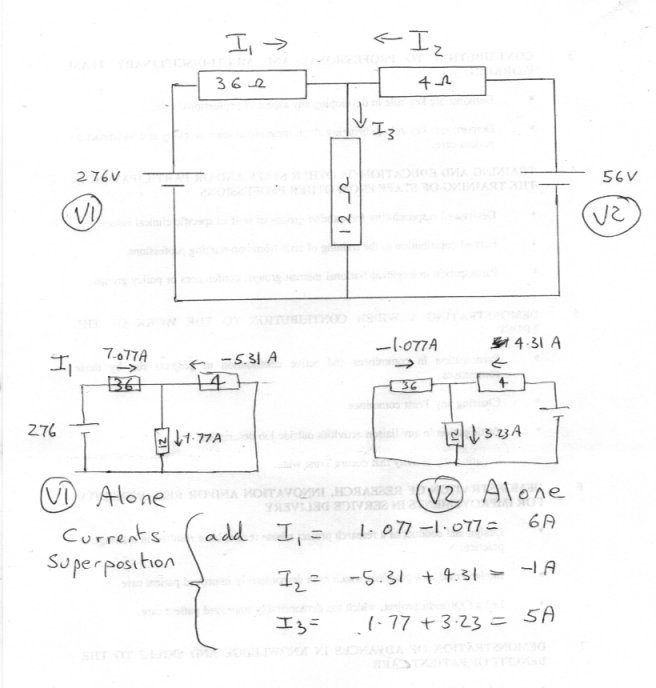
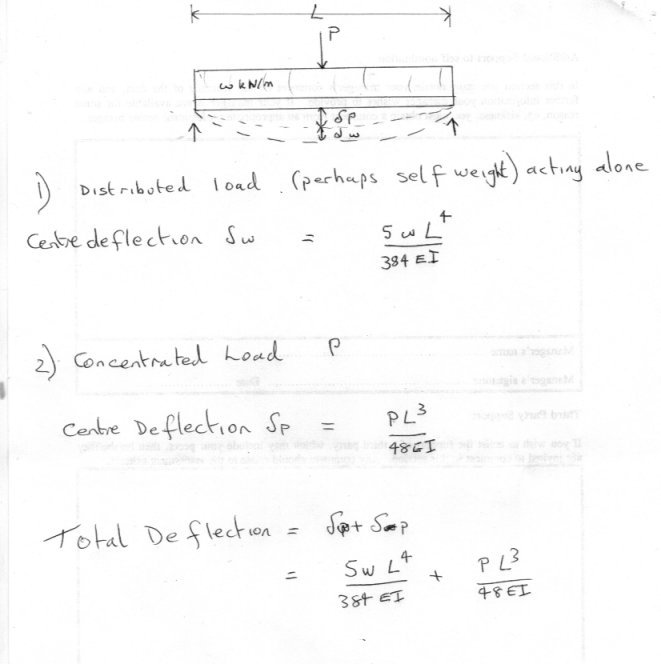
This is a really good time to review. A linear combination (superposition) of both slit one and slit 2????? Genady's formula is a linear combination of two fators. The effect of slit A and the effect of slit B That is the combination of the wave function of slit A divided by root2 and the wavefunction of slit B divided by root2 That is the new wavefunction after the barrier with the slits. The root2 occurs because, if you look back several members have noted that the probability of that wavefunction is proportional to the square of the wavefunction, not the wavefunction itself. It is observed that exactly 50% of the light passes through each slit which means that the probability of each is 1/2 (swasont has noted that probabilities must add up to 1) so when we take the square root of psi squared/2 we get psi/√2 This was also shown on the slits experiment attachment I posted as the pattern built up particle by particle. Superposition - everywhere A affect-influence B Yes electronics - current superposition is linear Yes, but both the defining equation (ohms law) and the linear combination are linear. Beam - Total deflection (concentrated, center deflection) is non linear Not quite. The formula the deflection due to neither load is linear, but these formulae can be used in a linear combination. LCAO is linear yes Schrodinger Equation applicable to atom Yes and to other particles. Each electron has a wavefunction yes Wave functions describe orbitals with 0, 1, or 2 atoms not atoms, electrons in orbitals. two atoms with one atom orbital each bond, creating a molecule and new bonding orbital; new orbital different from either two Again electrons in orbitals not atoms. A linear combination is used to calculate new bonding orbital? Yes adding a constant coefficient when nucleis are of different elements Yes but two constants, one for each nuclues and therefore each wavefunction (look back at my attachment) Surely entropy only applies to material things not 'potential things' ?
-
Well I don't see that anything here deserves negative point but I can only reverse one of them. After all you did what was asked and provided wht I take to be an English translation. However I do disagree with some of you claims, though considering the size of your post that is hardly suprising. Perhaps it is your English translator ? But surely there are many types of earthquake and many types of causes. The idea of exploding or expanding gases is interesting but cannot account for all earthquakes. This is just plain wrong. The Atlantic did not even exist until 175 MYA, which means it did not exist for 96% of the Earth's history. Whilst a complete axis flip is possible, though extremely unlikely, a change of 20 degrees or so is way outside the mechanics of the precession that is observed or can be justified. You mention the bouyancy of the Earth's crust several times. What do you mean by this ? I think that is enough for now as you seem to have mixed up several different theories and added stuff of your own.
-
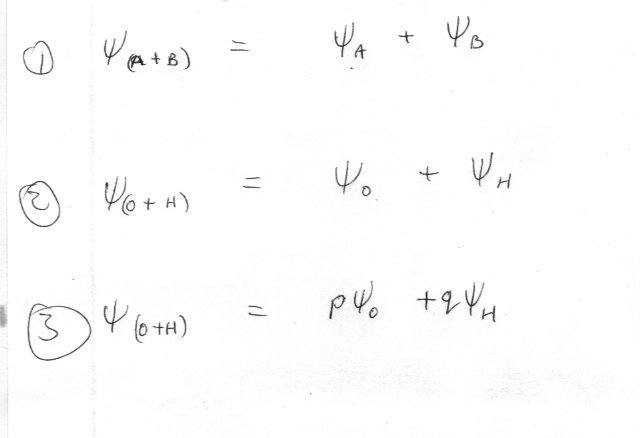
12√ψ1+12√ψ2. So can you explain how Genady came by this formula ?
-
Let's put some flesh on the bones Microstates v Macrostates. Here is an extract from a lovely article
-
Genady has answered youquestion about the slits, with - yes you guessed it - a linear combination. OK so let's get a handle on superposition so we can see move on to see how is can be employed in QM. Like before I will start with a couple of classical examples which are easier to countenance. (I hope you have fun translating the English) Superposition basically means 'in the same place' By 'place' we mean that the effect of process B anywhere that process A exerts an influence. Linear superposition requires that "The resultant effect of B superposed on A is the sum of A acting alone and B acting alone" In other words it is a linear combination of A and B. I am being deliberately a bit vague about place to leave it open ended. Place can be a real region of space or it can be an abstract region of a theoretical mathematical space. Right so real world example 1 from electronics. So translated into electronic terms the superposition principle becomes When there is more than one voltage source in a circuit the effect due each (current flows) may be considered as if each were the only source and the resultant current flows obtained by adding the individual flows obtained. Here is a simple worked example. I have not given details of the individual current calculations, but only note they themselves are part of linear mathematics via Ohm's Law. Right so those are individual spot values, about as simple as you can get. I hope you realise that some currents are negative because they are going in the opposite direction from the assumed. The next example is from mechanics. A simple beam carries two loads, its own self weight and a point load in the middle. This time I have given a formula rather than specific numbers to show that linear combinations can be for more complicated things than simple point values. Superposition says that the deflection at any point (I am just showing the centre) is the sum of the deflections due to each load acting alone. As you can see neither individual deflection is anywhere near linear. Yet we can place them in a linear combination (( i like your word) package. So we come to quantum mechanics. Our model, the Schrodinger Equation, can be solved explicitly only in a very few cases and these are for atoms. Most of the material world is made of molecules, which are packages of atoms bonded together by chemical bonds. Each electron in an atom has its own wavefunction. These wave functions describe atomic orbitals, where the electrons reside. When two atoms bond they approach each other untill an orbital of one overlaps the space of an orbital form the other atom. Part of QM tells us that a single orbital can contain zero, one or two electrons. If both of these overlapping atomic orbitals contain exactly one electron they atoms may bond. That is a new 'molecular orbital' is formed, called the bonding orbital. This new orbital has a different wavefunction from either of its constituents. We are only just beginning to be able to solve one of these molecular orbitals directly with our best computers. In the meantime we do what every scinetist and engineere does. They ask themselves will a linear combination do the trick? Yeha enter KJW's formula (with a small adjustment) see 1 on my attachment. Try the orbital of the combination as the sum of the individual orbitals. This works directly for a few molecules for example the hydrogen or oxygen molecules, where both atoms are of the same element. But most molecules are made of a variety of elements. The nuclei of different elements have different 'pulling power' on electrons so to reflect this I have taken hydrogen and oxygen and added constan coefficients p and q to the linear combination to compensate for this, just as we did with ax + by + cz before. So this is the final form of the LCAO method of describing what may be the most important natural process to all of us. LCAO means Linear Combination of Atomic Orbitals and it works pretty well in most cases.
-
Any chance you could rewrite this in English for us plebs please ?
-
Suggest an old fashioned mechanical metronome. They can be had second hand very cheaply since electronic ones took over.
-
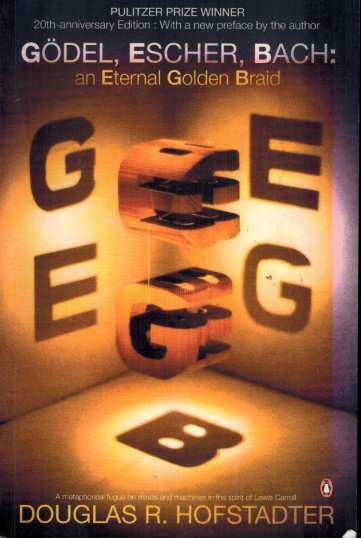
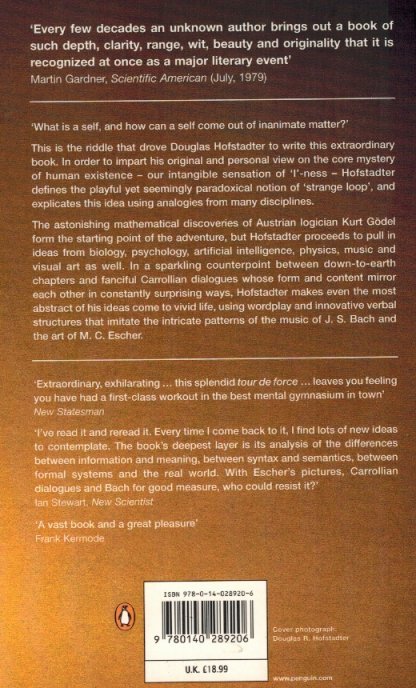
There have been lots of discussions about the the self, soul, mind, body, brain, consciousness and other notions disposition of in humans and other beings. Your impressively long list of references bear evidence to it being a very popular subject of discussion that has not been resolved. I like the writings of this Man.
-
Clearly I am not following you meaning. What about zero point energy ? please note I am working towards developing the LCAO bonding method as an final answer to Luc's question about QM and Superposition.
-
My apologies to @Genady for being so short just now. I was yet again loosing the tussle with the world's worst input editor, whils overcooking the dinner. Anyway thanks for quite rightly raising the question as it does point to our destination and prmpted me to elaborate more fully. Exactly so. You have got it in one. So back to the program. Please remember that if you can add two things this way you can add three or four or....... Can you give an example ? Do you for instance mean an unoccupied state such as an anti bonding orbital ?
-
Well Luc did better than you then because I assume that the small mistake was the missing z in As for you question, this is very fundamental and basic so I will labour the point. Let someexpression≡5 then we have 5 + 5 = 2 * 5 Yes ? Which is trivially linear. But the kicker is Let someexpression≡x4 Then [x4] + [x4] = 2 * [x4] even though x4 itself is decidedly non linear.
-
OK but it's still bottom of the list. If you are genuinely interested in verified information about what we know about the magnetosphere and geostorms, try reading the book by plasma physicist Melanie Windridge. It is readable by a lay person. Melanie has studied this in Antarctical, Canada, Scandinavia and elsewhere.

-
Many thanks +1. What an Idiot I be. The messages are white on black and have been going on for some months now. I just was quick enough to catch it before it disappeared this time.