studiot
Senior Members
-
Joined
-
Last visited
Everything posted by studiot
-
Here is a UK/European datasheet for a 3KVA single pipe model. This is the max you can get from plug in UK mains. Note the risk of explosion/fire and other caveats. https://www.appliancesdirect.co.uk/files/pdf/P12HPW 20240311.pdf +1 also to exchemist for finding that link to a sensible (US) evaluation. Interestingly we stayed in the YHA in Penzance in November this year and they had something like this in the room.
-
Only the one in my dolls house. 😀
-
Any system that condenses water out of the air will recover the latent heat of that water and if that water is emptied outside there will be some effect. You can also do this in a conventional freezer / freezer compartment by puting flexible plastic bowls of tapwater into it and throwing the ice outside when the water has frozen.
-
Which agrees with my point that they made the biggest ever change in Earth's history, but entirely without 'direction' and to their detriment. Quite the reverse of what you claimed in your words I quoted. Yet they lasted 250 million years. Do you think Man has any better chance of achieving that ? Again this runs contrary to your words that I quoted. Both answers were short and appear to be knee jerk rather than considered and you did not reply at all to my quote from Wallace letter to Darwin. Yes please , Luc a lot more detail.
-
1 "This unusual, supercharged evolvability gives us more control over our evolutionary future than we might think." 2 "From the origin of life, organisms channelled and directed their own evolution" 3 "The upshot of all this is that natural selection isn’t something that just happens to organisms: their activities and behaviours contribute to how it happens and whether it happens at all." 4 "From the origin of life, through continual interactive cycles of causation, organisms have channelled and directed their own evolution, and evolution has sculpted them in turn." 5 "and we control our own evolution to a much greater extent" 6 "And because niche construction tends to link adaptive traits together, it too influences both evolvability and the direction of evolution." Re-read the sections on 'Culture" and "Rethinking human evolution". Does it ? Let's take a look at evolution as far as we currently know it and see if these claims stack up or if we can point to any instances of this happening. Our knowledge of evolution is greatly influenced by our knowledge of geology. This was true even at the beginning of our knowledge of evolution. From the origin of life... a) The most enormous change, brought about by life on Earth, we now know was the total reconstruction of the composition of the atmousphere by early organisms (stromatolites) Since the remnents of these organisms still exist today in a few isolated places please explain how this is compatible with 'directed their own evolution' you mention in 2 b) Possibly the most detailed change we know about was the sudden demise of the life form that had dominance for 250 million years. How did the dinosaurs control their demise and how did the mamals that coexisted with thyem gain ascendance ?
-
Direction, that's the word that make me suspicious of a hidden agenda again.
-
This is why English has constructions where you need more than one word to exactly specify a meaning. To me is it ever visible has meaning A alone , to be used in response to a statemnent like Venus is not visible tonight (because of cloud cover) Someone might ask Is it ever visible ? If the speaker wanted to say the star is visible at all times she would never say the star is 'ever visible' in normal parlance. (unless she was using poetic licence as in 'the Star of Bethlehem was ever visible to the three wise men') She might just say the star is/was always visible. If she was as optimistic as Oztmandias she might say 'the star will be visible for ever'. When the statements are analysed the tense of the verb must match the rest of the statement, something Russians probably find more difficult as English has many tenses. Other phrases, this time from legal English, demonstrate my point about additional words The phrase Jointly and Severally to indicate the distribution of responsibility for something. Similarly we have 'Tenants in Common' v 'Joint Tenants' - a very important distinction.
-
My fault, I really should get a better spelling manager. It really should be external oscillation drive. As in the words from the article I linked to What they are saying is that it not not just the interaction between the piped fluid and the pipe that needs to be considered, but also some external ( to the fluid filled pipes ) drive physically moving the pipes as well.
-
What would 'conventional thinking' be ?
-
You have missed out the external oscillation dive. Watch the animations on the website.
-
I seem to remember that Gian is reading a bit ahead of the syllabus, which is designed to lay the groundwork to introduce such things at the next level. Since I endorse that good attitude, I try to help with this so long as I am circumspect in what I offer before time. Basically GCSE magnetism tells students that magnetic fields are directional and have a North and South. They use Flemings rule to indicate a force on charged material crossing the magnetic lines to demonstrate the principle of how that induces a turning moment on a bar magnet in an electric motor. The work is all qualititative.
-
No I was just told that I had to fit it into one and a half pages. Perhaps your teacher was recalling the traditional introduction to trigonometry. Traditionally this has been by way of acute angles in triangles first, this means that you already 'know' what a sine cosine and tangent are. Then extending the definition to obtuse angles in triangles. (Acute angles are less than 90 and obtuse ones are between 90 and 180.) Then extending further to angles of any size is introduced by a rotating arm that may be some radius or a unit. A simple version of the circle explanation has been known since the ancient Greeks, and we have followed their route from Euclidian Geometry, which is taught before trigonometry.
-
Magnetic Moment is not on the GCSE syllabus. However this american MaGrawHill introduction includes it simply, rather as swansont has said. https://www.accessscience.com/content/article/a223000 Ask again when you have read it.
-
Well I would have said, "is every fraction of π ..." Which is proved in the excellent Wiki article KJW (+1) linked to. I took any to mean "are there any fractions of π ... ?" Technically any would do but is ambiguous, whereas every is not. 😀
-
Waht is wrong with pi/3 or 0pi ? But what do you think an algebraic number is ? square root of 2 is algebraic since it is the root of x2 -2 = 0
-
Yes it looks like it. In mathematics there is nearly always more than one way to do something. No it is not advanced maths. I think somewhere in these many pages I have already mentioned signed numbers and sign conventions. There are plain 'ordinary' numbers we use for counting, measuring etc. They may be whole numbers or fractions. We use them for the four basic operations of arithmetic add - subtract - multiply - divide. But often we want our numbers to represent more than this. For instance up or down ; electrical positive or electrical negative ; clockwise or anticlockwise ; left or right and so on. To do this we establish a sign convention. The most common convention is that we attach a plus or minus to each and every number so the numbers we use are then called signed numbers. We do this because we can benefit from using the signed numbers in the same formulae we use for basic arithmetic. However in order to make this work we must learn some extra rules for these basic processes. The Kahn narrator is using signed numbers, not plain ordinary numbers in his column vectors. does this help ?
-
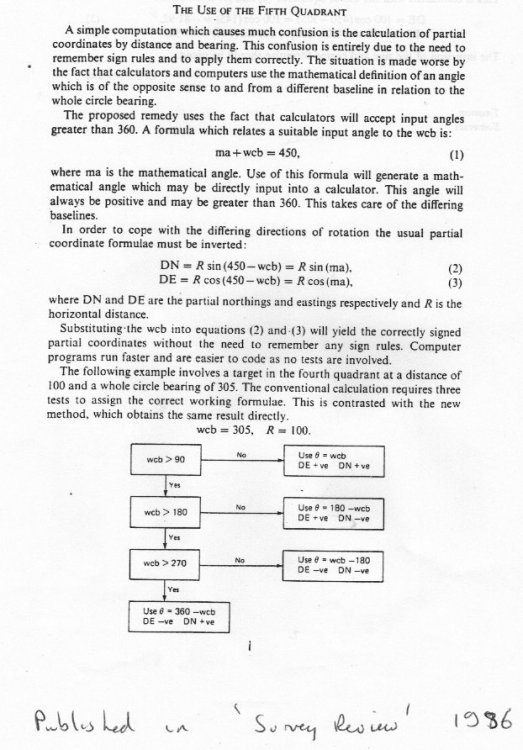
This brings me to an important point about published papers. The publisher controls the length of the article, not the author. The grand sounding Empire Survey Review was in those days the size of a penguin paperback and colour printing had yet to be available. I was constrained to one and a half pages so I chose to lay it out in a way that would mean more to surveyors than to others, even mathematicians. Any whole circle bearing lies between 0 and 360, but there are only 180 degrees in any triangle. Surveyors wish to use right angle triangle trigonometry for easy calculation. So the whole circle of 360 degrees is divided into 4 quadrants of 90 degrees each. A suitable right angles triangle can be chosen in each of the 4 quadrants. There is, however, a price to be paid for this convenience. That is the equations are different in each quadrant. This menas that the first thing a surveyor has to do is decide which quadrant his bearing lies in and then he can choose the correct equations.. This is why my flowchart is laid out as it is, for ease of programming. There is no need for a loop back as the outcome must lie in one of the four quadrants so asking is it in the first quadrant, second quadrant, third quadrant in formal sequence will identify 4 quadrants ; if the answer is 'no' 3 times the bearing must lie in the 4th quadrant. Any surveyor will already know this so I did not need to spare too much paper on it.
-
Remember the spin quantum number is responsible for the magnetic properties of the substance.
-
OK so I was able to see what the narrator was talking about. He did go through it very quickly, not only because he was distracted by a malfunctioning pen but also becasue the issue has nothing to do with vectors. It is more basic than that and stems from the problem many people have with signed numbers. you have two signed numbers viz minus 4 as well as minus 4 again. That is one use of the negative sign -4 ; -4 The signs belong with the numbers. they do not signify any operation at all, they are part of the (signed) number. Then you have an operation - in this case subtraction. So you have minus 4 take away (or subtract) minus 4 (-4) - (-4) So the negative sign inside the brackets is a different animal from the negative sign between the brackets. For the operation subtractio I recommend the rule To subtract - Change the sign od the second quantity and add to the first. minus 4 subtract minus 4 Change the sign and add So we have minus 4 add 4 (-4) - (-4) = (-4) + (4) = 0 does this help ?
-
Well I disagree. Firstly atoms in the plural were mentioned in the quote I responded to. Secondly it specified that this was the only way atoms (not electrons) could gain energy. The scenariao you describe refers to electrons gaining energy, not electrons per se. Secondly I also referred to a gas, in which the atoms or molecules may well be isolated for the purposes of this context. Yet those individual atoms are constantly bumping into one and other and in that process gaining or loosing energy. Therefore it is not the only way an atom can gain or loose energy. Thirdly even in a solid steel bar the influx of EM radiation affects atoms individually. The same photon does not excite two or more atoms. Finally the full quote I responded to follows a chain of reasoning commencing with the true statement "Light energy is lost and gained in discrete amounts limited by the energy differentials between electron orbits within the atoms." But this is followed by the definitely untrue statement that does not follow from the true premise. "This is why atoms can only gain or emit energy in discrete amounts." It is untrue because atoms isolated or otherwise can gain energy in other ways as I have noted some of them.
-
There are very many Khan videos. We need a link to the one you are referring to along with a time in the video to look at.
-
Sure. As to the non discreteness what happens to the atoms if I take a bar of steel or a bottle of gas and heat it up ? Alternatively what happens to them if I take them on the Edinburgh Express at 125 mph ? Or if I simply lift them 2 metres into the air. ? And what happens if one atom simply bumps into another ? One will gain energy, the other will loose energy. I think our mutual friend has forgotten about heat, kinetic and potential energy. Now for the poetic bit. The photoelectric effect was one of the two experiments that demonstrated that in some cases atoms can only take in some forms of energy in discrete amounts. But if you consider the whole experiment not just the sexy bit, energy input of too low a frequency will also be absorbed as above, but the expulsion of an electron will not occur. For example shining infra red light on ssomething will simply heat it up, shining UV or X rays will cause photon emission. Hope this helps
-
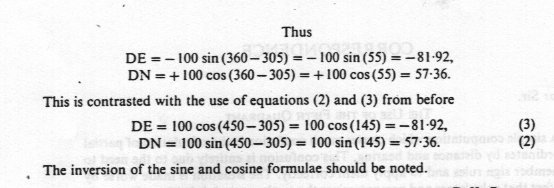
Actually no it is not a book for experts. Anyone can gain from it. I often find it fascinating learning the story behind many discoveries. It is not written in research paper style, but is 'popsci'. You might be suprised to find what can be learned when competent scientists put out their thoughts this way, as opposed to journalists and others. Of course that is not to say that all scientists are 'good' and all journalists are 'bad'. The great scientific discoveries are often made when someone (not necessarily a scientist) spots something that others have missed. My point about Roengten was not what he discovered (X Rays) but what he did with the information and how he published his paper, which is a very interesting and human story. Here is the short fifth quadrant paper. It was published in the Empire Survey Review in 1986 so has yet to reach Big G and M$. This puplication then had a circulation of perhaps ten thousand surveyors around the world. You should have no trouble with the maths.
-
But that was a pretty damn good summary of relevant aspects of quantum theory in refutation. +1 I think it is poetic that the very experiment that led Einstein to propose quantum theory and the word quanta also completely refutes this claim.
-
This thread is about reading papers. However I am happy to see it extended to writng them as that is the other side of the coin and the discussion is quite good. I am reading a new book by a particle physicist at CERN called 12 experiments that changed the world. It starts off with Roengten Many work like this today for fear of being gazumped. So how exactly is an artificial dumbness going to produce a paper on any such work ? AI only knows what has been fed into it. I am responsible for a handful of papers, all of which contained original (though of much lower import) work. Ask AI "How to use the fifth quadrant when converting eastings and northing to bearingas and distance or vice versa ?"