studiot
Senior Members
-
Joined
-
Last visited
Everything posted by studiot
-
OK so if I understand you correctly you wish to measure the resistance of a length of rail section ? You should be aware that electrical resistance does not change with frequency - IOW there is no such thing as AC resistance per se. If AC is involved it has a frequency dependant property called impedance, which is a compound quantity of the resistance and the ac reactance. Commonly instead of Vdc = IdcR (ohm's original law) we have Vac = IacZ One method of measuring the resistance is to use a variable frequency generator and measure the ratio of Vac / Iac For a range of frequencies and plot a graph of the result. You can then extrapolate this graph back to zero frequency (ie DC) to obtain the resistance component. This technique is often used to get around two effects that can upset the measurement. One is polarisation and the other is the effects of contact potentials or contact resistance with the measuring equipment. Does this help ?
-
Before I offer you some more amterial, here is a small question for you to think about. The Bible only refers to a small number of the worlds peoples. What do you think about where the ones it does not refer to came from ? Here is an interesting quote from a famous archaeologist Professor Andre Parrot
-
The short answer is yes, but it rather depends upon what you are trying to do. It is not as simple as you think. If you would like to tell us more about your problem we can help further.
-
A Short poem. The liberals and the greens Are nowhere to be seen Reform is interesting because half their policies are to the left of our left wing parties and half is to the right if our right wing parties. They have no middle. Since you worked the control room at Drax, you I am sure you are well aware that the whole point of a grid is that it is not a linear structure and it is not necessary to transmit the electricity 500 miles over a grid. I am also sure that you are in a far better position than I to estimate the losses (= pumping costs) of oil and or gas over thousands of miles as compared to electricity losses over suitable cables. The UK buys geen (nuclear) energy from France and southern Europe now buys solar exported from north Africa. There are now several pumped storage facilities in Scotland, the nearest match to Dinorwig is Cruachan. Interestingly Drax limited bought Cruachan in 2018.
-
Kind of you.
-
If you don't mind my asking What University are you at and what course are you studying ?
-
@Sensei a question for you My impression of these constructs is that the English I see is good, too good in fact. I wonder if they incorporate some sort of after filter to ensure this. It is easy for a clumsy human like myself to spot the product of a construct.
-
Some interesting responses there +1
-
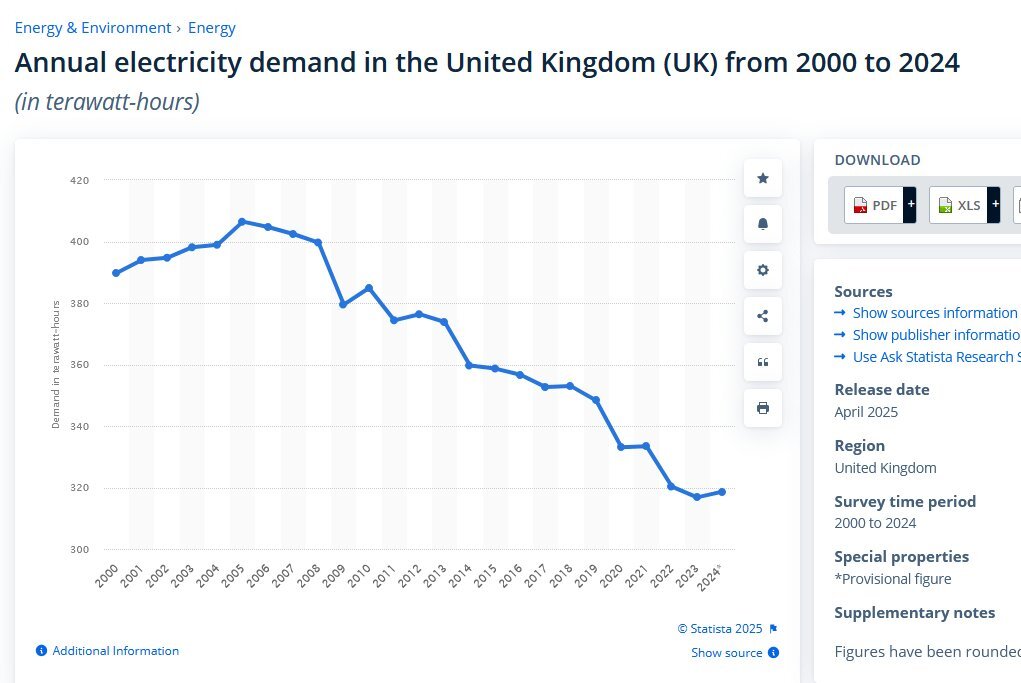
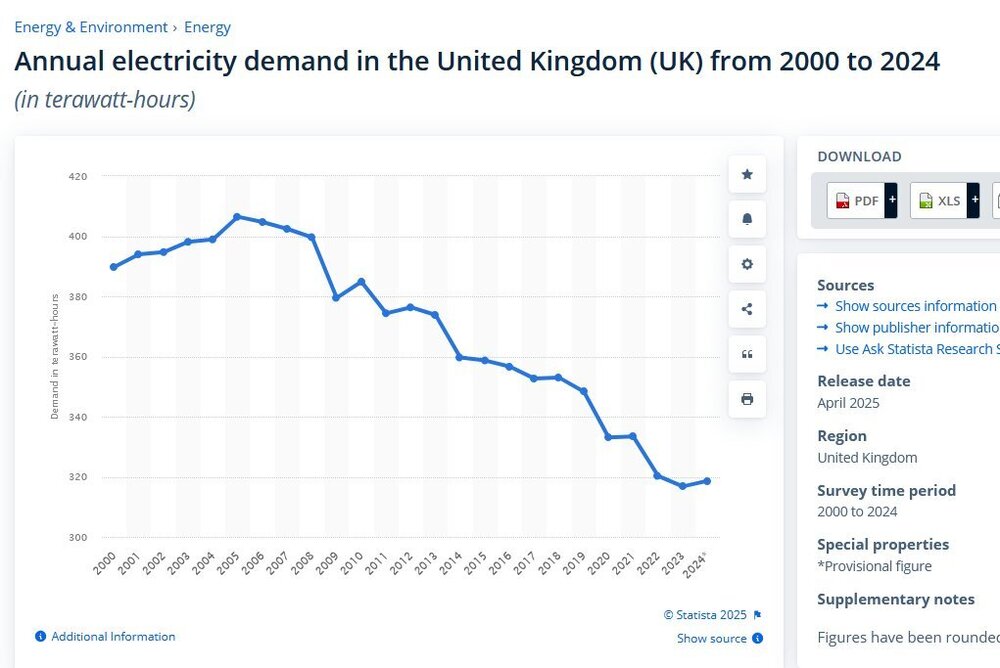
And then again, maybe not. The government's policy, announced yesterday is for all newbuild to have solar panels, so why would the new owners need extra grid supply ? Further the scheme for selling back surplus solar generation has now ended. We are also told that the building regs will be altered to make newbuild gas boilers illegal. Yet more tinkering around the edges instead of a proper set of regs, properly enforced, so that folks buying will not be subject to the gremlins of today. But in any event the official statistics say that electricity demand is currently declining.
-
And yet electricity use in the UK has been declining for at least 20 years. https://www.statista.com/statistics/323381/total-demand-for-electricity-in-the-united-kingdom-uk/ It is difficult to get historic electricity use figures. The government statistics office in particular wraps it obtuse ways and considers 'energy by sector'. Energy use overall has fallen significantly since 1970 So why do we need this new distribution network ? All I see is that two nuclear power stations near me have been happily supplying power since 1966. All of a sudden a third one is nearly finished (within 5 years nearly !) and the wise and wonderful have decided that the old transmission equipment is no longer 'good enough' so new pylons are being built. Tjose same wise and wonderful folks have spent the last decade ripping up the south east and south midlands to great distress locally to build that crazy train costing billions and bilions. If they ahd really though about it they could have provided a new spine for the grid, just where it is allegedly needed, within the 'land- take'.
-
Thank you for your reply. I'm afraid we will have to disagree on both your 'solution' and your analysus of the problem. If we cannot accomodate existing North Sea wind capacity, why are we encouraging more to be built at this time ? There are serious logical flaws in the whole setup. Mrs Thatcher's so called 'market' has been ruining our economy since the 1970s.
-
Apparantly green suppliers such as wind and solar are regularly being paid large sums to not produce electricity in the UK. BBC NewsThe huge sums energy firms get to not provide powerCould the government's radical plan to change the way the UK distributes electricity really bring down bills - or just lead to a postcode lottery? The tile of this thread says it all.
-
In more physical terms than KJW's answer If F(w) is the fourier transform of f(t) then (1/a)F(w/a) is the fourier transform of f(at) where a is a positive constant scale factor which changes the duration of the waveform in time. If a> 1 the waveform f(at) is compressed in comparison with the waveform f(t). The spectrum is then more spread out. Which is the maths underlying what I think is your question and correct observation. +1 This is known a a similarity relation and makes the process scale independant. Note the 1/2 is dimensionless so the product delta-t delta-omega is dimensionless and is the condition for a similarity transformation. The meaning depends upon the function chosen for f(t) so KJW's gaussian function has minimal spectral width, in contrast to the width of a rectangular pulse ( a la Dirac) which has infinite spectral width The maths we are discussing is pure maths but it not only leads to the classical uncertainty in radio waves that exchemist mentioned it also leads to the HUP.
-
Some further notes. Commutativity is more complicated than just commutable and non-commutable. For matrix multiplication Some matrices will commute with their transpose. some will commute with their complex conjugate matrix. But some will not. but reversal of the order may make MN = - NM ( this is called anticommuting.) Some pairs of matrices will multiply as MN just fine but cannot be multiplied at all as NM simply because they have incompatible rows and columns. In classical wave theory there is an uncertainty principle (not the HUP) which reads [math]\Delta t\Delta \omega \ge \frac{1}{2}[/math] Where delta t is the RMS duration of a wave packet and delta omega the RMS bandwidth. To prove this you start with Parsevals theorem introduce the Schwarz inequality and several pages of calculus. Maxwells Reciprocal theorem has an interesting form of commutation In a linear-elastic system a unit load applied at A produces a deflection at B which is the same deflection as the unit load applied at B produces at A.
-
Once again this shows your failure to understand Physics and Mathematics. In particular the meaning of the word 'conjugate' I have alredy explained in some detail the meaning in relation to HUP, which is not the same as the meaning in your extracts. Please tell us that you have not spent the last 5 months hunting for 'conjugate pairs' without understanding what that means ? Quantities, Variables or other entities P and Q are said to be conjugate if when combined according to specified rules produce a specified result. These quantites may or may not be physical quantities for instance x and 1/x are conjugate when the specified result is the number 1 or the identity in certain sets. Such relationships are so common that other particular names are given to the conjugacy for instance, adjunct, inverse, complex conjugate, canonical and so on. Please go back and consider the specification for Heisenberg I gave you, and then show me where those particular quantities appear in General Relativity. As an example from Thermodynamics I could declare "Thermodynamics is flawed because it is incompatible with Time" Of course this is not true since the Three Laws of Thermo do not mention Time at all.
-
Yeah your politeness pays off leading to good quality discussion. +1
-
This is one of the best summaries of escape velocity without maths that I've seen in a long time. So many get this wrong. +1
-
~This reads as if there was a powder called antimacassar that could be sprinkled form a sprinkler as pictured. I have only ever come across your stated purpose of a protective cloth cover and cannot find reference to anything else. They are still used in some places, some airlines, trainlines and coachlines in particular. Equally I cannot see such a powder being placed with food in a cruet set for the diner. The servants would have handled and put out the proctive cloths. Caster suger is definitely the most likely as the larger size fits the quantity of added sugar v that of salt or pepper as does the larger sprinkling holes. Here is a picture of a modern day 'spice ball'. You (partly) fill the ball with appropriate quantities of appropriated spices and dangle it in stews, casseroles etc during cooking. This prevents uwnated release of unwated particles such as clove sticks etc.

-
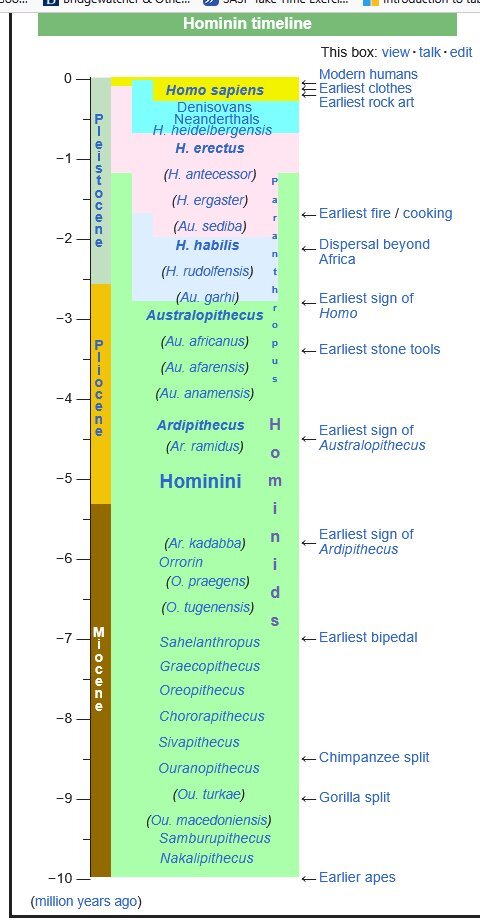
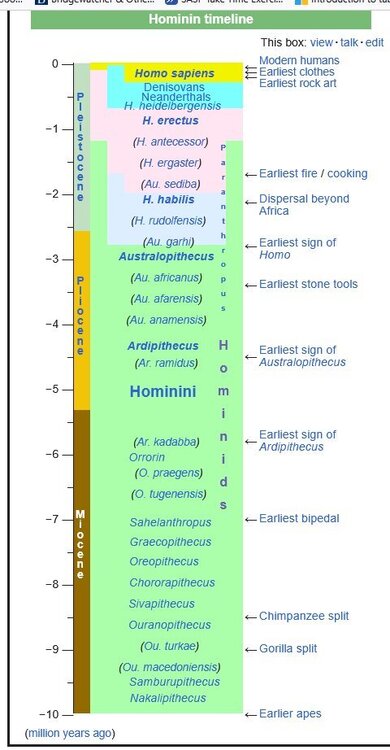
Pretty good explanation, +1 Agreed, perhaps you might have said more since Wiki takes us into what actually preceeded the historic term paleolithic - that is into geological time periods up to 10 million years ago. Sarae hope this helps https://en.wikipedia.org/wiki/Paleolithic and https://en.wikipedia.org/wiki/Hominidae +1
-
Thank you I have learned something there. +1
-
Not sure how that helps find prime numbers. Consider 7 3 times 7 makes 21 add 1 makes 22 divide by 2 makes 11 (another prime) and putting it back into group C not as you say, but to continue 3 times 11 makes 33 add 1 makes 34 divide by 2 makes 17 (yet another prime) So the process is more complicated than you thought. Also since 'groups' have a special meaning in mathematics and number theory and Collatz, I suggest you use another word, for example Class.
-
I think it's about time you started arguing from scientifically accredited facts rahter than valueless journalistic soundbites. Pity this ended up as a joke as it was meant to be serious.
-
Would you like to know what my first reaction to your post was ? Well I thought " Germany is famous for its dependance on coal. Well did you read that article you linked to ? If my figures about renewables v nuclear cut your russian oil argument off at the knees, this comment from your article
-
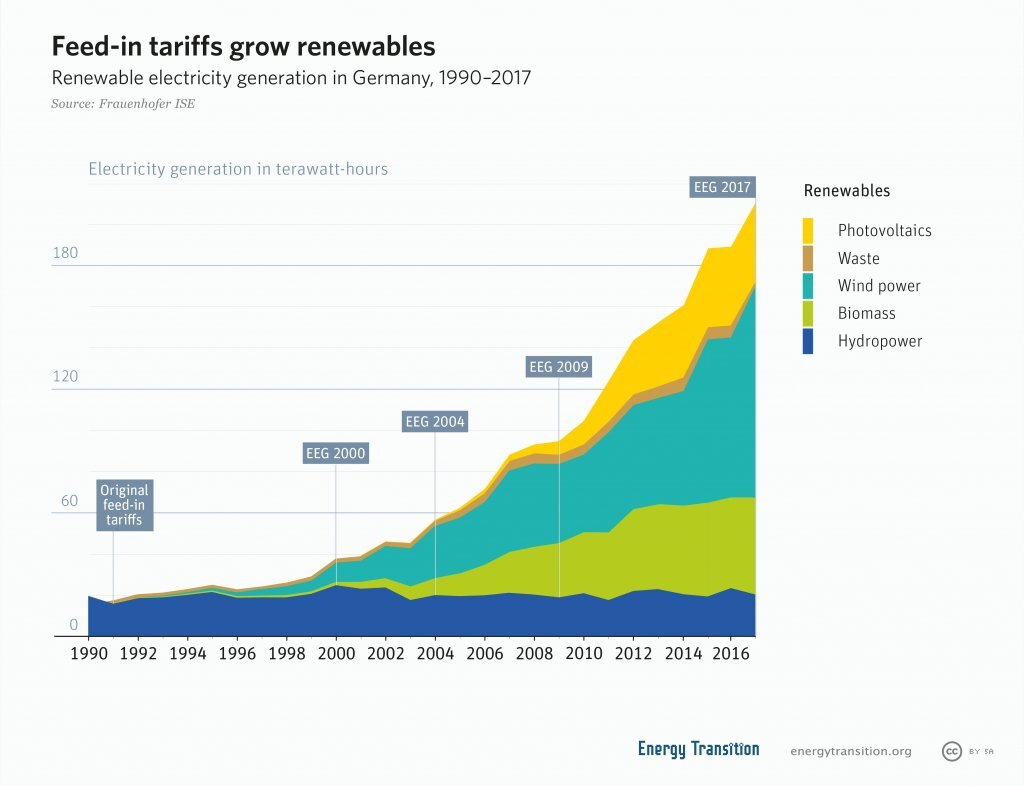
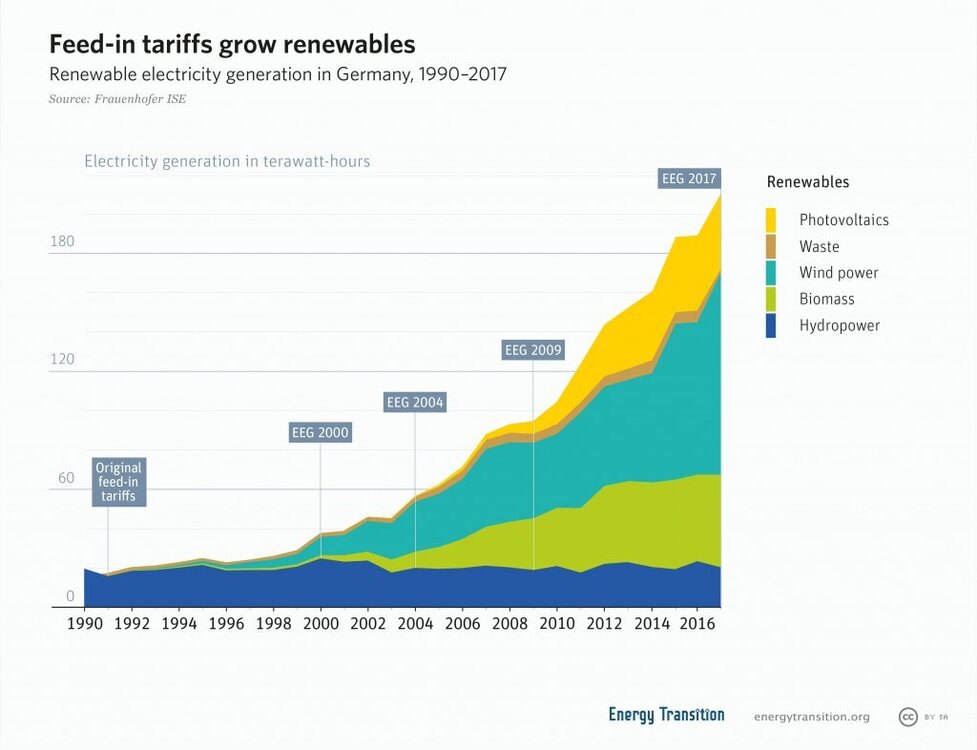
Actually no it doesn't follow at all. http://wiki.energytransition.org/files/2018/10/BL_ET_update_2018_Feed-in-tariffs-grow-renewables--1024x786.png Year electricity production 109 kWh 1961 0.024 1970 6.0 1980 42.6 1990 146.1 2000 168.5 2005 163.0 2010 140.5 2014 97.1 The first graph show the expansion of non nuclear renewable electricity in Germany and the following table shows the generation of nuclear power. The timescales are the closest match I can quicly and easily find. It is obvious from these figures that The decline in nuclear started well before the Ukraine war. Renewable generation has more than replaced the lost nuclear capacity ( in fact nearly double by 2014)
-
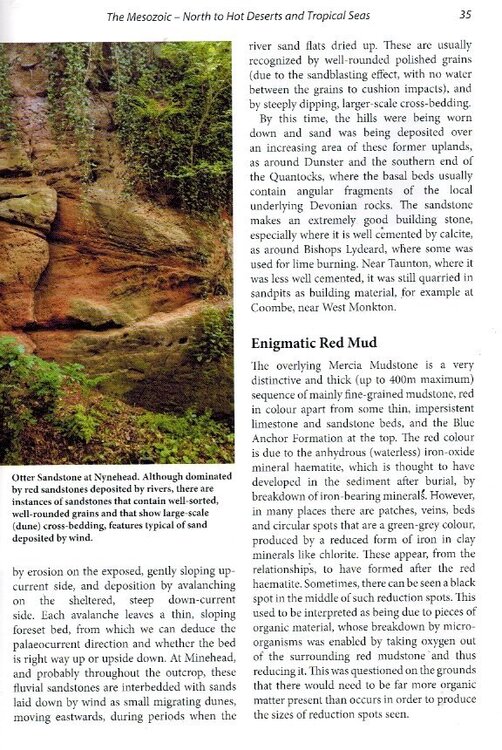
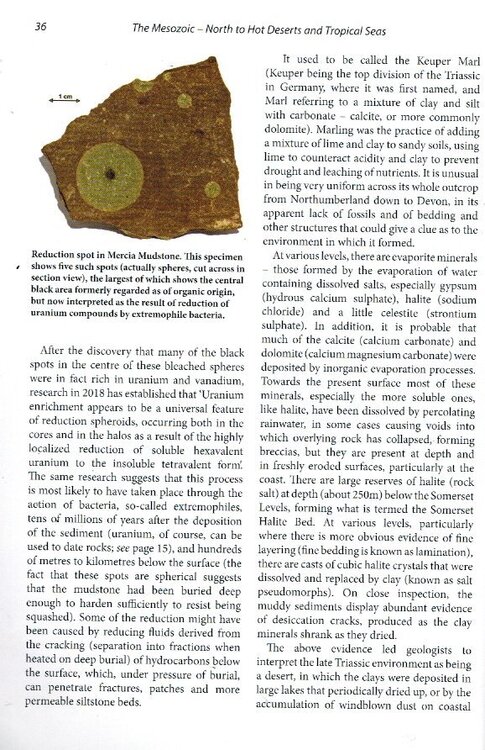
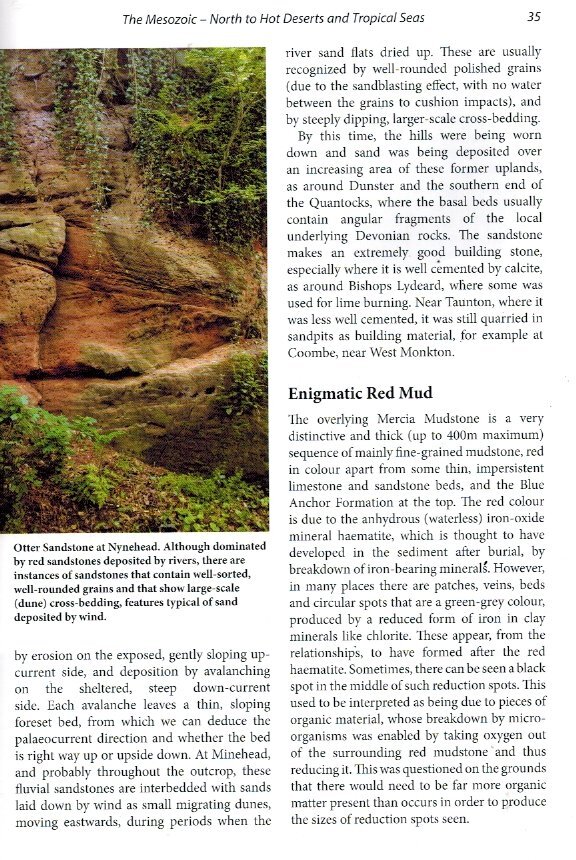
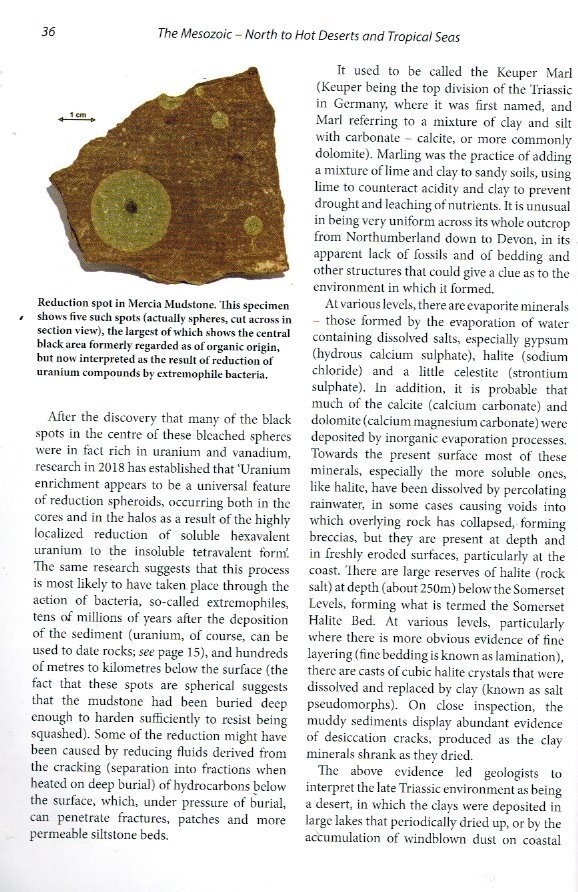
What is interesting is not so much the source of the minerals, but the mechanism of their accretion or aggregation. More recent studies have veered away from the carbon theory and apparantly the nodules aaggregated some tens of millions of years after the sediment was laid down. Although on my simplified map the volcanic rocks around Exeter are shown as granite, there are also outcrops of other volcanics that are a more likely source, especially as the nodules do not seem to appear in the more northerly Mercia series. The new red sandstone is part of the Mercia group , which is more widespread, and here is some very modern information, from Dave Green.