studiot
Senior Members
-
Joined
-
Last visited
Everything posted by studiot
-
What is this doing in mdern and theoretical physics ? Did you not read our rules when you joined ? If yes then why did you not abide by them an place this in speculations, where it belongs ? If no then why do you expect us to read your rules ? Since you have titled your wanderings 'Solid Physics' I suggest you start by carefully defining what you mean by solid, since that characteristic has special meaning in mainstream physics and chemistry.
-
Why should the received 'signal' be the last broadcast ? Just a suggestion folks but isn't is just as likely that a far off Trump has cut funding and sacked all the staff after the first broadcast centre of the source planet? You all have a good night now.
-
Hello, have you read the rules here ? Newcomers are allowed 5 posts in their first 24 hours as an effective security measure. This would be a prime example of the rule that all sections, including religion, are about the scientific aspects of that section. So I look forward to your scientific rebuttal by the moderator.
-
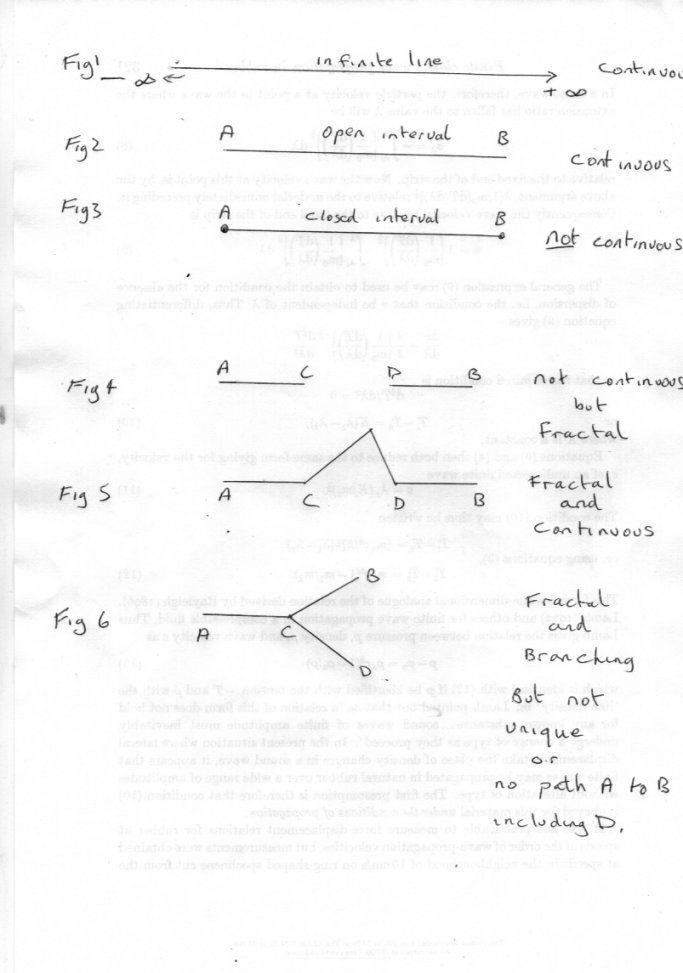
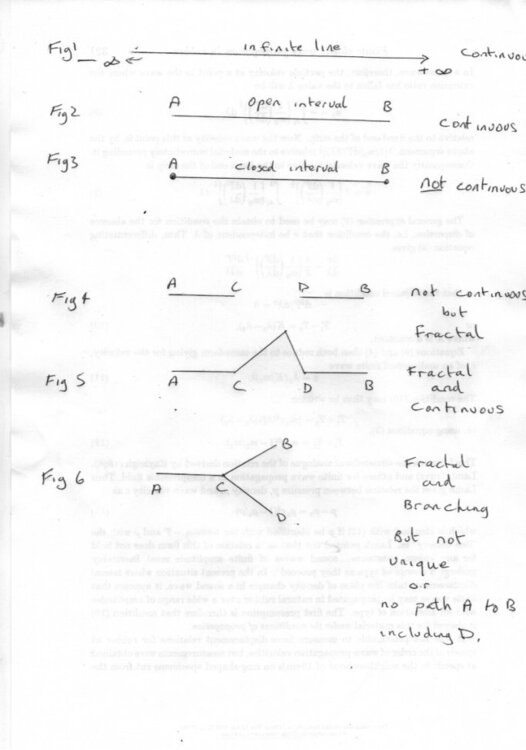
It has taken longer than expected to find the hour or so to compose this so I can only repeat what my Doctor said to me last week, "Sorry for the delay". So we have decidced that our model manifold need to be connected to be realistic. But is this enough ? As I see it, there are two issues to overcome for unique time to be fractal. Firstly we have a requirement for time to be continuous. An infinite line is fully continuous as in fig1 A finite line (AB) , in a open interval, is also fully continuous as in fig2 A finite line on a closed interval [AB] is not continuous at A or B as in fig3 Furthermore none of these are fractals. We can make them into 1 dimensional fractals by the process of Cantor's Dust, although the infinite line possesses special difficulties defining the 'middle third' that I do not intend to go into here. As in fig 4 But this is at the cost of of introducing a central discontinuity as well. And these discontinuities increase in number until the entire line is discontinuous as the process is repeated fractally. Continuity however, can be restored by creating a bump between C and D , a typical example being the Koch process. as in fig 5 But we are forced to enter a seconf dimension to do this. Alternatively we can follow your idea of a branch as in fig 6. This has the advantage of providing continuity maintaining from A to B via C along a single line path (dimension) However it introduces a second issue - that of non uniqueness. If you choose to go from A to B (via C) you cannot the go to D. or You have multiple timelines with different points in the different order between different endpoints. This situation multiplies as the complexity of the tree increases.
-
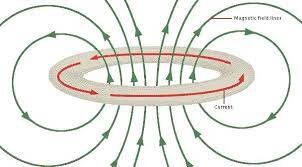
Two points. 1) Whilst it is true there are no poles as such, the magnetic field lines still point in the appropriate directions as shown by the arrows. 2) You have a ferrite core. The core material is important as it gathers in or concentrates the field into itself. ferrite is about the most efficient at this. Note also that Direct Current will not produce much field in a ferrite as the ferrites are meant for high frequency operation. This means that they are very good at creating a fast magnetic pulse from a step current at switch on/off, which accounts for their use in very old fashioned computer memories.
-
This account is only indirectly related to your subject. In the mid 20th century there was a series of short scifi stories published about a group called the Core of Unorthodox Engineers. These stories were very imaginative but grounded in Scinece as you might expect engineers to be. The one I am thinking of concerned a completely uninhabited planet that was broadcasting large quantities of radio signals, yet not a sign of past or present life could be found. When they solved the problem/conundrum the UE found that the planet suffered frequent violent (electrical) storms. Large quantities of lightning was discharged to the surface rocks over extended periods of time. The result was a sort of inorganic evolution. Those mineral structures that could not pass the huge currents safely were whittled away or metamorphosed and those that could remained. It would appear that the mountains became giant transistors. And that is how the radio waves were generated.
-
Thanks for the reply. We are all struggling with the new format for Scienceforums but please use the quote function - bottom left of the passage you wish to quote if you want the whole passage or highlight and hover for a moment ove just the part you wish to quote until a notice "quote" pops up. That separates what someone else said, from what you say and makes the whole thing clearer. But you are obviously a clear thinker and very welcome here. I look forward to your comments on other matters too.
-
So........may. I'm glad you said may because I agree that your hypothesis (not a theory that means something different) is possible. But possible is only the first stage of what doctors call a differential diagnosis. One thing that troubles me is the use of the word signal. If you study information theory (that is the correct use of the word theory) then you will understand that 'signal' implies both a sender and a receiver and part of the information theory is the relationship between sender and receiver. This is of great use in error correcting and decryption. But so say that some burst of radio activity is a signal could be akin to saying that the stripes on a zebra are a bar code. You have to rule out random or some other agent (zebra stripes are neither random nor a bar code but that is another story). Otherwise you are falling into the oldest trap of all assuming what you wish to prove or deduce. Having mentioned random, I have also got a comment to make about that subject. If observations at the receiver are truly random then you would expect clusters of such observations. So...... It is up to you to support your hypothesis with better than " scientists (others) can't explain"
-
A further necessary consideration. After all the man is building a roadway, not trailing polywhatsit fibres in the ocean. What are mud control slabs made of ? Well following the trail it appears that they are made from german 'yellow bag' certified end user plastics. https://fkur.com/en/knowledgebase/what-are-recyclates/
-
Isn't there something in the New Testament about judging others ? I am going to say +1 to the OP for giving the subject serious and proper consideration, although I am probably too late now to tender and useful advice. So instead here is a bit of my own experience. In the early 1970's I mistakenly persuaded my company to spend a substantial sum of money laying a geotextile fibre that was being promoted by way of 'technical' articles in the civil engineering press. The articles declared that the fabric separated the mud from the water, allowing the water to rise and disperse or be dispersed, whilst holding back the soil particles. So we laid this stuff onto thick clay, and you can guess the name I got when we all watched the fabric disappear into the mud. Yes my name was mud with that company. The moral of this is that it depends on what it is laid on. If the soil is a thinnish layer on something hard (eg chalk or gravel) it will work well. But if it tens or hundreds of metres of fine particles such as silt or clay it will fail. Ethically I personally see nothing wrong with appropriate use of 'plastics'. In fact I have long held that it is only commercial greed that promotes gross their over use ( along with other oil industry products) when we should in fact be hoarding this resource, ekeing it out over time for only the most essential uses where it can bring great benefit. Again kudos to the OP who notes the financial and environmental cost of most traditional solutions. Geotextiles have come a long way since the 1970s and their use can greatly reduce environmental impact in appropriate circumstances.
-
Let us explore your idea further, starting very simply and building up to see where that takes us. OK so you want to model the spacetime that we live in. So what to work on ? Let us start with a plain and simple set of points. By itself, such a set is not a manifold for manifolds enjoy extra properties than plain sets do not generally possess. In this we have 2 choices. 1) We can consider relationships between our set and other sets, taking the set as a whole. We can roughly equate set properties like this to the physics notion of 'global' properties. 2) We can consider relationships between elements of out set. This can be roughly equated to the physics notion of 'local' properties. Working on the second option Physicists like to introduce a coordinate system here. The advantage of this is that it brings with it the notion of ordering of elements, also called the axiom of choice. But doing this introduces aditional constraints we did not ask for. I will return to this later as this is the path conventional relativity takes and pays the price by requiring additiona equations/functions to define further structure. But the key property we must have is connectivity, because we want to model motion and exchange between elements. In a topological manifold we can do exactly that, so long is it is connected. Most authors make connectivity either an explicit or implied requirements and then say no more about it. But the bottom line is that if A is not connected to B the you an't get from A to B and there is plenty of topologicat theory about such neworks. In fact in relativity there are invariants for what is called 'the interval' between each and every event point in the manifold. So the manifold can be constructed as a network of invariants, fixing the place of each and every element in this network. Such a network does not introduce additional constraints in the way that coordinates do. So I propose to examine the path between two of your nodes or relativistic event point or my manifold called A and B becaue I want them to offer the same results. This is most easily done graphically, but it is too late to start sketching tonight so I will do this tomorrow.
-
Why haven't you read it ? Though I will say that you have made a better fist of attempting to fractalise Time. However you have not yet succeeded. Your model still has coordinates (x, y, z, t) and therin lies the problem. You realise that for a fractal to exist you require at least ( p + 1 ) dimensions for it to exist in, where p = int(Hausdorf dimension) and p > = 1 ? You are only fractilising time and you have only provided 1 dimension to do this in. that is not enough. The consequence of that deficiency will appear in you nodes and tree structure, as you scale the view. Points that are a node at one scale will not be a node at a different scale, leading to a node jumping around in time. Alternativelly your nodes cannot be considered as point structures.
-
What makes your time fractal ? We already have a current speculative thread proposing fractal time, but the proposer can't seem to support his claim of fractal time.
-
-
How many (English) words can you (without AIs or SEs) think of that have no vowels ?
-
Interesting. Solving 4 = (1 + r/100)25 tells me that this is a compound annual rate of increase of 5.7%
-
Just breaking established mathematics .
-
There you go again invoking fractals, without answering my question. Fractals cannot have tangents. If I am wrong about this I would expect to see a few mathematical lines starting with a recognised mathematical statement such as Derrick's theorem and ending with something like Therefore vector PQ is a tengent of fractal AB
-
Talking of time Rincewind is logged as posting his last post 6 hours ago on my screen You are logged as answering 2 hours ago and in you quote boxes it refers to /Rincewind's post as 37 minutes previously. How are those timechecks compatible?
-
Thank you for replying to my other points, if rather obliquely. But what was the answer to this one ?
-
Cab you please clarify the point of this thread in one simple sentence. Reading through your posts I find a mixture of very good and decidedly bad points so I remain unclear as to what is meant. It may interest you to know of the Mars bar theory. For a very long time, Mars has been recognised a a stable well run company. Economists have used the price of a Mars, over time, bar as an indicator of the value of a currency over time.
-
A good proportion of passersby these days are glassy eyed and either sporting large 'ear muff' things or talking on phone or throat mike. ☹️
-
You will also have to expend energy pumping stuff around the system.
-
Well most parts of the world have a version of good morning / afternoon from guten morgen to bonjour to gdday ...... and leave it up to them to respond or not.
-
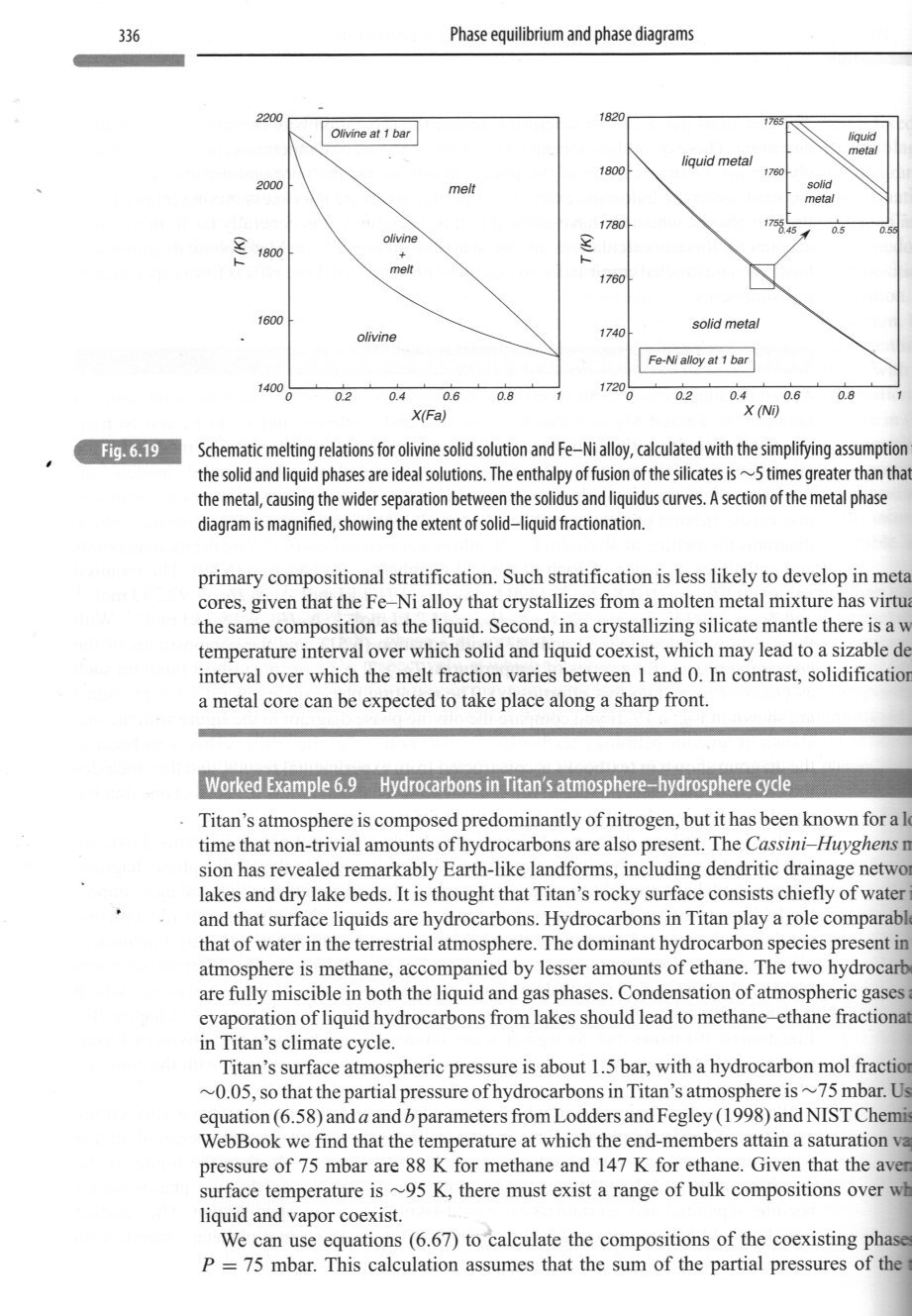
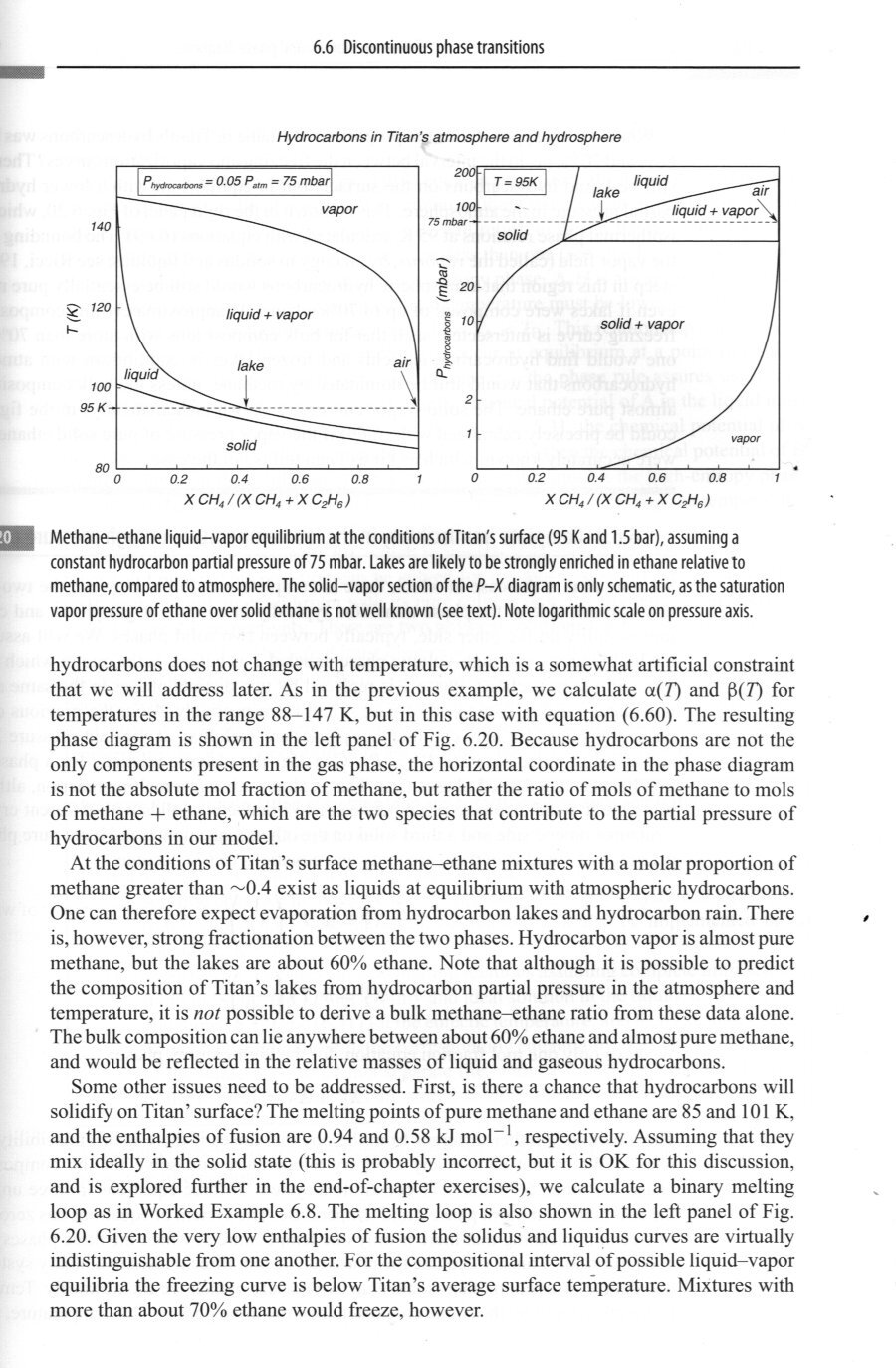
Whilst I can find quite a details of Titan's atmousphere in Thermodynamics of the Earth and Planets - Alberto Patino /douce - Cambridge University Press I cannot find any reference to heavy hydrogen (deuterium) so I would like to clear up a clear up what may be some misconception. 1 Deuterium is also called heavy hydrogen (as in heavy water) because it is ordinary hydrogen with an extra neutron in the nucleus. It's symbol is not H2, ( It is D) which is the hydrogen molecule made from two ordinary hydrogen atoms. None of the compounds named in (b) and (c) are really heavy organics, they are just a bit more massive molecules than methane. But yes, sunlight (UV) and not so strong at Saturn's distance from the Sun breaks down (dissociates) the methane into 'free radicals' (CH3)- and H+. These are highly reactive and so two mehtyl radicals can join together to form acetylene or one methyl and one methane molecule to form ethane, loosing an H- which joins with the other H+ to form a hydrogen molecule. 2 See swansont's answer 3 Yes I understand there is an outer haze that forms which acts in the same way as the earth's greenhouse effect by reflecteing back the longer radiation from the surface (although I'm not sure if this is now longer than infra red), whilst permitting passage of shorter wavelengths in the sunlight.