studiot
Senior Members
-
Joined
-
Last visited
Everything posted by studiot
-
One shortcoming of the algorithmic approach is that is only caters for one half of the rational process. Indeed this typical cryptic comment from dim actual nails it rather well. Rational thinking can be roughly divided into Analysis and Synthesis. The alogrithmic approach needs a goal and corresponds to Synthesis. Analysis on the other hand includes the observer having the nouce to say "Now how/why did that happen ?", which is of course what occured with the discovery of penecillin. In other words it includes inspirational thinking.
-
consistent rate ? Surely all it need to be is predictable ie a known function or a function with a known derivative. This is how radioactive clocks (dating) work. Nor am I convinced that oscillation require mass.
-
I notice that several discussion forums have very recently been enjoying the 'benefit' of new members that are sowing cleverly worded misconception as answers to simple questions including some older threads. Has anyone else noticed this or noticed it here ?
-
I really don't understand. What do you mean you can't see it since you have just quoted it (and I didn't when I referred to it) ? To be plain I asked " is a shadow real ?" in the discussion about 'real', which I believe you introduced, towards the beginning of this thread
-
I look forward with great interest to you doing so instead of ducking the questions.
-
So what? was that a reply to my post ? You don't seem to have answered my question about shadows.
-
The perhaps you can state the mathematics (algorithm or program) required in the following five scientific scientific, mathematical or engineering statements ? The discovery of penecillin. Younger rocks overlay older rocks. In granite, feldspar crystallises before quartz. The mathematical definition of a set. The production of concrete with a strength greater than 45.5 N/sq mm. Everything has a reason, rational thought is the correct understanding of that reason.
-
Apologies it is Salisbury Cathedral's clock. Not being religeous I tend to get them mixed up, though I appreciate the engineerjng of their day.
-
Yeah well you don't know it all and seem unwilling to accept anything outside your knowledge. For instance your 'metric' or distance function is only one of many possible ones satisfying the strict mathematical definition, some are most definitely not minimal. Interesting observation. Early mediaeval church clocks (for example the oldest still working such clock in the world at Winchester Cathedral) did not have a display at all ! All the monks of the day needed to know was when certain times of the ecclesiastical day happened and the clock chimed or rang bells to denote this. I This was a bit like the end of class bell in my schooldays.
-
Hello Ghideon. Thanks for that resume, I didn't know about the + collecting quotes, that works on another site I visit as well. Note there the quotes stay in you copy/paste table (like modern Word) from thread to thread until you need them. But I was actually wanting to create a blank block which is clearly marked out as a blank quote and then paste something into it from elsewhere (including acknowledgements and perhaps a link). In this case, I had found it straight after the migration but forgot how I did it, so iNow's offering leading me back to it was great.
-
You can certainly have fun with the definition and basic theory of a set.
-
Hello 0340, thank you for replying to my post. I see you are a new member so be aware that you can only post 5 times in your first 24 hours, for security reasons. Actually I disagree, unless you are a follower of Richmael Crompton's William books, you should not consider Mathematics a language. Yes this is much closer to my view but since I make this claim the onus is on me to explain it. Mathematics is no more a language than is golf or gardening. This is not to say that each of these (along with all other disciplines) has not got a structure and symbolism, including specialist terminology. The point is that language does not deal directly with ideas that we wish to express and communicate. It provides the means of expression and communication. There is nothing that can be expressed in Mathematics that cannot be said in English, a remarkable achievement in the evolution of language. But remember that all Mathematics, without except require 'assistance' from Language to get going at all. Two great strengths of Emglish are Firstly the idea of classifying nouns as abstract or concrete. Ideas are abstract, golf clubs are concrete. This allows it to make a fair pass at describing and communicating itself. No mean feat. Secondly English uses the structure of additional qualifying/quantifying words to build up complicated/complex ideas. This enables it to be put to use in the diverse disciplines already noted. One further question, following swansont's comment about holes. Is a shadow real ?
-
Again and again I have to point out to folks that not all scientific thinking requires calculation in particular or even mathematics more generally. I do however, live in the hope that all scientific thinking requires rational thought,
-
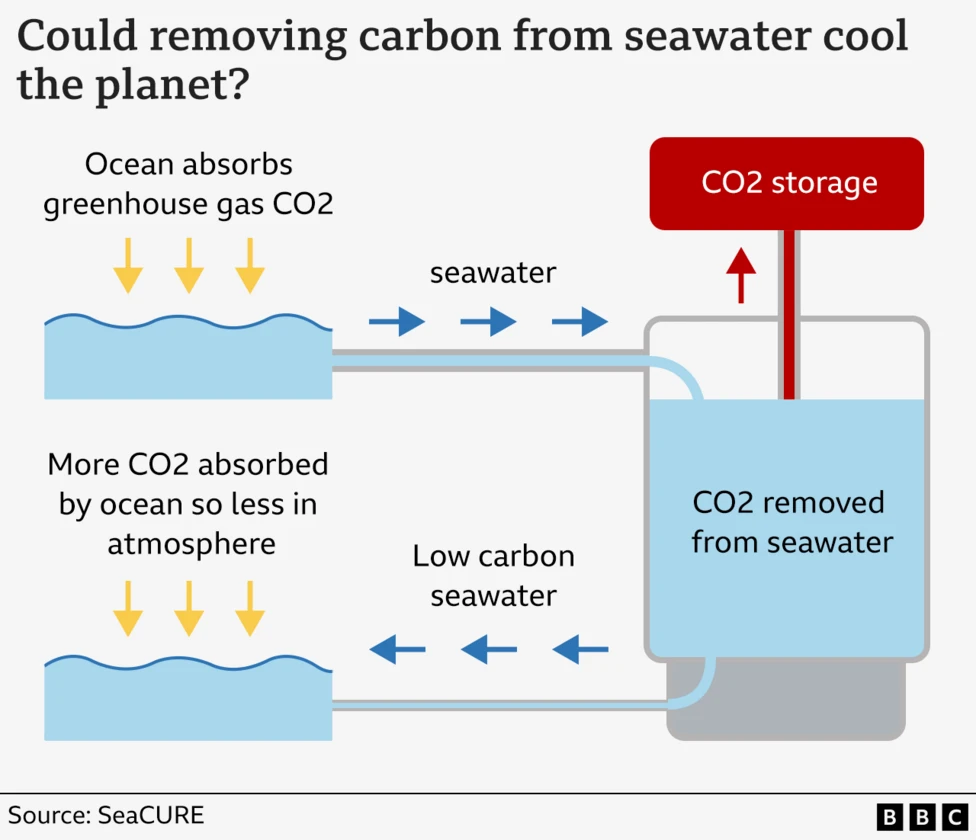
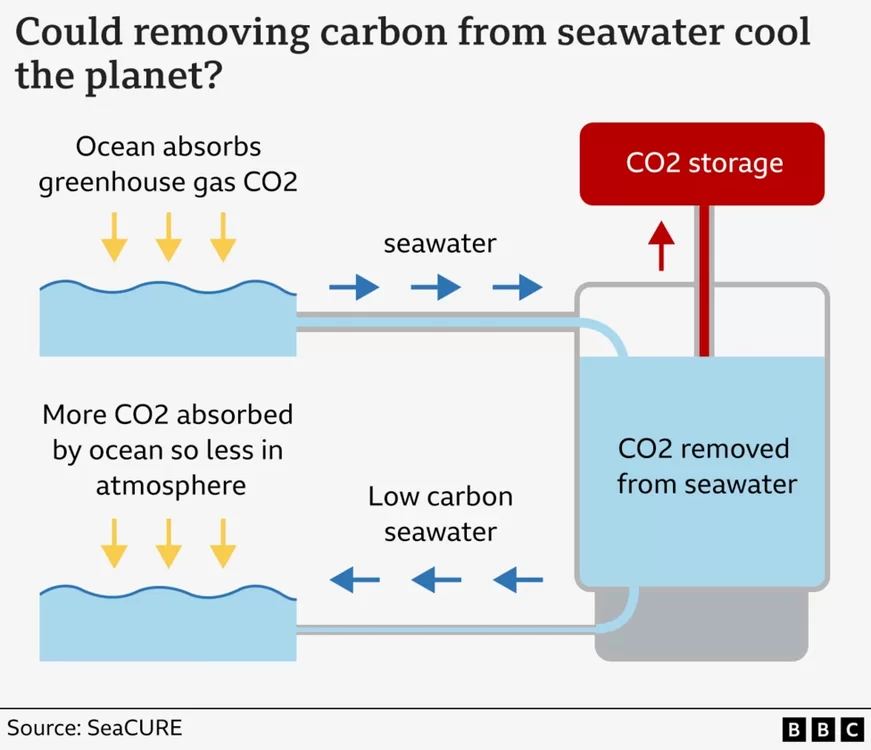
Thank you both, but it is not as simple as that since the oceanic and atmouspheric mechanisms are different. The carbon dioxide molecule has a molecular weight well above the atmouspheric average so the concentration will be greater at lower levels. Oceanic carbon dioxide on the other hand is not part of a gaseous mixture and subject to those laws, it is a dissolved ion, subject to oceanic mixing processes and removal processes. But the fact remains that the question how much seawater (preferably weight) v how much air (weight again) would you have to process to remove x amount of carbon dioxide ? The comparisons of how difficult/costly each would be can be fairly made.
-
You are right, but what a cumbersom rigmarole! Why hide the light under a bushel? Many thanks anyway, +1.
-
I'm glad you used the words 'can be' allowing for the possibility of other ways to define and measure time, although some negative resistance and other non linear oscillators may also present an issue. The problem with this is that this is just where mathematics and physics diverge. Physicists relax condition 2, the positive definiteness requirement, This is the same misconception you showed in the parent thread. Sets do not require a metric. That is optional additional structure.
-
Immediately after the site migration I'm pretty sure I found some inverted commas (as with other forums using this platform/format) which gave me a quote box to insert into. But I can't find it anymore so as noted in the screenshot I have had to create my own . As can be seen there are no inverted commas in the input editor toolbar at the top. Can we have it back please ?

-
I was disappointed with the smart arse responses to my topic as few seem to have read the article properly. In my summary I indicated some of my own reservations about the idea, as the article clearly sufferd journalistic mangling. An important unclear point was the statement QUOTE "Seawater has got loads of carbon in it compared to the air, about 150 times more," says Dr Halloran. ENDQUOTE What does this mean ? how was the figure of 150 arrived at ? It is crucial to the idea, even if other (im) practicalities mitigate against it.
-
Interesting project although the journalists seem to have moved Weymouth some 300 miles west. Also someone seems to have moved the quote function in the input editor as I can't find it anymore I also wonder if there are enough coconut trees in the world to make this a viable large scale project. Sorry I can't post a longer summary , without the quotes. BBC NewsCould taking carbon out of the sea cool down the planet?A pilot project will test whether it is a useful way of fighting climate change.
-
I'm sorry but you haven't clarified anything. You have merely repeated what you have already said before; equating clarification to repetition is not good enough in science and mathematics. For instance you have still not defined your field variable althogh I assume it is unfortunately called tau. I say unfortunate because tau has special meanings in conventional science, none of which accord with what you are trying to say. You talk of differentiating with respect to x but have yet to offer a single example. I take it that you mean xn , where the superscript conventionally refers to the number of axes employed. You talk of fluid flowing and organising and compressing and so on, but do not seem to be offering any differentiation to model these processes. I am not a great follower of trite popsci ditties but here is an apt one to consider. Space is what prevents everything all happening in the same place and time is what prevents everything happening all at once. Without both of these you have a derived function that is exactly zero everywhere and everywhen. As to advocateing divorcing space and time, I have carefully avoided doing this for the above reasons. Finally you introduced the misuse of the term field early in this thread and seem to like taking conventional terms with special meanings and trying to change them to suit yourself. All that serves is to confuse your readers. A new case in point is 'emergent'. Space is no more an emergent ' property of how the fluid organises itself' (as a matter of interest how can a fluid organis itself without space ?) than 7 is emergent from the sum of 3 and 4. My own favourite example explaining emergence works like this Emergence is a happens when the constituents of something interact in a way to produce some new property that none of the constituents by themselves couldmanage. So take a pile of bricks, thrown together at random. Even if some bricks lie on top of one another the resulting pile with not be strong or stable. Yet if these same bricks are stacked in a certain way the stack gains the ability to span large distances of empty space perhaps bearing large loads, and enduring for long perios of time. I am talking about an arch here and 'arching action'. I class arching action as an emergent property of not only the bricks but also their configuration. I note that another member also has a thread trying to establish a variable time axis to work on to explain physics and is running into the same difficulties you will. Perhaps you two ought to get together and talk ?
-
[math]r = \sqrt {\frac{{78.5}}{\pi }} \simeq \sqrt {\frac{{78.5}}{{\sqrt {10} }}} = \sqrt {\frac{{7.85*10}}{{\sqrt {10} }}} = \sqrt {7.85*\sqrt {10} } = 4.98[/math] Yeah, we're getting there +1
-
Your memory is more complete than mine. +1
-
Here is what is worrying me. And you don't seem to have answered my question, about fields. I can't agree with this. Spacetime (due to Minkowski, not Einstein) is not a field by either definition. In Physicists generally take a Field to mean a region (usually of space) to which a value (that may be positive, negative or zero) may be assigned to every point in that region. For example a temperature field is a scalar field that has the structure you want to describe at every point in say a bar of metal or the atmousphere or whatever. Temperature is the (scalar) field variable to which you can assign divergence, gradients and so on. BUT You cannot 'leave out space' as you have put it. Until this point is clarified I don't see how you hypothesis can proceed.
-
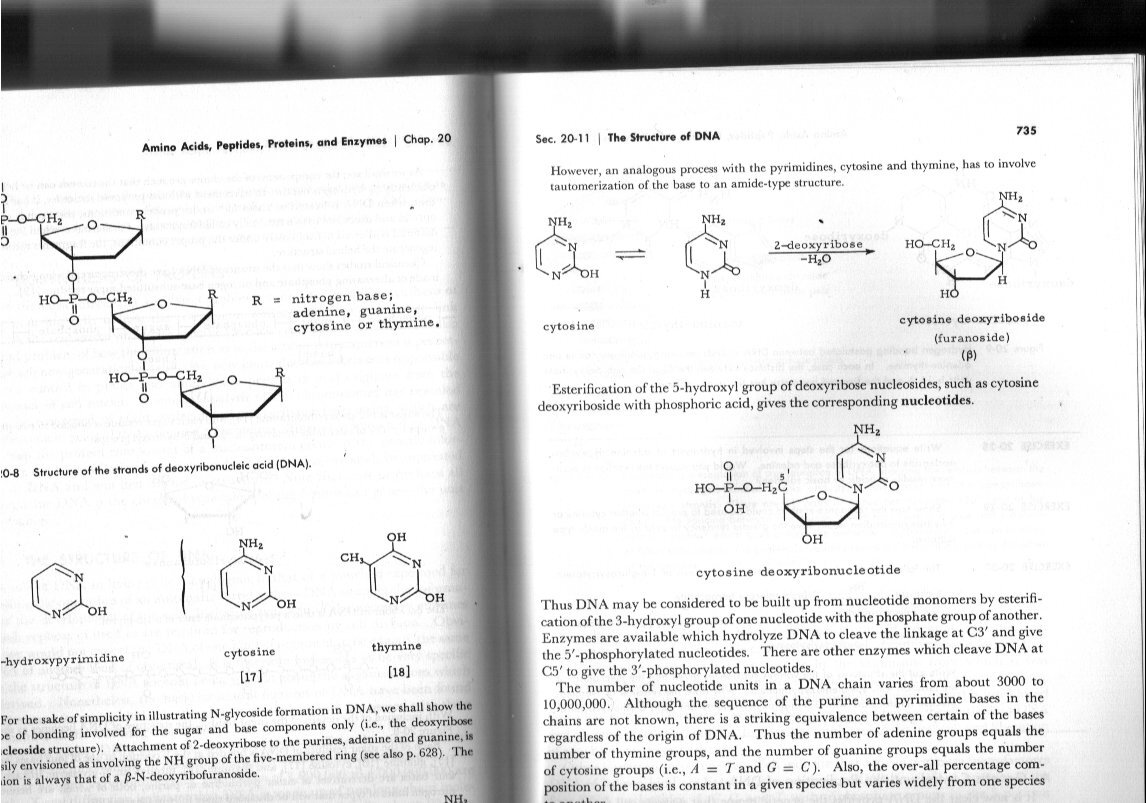
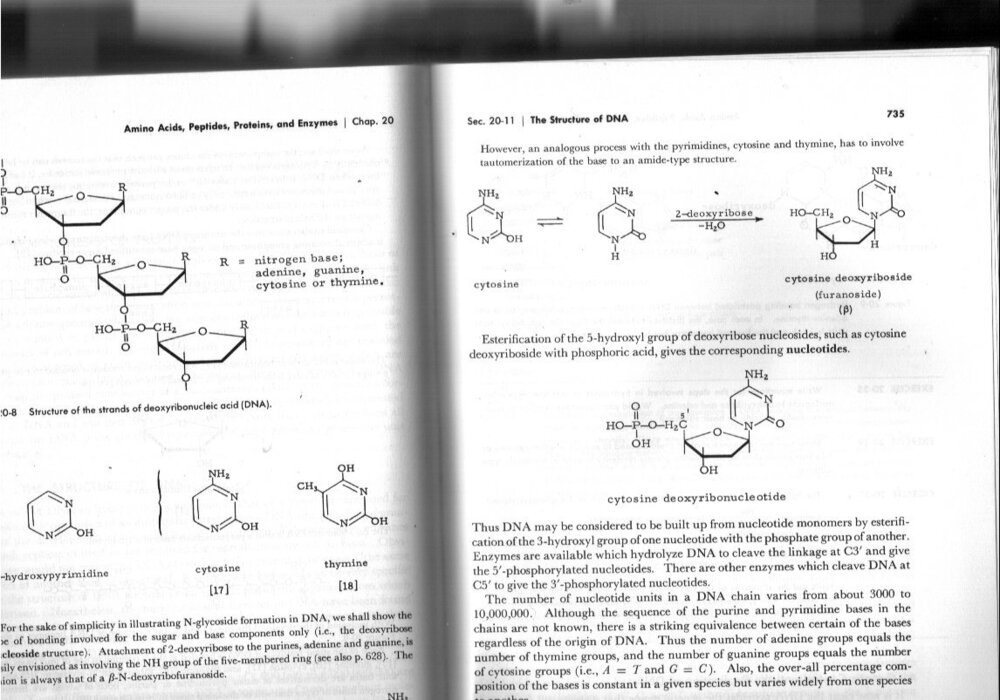
Cytosine has keto and enol forms that rapidly exchange by polytropic tautomerisation. The keto form is the only form shown in the Wiki article.
-
+1