studiot
Senior Members
-
Joined
-
Last visited
Everything posted by studiot
-
Judging by this and your other recent threads you are following some scheme connecting formal logic and maths. Both disciplines suffer from a plethora of notation, this may help. If you wish to contradict someone, my expectation would be to follow the bald negation with a proper mathematical substantiation of your own claim.
-
There has been continued interest in this subject since the days of Cantor and Poincare. Here are a couple of recent papers. One note of interest is confirming that the 1 in the naturals is the same as the 1 in the reals or the integers for those who widh to be strictly pedantic. Realnum_RMJ-2015-45-3-737.pdf acampo-real.pdf
-
Yes all constructions of R are isomorphic, I think at the current count there are more than 10 different ones. The only real issue about this is do you include the number zero in the naturals ? I don't see the downvote as justified, so I have added a balancing +1
-
There's nothing transient about a whip antenna transmitting or receiving CW. I think you have misunderstood my intentions anyway. The OP has admitted that the circuit as show serves no useful purpose, and it is also unclear whether the resistors R1 and R2 are the battery internal series resistors or not. Either way the three resistors are the only way power can be dissipated by this circuit, ideal voltage sources dissipate zero power. Therefore the input power must equal the resistive dissipation in the three resistors and his defining equation is a figment. I have tried to widen the discussion to something that comes a little closer to the real world, by discussing load lines. The configuration is actually very important in the electrical power industry where it appears as the parallel connection of generators. When the sources are alternating there are phase and other changes to consider. Further Sherwood's description of the circuit he shows specifically states that Kirchoff is not obeyed at switchon, and explains why. Equally you say that Kirchoff's laws are obeyed at every point. A small issue here as one is a loop law, not a point law,
-
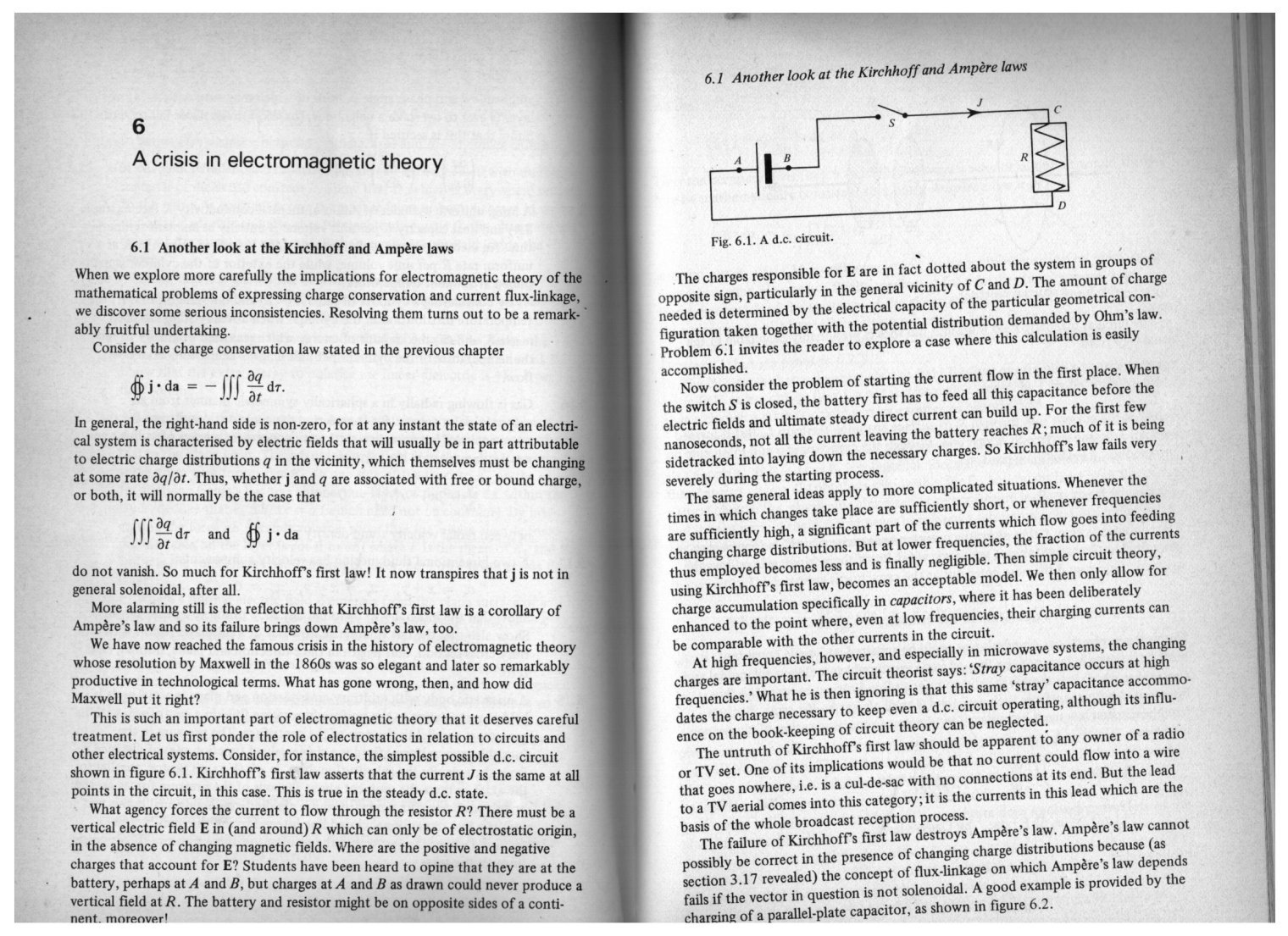
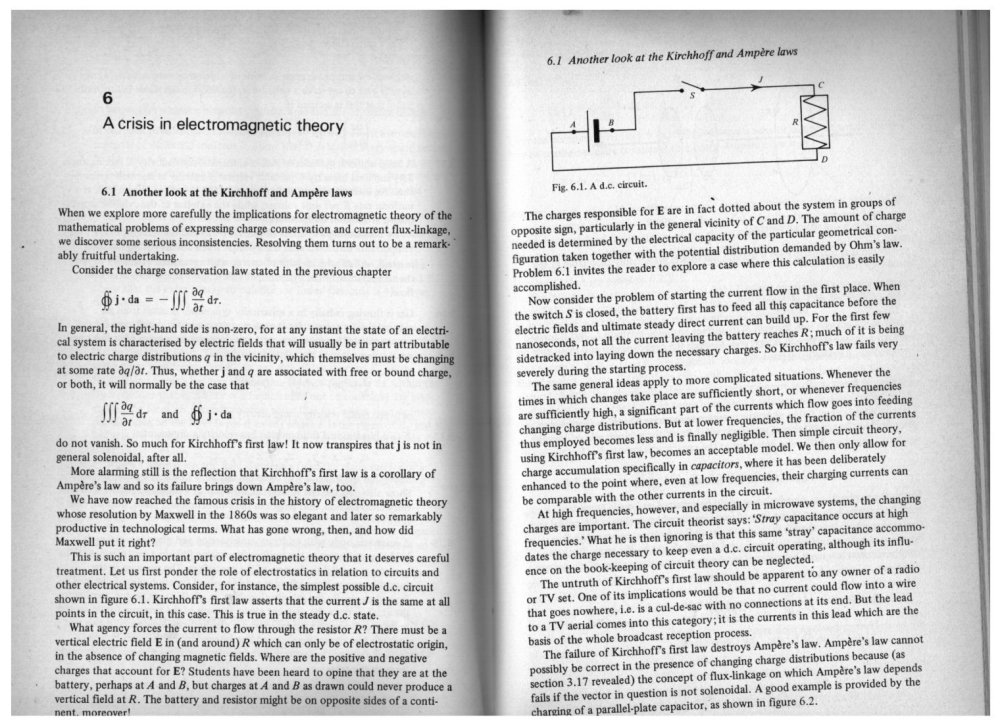
Kirchoff's laws are a very convenient fiction in a similar way to centrifugal force and other imaginary forces such as such as virtual work. They work in the right circumstances, in that they produce the same answer as calculations with models more aligned to physical reality. Here is a short extract from the late Professor Shercliff's excellent book 'Vector Fields' - Cambridge University Press. J A Shercliff was Dean of Engineering and Applied Maths at Warwick, after leafing a distinguished early career in Magento Hydro Dynamics at Cambridge, Oxford and the UKEA Sorry for the integrals, j is current and q is charge.
-
I asked you three questions but you only answered one of them. I asked all three for good reasons, because it is no use being clever with maths if you are either using the wrong model or do not properly understand the 'correct' model. That is why I asked if this is electrical engineering or mathematical modelling. It should be remembered that the electrical symbols you have employed refer to perfect or ideal components. So both voltage sources are ideal. Do you understand the significance of that ? Equally all three resistors are ideal. But what do you imagine R1 (10 ohms) , and R2 (20ohms) actually are ? An electrical engineer would immediately say they are the internal series resistances of real world sources. This makes a difference to how the circuit and the model operate. I also asked why would anyone connect two batteries like this. Well they wouldn't because neither 5 volt nor 10 volt batteries actually exist. But here is a real world electrical engineering situation where one might. We have a nominal 1.5 volt battery that is somewhat discharged to 1.4 volts and we wish to boost its performance by adding in parallel a smaller but fresh 1.5 cell we have in the cupboard. The resultant voltage will never reach 1.5 volts but will be greater than 1.4 volts, which may be sufficient for our purposes. For calculation purposes assume the larger, but discharged battery has an internal resistance of 0.1 ohms and the smaller fresh battery has an internal resistance of 0.2 ohms. Such a parallel combination of batteries would then be used to supply a load RL which would be R3 (30 ohms) in your model circuit. At this point I owe you an apology since I misread you initial post that sought a nonlinear programming approach and thought you meant a linear programming solution. In point of fact an electrical engineer could perform a linear programming exercise on my battery problem, based on load lines which in this case are indeed straight lines. By drawing or calculating a load line for each battery, a load line for the parallel combination can be deduced to find the terminal voltage and thus the currents flowing in the loops. It is necessary to understand the action of an ideal voltage source and the concept of its terminal voltage. Addendum You should be very wary of Kirchoff's Laws are they are actually a rather convenient fiction. This was known as the famous crisis in the history of electromagnetic theory and was resolved in Maxwell in the 1860s. Consider a single wire that is not connected in one end and explain why Kirchoff predicts that zero current can flow into and out of this wire. For without such current radio transmission would simply not work.
-
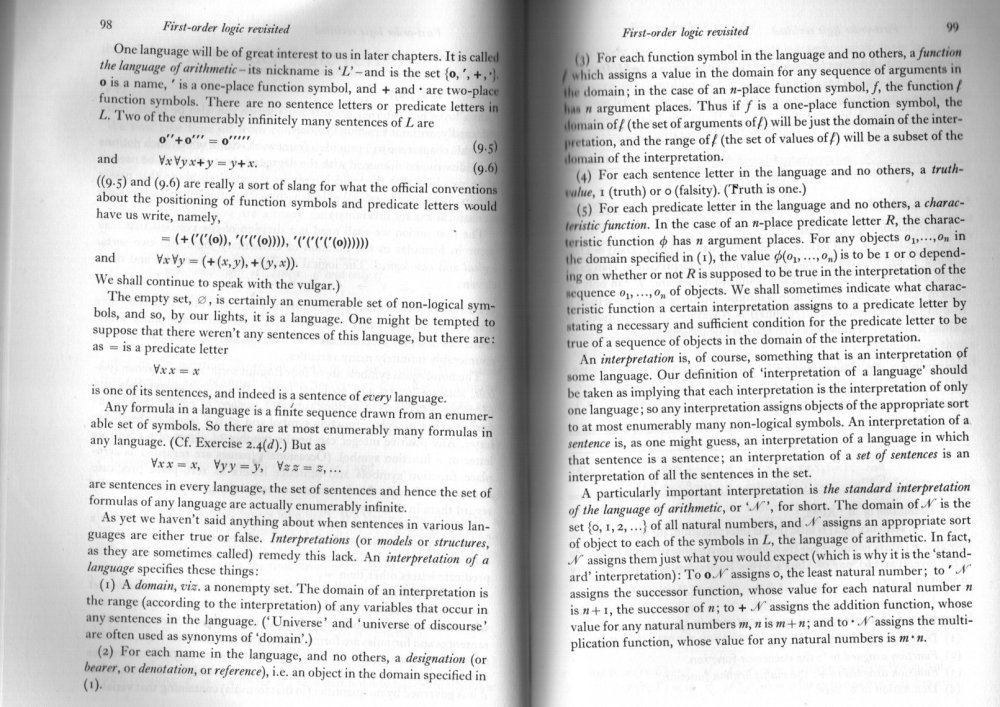
There is of course a perfectly satisfactory way of defining multiplication as the result of repeated addition, if subtraction is also allowed. What is more difficult to get round is multip[lication by a fraction. The completion or lack of it of the operation also dependes upon the domain you are working in. Addition is complete in the natural numbers, but subtraction is only compete in the integers. In any axiomatic system axioms are used to deduce or prove theorems. It may be posssible to substitute some or all theorems for axioms, so providing an different but equivalent set.
-
Surely this statement cannot be right. Say there are G axioms and axiom G is found to be provable from the other axioms A to F. Unless the proof of G is independent of one or more axioms, say B, how does this lead to an inconsistent set ?
-
If you want ordered pairs, you need the Cartesin product a A with itself. The pairing subsets in the product space then provide one way to define a relation.
-
You will also find Tare in many places today for instance on modern digitql scales. When making bread I put the mixing bowl on the scales and press the Tare function to 'zero things before adding the ingredients.
-
The for all is a problem, the for all physical even more so. Can two physical things occupy exactly the same space ? Is orientation important important ? Say I have two allegedly identical mirrors and I stand them side by side, one with the mirror face towards me the other with its back to me. If I shine a torch on them I will observe two totally different responses to my light.
-
This must surely depend upon your definition of identical ? I suggest the best way to approach this situation is a pragmatic one, like the definition of a point particle. "Identical for my specified purposes"
-
Yes I understand you can indeed light farts. There was also that Frenchman who could fart in tune. https://en.wikipedia.org/wiki/Le_P%C3%A9tomane
-
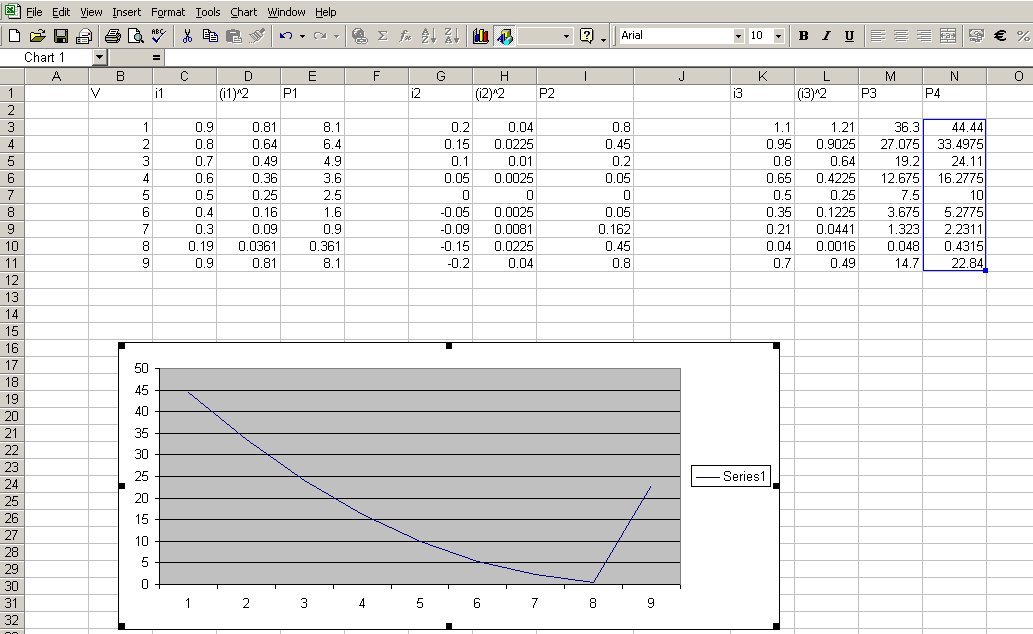
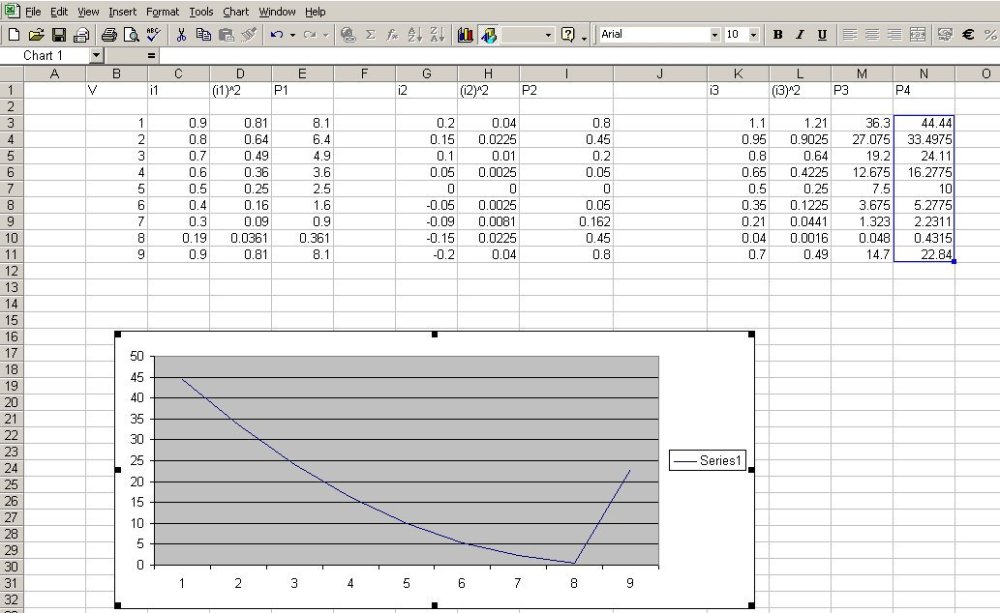
I agree with those currents, but here's the thing. The lead to a voltage at the junction of the 3 resistors of just over 6.8 volts. I am not sure if you are studying maths or electrical engineering ? But why would anyone connect up two batteries as your 'model' has shown ? What do you know about your model ? I am not at all convinced that your 'lazy' objective function correctly identifes the minimum heat dissipation in the three resistors. The actual values of the three currents varies with the voltage at the triple junction. I have prepared an Excel spreadsheet of the currents for each of the possible voltages 1 through 9 and plotted the result to find a minimum total power at just over 8 volts (not 6,8 as you have). These were calculated using the correct power formulae without fiddle factors.
-
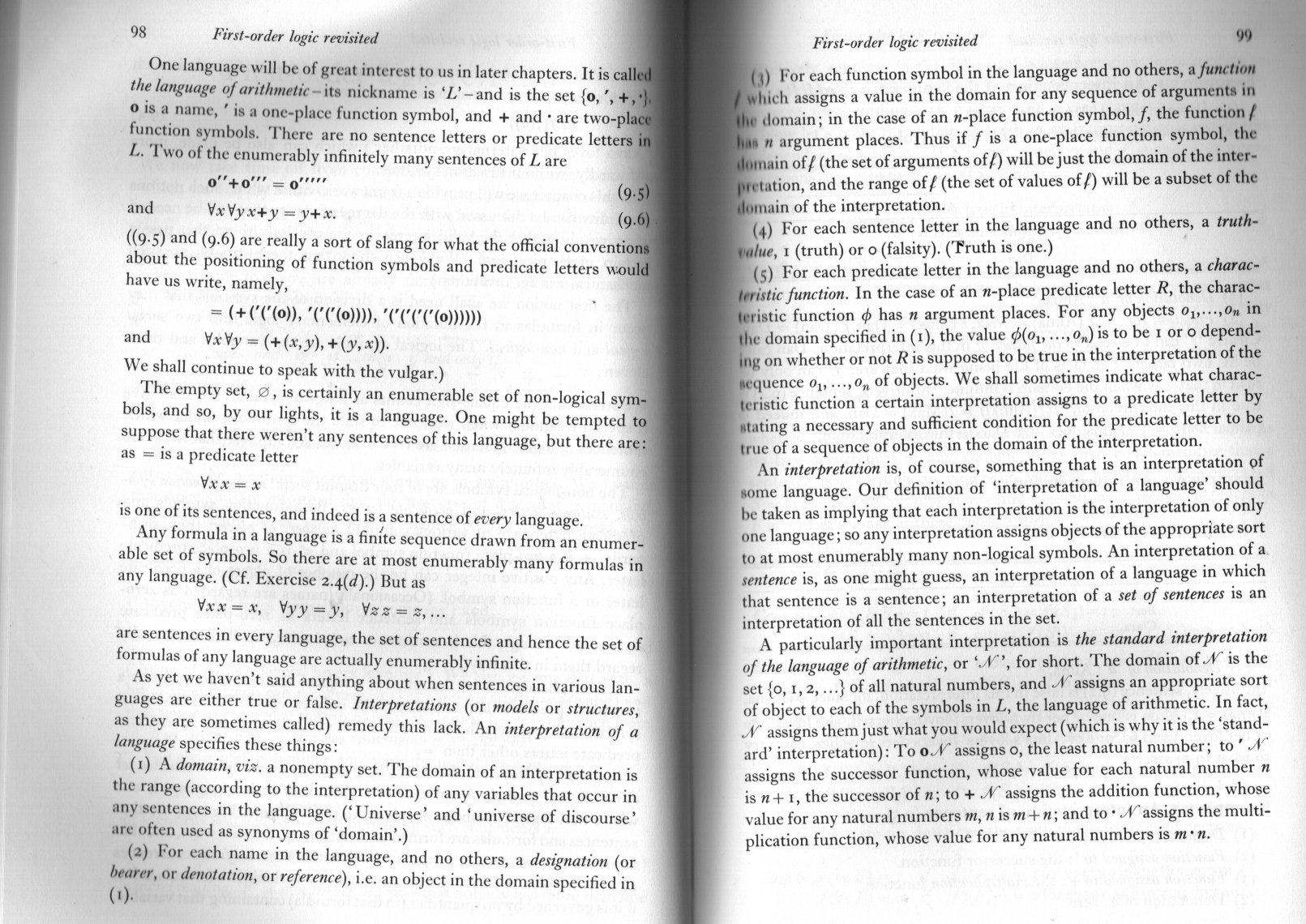
I don't understand why this question is being set in a recreational thread ? This has led to repeated requests for clarification. It is just too vague The actual answer will depend upon your formulation since some axioms/definitions/properties may be inherited. If it is really about the Peano system, which is first order logic, then peano arithmetic with only addition is Godel decidable; peano arithmetic with both addition and multiplication is undecidable. Peano axioms also refer to axioms for the construction of the natural numbers, as opposed to their arithmetic. Good discussion of these mathematical matters can be found in Computability and Logic Boolos and Jeffrey Cambridge University Press Readings in the Philosophy of Science Feigl and Brodbeck Appleton-Century-Crofts New York
-
Whilst I agree that energy considerations will produce solvable solutions via the shakedown theorem, I don't agree with your energy loss formula. Energy is not 1/2 resistance times current squared. Power is resistance times current squared , not one half of that, Energy is power times time.
-
Don't let mine get together with yours then.

-
OK so since 1990. But note the Gogle AI then contradicts itself with the second sentence about the UK. Looking quickly in post 1990 textbooks Edexel in 2000 (High School advanced Level) had the ph spelling MCQs in Pharmaceutical Calculation (pharmacists professional exam) had ph for sulphur but the f spelling for sulfathiazole. Most post 200 pharmacy books prefer the f spelling. So I expect the amercanisation of English to continue, considering the great resource imbalance. Mine is a 1966 reprint.
-
Glad to be of service.
-
To quote from the preface of the book Many of the important calculations in applied maths (engineering and physics) use functional analysis because engineers and scientists want numbers and statistics. Functionals are maps from diverse domains to some field, usually the real numbers. A good example is the definite integral, another is the time integral of the lagrangian (also called the action or the action integral). There are also many examples of everyday functionals in statistics, typically the mean and variance of a distribution is a functional. There is also the 'energy functional'. Indeed you can find functionals pretty well anywhere and everywhere you apply mathematics.
-
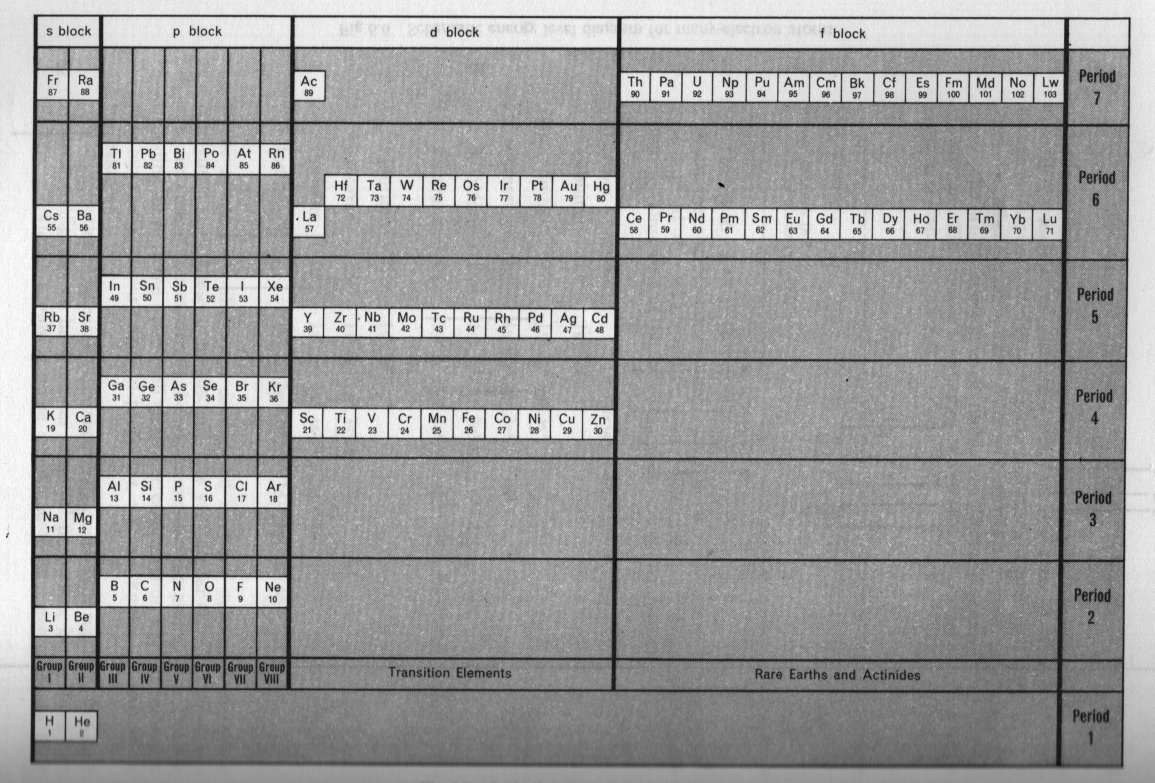
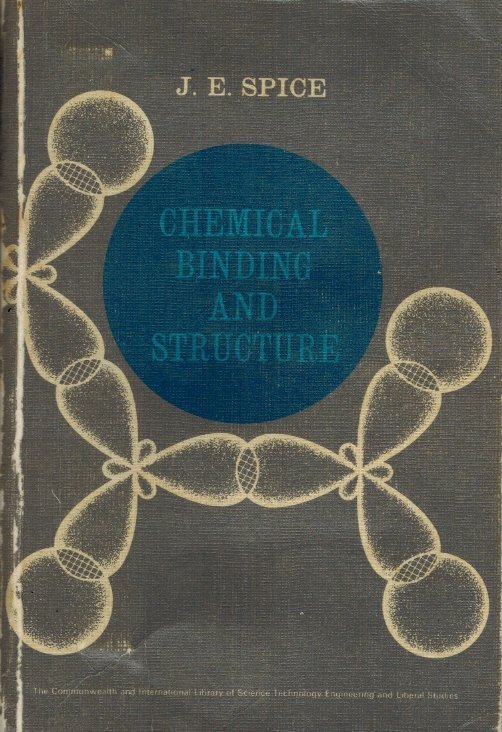
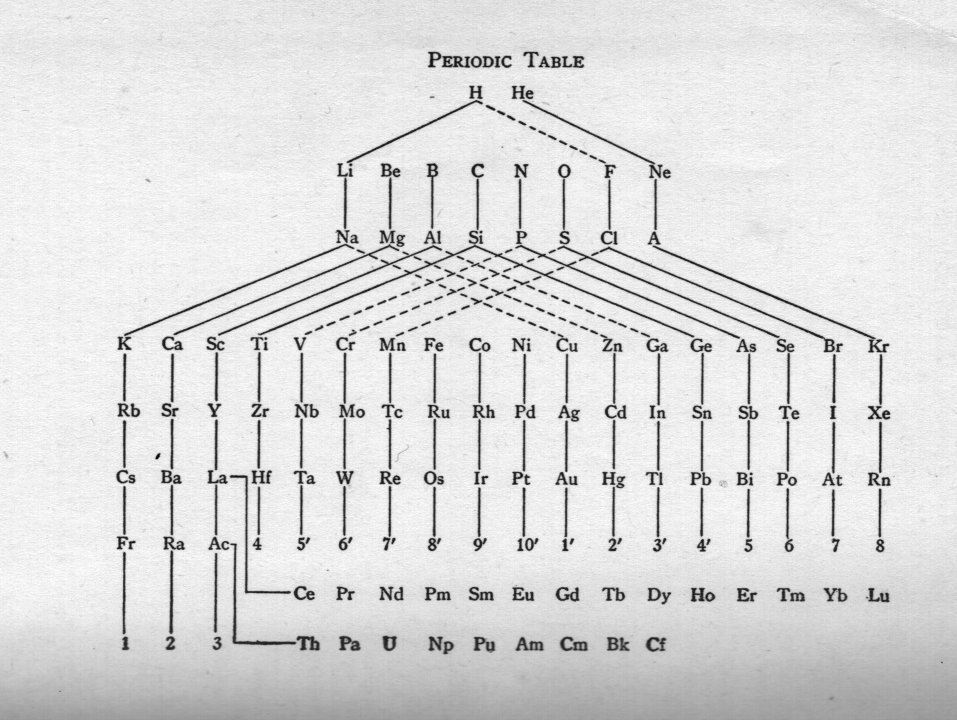
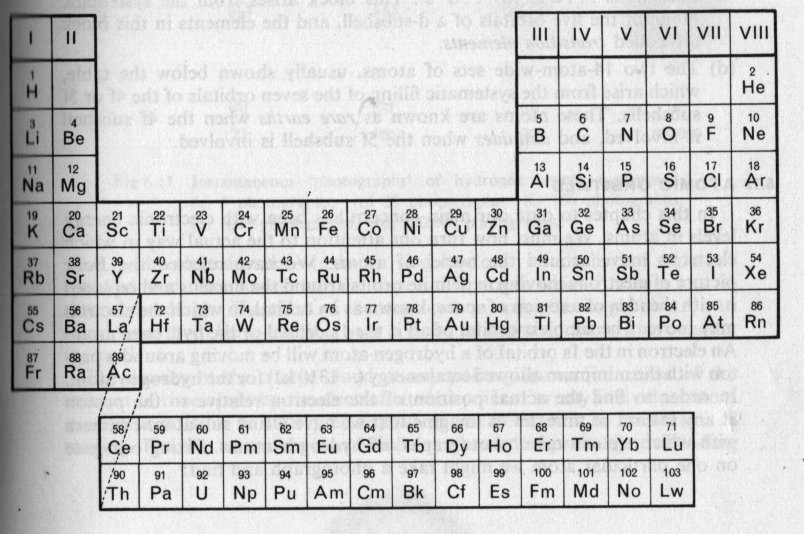
From much much battered copy of Spice (my second copy. ( It was so good I had the first one stolen from me). Sulphur is UK spelling, Sulfur is US. The americans have simplified quite few technical words. I'm sorry we didn't 'learn the table' , as some schools. Cambridge board never set any exam questions about the table itself in my day, only about the information it contained. The point being that you have to know a lot of the information for the table to assume real significance. The standard channel shaped long table was developed by about the 1920s. After this a single 'hanging' lanthanide line was introduced, followed by the double line in 1940. There are lots more in-between tables for those interested.
-
You mean this one ? Yes Professor K has written some excellent applied maths books, I remember preferring his book to the course set book at first year university, back in the 1960s.

-
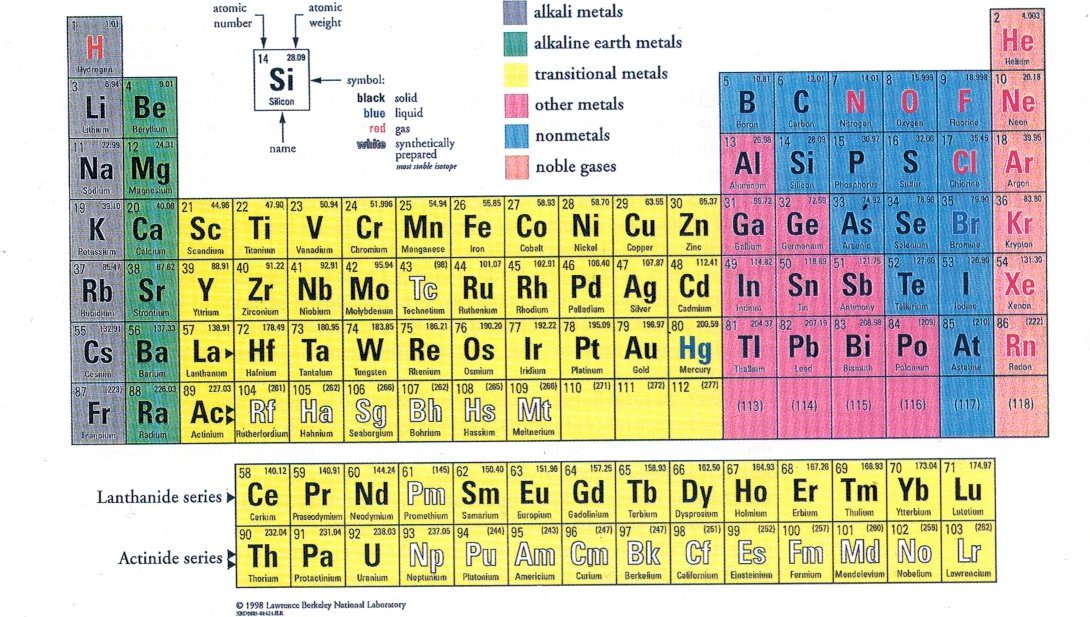
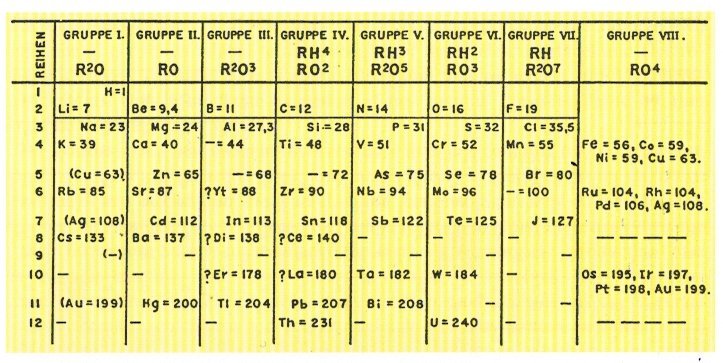
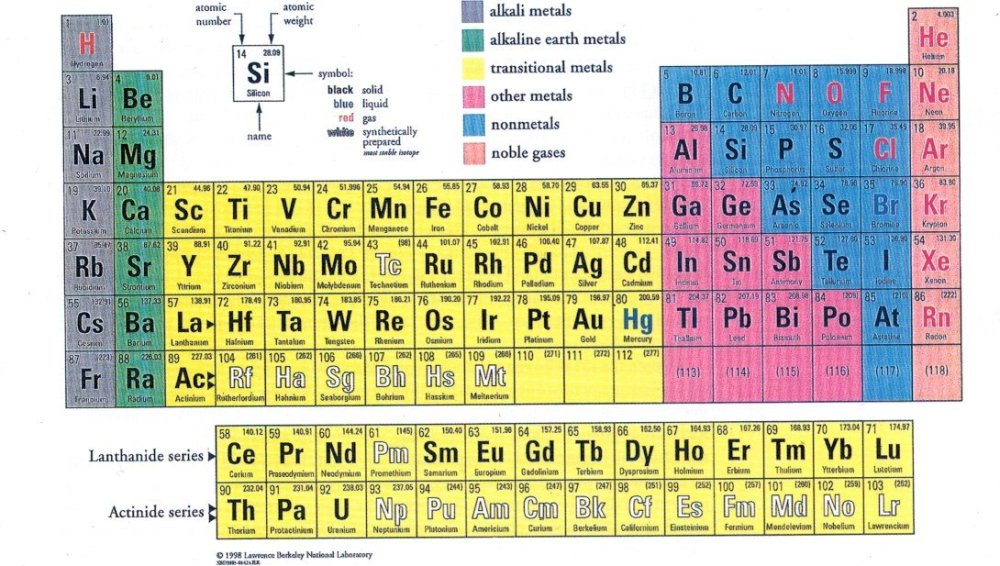
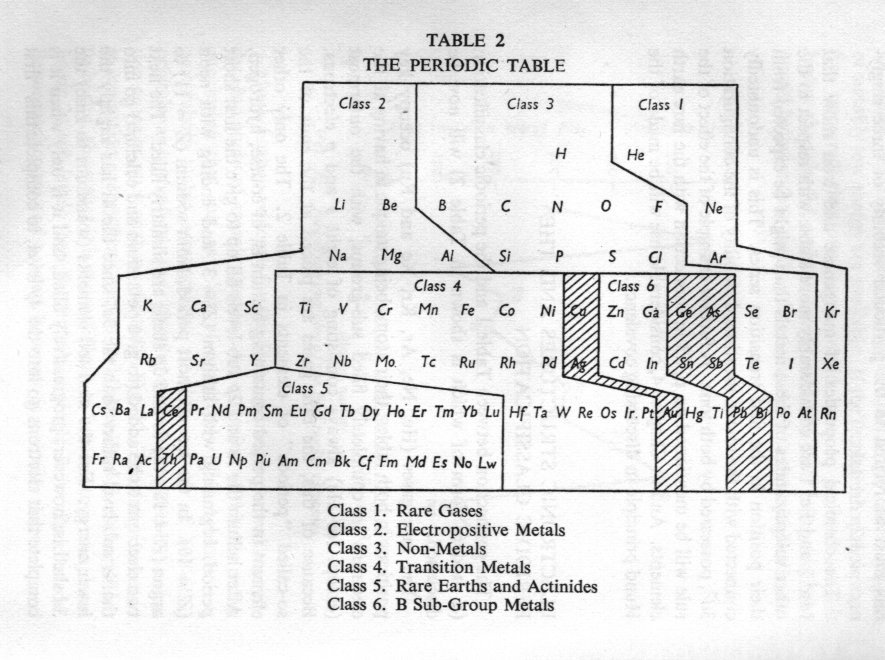
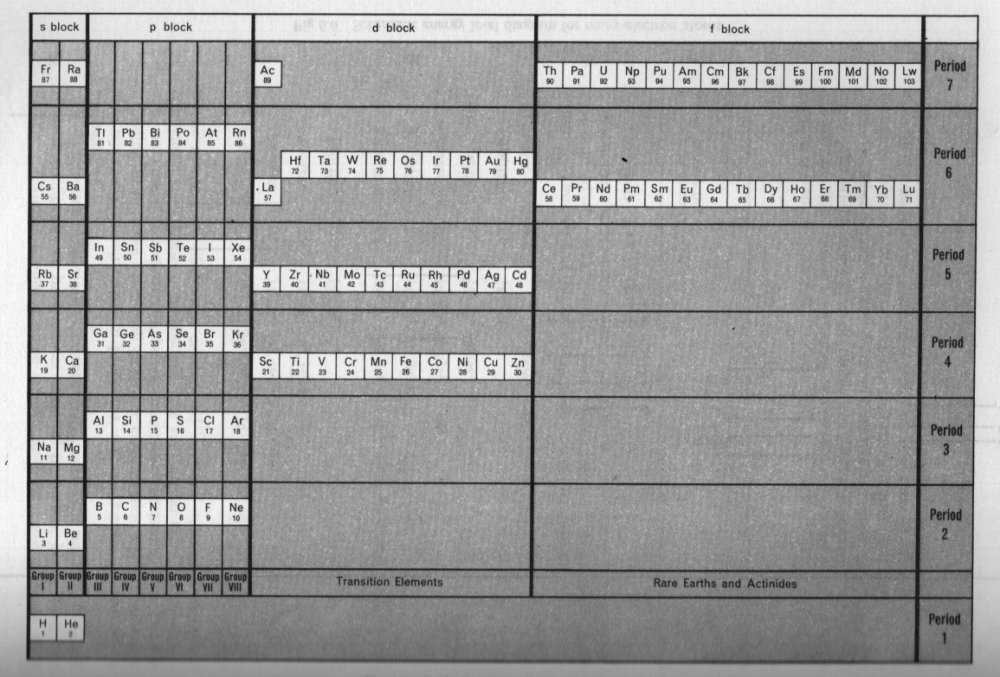
It is a common misconception that there is one 'periodic table' that can be presented in several different forms. But in fact the situation is more complicated than this Yes indeed it does depend upon 'which table' you look at, so let us look at how this situation has arisen. So what is the periodic table and what is a period ? Early chemists discovered that the 'indivisible elements' could be listed in small groups with similar properies. The main distinguishing property they could measure back then was atomic weight, so they listed the elements by AW. Mendeleyev was the first to notice that it was more than just collections, he noticed a regularity in the occurence in the more interesting (to the chemists) regularity in those lists, even though there were some anomalies in place on the list. This is the table he published in 1869. The' periods' go across the table, left to right. And the groups (Gruppe) are tabulated vertically. You can see he was a bit mixed up about group 4. But the real question was and still is "Which properties to you use to generate the categories ?" The problem being that different categories will include or exclude different elements, although listing in order of atomic number moved several misplaced elements into a more coherent pattern. This straightforward listing led to the form you are probably thinking of known as the 'long form' This form has the advantage that atomic number indexes every element and can be presented in a reasonably compact form. But Chemistry is about a whole lot more than atomic weight and atomic number - that is really for physicists. Chemistry is about acids and alkalies, metals and non metals, chemical reactions and most particularly electrons and their role. Considering electrons we arrive at 4 groups and 7 periods, which tells us where all the electrons are This information can also be displayed in other ways and I am guessing that you have looked at one of these. Finally a very modern version of the long table showing a few extra properties eg metal/non metal.
-
Since it is too difficult for idiots like me to understand why a missing electron is a wave of any sort I would be grateful if geniuses like yourself would explain in simple words that I can understand.
-
Thank you for your reply and the negative point. Since I am guessing that English is not your first language I can see why you have failed to understand my opening post and subsequent replies. Yes I agree that if you are correct that there is no duality (in reality) none of my examples represent duality. But then you failed to understand that they were all examples for discussion, to stimulate the idea that there may be more than one type of duality. You also failed to take into account that I said it depends upon circumstance. So it is true that concrete is very very weak in tension, but very very strong in compression. So it is weak in some circumstances, but strong in others. That is why we use reinforced concrete. You would certainly fail a chemistry exam if you claim that aluminium cannot act as either an alkali or an acid depending upon circumstance (ph in this case) That is how you can get the substances aluminium sulphate and calcium aluminate. That is reality, but is it duality ? I find your statement that a hole (in electronics) is a wave quite interesting. Especially as a hole is the absence of something, because something is missing. So what is this wave made of ? No duality in reality ? Children in school use a pair of compasses to plot or draw a circle as a trajectory of points a fixed distance from a centre. But in some schools they also construct a circle by 'curve stitching'. That is they plot those points by stretching threads along tangents to that same circle. In fact they are laying the groundwork to one day understand dual spaces in mathematics.