studiot
Senior Members
-
Joined
-
Last visited
Everything posted by studiot
-
A world of caution about politics , journalism and statistics. In the UK, reporting 'Energy' statistics or making policy decisions about them is a variable beast. For some years 'Energy' usage has been measured here by gas consumption, sometime domestic only, sometimes commercial, sometimes both. Both fuel oils and electricity consumption were ignored. Policy rebates such as the winter fuel payment were based on gas consumption statistics. The recent announcement of our wonderful (!*! ?) new prime minister that he was cutting energy bills by removing some tax on 'Energy', refers to electricity bills only. So which 'Energy Requirement' is the OP referring to ?
-
There, and here is me thinking that D'Alembert's Paradox is just an artifact of oversimplification, that actually yields acceptable results in certain (quite many) cases. But I hope you will agree with me that there is no such thing as an actual point load - it is an idealisation. Yet we apply vector mechanics to them all the time.
-
I hoped I had provided enough information to explain what I meant about the effect of the impact. If you want more detail please say and I will be happy to oblige. As regards vulcanism, this was nothing new at that time. The Deccan traps eruptions started before Chicxulub and lasted three quarters of a million years, whilst the impact lasted a few hours. Yes I think the Deccan was the second largest known system of volcanic eruptions, the largest being the Siberian traps nearly 200 million years earlier, which last a couple of million years. But also I expect you are aware that human seismology detects activity, on the other side of the world, even from human sized explosions. https://www.science.org/doi/10.1126/science.aau2422
-
Yes I'm inclined to support this view. Something that is pretty important to Science in general is the way we knowingly use false models, because they give the right answer. Examples would be Maxwell's mesh currents, Imaginary forces, simplified equations and so on. Is D'Alembert's Paradox a truth a fact or an artifact ?
-
You don't need to be an expert to understand that the impact wasn't powerful enough have a very big effect on the larger body of the Earth (as a body) , although the effect on life more generally was obviously immense. The evidence for this is that the Earth was not shifted appreciably from its orbit, its spin was almost unaffected, it did not flip or shift spin axis appreciably. It should also be noted that, although by far the largest factor in the extinction, there was also an accumulation over time of other important factors, unrelated to the impact.
-
I have too much respect for you to want to sound pernickety. What I am doing is sounding a note of caution about oversimplification and the theoretical physicist's habit (pun intended) of packing too much into too few terms, leading to the danger of circular arguments. For instance the term 'states' by itself is not as detailed and precise as the original thermodynamic definition of 'state'. For QM only energy is considered, but then you need a definition of energy, invoking the danger of circular arguments. Considering Relativity v Navier Stokes. By not including compressibility and viscosity variables you will arrive at the conclusion that there is zero force on a circular object in a flow. Physicists would love to drop the Lambda term in the GR packed equation, for the sake of 'elegance', which is a similar mistake (in my opinion). [math]{G_{\mu \nu }} + \Lambda {g_{\mu \nu }} = \frac{{8\pi G}}{{{c^4}}}{T_{\mu \nu }}[/math]
-
I do think the underlined is an unfortunate example since the word bachelor has (had) several meaning; the original one having nothing to do with marital status. Your point about certainty is on better mathematical ground as one of the meanings of a probability of 1.
-
One mathematical comment here. Just because two different physical systems obey the same mathematical equation(s) or structure over some or all part of their range does not mean they are the same. Mathematical analogues are very useful and it is remarkable how few equations we make do with. How many different physical systems obey Laplace' equation for instance ? We are in danger of falsely conflating such systems in the case of entropy, just because we can identify similar structures incompletely different physical systems. Other aspects of each such system may not be so similar.
-
You guys might like to explore this website, which is also the website associated with the book I reviewed in the lounge. Emergence is a particular topic The Material World - Physics Fixes All the FactsComplex systems seem to magically emerge from the interactions of their parts. A whirlpool emerges from water molecules. A living cell from organic molecules. You emerge from the cells of your body Markus mentions Navier Stokes. A word of caution here. In the 19th cent Messers Navier and Stokes constructed their equation to include all known contributory variables, which is why it is so difficult to solve. In the 20th cent Messers Black and Scholes thought they would do the same with economic systems. Unfortunately they did not do such a thorough job, which is why computer implementations of their equation caused the instability and stock market crash of 2008. We should beware of what we wish for when declaring emergence, we might well find something quite different from what we expect.
-
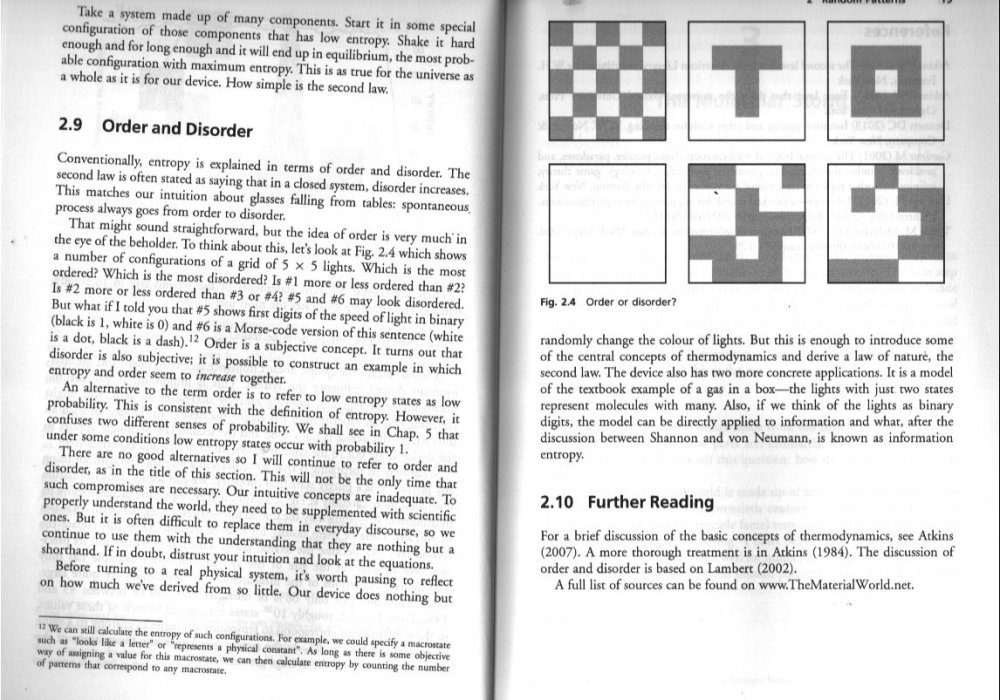
It is not often you see a book at his level from Springer Verlaag, but they have an up market reputation as publishers. I recommend Molecular Storms (2023) as good background (almost) non mathematical reading with many insights. It is physically well put together on decent paper with many colour diagrams and written by a professional Physicist with modern ideas. In particular it explores many of the subjects that have been discussed recently at SF. Entropy, Emergence, randomness, the origin of Life, the role of time, cosmology the physics of biochemistry and and more. Every Chapter has good modern references at the end. Here is a scan of an introduction to order and disorder. Note the novel approach.
-
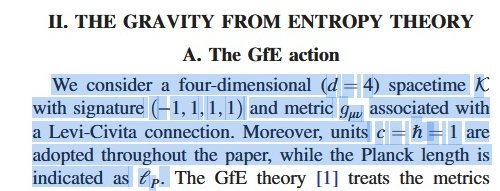
Thank you Markus for bringing this paper to our attention. It must have taken several years to work all this out, so it will take that much again to work through it with the thoroughness it seems to merit. Bianconi seems to have presented his working properly, with well defined mostly conventional symbolism, that makes things so much easier for the reader. However I am always suspicious of circular arguments when I see this sort of thing. The attempt to constrain the premises to, IMHO, too few variables. We recently had a couple of long threads involving this.
-
I disagree that the range as stated is a fact. Both responses help demonstrate the many ways something can be expressed, all with subtly different meanings. I don't think MigL's version is specific enough to be a fact since we have not measured the weight of every ringed plover, nor is it inconceivable that a particularly heavy or starved bird might turn up. If we said "It is a fact that 3 lies between 2 and 4" that would qualify as a fact. But the weight of plovers is the truth a far as we known it. The actual figures came from Google AI by the way so should we trust that ? So long as you are careful enough in specify that information as noted above. Equally you can note that some statement is you best estimate, rather than saying "I believe it to be true " as that allows the possibility that you may be wrong. Using this phraseolgy also removes the need for binary choices.
-
Very clear distinction drawn there. +1 No how about this for a clear difference between truth and fact? It is the truth that the weight of an adult ringed plover lies somewhere between 55 and 75 grammes. It is a fact that this specific adult ringed plover weighs 62.3 grammes. Facts are specific, truths may be more loosely described.
-
Google AI is good here Google "download via usb to huawei P" getting spelling right"
-
Consider this: It is a fact that I have a book in my library entitled Organic Chemistry. I expect it to be the truth for exchemist , sethoflagos, charony and others. It may be the truth that their books are the same as mine. But my book is by McMurry, yet theirs may be by another author. Even if their book is by McMurry it still may not be the same as mine since mine is the fourth edition. Even if theirs is the same edition, they books may not be considered the same, just two copies of the one book. So I think one reason to have different words is to be able to express different concepts, both separately and in combination.
-
Not sure if the moisture in the still is drawn out of the ground by the heath robinson greenhouse into the air, where it then condenses again and runs down inside the device to the collector.
-
Excellent question, sorry I don't know the answer, but that is the whole point of a discussion. +1 In regards of the the Maths comment, I agree this is very disconcerting as I discovered many years ago as a pupil. It springs out of the need to learn in what I call a spiral approach and occurs in many disciplines. We have to start somewhere and as we gain knowledge and progress simple versions of the topic are often presented. The trouble comes when the teacher tries to drive a point home by being too adamant, even to the point of cutting short a brighter pupil who asks questions. Another good example of this occurs in elementary Physics. A vector is a quantity with magnitude and direction, right ? Well not quite since the zero vector has no direction, but how many teachers present this last fact. This is being discussed in this thread about AI, where @CharonY is arguing strongly that AIs do not make good teachers. It takes a good teacher to strike the right balance between pedantry and future progress.
-
Is this a more sophisticated version of the 'Desert Still' ?
-
Don't be sorry, I'm happy to explain. But tell me is there a language barrier ? - Are we communicating through a translator ? I chose those three subjects because of their link to symmetry and design. Here is an introduction to the wonderful book about symmetry by a professor of Mathematics who went to the Alhambra to study symmetry in Islamic art and then wrote this book. You see I could have chosen many different combinations of subjects, all related by the patterns of symmetry. The point about the Alhambra is that in my history at school we spent a term studying medieval Church architecture and the many types of (symmetric) arches they built. Obviously we also learned other stuff and a bit about the wars of the time. But the Physics of why they built the structures they did and the maths of how the Romans knew where to start the arch supports for their aqueducts and viaducts tie things together.
-
Thank you both for enquiring more deeply into the subject, yet showing much common sense. True or truth is also extensively used in Science and Engineering to mean 'correct or fitting or some other specialist meaning', often echoing Seth's Germanic derivation. Carpenters and mechanical engineers have a true angle, (meaning a right angle) a true cut , a true and they test edges and surfaces for truth (straightness or flatness). Draftsmen, surveyors have a true section (meaning both axes are at the same scale) and true to scale. None of these truths are facts.
-
I have no idea how this is connected to my post. Please explain. Why does everyone seem to think History is only about battles ?
-
No I don't think that will help tie things together at all. What was wrong with the example I gave ?
-
Of course, but academics pride themselves in their alleged thinking superiority. the example I gave is excellent because it (can) study the same subject from three different viewpoints, linking them together.
-
Well think this is a jolly good idea. +1 But,as swansont says, the cross fertilisation needs to be sensible. The UK has a long tradition of forcing 'liberal studies' on STEM students.But Art, and History and Geometry can very easily fertilise each other.
-
That does not allow for the acknowledgement 'I don't know' something but I know it has a value'. If you believe something you consider it true or a fact. In fact (!) are therefore not absolute or immutable. We do since that value conforms to many possible formulae. However we can't know the exact momentum of a particular particle at a particular point. Actually this is very close to my point, that no one seems interested in, about a difference between truth and fact. The word fact is not standalone; it is meaningless by itself it has to refer to something else containing the substance of the fact. Truth on the other hand can indeed be a subject. Consider 'Truth is a virtue' has meaning, but 'Fact is a virtue' does not.