studiot
Senior Members
-
Joined
-
Last visited
-
Currently
Viewing Topic: Open AI claims to have solved Navier-Stokes puzzle
Everything posted by studiot
-
Like the analogy. +1 Remember the end of Fahrenheit 451 ?
-
+1 😀
-
Only 2 ? In a country the size of a continent!
-
Gosh you get up early, but this last post is really good (+1) as it pinpoints your misunderstanding nicely. You may remember back to school where you learned about 'relative velocity', velocity parallelograms, velocity triangles and the like. But all velocity is relative (to something). Velocity on its own is meaningless. The school stuff relied on a background earth that wasn't 'going anywhere'. Fast forward to einstinian relativity. This has the same thing. In Einsteins day the fastest known artificial things were trains, so it is no surprise that the background was taken as the tracks. We now call this 'The Laboratory Frame@ Note I have slipped in the use of the word Frame. But we say that everything is stationary in its own frame, meaning that the relative velocity of any body to itself is zero. Looking forward a bit here is a question. Two spaceships are approaching each other, one at 0.1c and the other at 0.8c. What is their closing velocity or relative velocity? Can you see what is wrong with this question, considering what I have just said before ? You also mention ' the fundamental point of relativity' also called 'The principle of Relativity' We went through this in your previous thread, but it requires that the form of the physical laws or equations are the same in all systems (GR) or the same in all inertial systems (SR). What is does not say is that the numbers yielded by these equations will be the same, apart form the speed of light which is the second postulate. Does this help ?
-
But this is true of most sports at a much lower level for events between say football clubs for different towns or even between clubs from the same town.
-
Thanks for the reply. One aspect of this I suggest you look into is the history of "fly by wire" systems and the failures that authorities originally tried to deny. This has modern implications for driverless vehicles and some of the computer 'assistance' offered in the most modern vehicles, for instance lane following.
-
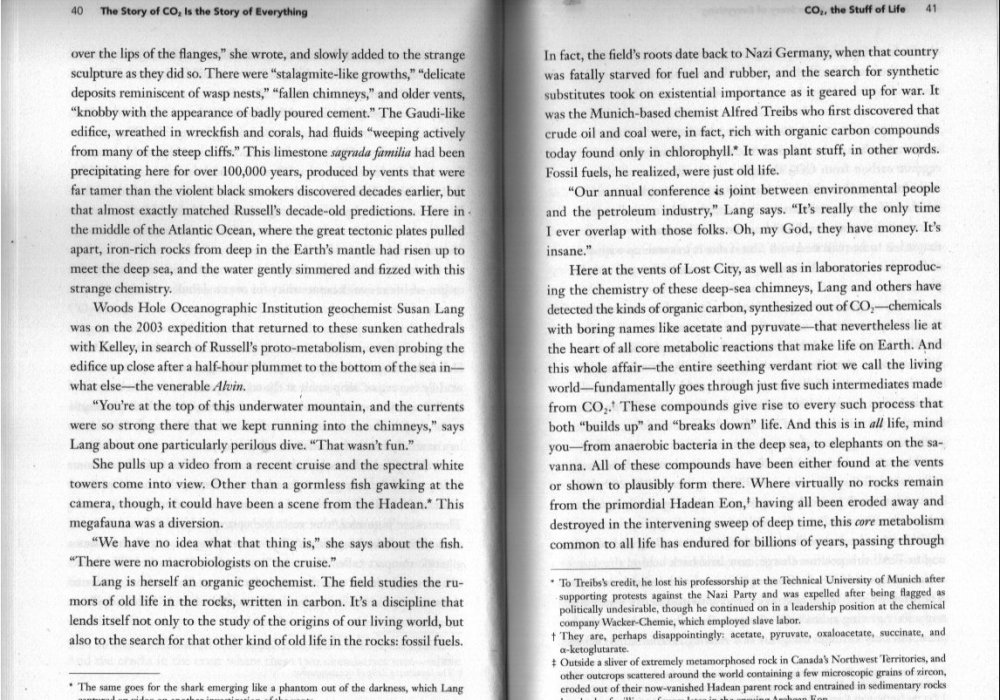
I am currently reading a new book The Story of CO2 is the Story of Everything by Peter Brannen 2025 Peter is an american science writer and scholar and the book is fascinating. The book is almost completely non mathematical, but he does manage to weave together a coherent story of modern investigations into the headline objectives using Chemistry, Biology and Physics, supported by an impressive list of references. Here is a scan of a couple of pages.
-
Good Morning and how have you been since 2021 ? What please is this 'fixed space' you speak of ? Remember what was said back in 2021 ?
-
Interesting discussion gentlemen. But that is what this thread is all about. For my part I chose to use an equation expressed as a multiplication not a division to avoid the issue of division by zero. I would also consider that equations that require boundary conditions to be complete are less simple than those that do not.
-
As far as I know there is no right answer. But this is a recovering science discussion site and this question is already well into its second page. I suppose by simple I was thinking "how many things do you have to know to solve the equation" As I said if you know either time period or frequency you also know the other one. With more general equations of proportionality you also need to know the constant of proportionality. I am not convinced that x is a valid quantity in any science it normally is used in mathematics to stand for a general unknown quantity. For instance if we wish to know distance we do not write x = speed times time, we write d = speed times time
-
I don't have a choice. I'm perfectly happy for someone else to come up with a better offering. But is x a scientific variable ? x+0 could be binary. I have already explained where the idea came from and why I posted it.
-
Well I originally thought of the original notion this morning - it just sort of popped up and I thought it would be a good question to create some activity here. I was thinking that since frequency is the inverse of time then in a way they really are just one single variable in the equation Frequency x time = 1
-
I'd call that an inequality. But still a very strong candidate.
-
That's for you to decide when you compose your answer. Well I can't think of a simpler one, but I am trying to promote discussion here. I did try to put my equation in a spoiler, but couldn't remember how to hide it.
-
Ah but which one ? You mentioned variables in the plural. The one I am thinking of has essentially one variable. Sorry it's been so long off line I've forgotten how to hide spoilers, it doesn't seem automatic.
-
Does ancestor worship count as there are no external gods and the ancestors undoubtedly existed?
-
What is the simplest equation ? There are a few candidates so please justify your offering.
-
Yes about a week for me too. According to Mr AI it was working in America and the problem was in some intermediate link between Europe and America.
-
Yes, of course the study did not include London cabbies. My oversight. I do note however in the study period 2020 - 2022 there were approximately 10 million deaths in the USA of which the study considered 8.9 million deaths and that there were approximately 1 million Covid deaths in that same period
-
In doing some research around the paper I found out that in London uber drivers are not cabbies. The London licencing authority regards them as private hire drivers, so they fall under different regulations and do not require the exam commonly known as 'the knowledge'. Furthermore the payment regulations are different as well. Cabbies are paid on a mileage and time basis to a formula, so the exact fare will not be known until the end of the journey. On the other hand uber drivers must only be engaged through an app and must quote a fixed fare for the journey beforehand. A good question I did not find the answer to is 'did the study include uber drivers under cabbies ?' Bear in mind that ubers were popular but then banned during the early part of the study.
-
The issue presented raises moral and legal questions about the training of AI BBC NewsSecondhand book sales are booming. Is it because of AI?Booksellers are reporting mysterious bulk orders. It's thought the books are being used to train AI - and ending up pulped.I wonder also what Ray Bradbury would have made of it (Fahrenheit 451) ?
-
Interesting video. Strange combination of accent, and units.
-
Did you read the actual study ? I see that it simply stated that the taxi (and ambulance) drivers it studied were found to be the least likely to contract the condition. A good and correct report, too often omitted these days. But as I already noted there is plenty of statistical data to consider.
-
Yes indeed there is much to be gained by reading the statistics in the original British Medical Journal article properly. The data in the original article is freely available, so amenable to more detailed questioning/analysis. In my time I have noted a definite skew in the populations of taxi drivers towards men as prepared to the population at large or the population of drivers, or the population of professional drivers.
-
Yes agreed, but £200.000 is less than many a replaced set of traffic lights in the shilly-shallying period. A true bascule bridge is counterweighted so the effort to lift it is actually quite small compared to its weight. Perhaps that is why the hydraulic ram looked weedy. But lack of maintenance may well have caused large stiction forces to operate.