
studiot
Senior Members
-
Joined
-
Last visited
-
Currently
Viewing Topic: Open AI claims to have solved Navier-Stokes puzzle
Everything posted by studiot
-
Since I've been a member the active membership seems to have shrunk. Perhaps if we, the members, posted some more attractive subject matter that trend would reverse and the admins would also be more active as they are playing a different part from ordinary members. There is a commercial imperative underlying and supporting SF.
-
I am not talking about modelling in chemistry, although obviously as you say modelling techniques are used there like everywhere else. If you want to use modelling, choosing and solving a set of simultaneous equilibrium equations would fit the bill as there can be different ways to do this. But neither of my two examples are models. But please try to see the thrust of my point, which I agree is not very well explained. I am starting from the premise that the most common thread at SF begins along the lines of "My theory of Everything........." It is probably easier to make my point in Mechanics than anywhere else.
-
Perhaps the discoveries are being made in other branches of Science ? Some branches are definitely more mature than others, but progress is still being made, with no end in sight. Many of these newer branches have become possible as the accumulated knowledge and wisdom increases, along with material wealth and comfort. Should these latter fall apart as with the end of the Roman Empire perhaps we would regress and have to rediscover things ?
-
Thank you for your response I will try to illustrate what my meaning by examples from chemistry. Being an organic chemist you can probably think of examples of this better than I but here goes. I seem to remember there are often several routes to synthesise a particular substance from precursors, often involving multiple steps.Some are more convenient than others but I would not say there would be a more elegant one. In chemical thermodynamics there is always more than one way to calculate thermodynamic quantities, again why would any one be more elegant than another ? Consider 1kg of ice in a well insulated container with a stopper. Would you consider using Free Energy methods to calculate the entropy of the change as the ice melts ? Or would you prefer more direct methods ?
-
You seem to have moved on from staff training ? Your second paragraph above sounds much more useful and interesting, please elaborate.
-
Please note no actual cats were harmed in the production of this post. In my experience there is usually more than one way to skin a cat, as the saying goes. In more technical words in pretty well every mathematical discipline - science, engineering and so on - there are multiple methods available to analyse and solve most questions. Whilst it is true that sometimes a given solution equation has more than one solution and it is important to choose the right one in many cases there is actually fundamentally different theory leading to different equations, that have the same ultimate solution. This is actually a comfort rather than a hindrance since we can confirm the correctness of our calculations "by independent means" Further on many occasions one method is actually more efficient than another for solving a particular problem. In the light of all this why is so much effort put into trying to reduce theory to as few a set of equations as possible - Theories of Everything ?
-
-
The scientific term Silurian comes form the ancient tribe in Wales, called the Silures where Silurain rocks in Britain are to be found.
-
I think it more complicated than that. A single cell can be in one of two states call them 1 and 0 - A binary system. Adding two of these can only produce a 1 or a 0, never two digits as that would require two cells. And a two cell system has four states 00, 01, 10, 11.
-
Didn't the authors pick the wrong geological period ? the Silurian was 425 MYA This is long before the Carboniferous period produced the coal and oil we find today. Isotopes are mentioned as possible tell-tales. We do that already to distinguish between volcanic eruptions and meteorite impacts with extra terrestrial irridium.
-
Where exactly did you state these numbers to be real numbers ? I replied almost immediately, requesting detail of your claim and noting that as it stood it did not match the absolute category of truth. To which you replied rather rudely and carried on in that vein subsequently.
-
Nor would I. Interesting example. +1 Ref: Number Line Unfortunately this is not proof of what you actually said. If you read the article you referred to it makes it clear that there are several number lines and you chose to pick numbers from the set of rational numbers Q. So you are referring to the Rational number line, not the Real number line that most of the article is about. Now Pi is, as I mentioned in my first response, not a rational number or a member of Q. So the mathematical expression your wrote, though well meant, is actually strictly meaningless. I know what you mean, but that is not enough for the title 'absolute' , which is not the famous engineering 'near enough is good enough'. For your further information Q is the simplest number system that is complete (which means there are no gaps). So there are no gaps to insert numbers like Pi or, as I also mentioned, the square root of 2 That is why these numbers are irrational. Q has the same property as R that between any pair of numbers there is an infinitude of further numbers of the set. You can chose a rational number as close as you like to any given one, but however close your get you can never close the difference. There will always be an infinitude of further rational numbers between your proposed one and the given one. Yet, as the ancient Greeks (Pythagoras) found out to their horror there are further numbers that require a different number system, hence we have the Real number system. So as I said your statement is true in the reals, but not the rationals.
-
Since you have made the claim, I am waiting for you to substantiate it in true SF fashion. Just saying ( to paraphrase) "It's true because I said so" is not enough.
-
Dicynodonts were just one of the many branches of synapsids, which is a more general classification that includes mammals. EBSCOAnapsids, Synapsids, and Diapsids | Zoology | Research St...<p>Anapsids, synapsids, and diapsids represent three key groups of amniotes, a class of vertebrates that evolved the amniotic egg around 310 million years ago during the Carboniferous Period. Anapsids
-
Since the times of the ancient Greeks schoolboys have been taught that neither Pi nor the square root of 2 are members of the rational number system. But if you couldn't be bothered to read my post, why reply ?
-
Brilliant +1 I think I indicated that there is more too it than that, the car industry being a good example of the effect I am talking about.
-
I don't know whether to say this as not a very good example or is a very good example The question is example of what ? It is true in some number systems but not in others, where pi may not even be defined. So how can it be absolute truth ?
-
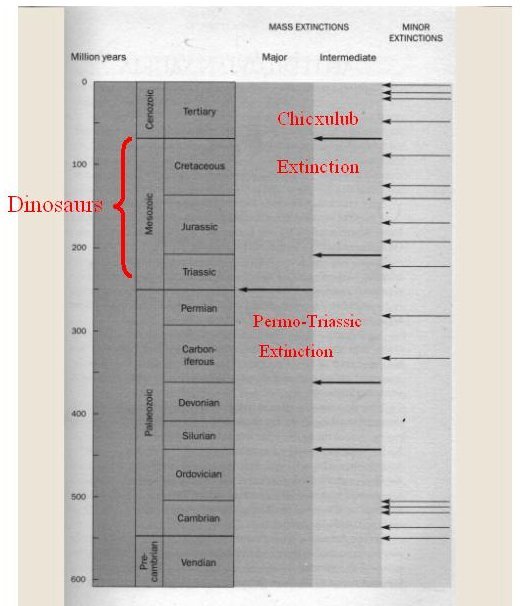
In response to your questions please note that the dinosaurs' time on Earth spanned nearly three geological periods. This is compared to our time as a single thin line across the top of the diagram. Consequently they must have experienced many different environmental conditions before the Chicxulub extinction event. Prior to the rise of the dinosaurs the dominant land animals were reptiles called synapsids. These included rhino like vegetarians and sabre toothed tiger like meat eating predators. So pretty big creatures. The developed in the late Devonian and spread across the globe. Their heyday was in the Cretaceous when the atmouspheric carbon dioxide was at a maximum and enormous plants abounded. This all came to an abrupt end with the Permo-Triassic extinction, the greatest extinction event of all time, where (as far as we know) only one species of synapsid survived. This we called Lystrosaurus. Following the plate tectonic activity that caused the PT extinction an the synapsids did not recover well, leaving a space for diapsids to develop and evolve in the Triassic. These diapsids developed into the dinosaurs and eventually again spread over most of the globe. The dinosaur branch was totally wiped out, but some smaller (by comparison) diapsids (such as crocodiles) made it through to the present day. For information the mammals were a branch of the synapsids were present but lost out under the dinosaurs, but developed rapidly after the Chicxulub extinction as some survived.
-
How's this ? I would say that thought is a general term that relates to both voluntary and involuntary abstract processes in the brain, some useful some less so that may be constructed of several ideas. In this sense perhaps the relationship between truth and an fact is similar in that a truth may be constricted of several facts. For example It is a fact that hydrogen is the smallest atom. It is also a fact that hydrogen is the 'lightest' atom. So it is true that hydrogen is both the smallest and lightest atom. You will have to ask @Gees about the rest of your post.
-
A further comment would be that technological innovations follow each other in a sensible sequence since they all require some part of previous innovations to be possible or accessible. Some of these innovations brought great benefits, some less so. The innovations that were affordable by the general population will show the greatest deflationary impact. Most of these were the result of mass production in some way. There has been a succession of such examples before and as the Industrial Revolution developed. Semiconductor devices could not have occurred before we had reliable machinery to make them This machinery could not have occurred before we had reliable materials to make them of. Modern very high density electronics could not be manufactured without the sophisticated electronics to control these machines.
-
First to answer your question. Why am I talking about Harry Potter. Because it is my answer and amplification to another member's post. Yes this thread is about the difference between truth and fact. And I have openly admitted that I do not know the difference nor has any responder provided any comprehensive and satisfactory answer. There have been many responses, and I have tried to address all of them. But many have also introduced other concepts some of which need setting aside from the main topic and perhaps even merit a thread of their own. What has emerged is that everyone seems to have their own version of this difference, but that everyone's personal difference excludes some or even all of another's version. Surely this can't be a totally satisfactory state of affairs. No I don't see 'lies' as a qualifier. I had tried to indicate that lies are one of several types of falsehood. Perhaps that was not clear enough. As regards your theatre comment, I suggest that whilst the technical world has its 'models' the arts world has its equivalents, a 'plot' being the literary equivalent. But in both cases the oft used expression "The map is not the territory" applies. A model, or a plot or an graphics outline, or a musical schema etc all have the same characteristic that they only embody part of what they are portraying more or less faithfully. Some models are more complete than others but; None of these can ever be an exact replica in all respects. In a way maybe a fact is a model of truth, but only part of it. Don't forget reflexes, which are actions without thought.
-
+1 Perhaps a small addition ? We don't really yet want to have a handle on the hidden costs.
-
Well I agree with swansont that technology improvements in the semiconductor industry has had a significant effect on relative values in our society. But npts2020 has hit the nail on the head with mass production, although it started 200 or even 2000 years before Henry Ford and each time around made a massive impact on society. +1 There have been other factors thoug, - wars, the throwaway society, pre semiconductor and even valve communications technology, electricity for example.
-
Whilst I was asleep during some ancient history, I was wide awake in English. Unlike many languages English distinguishes between 'Abstract' and 'Concrete' nouns, again underling its suitability as a language for Science. Abstract nouns includes your 'world of ideas'. Both types are regarded as 'real' . You need to add qualifying words of phrases to make finer distinctions, another capability English excels in. One such might be material v immaterial. Shadows are still very real, but immaterial. A concrete block is obviously real and material. One test I like is "Can the object affect the real world ?" as separate from abstract v concrete or material v immaterial or true v false. As regards your scientific question it is necessary to distinguish between action at a distance and instantaneous action at a distance. Noting first that 'action' has its standard English definition, not the specialist definition used in Mechanics, I would observe that the problem hasn't gone away. They were aware of it in Newton's time, but they pushed it into the long grass as intractable. In truth, all we have done with better experiments and measurements is to reduce the scale over which it might be observed, very dramatically. We too have brushed it under the carpet.
-
Obviously I was asleep during that history lesson so I had to look it up. Google has a different version of the story but I get the gist. The difference between Harry Potter and the Delphi Oracle is that users (not necessarily the prophesiers) believed the prophesies to be' true'. I can't think anyone believes Harry Potter to be 'true' except within the context of the books. Prophesies may be lies, deliberate untruths, fiction is generally known and recognised to be 'made up'. (I know that some call some fiction lies such as "The Man Who Never Was" in WWII a made up character the Allies knew to be untrue that deceived the Germans." But yes lies, pretence and deceit can also affect the real world around us, as noted.