Trurl
Senior Members
-
Joined
-
Last visited
-
Yes I base the hypothesis on the simple fact of the shape. I am just reading about genetics now. Again with the simple fact that some guy in the 1990’s mapped the genetic code. I understand that it is a complex and unlikely task. But I am less concerned if it is impossible than the fact I want to test it with my ideas. Like Swanson said why aren’t x-rays boring? I would test 10 thousand x-rays if it had the potential to find the shape of DNA. When DNA divides does it duplicate or does it combine with other DNA? I thought RNA was just the instructions to the DNA. I know I can’t say the Caesar cipher will explain there mutation of a cell. But DNA still has protocols that describe how it functions. And geometric models still apply. Do remember when you could donate CPU cycles to aid in computational protein folding? Never not look for a pattern just because a pattern doesn’t seem possible. It is like not chasing the girl because she is too hot. If there is no risk there is no reward. Again back to taking hundreds of x-rays not knowing if you are going to find anything if it evens exists. I’ll have to look it up. I believe that if you use alternative coordinate systems like the log spiral or maybe your idea to use the sieve new patterns are shown. How many functions like circular functions have we got patterns from graphing them? Which leads me to the question why were they testing for a double helix in the first place?
-
Maybe not, but isn’t finding an energy source to travel light speed physically impossible? I’m not claiming it works. But do you agree with mechanics we are limited by our energy sources? And we know light can travel the universe. I know it is science fiction but the method of light is all ready there. Why aren’t we trying to build particles?
-
Thanks for some excellent responses. I realized the post doesn’t seem to fit any one topic. It is just a reflection of things that have caught my interest. I will share with you guys why I wanted to put crypto into the genetic code. I am not a biologist so I don’t know how the genetic code is organized. But when I was trying to find a pattern in Primes, I hypothesized that a logarithmic spiral could be modified to fit a pattern that reveals Prime numbers. I couldn’t get it to work, but I hypothesized that a coordinate plane fitted to a logarithmic spiral could find useful patterns. And a double helix is just a log spiral and its mirror extruded along the z-axis. As for particles always being smaller. What if instead of a Corvette you build a large “particle machine?” I mean enlarged a particle and rode it light speed across the universe on a light beam. Mechanically I don’t think we can build these machines based on current technology.I mean the things we currently build will never be capable to overcome the mechanical limitations.
-
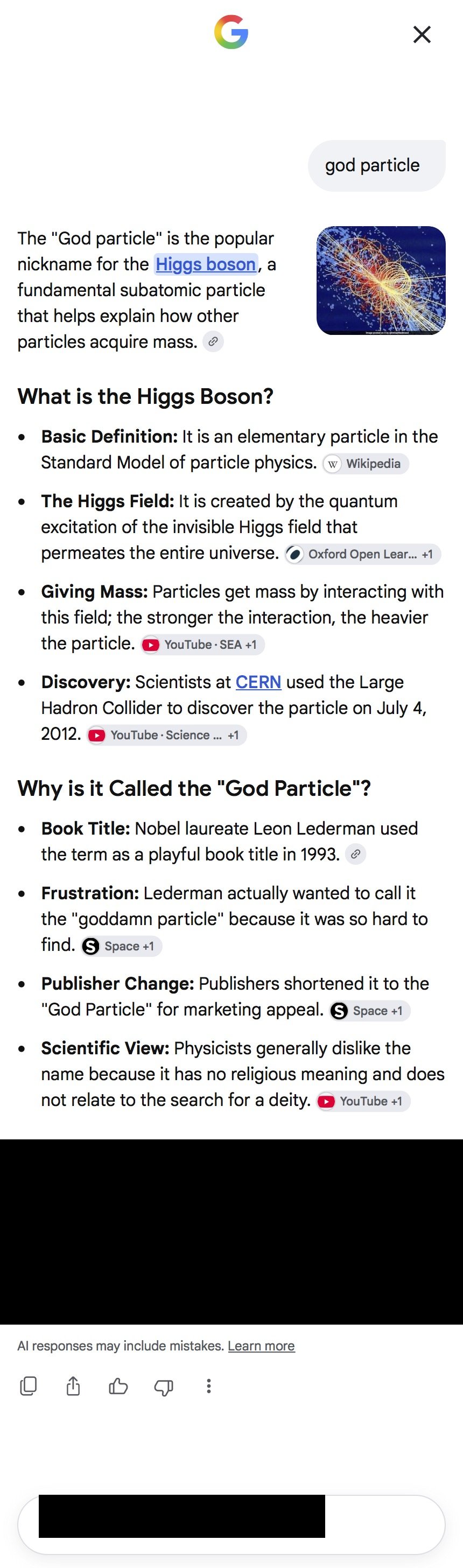
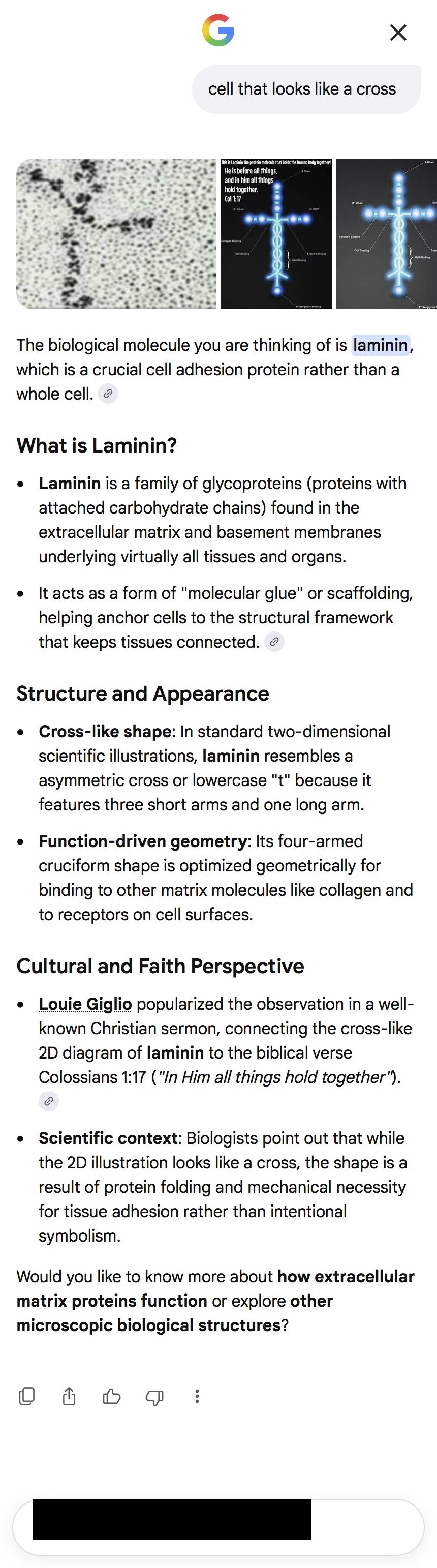
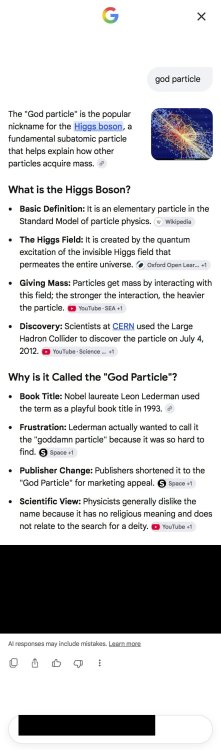
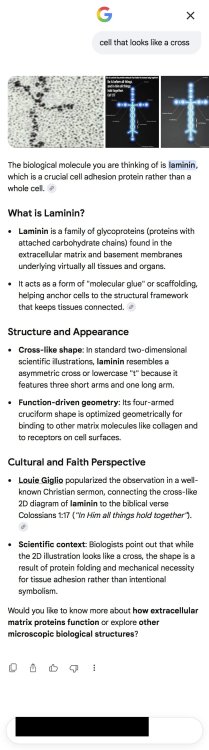
This is going to sound dumb, but why can’t a Higgs boson particle be large enough to view? And why can’t a single cell be large compared to my height? Why do they exist in a state that is always smaller than my eyes can see? What is setting the scale on which everything is measured? I am reading a book called Meselson, Stahl and the Replication of DNA. So far the book is good at explaining to a amateur the research that found the structure of DNA. In chapter one they are using X-rays to find the DNA in a single cell. It’s brilliant. But would it seem brilliant as the research is being conducted? Wouldn’t it be boring to measure with X-rays? But it worked and I guess that’s why it became awesome. While I was doing research about cells and particles I came across the God particle who’s name has nothing to do with religion and named improperly. And I rediscovered a protein that resembles a cross. I know you guys are already aware of this protein. I find this interesting and it is easy to research because one only has to type a question into Gemini. But I am interested in this for the same reason I was interested in Gematria and that is to find a pattern that unites the scientific with spiritual. The spiritual may have many implications in the science. I want to treat genetics as a form of cryptography. Genetic patterns are found all the time, but I am not a biologist and the genetics might as well be written in a different language. What if we had build blocks and made genetic patterns as common as the cryptogram in the newspaper? That is why I have an interest in biology. I know on a science forum this isn’t the preferred method of conducting scientific. But I don’t think it breaks the scientific method.
-
I don’t have any plans for creating a digital signature. I don’t think it is the strength of this protocol. I am not saying it’s impossible but I think the strength of this protocol is anyone can send Caesar a message securely by only knowing his public key. It would act like a one way pad without both parties exchanging secret keys. I believe it is quite powerful. But it all relies on determining Alice’s key based on the comparison to the public key and the public key’s next iteration. This is difficult but so was the task of RSA to find the trap door function. Remember it is just a protocol. So I am saying that we assume that the great task of comparing Alice’s encryption to the public and reversing this change of encryption by comparing it to the next iteration of the public key is possible. When I talk about this I think of Ham radio. There the math from signals would do graphically and mathematically what such a complex equation could not. Like the curves based on a sine wave being combined and modified. It is just an idea. No guarantees it work. But I put it here so someone could make it work. If a solution completes the protocol it would be as valuable as RSA 48 years ago.
-
Well if you guys didn’t like Trump on buildings you’re really not going to like that Fox News is reporting that the race in AI and data centers is to create and train a Trump. 🤪 Now he can be leader for generations. This is the danger that Anthropic and OpenAI warned about.
-
You guys are right I don’t have a digital signature. You could use other systems to exchange keys. If Eve does impersonate Caesar, Caesar can add more public keys at different iterations of the key cipher. I will work on this. I am saying Alice encrypts the public key. The difference between what was just encrypted and the next iteration of the public key compared to Caesar’s secret key is the plain text. I still have the impersonation problem, but if we can compare keys in this way the protocol should work. You are right Sensei, this also is a problem. This is why the Caesar cipher is insecure. I know the terminology of hash, padding, a SHA, but not the actual setup. What is salting? I was under the impression that if I had the protocol and the cipher these things were already established. By changing iterations based on Caesar’s private key you could establish impostor Eve by establishing a secure key that is secured non publicly. After this was established you have security. This digital signature is tricky and I don’t know if I can make it happen. Wait a minute. Caesar is the recipient of the message. Eve can impersonate Alice, but Caesar would just get an incorrect plain text. The whole point is that Caesar gives his public key and have a secure message sent to him. If you publish your public key doesn’t it mean anyone with that public key can send you a message. Even a dog turd.💩 Alice can just like Caesar publish a private key.
-
Don’t be deterred by the Gematria. Any strong 2 key system should work as I mentioned. I just used Gematria in the example because it works well with the protocol. Gematria is consider numerology but is really a cipher language. Read the Wikipedia article. As early as 88 B.C. It was used to hide scripture in plain text. The Hebrew people could be killed sharing scripture. I hypothesized that it did have a higher meaning to them assigning words to numbers. But remember these were intelligent people they may have disguised there ciphers as religious meaning to broaden the cipher’s skills across the believers. It is a brilliant move to spread secrets across those who share your views while preserving the cipher’s effectiveness. Caesar in my example did not use a Caesar cipher because it is insecure. Sure he could use some type of geometry or increase his alphabet. But the Gematria a more robust, established system. To be honest I haven’t tested the Gematria yet. I just wanted to create a protocol that would enable private keys to become public cryptography systems. But it may turn out that Gematria is to Caesar’s protocol as Morse code is to simplify the alphabet.
-
Caesar has a private key. He uses Gematria (or similar crypto scheme) to run the private key through many iterations. A given number of iterations where the complexity is enough becomes the private key. Alice takes her key. Which is the second private key. For her use only. She uses a cipher, say Gematria and encrypts the message according to the public key and her private key. Caesar uses the public key and extends his private key one more iteration. This is what his cipher would look if he extended it one more time. Caesar then subtracts the value of the extended of his private key from Alice’s private and the public key. This is Alice’s plain text. Not a damn thing Eve can do about it. That is the protocol. It is public key but not based on current models. I am not trying to rebuild RSA. This relies on ciphers. I used Gematria in my protocol. It needs a ciphers to work. A cipher that wasn’t public key is transformed. It is a signal processing system. But it relies on the difference of each private key being found based on the way they react to the public key. It is a radar system.
-
This is why I think it had potential: The protocols have to work or the math is meaningless. The math of mapping out the Gematria ciphers through many iterations is the most difficult math of the protocol. Taking the Gematria cipher again and again. Say 3 cycles of Gematria. I designed it based on the fact that you need 2 private keys. Alice and Caesar’s. To decipher the cipher text created by Alice we take the public key and the difference of Alice’ Gematria encoded cipher text and compare it to the value if Caesar’s private key as if it would have made one more iteration!
-
Thanks guys for all the positive critiques. Sensei is right I need to get my hands dirty and get computational. But a should note this is not my go to RSA problem. This is trying to use established ciphers to form less computational public key systems. KJW is correct that it might be easy to encrypt such messages but may prove impossible to decrypt them. Anyway I am working on a bunch of stuff, but here is a better explanation of what I was attempting. Here is my reasoning why non-one-to-one ciphers lead to public key cryptography schemes: There are 2 keys. The plain text is not known. Take Caesar’s scytale. Alice enciphers her message with the public key. (As defined previously.) This plain text is now the cipher text. Eve has the public key but this key only is useful if Eve has the plain text because Alice is using the public key to encipher (a none one-to-one function. (This can be Gematria or other compatible non one-to-one cipher function.) Caesar holds the private key. Just as Eve has the cipher text she does not know the shape of the scytale, the private key. This private key is the secret that went through a given number of iterations of Gematria ciphers to form the public key.,This is the foundation of this proposed one way function works. That is you can use the public key to find the private. Will cycling through Gematria enciphers be labor intensive enough to obscure the private key? There are only 2 keys but the pubic key is used in a Gematria cipher of the plain text. That is the hack. So Eve knows the public key but the cipher text is a non one to one cipher. The cipher text becomes its own public key. So I hope we can use the private key which is the original Gematria key before we created the public key from the private key to decipher the encrypted message from Alice.
-
#2 of my steps should say public key. Make a public key: Run the private key through many iterations of Gematria ciphering. I am basing the fact that using the public key to encipher the plain text is a one way function. So much so that it may even be difficult to decipher with the private key. If Gematria is used as a cipher the plain text will not be deciphered knowing the public key even with also having the cipher text. The hypothesis is the Gematria cipher can act as a one-way-function. It is just a hypothesis. I have no experiment yet. The reason why I believe you can’t reverse the cipher text with the public key is because the Gematria cipher relies on the plain text. I know the idea is abstract. It may not work. But I see potential from this hypothesis. As you say if the public key reverses the cipher text it doesn’t stand. But if the plain text and public key is not a one-to-one function then we have hundreds of new public key encryption schemes.
-
The protocols are the same in my example as your protocol. I am just using a substitute cypher like Gematria to encipher the keys. It doesn’t have to be Gematria. It can be other established ciphers. The goal is to simplify the encryption. By that I mean easier math and more security with less computation. I don’t even know if the idea is even a new concept. But I think the reason we don’t see it implemented is that when RSA was invented they didn’t have the computer language to run it. I am saying to make a private key: Make a cipher based on the key to any Gematria cipher. Make a private key: Run the private key through many iterations of Gematria ciphering. Encode the plain text with Gematria based on the public key. As long as the public key can not reverse the ciphering text of the plain text, the private key can decode the ciphering text and we have a less computation encryption scheme.
-
I agree. Interest helps talent but what activities you are interested in is personal preference. I am only joking that Coepernicium post sounds Shakespearean. I really have a friend that is rumored to be a playwright major while he has extreme engineering abilities. Coepernicium is right about the math and science of higher education is hard to get established. High school doesn’t always prepare and for some reason in college they intentionally try to fail you.
-
You should be in theater and not mathematics. I know a guy who was a theater student. He should have been an engineer. He can run heavy equipment and rebuild cars. He works in the field. He would have made a great engineer. I don’t think he completed the theater major. I am not joking either. I will joke and say they must have switched your college applications.