studiot
Senior Members
-
Joined
-
Last visited
Everything posted by studiot
-
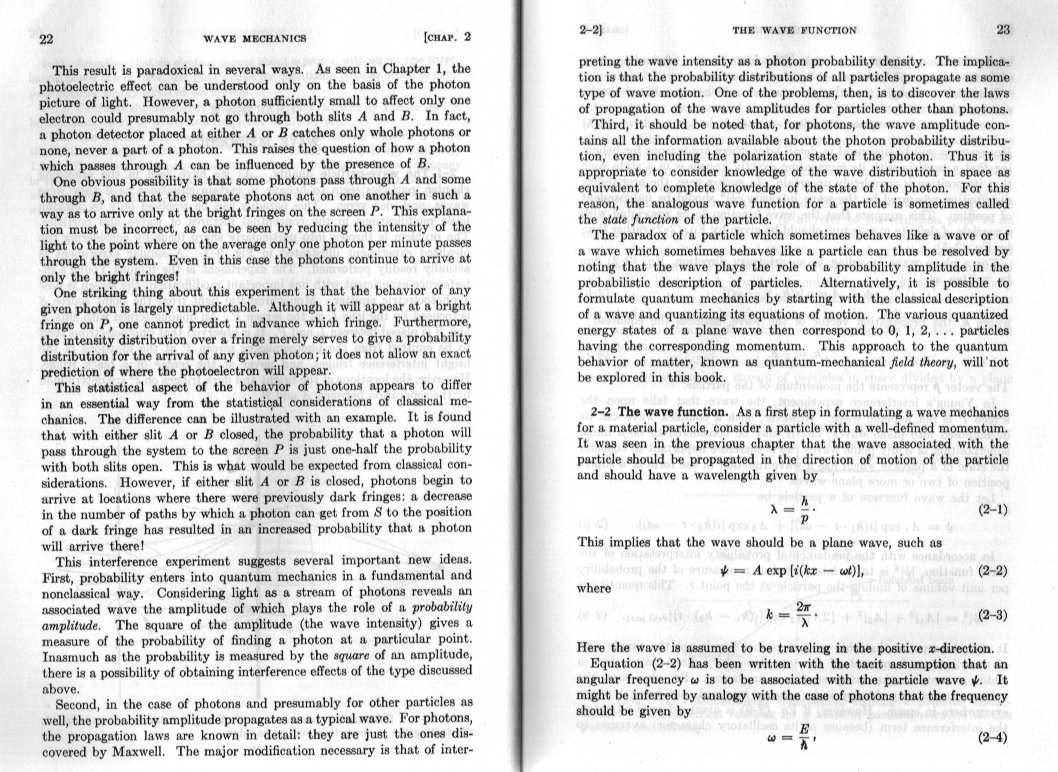
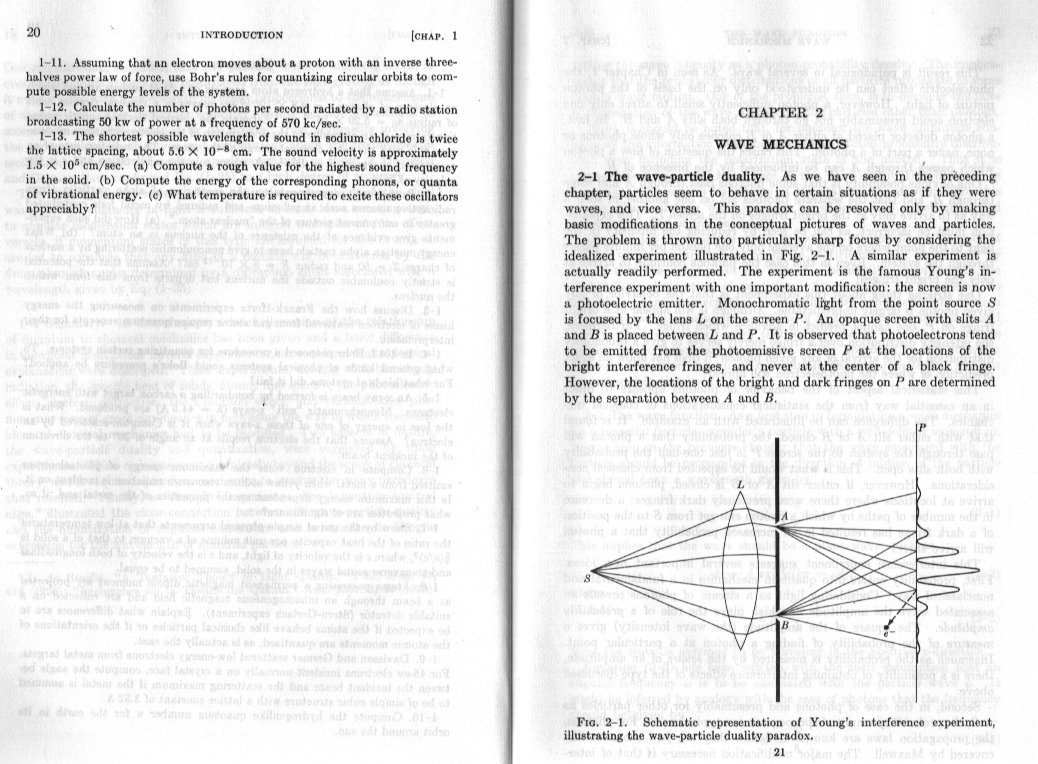
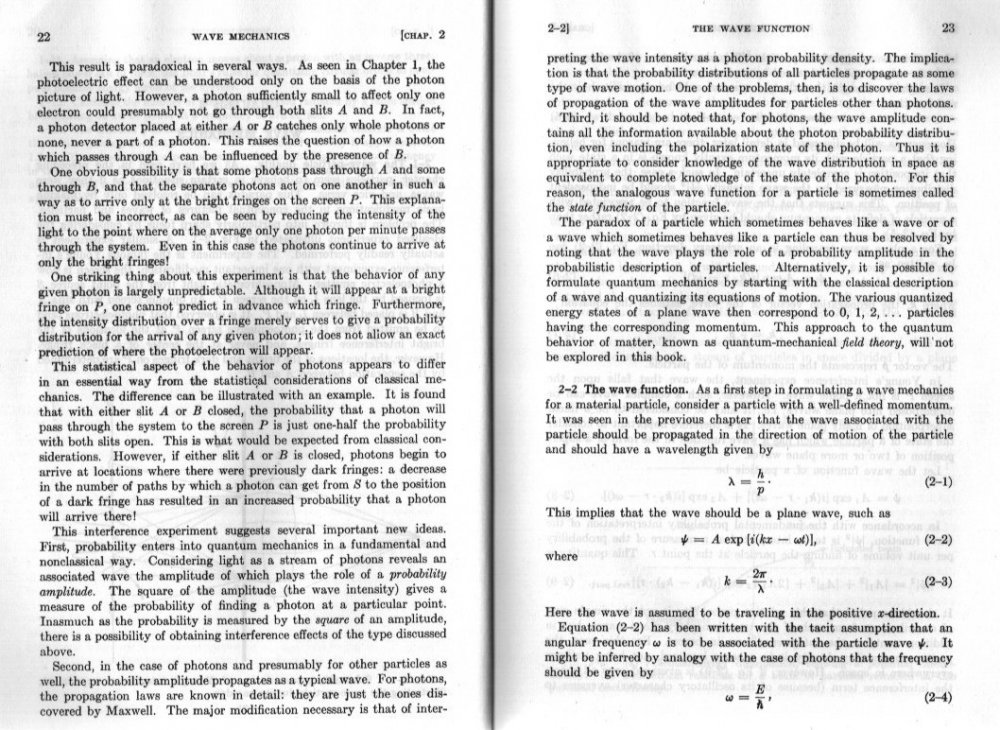
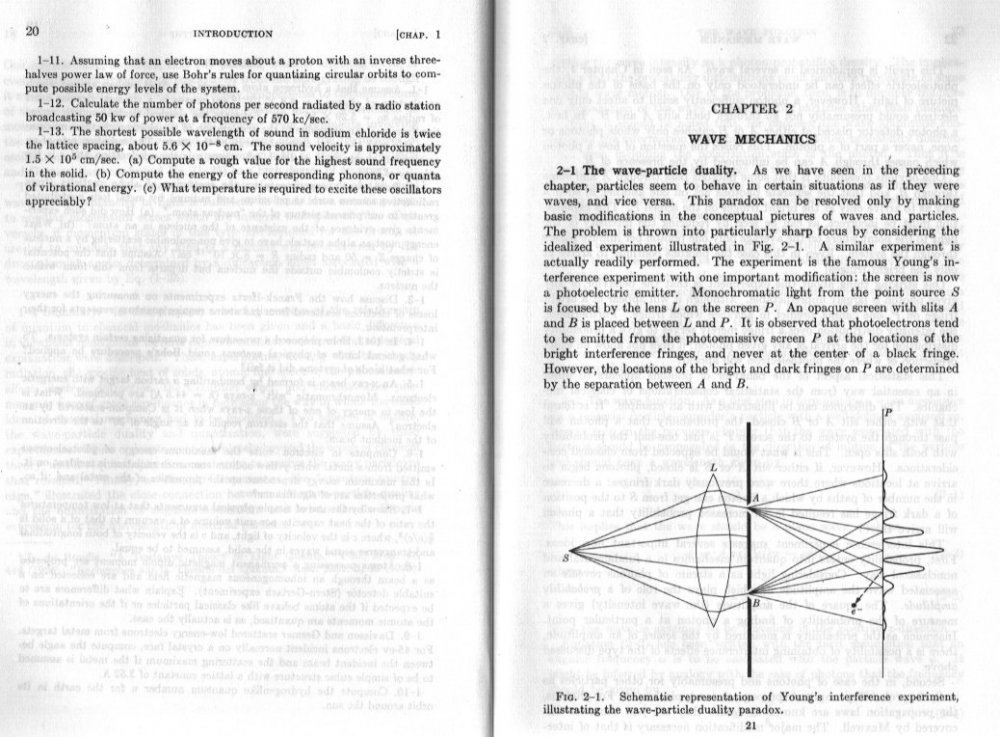
The double slit, for some reason, is one of the most controvertial experiments in physics. +1 to swansont for a better, though brief answer. The most compact description of what happens and our best explanation I know of is to be found in Dicke and Wittke's Introduction to Quantum Mechanics, an altogwether excellent, if a bit dated, tome. I know my extract is in terms of photons, but if you read the book it does deal with electrons and other massive particles, however basic questions should be addressed in basic terms first. Light can be dealt with directly, as was done since Young's day, but quite a bit of later (eg De Broglie) theory is needed to move on to electrons.
-
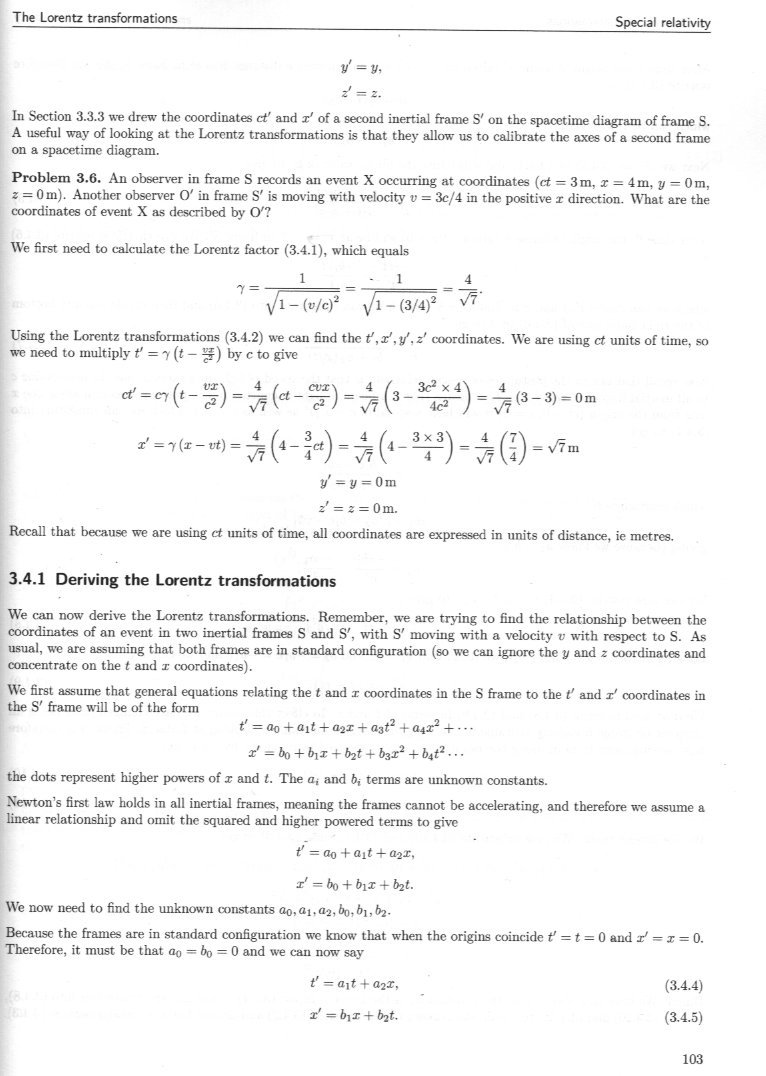
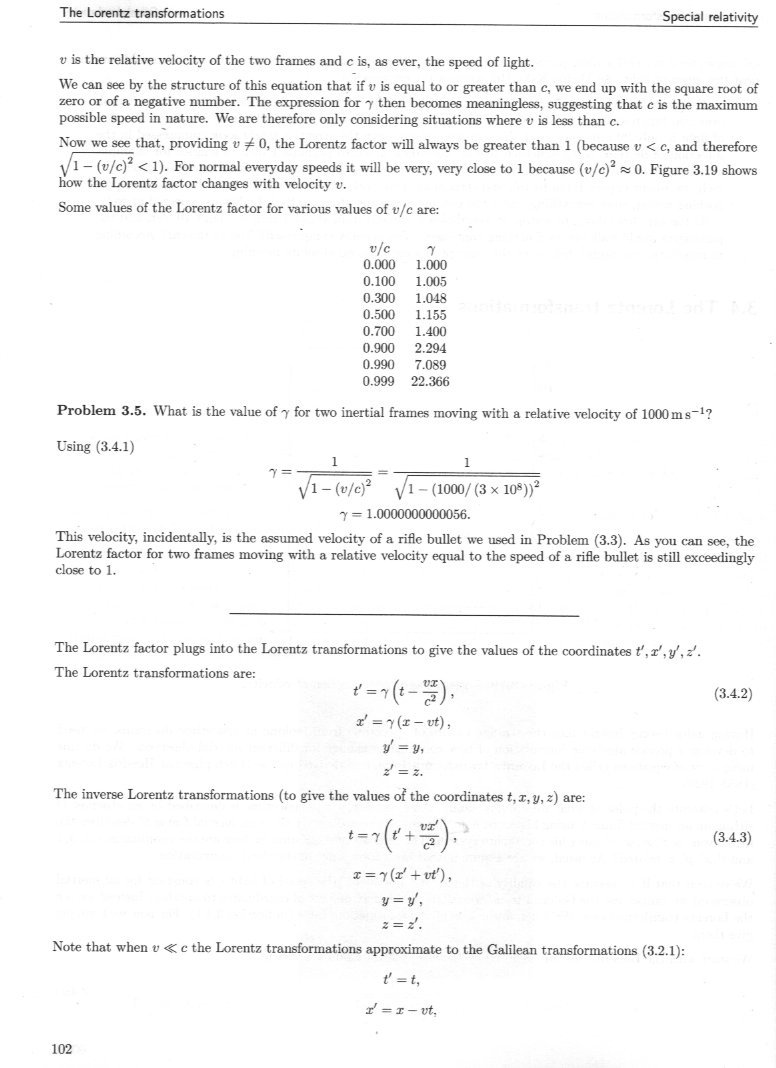
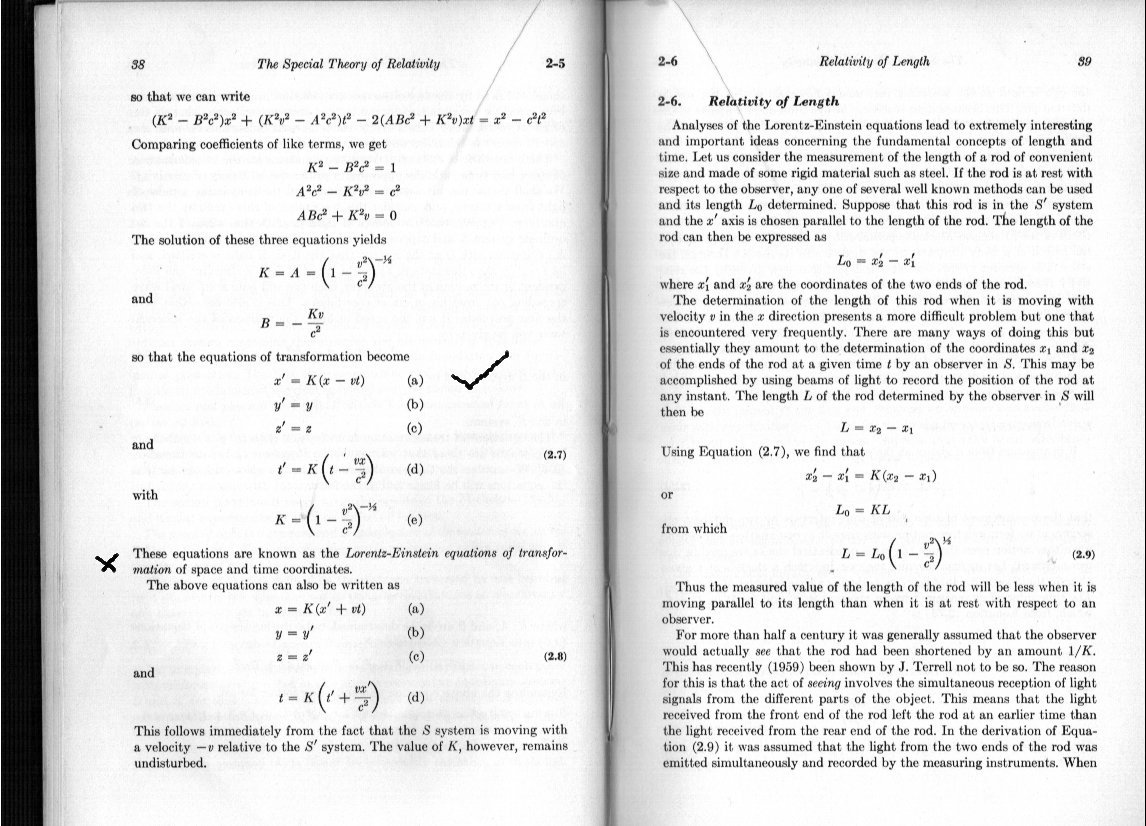
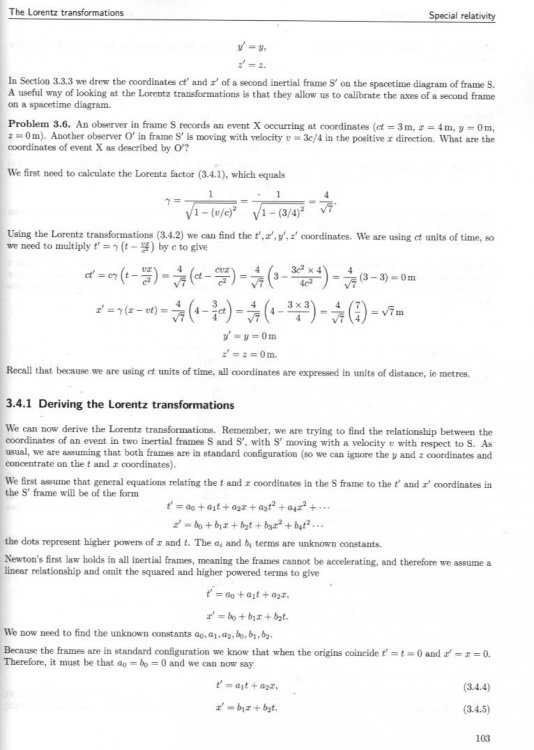
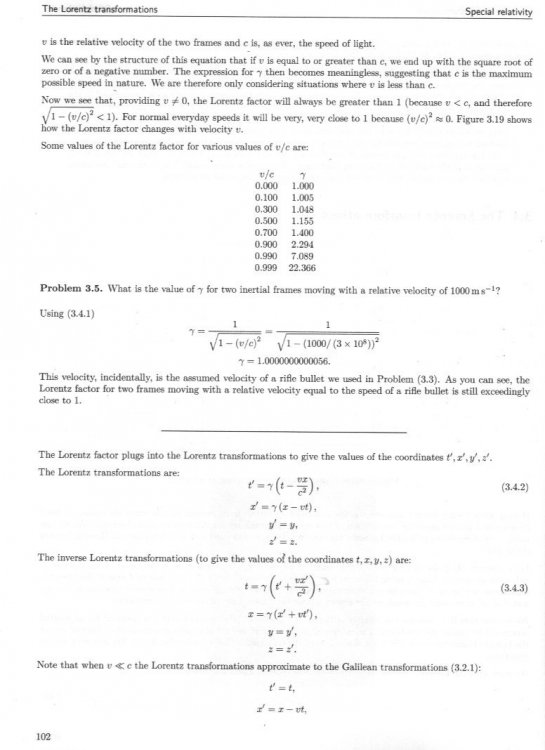
I don't know if your interest is course based or you are an amateur, but I note your other threads are about cosmology etc. Here is a book (also available as a pdf I understand) that may be of interest as it develops the maths, and science to go with this stuff, written by someone who didn't like current textbooks so went out, taught himself, and then wrote one (at reasonable cost I might add.) https://www.amazon.co.uk/Most-Incomprehensible-Thing-Introduction-Mathematics/dp/0957389469 Here are two pages from Peter Collier's book The first describes the Lorens factor and transformatiosn, the second contains a nice numeric worked example.
-
+1 It's a while since I had a rennet pudding.
-
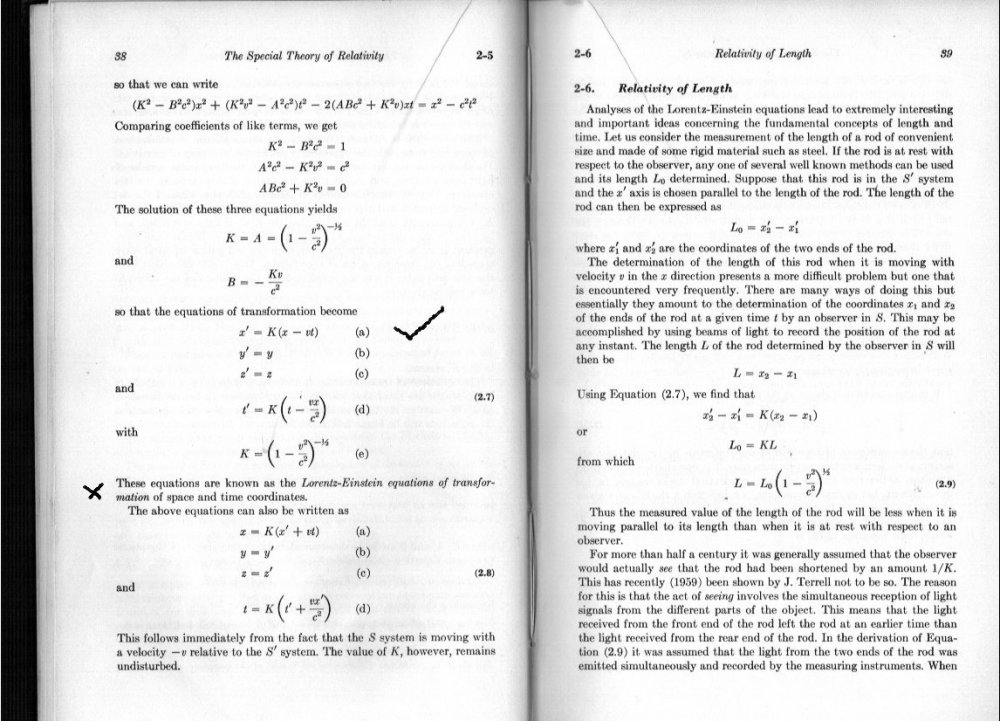
Thank you for your reply. There are many different ways of presenting relativity, this way is very simple and appears to be the same as the path you are following. With the exception that Semat uses K instead of gamma for the Lorenz factor. What (I think) you call the Lorenz first equation appears as equation a on the left hand page. I have ticked this. I have also indicated where he explains these equations as The Lorenz-Einstein equations of transformation of space and time coordinates I have underlined the word 'coordinates' which in this case is the x coordinate in one coordinate system and the x' coordinate in another. But x and x' are not distances. Distances are treated on the right hand page and called lengths. Distances are coordinate differences. Finally note that the left hand page contains two sets of equations, the forward transformation giving coordinates of the second coordinate system in terms of the axis variables of the first. The second or reverse set gives the coordinates of the coordinates of the first coordinate system in terms of the axis variables of the second, dashed sytem. If this looks familiar, we can proceed and examine why we need all of x, y,z and t in one system and x', y', z' and t' in the second. I repeat these are the coordinate transformations. The next step is to understand the how to apply these useful quantities like distance, time, velocity and so on. Then we will get to some examples we can put numbers in.
-
I think you still haven't got the idea, perhaps this is because the discussion so far has been too general. Perhaps looking at a specific example might help. So I agree with this and understand where you are coming from. I have been trying to generate some suitable numerical examples as this is obviously important to you. However the first part of your first post contains a misconception which I have highlighted. v is not [math]\frac{x}{t}[/math] but [math]\frac{{dx}}{{dt}}[/math] This is a convenient point to ask you if you have any calculus and if you have met the derivative before ?
-
Thanks all I'm glad folks have foun cud to chew about in this thread. Just a note to our newcomers. A couple of years ago I went to the Frome Internatinal Cheese Festival, and we had a longish discussion about cheese and some interesting photographs and cartoons. I also posted another thread about a zero fat cheese - basically solid protein. Does anyone remember either ?
-
Have a look at Hess's law and Entropy. https://en.wikipedia.org/wiki/Hess's_law This is used as the basis for calculating many bond energies.
-
I didn't say I wanted to argue semantics or that you do not make some very valid points. What you are proving is that the situation is, as I said, more complicated than the OP thought so a simple answer will give the wrong impression.
-
That would generally be true, all other things being equal. But why do some molecules break up under the influence of catalysts, but not without the catalyst ? We should be discussing which bonds, which energies and which states. So exactly which new bonds are you thinking of, especially with reference to my hydrogen flouride example ? The hydrogen flouride molecule breaks up but what new bonds do the hydrogen and flouride ions form ?
-
This article in the BMJ (British Medical Journal) is a good example of a report on peer reviewed study. The results may be of interest to those worrying about thinning bones. https://www.bmj.com/company/newsroom/small-daily-portion-of-jarlsberg-cheese-may-help-to-stave-off-bone-thinning/
-
Thanks +1
-
Thank you for asking what I meant rather than just taking an opposite view. +1 Is the solution of hydrogen flouride or sodium hydroxide not exothermic ? Thank you for the clarification. I think the comments here show the value of a well posed question as opposed to a vague one, with respect, like yours. Ok you have mentioned water. So there are many types of bonds. Some types of bonds have a very specific 'bond' energy. Other types have a range of energies and a statistical average. Water is subject to both of these types. The intra molecular bonds exchemist refers to are of the fixed or specific type. But the bonds which hold solid water together are of the statistical type. So it is conceivable to create the bonds on the low side of the statistical average and replace them with new hydrogen bonds on the high side of the statistical average bond energy. And of course vice versa. Of course this process cannot be continued indefinitely on account of conservation of energy.
-
Not necessarily because life if more complicated than you present. Some bonds release energy when they break. These are called exoergic (also exothermic but that is strictly heat is released. The reason they don't immediately break up by themelves and release energy is something called activation energy. How far do you want to go with this topic ?
-
I don't agree with this statement, in thecontext of this question. Have you ever wondered why the OP has not come back to discuss it further, although he has been here since he posted it ? I do also wonder if there was not a mistake on the whiteboard (or copying from it) and that the Pex under the integral sign should be just P or that there was a carry over from a previous whiteboard we haven't seen ?
-
Wasn't the big thing about Yeomans was that he was trying to think of and use the positives, rather than moaning about the negatives ?
-
Is this homework, Looks like it to me ? I'm suprised you haven't started off with a few ideas of your own. As regards gravity I have in mind a gravity dam, with an installed hydro electric generation scheme. The first is a use of gravity that is the exact opposite of mathematics offering. The second is a direct use of his offering. So it would be courteous to thank members for their contributions. Further I suggest you list out the definitions of the four forces and see if that suggests anything to you. Here is a starter The weak force cause radioactive decay. What medical uses does this suggest to you ?
-
It would be more helpful if you actually answered my question. Scientific order and scientific chaos are not opposites but have a very tenuous relationship. Chaos Note the word apparent. Order is more difficult. There are a great many mathematical uses of the word order, but none of them mean colloquially 'like a bunch of soldiers on parade' which would be a popular misconception. There is a process in statistics where you select one state and call it 'order or the ordered state'. Then all other states are 'disorder' note not chaos. You can then use probability theory to determine useful things about the relative probabilities of each state.
-
Repetition is not explanation. Also if you want this to be a discussion of theoretical and modern physics then you need to use specialist terms correctly. We can and will help you with this, which is why I asked about your understanding. Suggestions on the other hand belong in speculations. A note: a new member is allowed 5 posts in their first 24 hours as an (effective) anti spam measure. Please don't waste them arguing minutiae, this could be an interesting discussion.
-
Does this thread have a pont we can discuss ? Perhaps you should explain what you think the terms 'chaos theory' and 'orde'r are please ?
-
Thank you for the Australian viewpoint. Have you come across P A Yeomans and his keyline proposals and can you shed any light on how they are making out today ? I have recently been told they are still going strong. P A Yeomans Water For every Farm.
-
I saw no mention of a burst tyre in the OP. We don't know that heat is not being considered or other matters on other screens/snapshots of the lecturer's presentation. In any case you have to calculate the heat and work terms separately. We don't know if Ideal or other gas laws are being invoked. In fact we don't know much about the problem at all.
-
Whilst I'm all for experiments, I seuggest yoy would be better off reading this book first. Particularly the chapters on Foucault and other pendulums, atomic clocks and most important sunchronisation of a chain of clocks. A brief History of Timekeeping. Chas Orzel 2021 / 2022
-
Not sure I understand the meaning of 'fluid pressure acting on itself' ? We don't actually know much about the way this student is being taught. The one liner statement isn't sufficient to go on. There is, for instance no mention of a piston or description of what the diagram represents or where it comes from. Also sometimes students miscopy what is written or mishear what is said, but are intelligent enough to realise later that something is amiss with their notes. I have already noted my guessed interpretation. If the diagram represents the expansion of a fluid into the atmosphere, from a small volume at high pressure (points 1 on the diagram) to a larger volume and lower pressure (points 2 on the diagram) and this lower pressure is the expansion into the atmosphere this process is irreversible. The work done is the work done against the constant atmospheric pressure, represented by the blue horizontal line and the volume change, delta V is the difference between the volumes at point 1 and point 2 on the diagram. This product PdeltaV is correctly shown by the blue hatched rectangle.
-
Thanks for coming back to us to report. +1 You first posted this question in spring, ie at the end of winter. It is not uncommon for a failing battery to 'recover' during the summer months and fail again the following winter. So if your tests revealed an elderly and failing battery you have the rest of the summer to get it sorted.
-
Yes I understand that, but I am asking why is that important ? Did you catch my comment/question about the importance of Pluto's very tenuous atmosphere ? It is really only very simple arithmetic to derive the end formula which is vry simple and all that matters. Skip to the end and let swansont or joigus or janus dissect it, as I'm sure they will. I will try to plot a suitable graph of the result, that may help visualisation. I should also point out that some planets are spinning faster than others and the rotation makes a measurable difference to the apparent gravity. My calculations assumed a non rotating planet.