
studiot
Senior Members
-
Joined
-
Last visited
Everything posted by studiot
-
I was eventually coming to that, but you beat me to it. +1 I have a bit of a quandrary here as the OP question was about Bernoulli, not the mechanics of flight, which is all too often misrepresented. I believe @jfoldbar is a student but I am not sure where they are in their studies. Bernoulli assumes what is called laminar flow. - Parallel (not necessarily straight) flowlines. Since the flowlines are parallel they do not get closer together or further apart. Starting with statics we have a theorem that every system of forces can be reduced to a single linear force and a moment. The linear force and the moment can vary independently and in particular each can be zero or any other value. Transferring this to dynamics we have the same theorem that any combination of motions can be reduced to a motion along a line and a rotation. In Laminar flow this rotation is zero. If we place a suitable obstacle in the way of this laminar flow it causes the flowlines to bunch up and/or spread out. This can be equivalent to changing the rotation from zero to some value. I say suitable and can be because some obstacles maintain the flow as laminar. Without going into the maths, introducing this rotation introduces the lift force that keeps the aircraft up. Understanding this then allows discussion to proceed to using Bernoulli locally to describe the bunching and spreading in terms of pressure forces. Fixed wings are always set at some angle to flow to accomplish this. It is also necessary to consider the statics of the aircraft in terms of a rotation and a line force.
-
Of course there are - that is how fingerprints are produced and how you get coloured fingers if you touch wet paint. But what is transferred, which way it is transferred and how much is transferred depends upon the nature of both your skin(how oily/sweaty it is) and the nature of the surface you touch.
-
Can you rephrase this into a meaningful question please ? The Butterfly effect is a complicated (please don't use the word complex, that means something else that could be confusing) dynamic.
-
I hate to rain on the D shaped parade, and note you haven't replied to my earlier post. Nor have I watched the video. You sensibly asked about Bernoulli, and said your aim was to understand how a 'heavier than air' craft can fly. I take it that you have seen some explanations using Bernoulli. Understanding Bernoulli is a good first step, but it is only a first step since lift is much more complicated than Bernoulli and involves other factors, not present in Bernoulli. The D shape is often offered as an explanation but it is not necessary. Take a sheet of writing paper, hold it out in front of your mouth so it dangles down from your fingers. Then gently blow over the top. The sheet of paper will rise and almost straighten out due to the lift force that is generated. This should be you starting point and can be discussed using Bernoulli
-
You don't need a microscopic scale to understand Bernoulli. In fact such consideration is likely to get in the way as you would then need to start considering statistical mechanics. Plain old standard mechnaics is quite good enough. The law of conservation of mechanical energy states that "The total energy of (an isolated) mechanical system is constant. Note an isolated mechanical system is one that is not busy converting its energy into something else, say electrical energy. That is it is purely mechanical. There are two basic forms of mechanical energy potential energy and kinetic energy. The total mech energy is obviously the sum of the two. So if one goes up, the other goes down. For example as a stone falls under gravity, its potential energy due to gravity reduces but its kinetic energy increases as it speed up. A fluid is a mechanical system. And Bernoulli is nothing more than the above conservation of energy.. A fluid potential energy is represented by its pressure and its kinetic energy is represented in the usual way by the velocity times the rate of mass flow (or the volume flow times the density) So to come back to your question, the total energy is constant so if the speed increases it icnreases the kinetic energy, therefore the potential energy must fall so the pressure falls. A useful term is the stagnation pressure where the fluid has stopped moving and all the energy is potential pressure energy. Mathematically this stagnation pressure becomes the standard expression of variation of pressure with altitude. Does this help ?
-
I have not looked at this thread before but this post caught my eye in the list. So I looked at the OP and to my suprise the only question I could find in the OP was So as things stand I couldn't understand the OP I don't know who Alan is or was So I am at a loss to proceed. The only thing I can suggest of help is to refer you to the 1960 film "The Bulldog Breed" Which was about a scenario not dissimilar from the one you describe, except it was set at the UK national cold research centre and featured Norman Wisdom, not students. This centre produced over 1000 papers whilst it was active, they must still be a matter of public record so I suggest you start there. https://en.wikipedia.org/wiki/Common_Cold_Unit
-
Bolded quote And modest with it. I haven't presumed anything. Bbolded quotes I very much doubt this claim, especially since it is offered with no support whatsoever ans just so easy to find numerous counterexamples. Do you understand the geometry of Scottish Dancing or the placement of Tiles, or the arrangement of atoms in molecules ? In other words the geometry of Juxtaposition ? How about Pick's theorem ? Or Mandelbrot's question "How long is the coastline of Britain ?" Bolded quotes Really ? Bolded quotes Perhaps, but not interested in the sincere offerings of others. Good of you to say so So why do you write so disparagingly about them ? This was later shown to be undecidable. That is the both the hypothesis and its negation are consistent with the standard axioms of set theory. (Godel) Is the the mathematical continuity you mean ? First bolding You need to be aware of the very very very great difference between the meaning of Field in Mathematics and in Physics. In Mathematics a Field is a set of entities subject to two binary operations and certain other conditions. In Physics a Fields is a set of elements that are either arguments or values of a function. The union of the range and the domain of a function. Second bolding Of course it is not absurd to ask. In fact most consider asking to be excellent practice. I have tried to offer the beginnings of some answers so it is most disappointing for me to find that you are not receptive to discussion about the topic and only seem to wish to pronounce your views as though no one else has ever had anything worthwhile to say. Others have found them even more upsetting. However I have always treated your posts as those of a thinking adult. Here is some modern (only 55 years old) geometry that is one way to introduce the answers in Mathematics you claim to seek. And yes, it is Scottish Dancing. A final question to think about. You keep mentioning "Natural" - Natural Geometry, Natural Science, Natural Order etc What would then be Unnatural Geometry, Unnatural Science, Unnatural Order ?
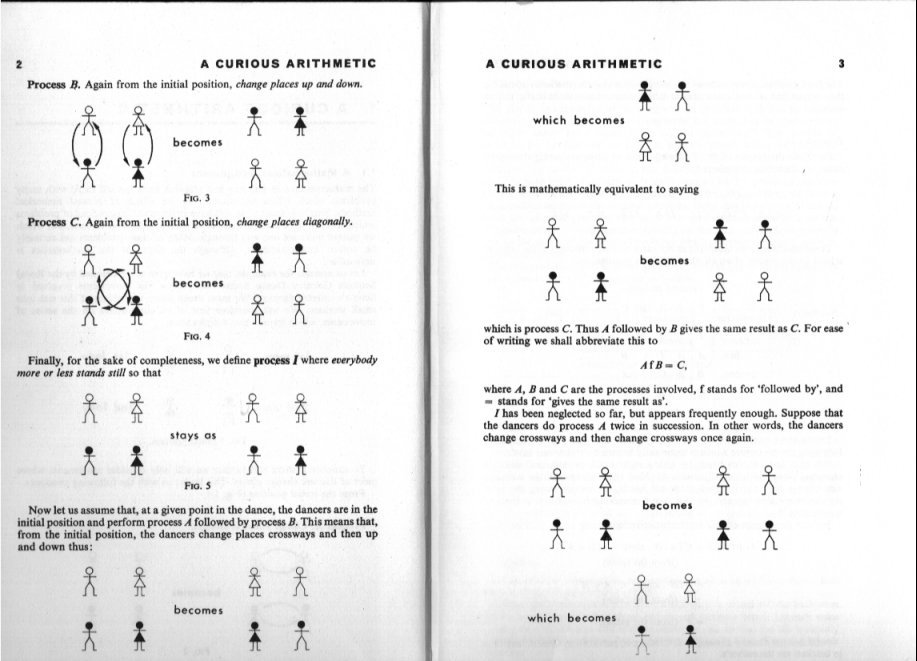
-
Thank you for your posting, I fear it will not be long before the moderators remove your attachment as being against the rules here and against what they have already told you. I see from the attachment that you wish to discuss two and a half thousand year old mathematics. Do you not think we have moved on at least a little bit since then ? You have introduced some more modern terms manifold, group, order but tried to use them in non mathematical ways. The 5 platonic solids you mention form what we now call a 'homotopy group' and it is by this means that we can prove that there are only these 5 regular solids in 3 dimensions. They actually enjoy no particular order (in the mathematical sense). Groups are not, as you suggest, series in mathematics, they have a very special definition. Unfortunately the rest of your article starts to wander off into mystic woo, for instance trying to introduce the so called golden ratio, instead of finding out just how much more modern mathematics in general and geometry in particular has to offer. You may wish some entertaining light reading about geometry. Try perusing The Penguin Dictionary of Curious and Interesting Geometry by David Wells. You may also like The Self Made Tapestry - Pattern formation in nature by Phillip Ball I think you will find many suprises in it especially as it has a similar theme to yours, but with the benefit of modern scientific observations so it represents the best of our knowledge. I suggest avoiding entering a slanging match about Einstein. Although he may well have been the world's greatest Physicist, he was no a Mathematician and had to rely on support form for competent mathematicians. Od course many other scientists have done great things in many other areas of science, both before, at the same time and after. One thing I picked up from your earlier postings was concsrned 'the continuum'; The theoretical nature of the continuum has, as you say, been a subject of investigation since before Greek times and has still not been settled today. But for all current practical purposes the continuum we live in behaves observably like the one you will find in any standard textbook of continuum mechanics. It is only the pure mathematicians that are still arguing over Cantor's 'Continuum Hypothesis' and the practical result will be the same whichever one is eventually proved correct, - if that ever happns.
-
Instead of the over lenghty preamble, can I suggest you explain/define some of the terms you are hefting about ? I am a retired applied mathematician, who has also (had to) studied lots of other applied subjects to go with the mathematics. So I was always interested in verifiable answers and results. Since I have been retired I have taken the opportunity to look into the foundations of Mathematics to widen my base. And I have never heard of 'Natural Geometry'. So first of all what is Natural Order ? And then what is Natural Geometry ? Never mind your famous solution, that would be for a much later post when I and other members understand what you think is wrong with Mathematics in general and Geometry in particular. In other words what is the problem that needs this 'solution' ?
-
Well go on then, demonstrate it. Since it is geometry and you are new here, do you need help posting something ?
-
Wiki has another more detailed article on rotations https://en.wikipedia.org/wiki/Rotation_formalisms_in_three_dimensions
-
You need Euler's equations of motion for this. https://en.wikipedia.org/wiki/Euler's_equations_(rigid_body_dynamics) For any shape other than a perfect sphere rotation about one of the three axes will lead to a chaotic motion.
-
I don't know what was in the other 70% of your hydrochloric acid. What colour is it to start with? As a matter of interest I opened one of my turmeric extract capsules (from Hey products in London). Inside I found a yellow powder very similar in colour to the turmeric in my spice jar. Upon testing it turned my limescale acid from bright blue to bright green, just as the spice turmeric did. Again there was no hint of red. Adding water just thinned the green down. This is interesting. Where did your turmeric extract capsules come from and have you found them of any value ? I have just started trying them for my arthritis after a very strong recommendation from a friend.
-
Must be some expression they use in Glos. No wonder I didn't understand. And can we borrow a few cricketers please ?
-
Like all employment practices, performance related pay can be well implemented and beneficial to both sides. Or it can be abused by one side or the other (or both).
-
Here is a ph calculator for HCl solutions https://www.oxy.com/globalassets/documents/chemicals/products/chlor-alkali/tech-calculated_ph_values_hcl.pdf
-
Lovely and simple that even my dog can understand it. +1 But please note that whilst all lines of longitude are geodesics, the equator is the only line of latitude that is one. So lat andm long constitute a mixed coordinate system, not a pure geodesic one. @Mitcher This reminds me of another mathematical oddity. The Hairy Ball Theorem and the Mermin-Ho Theorem and their relation to singularities and Index Theory. https://en.wikipedia.org/wiki/Hairy_ball_theorem https://www.parabola.unsw.edu.au/files/articles/2000-2009/volume-43-2007/issue-2/vol43_no2_3.pdf http://www.maths.adelaide.edu.au/hang.wang/resources/What-is-Index-theory-1.pdf https://physics.stackexchange.com/questions/656025/how-does-the-mermin-ho-theorem-handle-singularities-arising-from-the-hairy-ball
-
I tried some old turmeric from my spice drawer in some Tesco limescale remover. Unfortunately this limescale remover has a bright blue dye so the result was a bright green solution, with no hint of red. The concentration of HCl is stated as 6.75g per 100g so appears a bit weaker than yours. I will have to calculate it's pH. That is the best I can do on a Sunday evening.
-
I don't have colours below pH 2, but will try the experiment. The above is from my link Have you tried this with turmeric from any other source ?
-
I am reporting failure to address my example, (also noted by Joigus) as a breach of forum rules. You cannot make potassium aluminium sulphate without the interaction of 3 separate and distinct bodies. You introduced molar quantities and mass: the dynamics of this reaction proceeds in accordance with the law of mass action.
-
All good then.
-
Well the pH of 30% HCl is less than 1 and MY turn from yellow at pH 2 to red at pH 1 so it could be present, depending upon how much HCl you added. Do you know the source of your turmeric or its physical form ? The yellow colour in turmeric is due to curcumin, which is normally neutral to alkaline pH (greater than 7). Here are some pictures of pH variation from 2 to 13 The curcumin color changes from pH 2-13 (a), and the curcumin UV-VIS... | Download Scientific Diagram (researchgate.net)
-
Ahem ?
-
Why should I ? This was a direct response to your claim that there are no sellers that do not have the right to force a price on me.
-
Have you tried to negotiate a price with a water company lately ?