
studiot
Senior Members
-
Joined
-
Last visited
Everything posted by studiot
-
Once again I can partly agree with your statement. Physics does indeed 'use' logic. But logic is not the basis or foundation of Physics, nor is it the final arbiter of any proposition in Physics. If you do not understand and appreciate this it may be why you are having conceptual difficulties in Physics. By the way you did not actually answer as to whether you appreciate and understand the difference between a Field in logic and a Field in Physics. This is fundamental since you startd by insisting that Fields have substance ("they must be made of something"). Nothing in logic has substance. Plase note these points are meant to help and make you think it out for yourself.
-
Since you don't want to talk to me or answer my legitimate question, have a nice argument with swansont and joigus.
-
This seems to be a rather mixed up point of view although I would agree that "the idea that a field is numbers assigned to space points. " is indeed the beginnings of the way Physics regards a Field, but there is much more to it that that and the definition of a Field can be made much more complete and useful. I also find it interesting that your previous posts have been about formal Logic as in Mathematics. Here a field has a totally different unrelated definition, mcuh less 'natural' than the Physics idea. How do you view this ?
-
Like it. +1
-
Newton's Bucket ? https://en.wikipedia.org/wiki/Bucket_argument By the way that's a crap picture you posted, quite unrepresentative of even the simplest classical mechanics taught in junior high school.
-
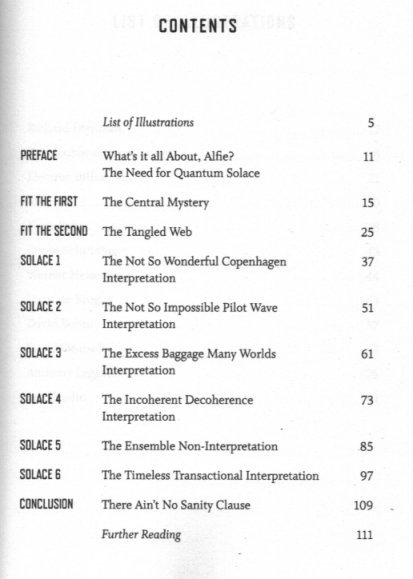
My local public library is very good at offering new books. You might like to take a look at this one that has just been published. https://www.amazon.co.uk/Impossible-Possible-Improbable-Science-Stranger/dp/1785788825 The book is divided into the sections, as per the title. The first section deals with QM and in particular interpretations of QM from Copenhagen right up to the present day. Localism, realism, Bells, Hidden variables and many famous names are all discussed. Of particular interest are six different interpretations of QM, superposition, entanglement, etc. Here is the expanded contents list for this first section.
-
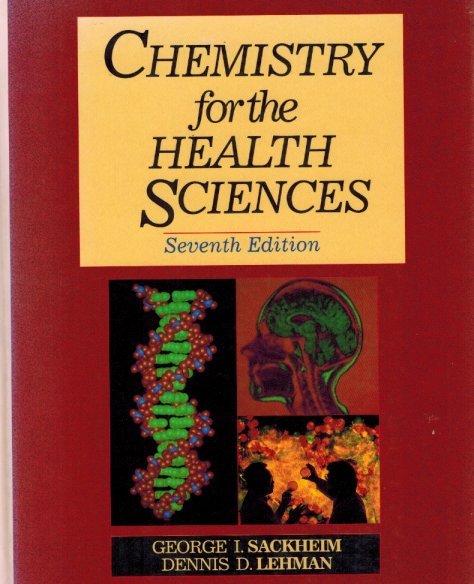
Rather than wade through a lot of organic chemistry that is of little interest to you why not try something like the latest version of this ? Other tnagential approaches might be the Oxford books on Physical Chemistry for Biochemists and Pharmaceutical Chemistry. Come back if you want more details.
-
Although a true statement, I have absolutely no idea what this means here or is relevent to.
-
I realise that English is not your first language but your English is pretty good all the same. So I am suprised how completely you have misread my entire post. I am sorry it was not more clear.
-
Whilst I agree with your sentiment, I can't fully agree with your reasoning. +1 The sentiment expressed in both your posts suggests that we should be (collectively) making much better use of the resources our planet provides. +1 I have been saying this since I first took an interest in the 1960s. But surely the worst offenders against both global pollution and weaponisation are actually also the least democratic nations ? Democracy is undoubtedly a less efficient organisational method in some respects, but it remians the best, perhaps the only, defence we have against totalitarianism. As such, those who enjoy it are prepared to accept the increased 'cost' of deploying it in some form. Finally I think you once mentioned that you are in Poland. Do you not find it ironic that Poland now finds itself better placed to reject Russian gas than Germany, becuase of its insistence on maintaining its brown coal power source ? I also agee with MigL. +1 We need to do two things; one short term one long term. Both of these are consistent with the long term aims of 'making the best uses of our resources' sentiments. But we also need to take more responsibility for our individual and collective actions, and not try to shove them off onto someone else. Sadly I don't see this revolution happening any time soon. Sadly short-termism will hold sway for a long time to come.
-
Fixed.
-
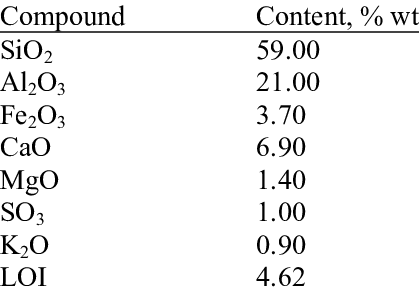
I asked you a simple question to which you have not made any reply. All you have done is repeat your early claim more strongly without any support whatsoever. So I will make it eay for you. The waste material from coal burning is called PFA (pulverised fuel ash) or fly ash. Far from being worthless it is a useful industrial material in its own right as it is pozzolanic. To make it easy here is a breakdown of the minerals in PFA https://onlinelibrary.wiley.com/doi/abs/10.1002/jctb.2720240405 The reaction of calcium oxide and carbon dioxide. This will lock up some carbon dioxide, but will not make any progress towards turning the waste into arable soil.
-
Thank you for the information. The Wiki article you linked to seems to suggest fracturing would be needed.
-
@Ayub Umar Whilst I think you suggestion will do far more harm than good, it is really good that you are thinking about soil health. The continued reduction of soil health over large swathes of the planet is a hidden danger for us all. https://www.bbc.co.uk/news/business-63283986
-
The point is we want numbers not hand waving. If you go to your bank manager and say There are lots of cheap bananas and coconuts in the Windward Islands. I want to make money by buying them there, taking them to New York and selling them for much higher prices. He will say What is you business plan ? I want numbers. How much do they cost? how much can you sell (some) of them for? How much wastage and unsold stuff will you have? What are your storage and transports costs? What are you import regulatory costs? What are you staff costs? It's the same with Science and Technology. It's up to you to show the true maths, not offer wishy washy statements like
-
And I did ask for an example of this 'anything' , whilst at the same time pointing to a well respected treatment of QM, involving plenty of imaginary and/or complex numbers. But this is taking the discussion away from the key statement Yes I am aware of extension algebras and arithmetic and I know tha there are some pretty exotic creations floating around there, but I am not very adept at them. I was always given to understand that for every gain in one direction you tend to loose something in another when you add to algebraic complexity.
-
Entirely ? I don't think so. But then I don't think you mean quite that literally. Nor are real numbers entirely commutative either. For example multiplication and square rooting are not commutative 2.√3 is not equal to √2.3 They are both commutative for either of the two operations of addition and multiplication as befits their status as Fields, which I believe I mentioned. But QM commutation is about the commutation of two different operators. So can you detail your real operators in QM that do not commute ? The dreaded 'i' seems to appear lots in this treatment. https://quantummechanics.ucsd.edu/ph130a/130_notes/node109.html Maybe the factorisation was stretching things a bit far as composition is involved, but I can't see what you mean by this How is (1+√5)/2 an element of an integer ring, when division is not closed with the integers ?
-
Actually there is more to what Markus said than meets the eye. The twist in the tail of using complex numbers in QM lies in non cummutativity. The 'full' set of complex numbers entail numbers of the form a + bi, where a and b are real numbers. Both the real numbers and the complex numbers formed this way form an algebraic Field and enjoy all the field properties, including the 10 Field axioms. One of the most important consequences is the unique factorisation theorem which guarantees unique solutions to all alegbraic equations in one of these Fields. Now Gauss discovered and did a lot of work on something simpler, we now call 'Gaussian Integers'. These connect ordinary integers with Gaussian integers in the same way as the reals and the complex numbers. So if p and q are integers then p + qi are gaussian integers. Now neither the ordinary integers nor the gaussian integers form an algebraic Field. They only satisfy 6 of the field axioms. But they do form a more general algebraic structure called a Ring. Some rings such as the integers still satisfy unique factorisation so for instance the only factorisation of -28 is -(1x2x2x7). But in the ring p+q√5i, the number 6+0i factorises as follows:- (2+0i)x(3+0i) and also (1+√5i)(1+√5i) Such rings of complex numbers fail to satisfy unique factorisation - essentially a quantum behaviour.
-
That's exactly right, well done. +1 'Complex' means made of more than one part and as you say 'The Complex Numbers' are made of two parts. What did you think of the other information poeple provided ?
-
Thank you for your further reply. This is your thread and your proposal. Whilst it is interesting to discuss generalities, it is up to you to explain the chemistry of how it works, especially in the Chemistry section. But so far you have only offered generalities. If you injected carbon dioxide into any type of earth material, what chemistry would be involved to keep it there ? Why would it react at all rather than just dissipate ?
-
My apologies that equation should have been 20x2-2x+1=0.
-
If the armour plating on a tank or a battleship is insufficient shielding against an EMP weapon, I doubt you could shield you computer. It has been suggested that old fashioned valve technology is more resistant than modern semiconductors on account of the very much higher breakdown voltages/field strengths involved.
-
You have posted this in Applied Mathematics, and it is true that most if not all applications can be handled in other ways. Perhaps you do not know the role played by complex numbers in Pure Mathematics. Perhaps the simplest answer is that number systems were developed in sequence starting with the simplest counting numbers, Going through systems including The full set of integers. The ratioanl numbers (fractions) The real numbers The imaginary numbers The complex numbers (do you know the difference between imaginary numbers and complex numbers ? What does complex mean ? Now each of these systems was introduced when it bcame apparent that there were equations in the simpler system, that had no solutions in the simpler system. For instance the equation 2x = -30 has no solution in the counting numbers or the positive integers, the equation 2x = 1 has no solution in the integers, the equation 2x2-20x+1=0 has no real solutions - both solutions are complex. So complex numbers are necessary to provide solutions to all quadratic equatuions. Some equations of higher order do not even have a solurion formula withoug involving complex numbers. It is just fortunate happenstance that having developed complex numbers they find many useful applications elsewhere. Of course the process has not stopped there, there are even more complicated 'number' than complex ones.
-
I was going to put my reasoning for my statement into an answer in the 'movement without time thread' , but the OP there seems to have lost interest. So I will just point out that some (very important) equations of motion have time independent solutions.
-
Others have already commented on the unwanted chemical side effcts of your proposal. +1 each. So I will concentrate on asking how you would achieve your desired ones. How would the chemistry of 'infusing with carbon' work ? What would be the production rate of such a process and what would ecological transport costs of placing it somewhere useful ? Why would you need a greenhouse-like structure ? Why would an ordinary shed not do and how big would that shed be ? I would just like to add that Drax represents one of the biggest cover ups of wasted public money and effort in our history.