studiot
Senior Members
-
Joined
-
Last visited
Everything posted by studiot
-
Of course they would, but I'm not talking about their publicity department. They certainly invented Nylon and ICI held a licence for its manufacture in the UK. But after the war the Sherman Act cause bitterness and much litigation over this licence. Wikipedia will do https://en.wikipedia.org/wiki/Polyethylene_terephthalate#cite_note-9 There is a facebookmemories group you might be interested in for the now defunct ICI fibres. https://www.facebook.com/groups/332552444829415/ Perhaps there is one for Du Pont ?
-
+1 for your usual clarity of insight.
-
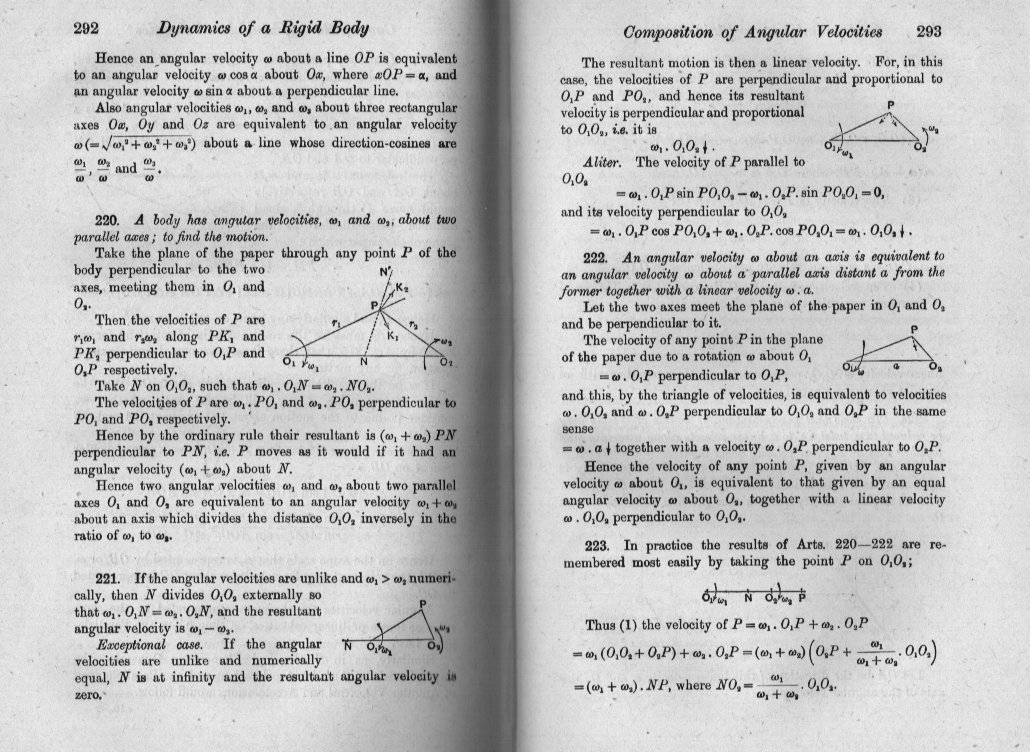
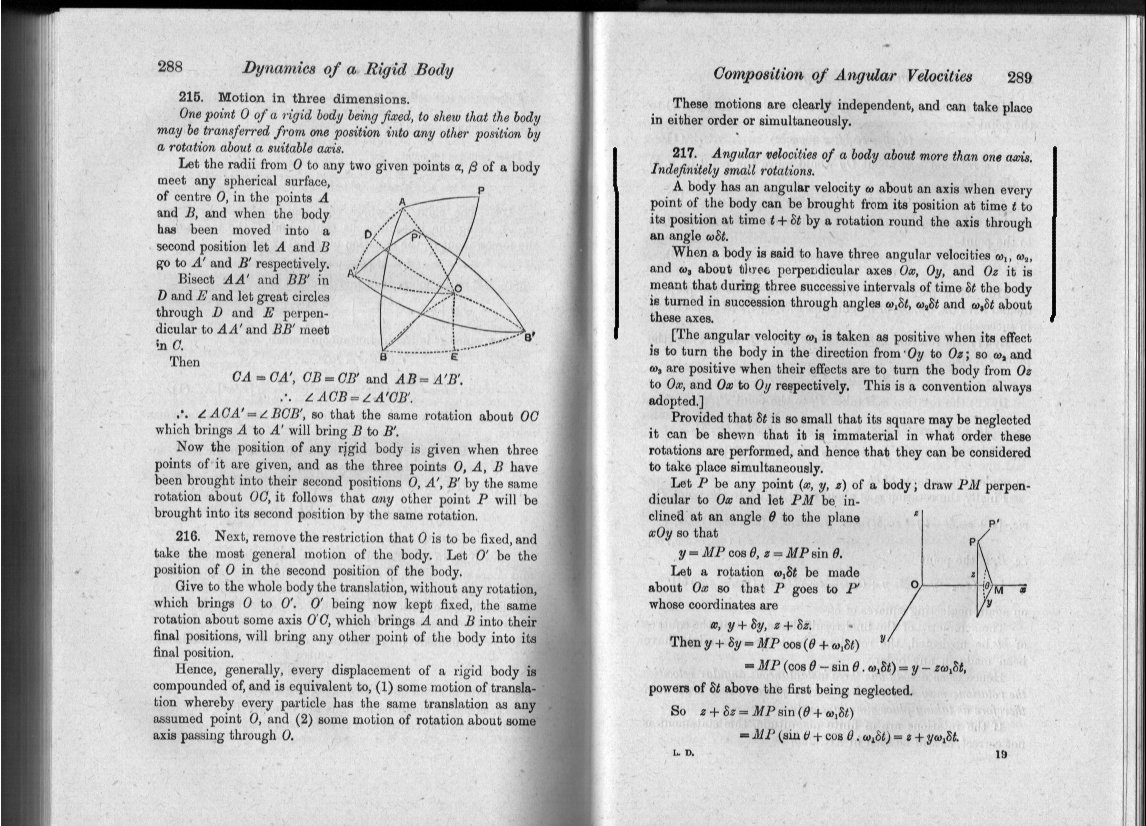
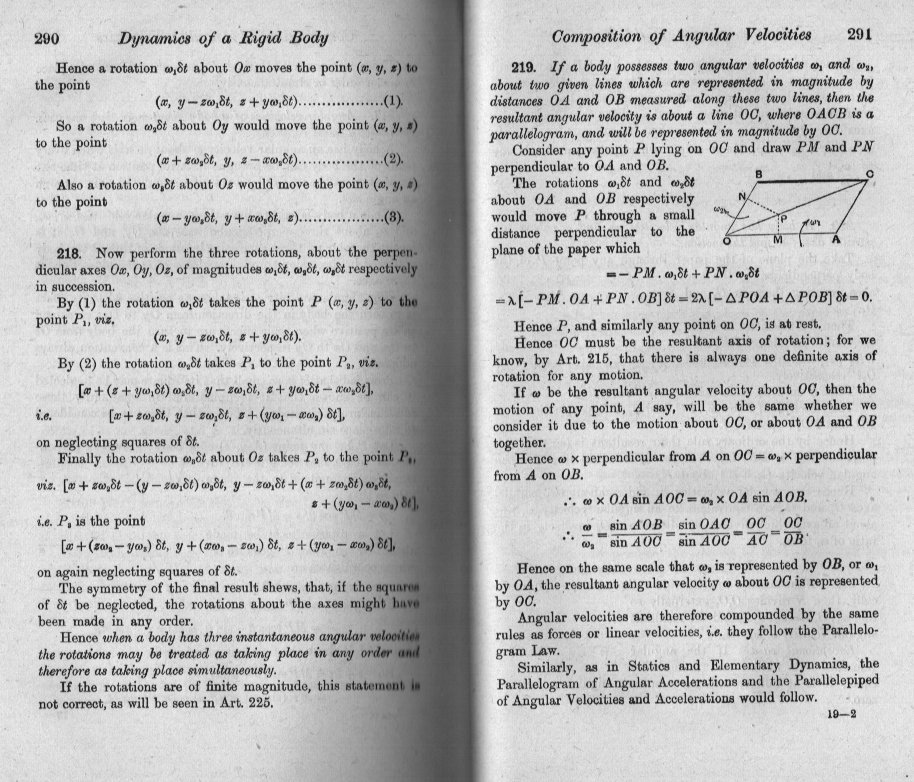
Yes and no. There are real mechanisms that work using separate rotation axes so it depends upon your frame of reference. Have you heard of Hooke joints or of gimbals for instance ? They are pages scanned as jpegs. click on them to expand to full size then just download from the site page.
-
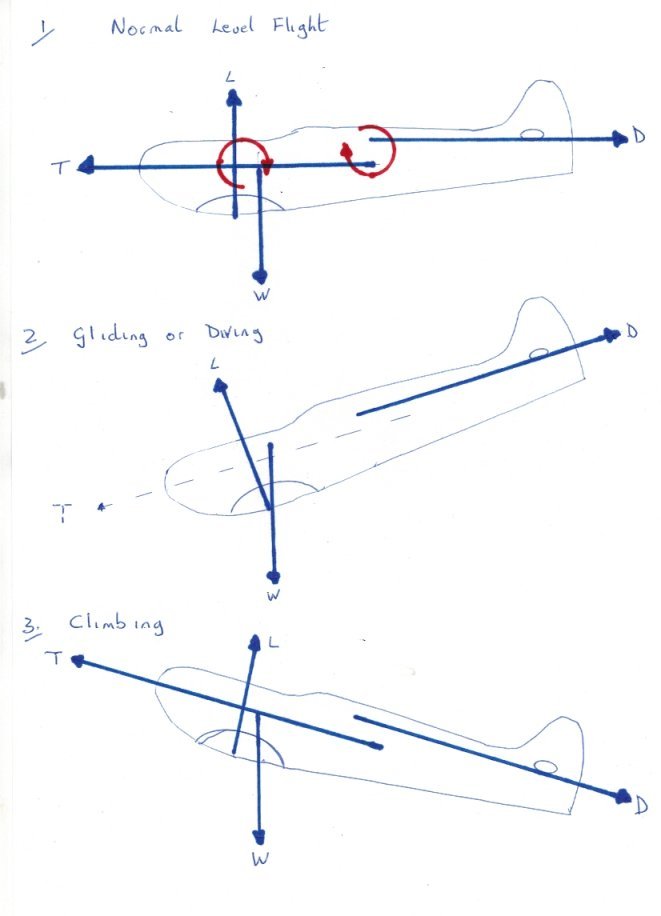
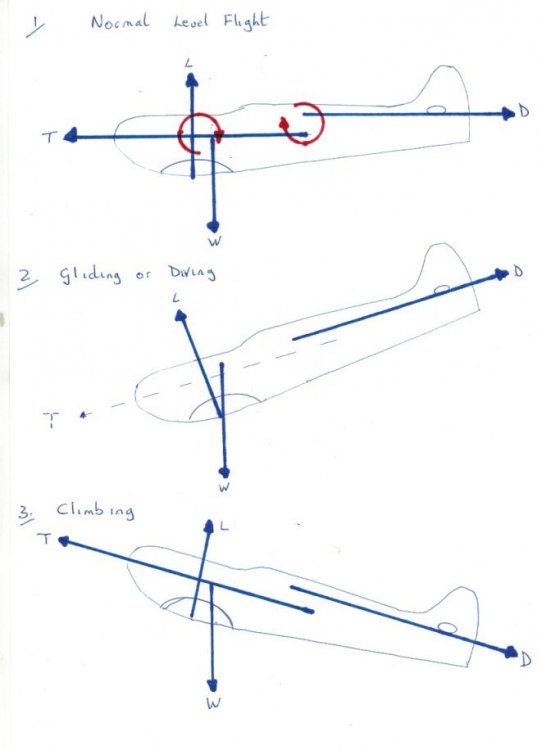
@jfoldbar To continue with my four forces theme here is a diagram to show how they affect an aricraft in flight in the three basic different situations. Do you wish to discuss and understand these before worrying about how they are generated ?
-
+1
-
But you must have more interesting tales you can share from that time ?? +1 As a matter of interest I recall being taught that Dacron was acquired by DuPont from the pre-ICI who invented the stuff (then called terelene). We understood that the US had nylon and the UK had terelene.
-
The moderator moved this to the politics forum, but this still remains a scientific website and the rules say the religous section is for the scientific discussion of religous matters. It would be scientific to note and discuss the difference between certain christain denominations in respect of trans-substantiation beliefs, but not to look for justification in believing them or to mock them or supports them.
-
Nice calm replies to some needlessly imflammatory unscientifc words. +1
-
Many thanks for all that new information. +1
-
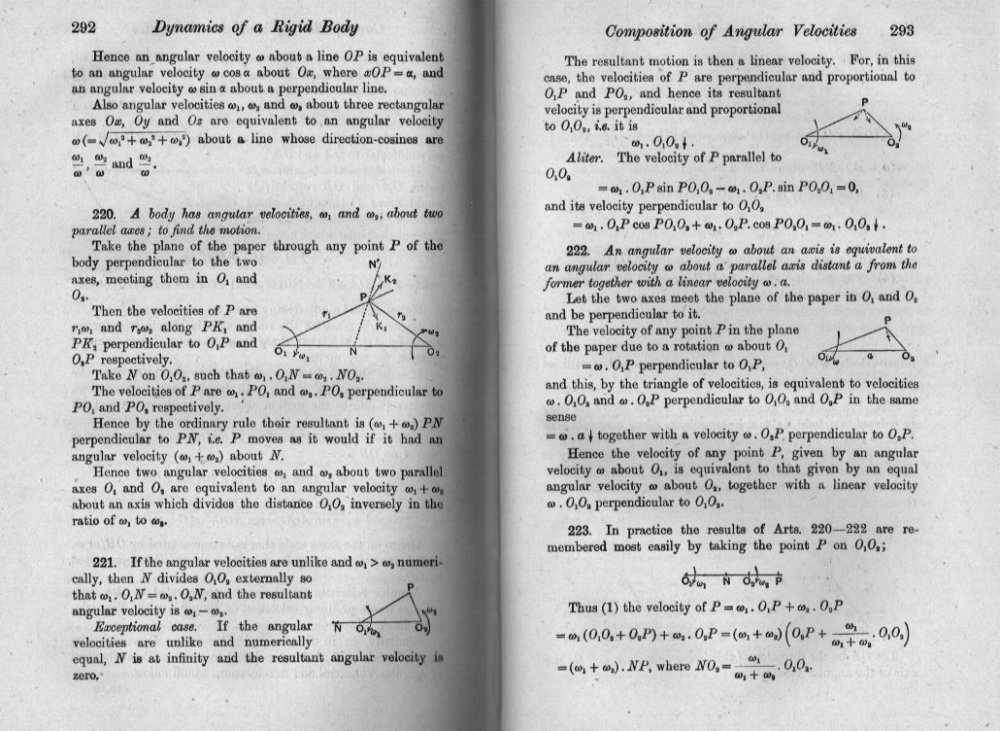
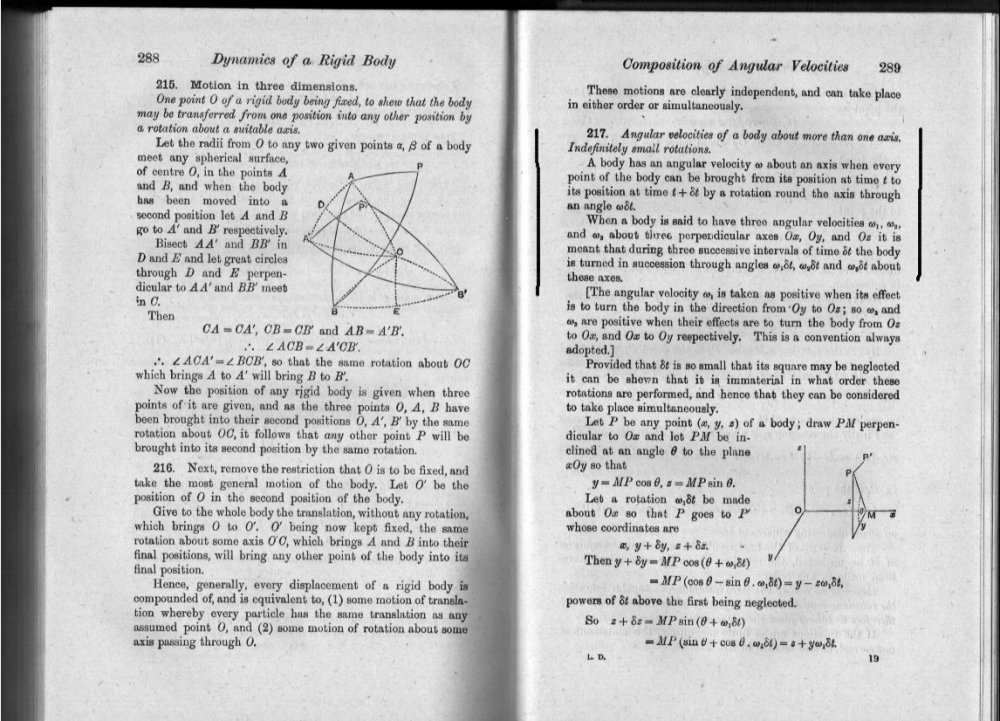
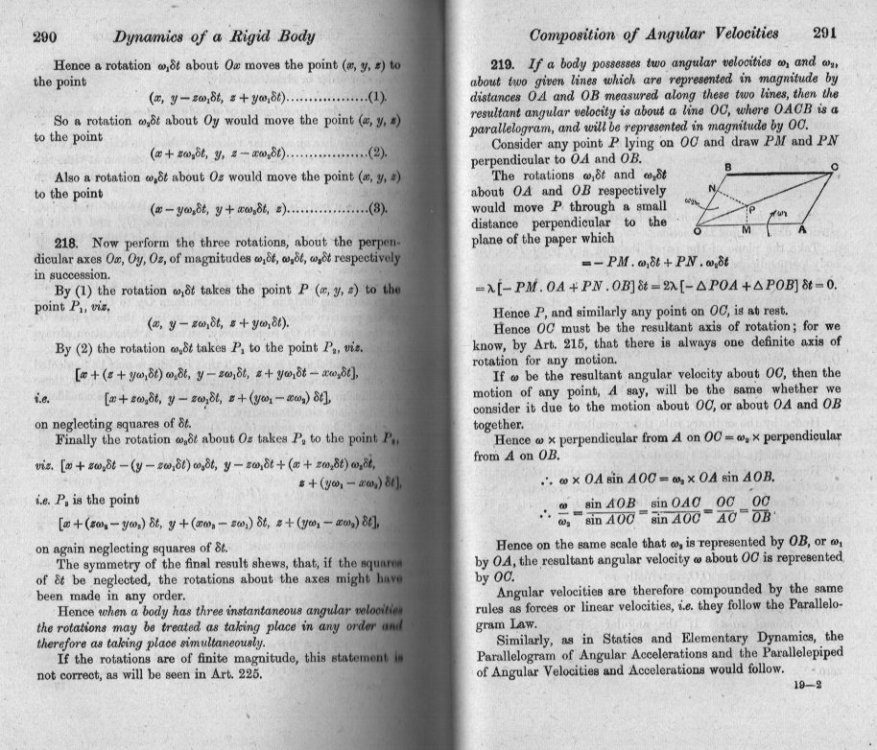
OK so here is the simplest form of Maths I know for this subject. I have marked the starting point page 289, article 217 - Angular velocites of a body about more than one axis - on the first attachment. You will need some simple calculus and trig.
-
At my local supermarket

-
This is all perfectly true but nothing to do with the question in hand which concerns something which is spinning with angular velocity omega about an axis. Your quote concerns the difference between rotation through some finite angle and some infinitesimal angle whereas the angle rotated thorough by spin is unbounded.
-
Yes, vector combination is quite basic. So, having sent a sphere into 3 separate rotations would have the same effect as a simple rotation along a single axis ? This is completely counter-intuitive. How a single axis would be selected in relation to the other 3 ones then ? Intuition can be a misleading process. The relevant theorem is the original version of Poinsot's theorem which was originally stated in statics, long before vectors were invented. "Every system of of forces can be reduced to a single force and a single moment (torque) , either or both of which can be zero. " This gives rise the the two laws of statics viz that The sum of forces acting in equilibrium is zero. The sum of moments in equilibrium is zero. This can be widened to refer to vectors in more modern parlance and to dynamics where they become https://en.wikipedia.org/wiki/Poinsot's_ellipsoid The point being that any number of rotations can be compounded to become a single rotation resultant, just as any number of forces can be compounded to form a single resultant or net force.
-
Agreed it is hard to picture. Do you understand resolution of vectors into components ? And that you can equally achieve the same effect as the one vector by (re)combining those components ? Rotations are more complicated motions than linear vectors but the idea is the same.
-
+1 Perhaps we can put the whole thing down to a 'Samuel Taylor Coleridge' moment - as in Kubla Khan. Perhaps also your imagination would be better directed towards the arts than towards the sciences ?
-
There is a good account of this and other infinite products for trig functions in the penultimate chapter of Hobson's Plane Trigonometry, entitled Infinite Products, pages 338 - 373.
-
If you read the wiki article you should note that there are 3 separate angular velocities, [math]{\omega _1};{\omega _2};{\omega _3}[/math] about three mutually perpendicular axes. You can choose any such set of 3 suitable axes, even not perpendicular ones, but the transformation equations normally work the other way because the 3 principal axes of inertia present the formulae in simplest form (diagonal matrices if you work in matrix format). Of course all that is moot for a perfect sphere because any axis is a principal axis and the others follow by symmetry.
-
Thanks for replying I was just trying to row back a little on the discussion, which was getting rather esoterical. OK so in lower high school (GCSE) enough Physics is introduced for someone to understand but not fully appreciate the mechanics of flight. Anyone with upper high school ( A level) physics should be able to appreciate fully. For some reason nearly all treatments of flight mechanics launch straight into the issue of what keeps an aircraft up. In my opinion this is the hard way to approach it and also leads to a failure to take note of all the forces acting - something the early pioneers failed to do with as result in so many crashes, despite have enormous (by moderns tandards) wing areas. When a physicist talks about "The Four Forces" she means the four fundamental forces of nature and not what we need here. When an aircraft engineer talks about " The Four Forces" he means the four forces that control the mechanics of flight between them. These four forces are Weight, Lift, Drag and Thrust and all are required. (Before you ask, a glider with zero thrust needs a start velocity and eventually fall out of the sky, hopefully in a controlled manner) In my opinion it is best to start with these, just accept they exist, and postpone how they occur until you a happy with knowing how they interact to control flight. This is the approach taken by flight instructors to din these interactions into pilots, so they can 'instinctively' perform the necessary balancing act between the four. I was planning to offer this in more detail when you had responded, but I am about to go out for the day so I will look again this evening.
-
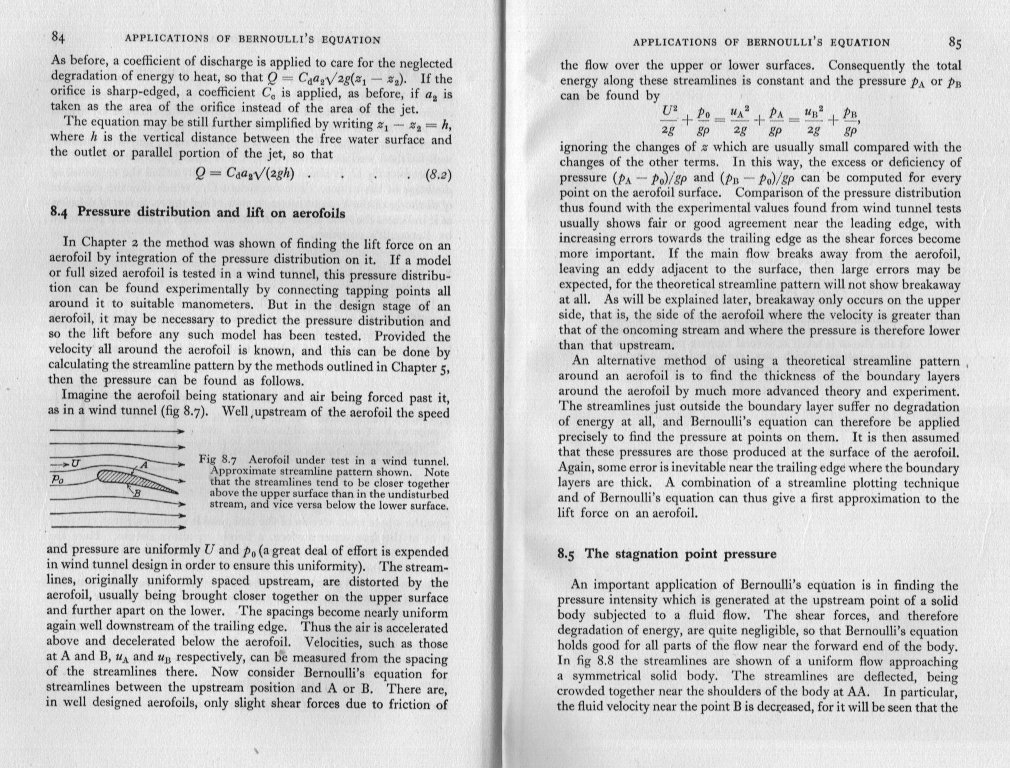
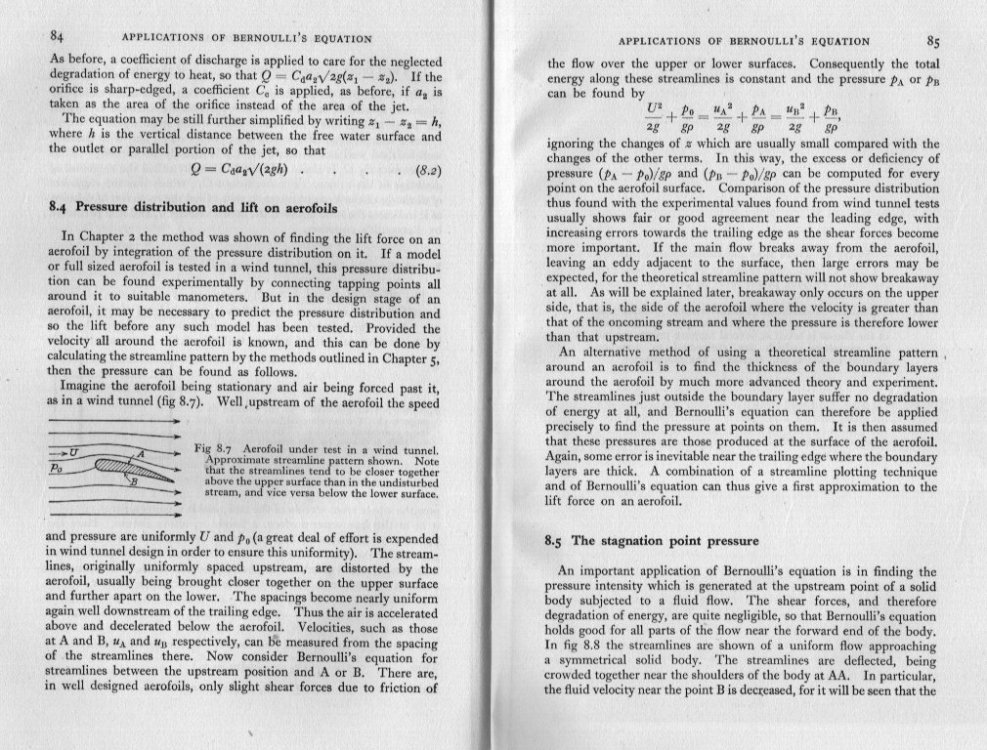
As you say the same result can be obtained by different routes. Here is a very simple derivation of the lift force from Bernoulli for @jfoldbar to aim at. It shows the angle of attack, the Bernoulli equation, the bunching of the flowlines I mentioned and explains the circumstances and the limitations of the model. The next thing to then do is to discuss the application of that lift force to the aircraft and the effect upon its trim.
-
I found the 5 page pdf safe to download and interesting. However the text reads more like a technical advertising document than a technical information document. Long on rhetoric and short on detail. Looks as though it could be a developemnt of mathematical flowgraph techniques, but with a call to manufacturers to implement the necessary hardware. Doesn't the modern GPU go some way towards this goal ?
-
I think both momentum and energy transfer considerations are needed. But you have to be careful with auxiliary variables such as velocity and resistance to movement as with the situation when calculating the KE of a bullet entering a sandbag or plank and apply the appropriate conservation law. I'm sure we really mean the same thing.
-
I'm sorry I have just watched that flawed YT video. According to the video if I stopped the flow by blocking off both ends of the pipe the wall pressure along the length of the pipe would vary with the diameter of the pipe. This would be contrary to experience. The problem lies in the explanation as well. It equates velocity of impact with pressure. But this is not the case since the larger diameter portion of the pipe will also have a large surface area to impact on and the impact may result in a large force, but that impact force will be distributed over a larger area and therefore a lower pressure since pressure = force/area. A further problem is that the video describes incompressible flow in pipes. Pipe flow introduces another complication - it is described by the poiseuille equation. There are no pipe walls in the atmousphere. Atmouspheric air flow is not incompressible except in very special circumstances.
-
I think this question is too wide / open ended to get very far because it has been posed in isolation. So far there have been several references to 'govern' you can't divorce and isolate democracy from government. Also fundamentally involved would be the legal system, and with it the aspects of rights and responsibilities of individuals. I think pretty well everyone would agree that it makes sense to give someone or group the power to decide on 'the rules of the road' for highway purposes, although I have lived in a country (not a democracy) where this was not so. We don't really need a democratic vote to decide which side of the road we drive on every time we go out. But such considerations then lead on to methods of enforcement and the 'powers' granted to persons or groups. And by whom and how these powers are endowed.
-
Need more details please.
-
+1 But there is more to the issue than this. The design and implementation of even the simplest computer/software system needs phase of testing on examples with known outcomes. The greater the complexity of the process being computed the greater the risk of unforseen interactions resulting in unwanted outcomes. Thus the greater the complexity the greater the need for more wide ranging yet intensive pre implementation testing. Far too many large 'database' projects have foundered on this rock and AI is no exception. So how much testing would be required for you proposal and how long would that last. How strong would any guarantee of zero to low unwanted outcomes be ? It has been most illuminating (for me) to watch the implementation of computerised robot medicine selection from stock, packaging and labelling, ready for dispensation - and to see all the things that can go wrong with even such a limited objective.