studiot
Senior Members
-
Joined
-
Last visited
Everything posted by studiot
-
I think all this consideration is small compared to the fact that different parts of the Earth are rotating at different (angular) speeds and possibly in different directions.
-
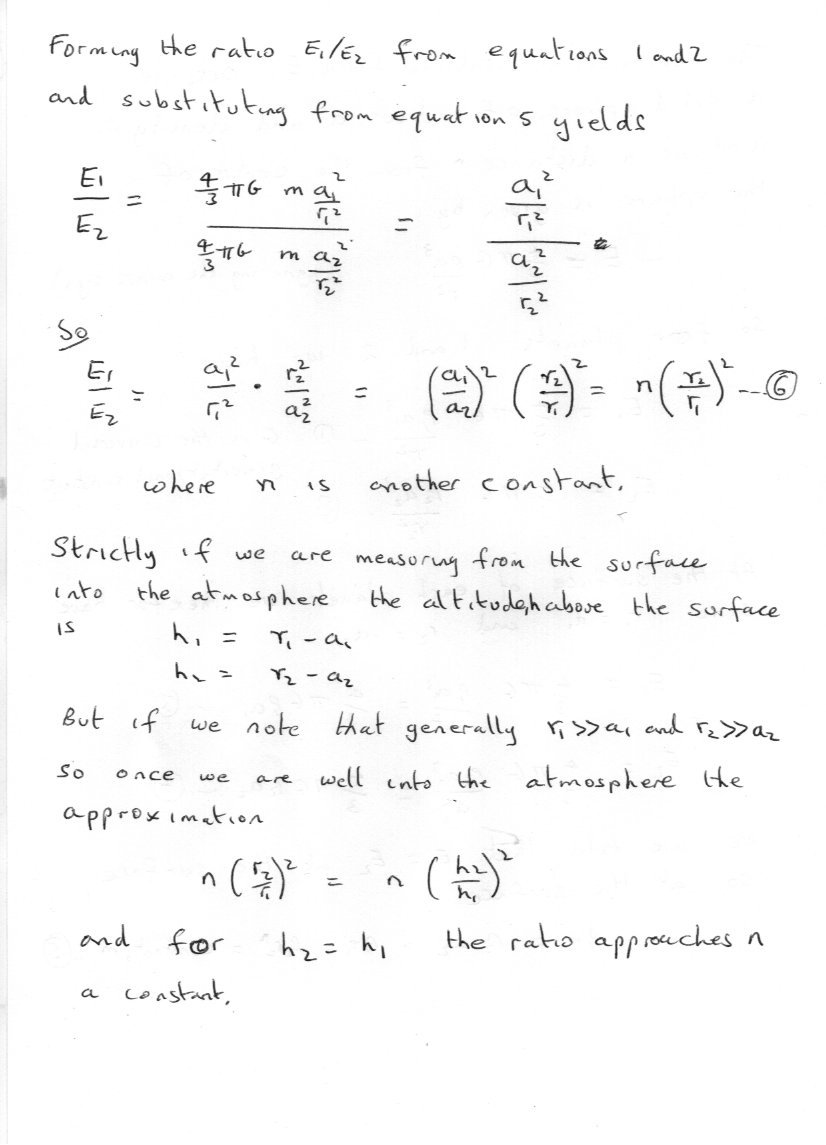
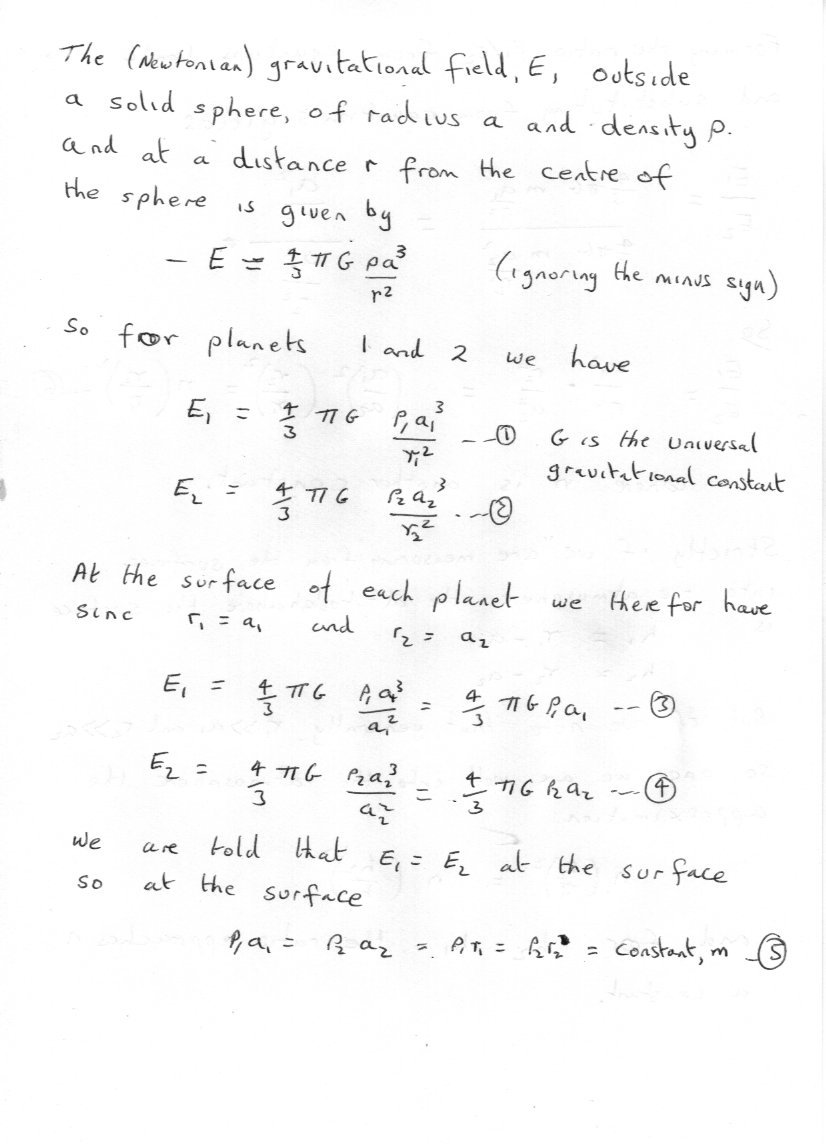
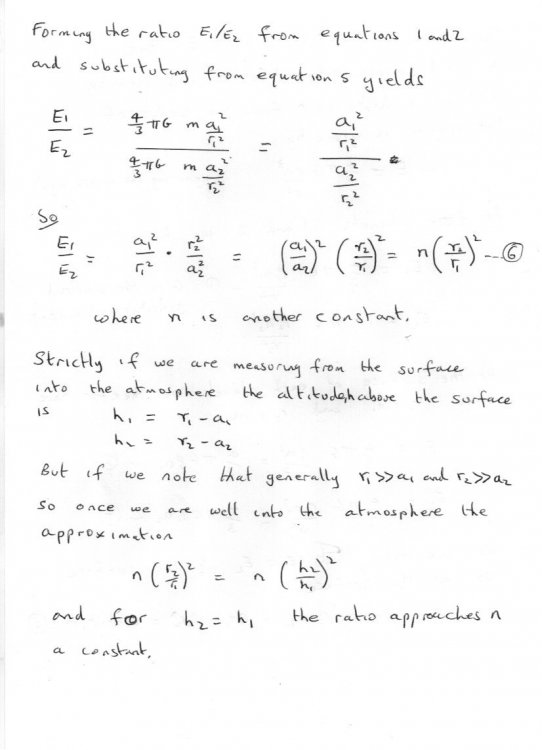
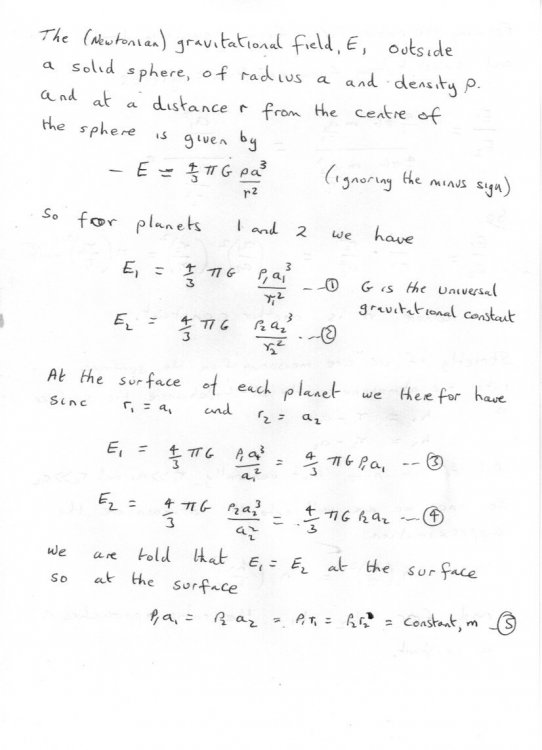
On first reading I thought only mass was involved, but on more carefull reading I see that you have incorporated density difference. I have now had the time to sketch out some maths.
-
Of course you can, the number is still on my website. However the last time I fixed Jesus' computer it was for eternity, so I would know immediately that the call was a scam. An fraud that has been going around quite some years runs like this, though there are several variations. A uniformed person or pair turn up at the front door of proababklly an elderly slightly confused person and claim that they are police officers who are tracking criminals who have hacked your bank account. Sometimes they can persuade the person to go to their bank and withdraw a large sum to place with the police as bait so they can catch the alleged criminals. Of course they simply make off with the cash in the "unmarked police car" and are never seen again. I have an elderly relative who fell for this one to the tune of £10,000 The problem then is that the politician, large or small, has someone else to blame when thing go wrong, but want all the credit when they go right. But even the bureaucrats play this game. UK ministries are forever employing 'arms length contractors' for this purpose.
-
With equal respect, it is quite a different issue from , as stated, a different article the previous week. But the issue that those who wish to be or become leaders must face is that they have to deal with all the issues that arise, not just some of them. And that is the point of this thread, references to news articles are just examples of the manyfold issue currently arising in the last couple of week. There is another one today about a serious case of hacking into the NHS.
-
Seems like small potatoes compared to the mass of eroded material brought down from the mountains by water or just gravity to me. I haven't measured it but not only is the mass small but the average leaf fall from trees is about 30m whereas rivers of say the Himalya drop severalthousand metres.
-
Weight loss ? Three phase? They must have been of the 5 - 2 diet And 5minus 2 is well three of course.
-
I note that swansont's press release refers to milliseconds of variation. Set that against the addition of leap seconds (last one in 2016, two in 1972) to the clocks to balance out variations in the rotation speed.
-
Thank you for your thoughts. I see you have nearly as low an opinion of top politicians as I have. +1 Not all the scams are computer fraud however, although last week we were treated to an extensive scam involving b__king.com. People were turning up at folks doorsteps saying "We have arrived for our booking in your property" Some property owners from London who were interviewed said that sometimes 3 or more separate parties turned up per day. Some of the scammed visitors came from Hong Kong, Australia, New York and so on and were left accomodationless and holidayless in the middle of London as the owner had never had anything to do with b__k.com or intended to let out their home. This continued in some cases for months after the scam was reported. So please don't plead the victimless crime argument.
-
Hi, Moon. I'm not sure why you homed in on the 'extensiveness' of the atmosphere ? As Janus points out there are many variables involved and it should be borne in mind that the importance of a planet's atmosphere does not depend upon its extensiveness. A fine example of that is the discoveries made by the New Horizons team in respect of Pluto, whose atmosphere was regarded as 'thin to non existent' before the spacecraft flew by. Now we know the profound effect this thin to non existent atmosphere has on that planet's geohistory.
-
Yes I think that's a good way to put it. +1 But wider still, not only can theory A be based on theory B but also theories C, D, E.... and still not the other way round. Thanks for that insight.
-
I don't suppose any of the current tory tinyminds in the leadership race will do anything about this scandal or if the even know or care about it. https://www.bbc.co.uk/news/uk-england-manchester-62494987
-
Seems rather less primitive than I was thinking. Surely you can only establish a connection if you can 'distinguish' the two elements ? And many so called basic operations such as counting can be mimiced by not counting at all but simply placing in one to one correspondence.
-
Thank you for taking my thoughts seriously, even though you disagree. +1 You make a very clear point. Nature of does something mor or different from our predictions. But not always and averages have a way of reasserting themselves especially over the longer term. Some comments I used the USA recent natural occurrences as an example, there are plenty more around the globe. I am disappointed no one has taken up my comments about the Indus and the Harappans. With specific reference to the UK, we are now moving into a patchwork of water restrictions we should not have. Unfortunately the politics is that we now have a patchwork of relatively small water commercial companies that are now largely owned by foreigners. This was due to the privitisation and fragmentation of the water industry that was gradually drawing together over the first 3/4 of the 20th century. We were told that privatisation was 'good because it would bring private investment' but, of course, that never happened. Companies, espcially foreign ones, are there to take money out, not to put it in. All they do is 'manage existing installations, some a hundred or more years old or more. There was considerably greater vision 150 years ago. Further there is a general lack of cooperation between the companies and between the companies and the general public, who rightly mistrust them. There are bright spots in this but they are few and far between. We also have a 'regulator' who finds is easier and more convenient to regulate the customers, rather than the suppliers. Because another 'obvious' engineering solution is to simply restrict customers access to supply. As a small country, with plenty more water than we need, and a substantailly reducing industrial demand following the demise of much of UK industry; We simply should not have a general flood and drought problem, though as you say Nature will still occasionally thwart us. The sort of (natural) drought we are now facing last occured in 1976 - almost half a century ago.
-
I like it. +1 But correspondence is more primitive than counting - which requires numbers. Consider the following. The Australian Aborigenes had a number system one, two, many. 3 numbers only. So they could distinguish but not count. Marked tally bones (there may have been tally sticks as well but these will not have lasted as well as bones) for 30,000 - 50,000 years ago have been found. What were they for ? Well perhaps the head of the tribe sent scouts out to mark a tally stick by scoring marks onto the tally in one-to-one correspondence with either goats they were herding or hunting or the war aprty from another tribe or whatever. Perhaps the headman could count but the scouts ? A matter of conjectures. These marks predate known cave writing, though not pictures. So the scouts were distinguishing and tallying. Mathematics is about a whole lot more than machine calculation and numbers, geometry for instance. How would your machine tell the diffeence between a square and a rectangle or discuss the symmetries of a snowflake ?
-
So you can't do mathematics without a CPU ? Thanks for the clarification. I still think that is too high a level of operation. Inow has a similar idea to mine, with 'division'. Mibne is still more basic though. The two most basic operations in maths I can think of are are 1) Distinguishing between two 'objects', say A and B. 2) Putting 'objects' into correspondence with each other. These two operations may have also been the start of language as well as mathematics. All the proposed operations above (by others) rest on these two but may be that someone can think of some more. This is a genuine discussion topic folks.
-
So how would you establish the equivalence relations greater than and less than in this system ?
-
Since I don't understand what you mean, I can't answer the question. But I don't doubt you will have a worthwhile opinion on the OP, when you explain.
-
The title says it all. What operations do you need to carry out before you can do any sort of mathematics ?
-
Speak for yourself and the handful of other like minded people. The rest of the seven and three-quarter billion people on the planet have more pressing concerns.
-
Yes martensitic stainles steels are usually magnetic, other types less so because they are usually low carbon and softer. High carbon martensitic stainless steel is high tensile, brittle and can take a keen edge. Normal stainless steel is of lower tensile strength and softer (more ductile) unless there are additional alloying elements such as molybdenum or manganese. The stainless part comes from having sufficient nickel and chrome in the alloy. But whilst chrome-moly alloy steels can be used for springs, they are often chrome-vanadium, with even some cobalt and or copper. https://www.coilingtech.com/chrome-vanadium-springs/
-
I think joigus has your answer but I would like to elaborate a bit further. It's very often the external pressure that counts, especially in chemcial reactions since the reactants in the open test tube are pushing against the armousphere, which is sensible at constant pressure. So this will be PV work done by the system on the surroundings. As joigus notes the internal pressure of the system is not measurable. Thermodynamics (first law) is about the energies and masses crossing the system boundary and you will often find the calculation easier on one side or the other of this boundary. Finally this is for irreversible work. A reversible change would be carried out so slowly that the internal pressure always has time to equilibrate at each infinitesimal expansion or contraction.
-
You have posted this in homework help. Are you working on some kind of project ? If so here are some more pointers. Babbage's wife, Ada Lovelace probably added more to computer theory than Babbage himself. But the great thing would be to separate the those who added practicality and those who developed theory. Both of these were needed in roughly equal parts. It is not known who invented the abacus, various civilisations in ancient history had some form or other. Later calculating machines were developed to, well to help calculate values for tables. Napier was the theorist and Outred the practical implementer (he invented the slide rule) Digital Theory probably started with DeMorgan. This is where Babbage came in with his analytical engine (the practical man) and Ada was the theorist. The next big development came before Turing's time and was still purely mechanical. Industry threw up the need for control of machines that required a series of steps. Hollerith invented the punch card system, which also started 'data processing'. Electricity was also beginning to make an impact and devices using electric switches (relays) followed by vlaves (american tubes) and then semiconductor devices were made. Von Neuman formalised the idea of 'the stored program architecture' originally using Hollerith cards and the modern computer was born. Turing did much theoretical work on the capabilities and limitations of such machines and invented the 'turing machine' as an idealised model. Now I have started your rehabilitation from the red marks with a +1 since you are showing some sense now. Keep it up and I hope you project, if you have one, goes well.
-
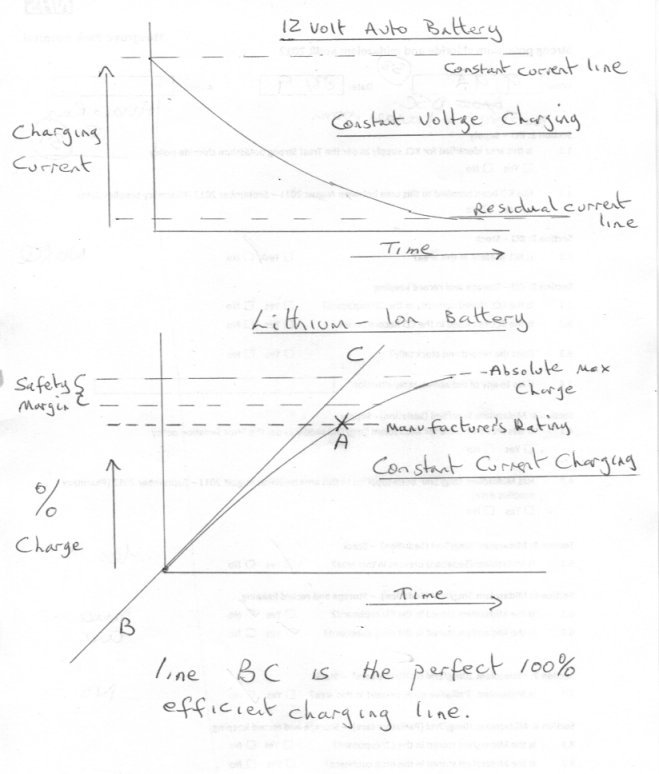
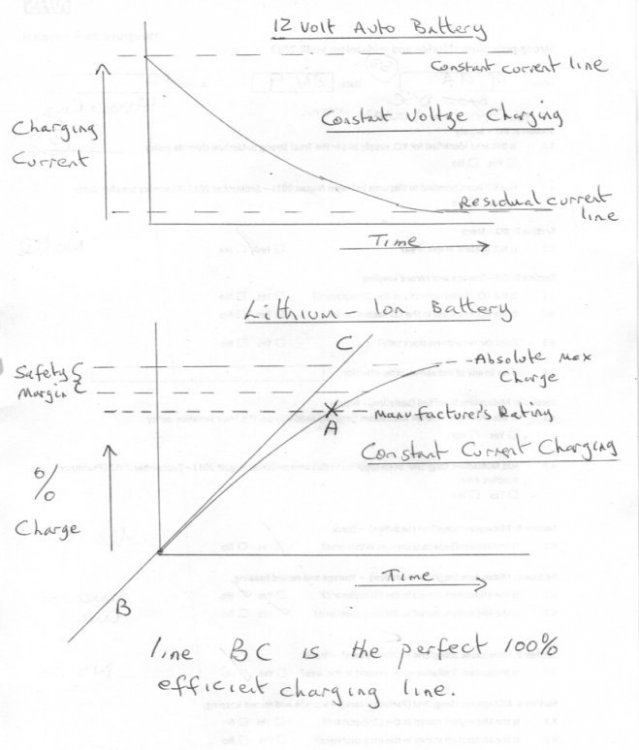
This should help. Exactly. That is what Erina quoted from Tesla So charging efficiency. I have attached two diagrams firstly the charging diagram of an ordinary common or garden 12 volt car battery. As can be seen the charger or alternator produces a (laughingly) constant voltage and the current is initially high for a discharged battery but gradually drops off as the battery voltage rises so the difference between the charging voltage and the battery voltage falls until the charger is just receiving a 'trickle charge'. This trickle charge can safely go on indefinitely. Processes within the battery dissipate the very small amount of energy safely as heat. Also since the charger voltage is only just higher than the battery voltage it cannot add further charge to the battery. Also shown is the dashed constant current line that sophisticated battery 'fast' chargers operate. It is not safe to try to pump the high initial charging current into the battery so when the finish point is reached this type of charger switches itself of and perhaps disconnects the battery. Lithium ion batteries can also be charged in this manner but constant voltage charging is slow especially when the amount of charge to be added is considered. So they use constant current charging and sophisticated controls which stop the process at the point A on the curve. Now an EV battery is much higher voltage than the old type - the Kia is over 300 volts - so the safety implications of overcharging are much more serious. Also there will be statistical variation in the absolute capacity from battery to battery. So the manufacturer rates the battery below this point and I have shown the statistical safety margin above this on the curve. But note the curve also turns over compared to a straight line 100% efficient charging, just as the 12 volt battery did. I have also drawn line BC to show this 100% efficient charging line. Now the further up the curve you go the further below 100% is the charging efficiency. So where the manufacturer places their battery rating on the curve determines the charging efficiency. The Kia is a cheaper car than the Tesla so I expect that they can less afford to offer a generous rating and are pushing their batteries harder. This would imply that their charging efficiency suffers comapred to the Tesla.
-
You have a PM. Carbon dioxide concentration is fourth on the Cambridge list of 24 atmospheric gases and particulates and stood at 384 ppm in 2007 with an annual increase over the previous decade of 1.65 ppm. Ther primar source (referenced) was NOAA. So something over 400 is hardly suprising today.
-
I'm sorry I still don't understand this. A formula is not a number. Perhaps there is some translation problem ?