studiot
Senior Members
-
Joined
-
Last visited
Everything posted by studiot
-
Yes I see it at the end of the address bar. But how would my browser know which post I was looking at ? For instance it shows blah-blah-blah/6/#comment-1229858 for every post on page 6.
-
Very clear thank you. Clear that you have classed all combustion engines as not being heat engines.
-
All I see is a yellow (ish) box with a date and time popping up. But if you really have found a numbering system that would be marvelous.
-
Not necessarily. Some chemical reactions evolve or accept either work or heat or both sometimes with a temperature change, sometimes not. You made no answer to my previous post so this is the last time I attempt to help you.
-
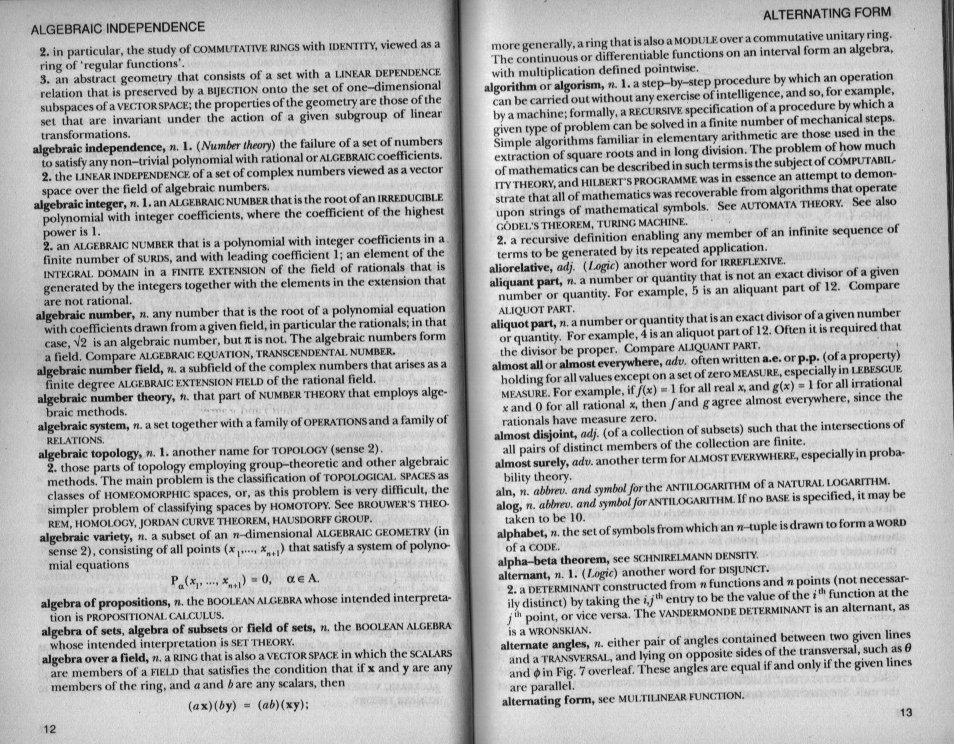
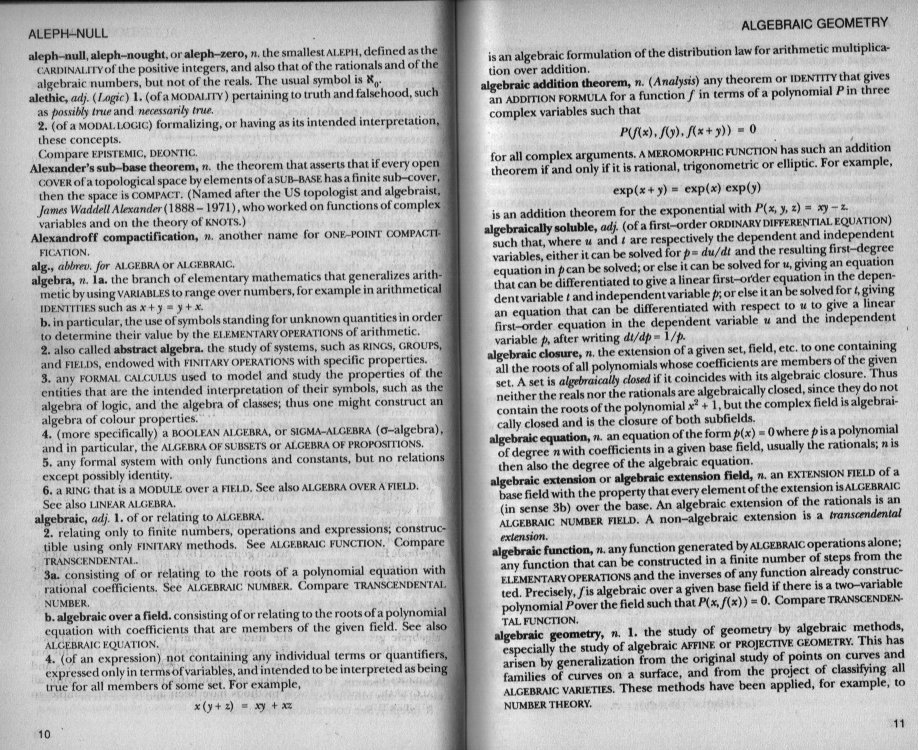
Yes, a groups is simpler and more basic than a field. If you can demonstrate the set elements forming a group, your propsed field can inherit group properties to satisfy field axioms. Field, group, algebra are some of the many words that combine with others into specialist phrases. Here are some useful definitions for you in algebra and number theory.
-
Not always, no. What about the heat of combustion ? What about latent heat ?
-
I didn't say that was the reason. It wasn't. And I didn't say they were wrong full stop at any point, not a courtesy to extended to me. I did say they were not completely correct. I also indicated that others in this thread made some good points as well as some less good ones. Yet you singled me out in most of your posts for uncouth personal comments. So yes I will remain a 'baby' if that is the way adults behave these days.
-
Reference please. My opening article said and I quoted
-
Most definitely a great summary. +1 We have all missed points here which is why the wind loading design codes offer exactly this. For example CP3, Chapter 5 in the UK offers 1) From the map of standardised wind speeds and modifying tables choose the design wind speed, V, appropriate to the location. V is in m/s 2) Calculate the 'dynamic pressure' , q from the equation q = 0.613V2 N/m2 The coefficient 0.613 is not dimensionless but enjoys suitable units of conversion. This will yield a pressure similar to Seth's calculation, but for different reasons from either his or mine. The history of wind loading in UK structural engineering really starts in 1879 with the Tay Bridge disaster. It is interesting to note that in those days responsibility for meteorolgy rested with The Astronomer Royal, then Sir George Airy. The bridge designer, Sir Thomas Bouch wrote to Airy, requesting a pressure loading figure and received a written reply of 10 pounds per square foot But he hastily revised this fugure to 120 pounds per square foot, following the disaster. Bouch, however collected all the blame. Subsequent to this a whole series of experiments were carried out at the National Physical Laboratory relating loading to building shape and size during the later 1880s and 1890s. This led to the CP3 figure, originally in imperial units along with a bunch of modifying factors. So I disagree that there is nothing worth discussing here, so long is it is not in such inflammatory language. The mechanics of this must be Newtonian so we have all missed points here, myself included and we can all benefit from acknowledging the contributions from all concerned (including those not mentioned in this post) as no one was completely right or completely wrong.
-
This whole discussion seems to me to be a rather silly argument. Energy is not destroyed when work is done. It just goes somewhere else. The concept of heat as a substance was replaced by the concept of 'internal energy of a system'. All systems have internal energy. When they do work or transfer heat this becomes an increase in the internal energy of another system (generally called the surroundings). This increase in the internal energy of the surroundings is matched by (equal to) a corresponding decrease in the system doing the work or transferring the heat. Energy itself is not a substance, it is a property of a system. Internal energy can be held within a system in several different ways, which we distinguish as different 'forms' of 'energy'. This concept leads to one version of the First Law as The energy of an "isolated system is constant", which is consistent with the more oft quoted dE = q+w. @Tom Booth I suggest if you genuinely want further understanding then you study the terms open, closed and isolated; energy, internal energy, potential energy, mechanical energy, electrical energy, so that you can put these concepts into their proper place.
-
Did I ? Please quote the passage since this forum insists on not numbering the posts. In order to show that some set S constitutes a mathematical Field it is necessary to prove that S and its elements satisfy each and every one of the 11 Field axioms. https://www2.math.upenn.edu/~kazdan/202F13/notes/FieldAxioms.pdf If it is a field with extra properties these are extra axioms that will also need proof. But remember each and every axiom must be proven satisfied.
-
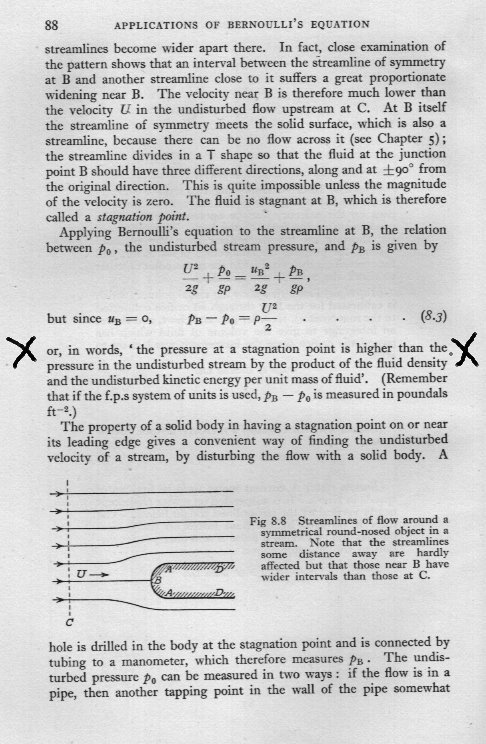
I don't wish to enter a person slanging match with anybody. So lets clear up the stagnation pressure once and for all. I have indicated the relevent theory and the factor of 1/2. So Seth's formula is the overpressure above normal stram pressure, which has not been included
-
That's why I have given up on this thread a long time ago. +1
-
Perhaps you would like to elaborate on this wall of yours, and what you actually want to know. The dam wall I was thinking of is 90metres high and 500 metres wide. Wind loading analysis can be very complicated and what I offered was the beginning of it to try to connect the quantities you mentioned without calculus, for understanding purposes. Winds are normally specified by a general incident pressure and a host of shape and other factors that control the wind regime. The resultant load is of course forces and/ or moments. I say moment because it may be that for a brick wall the wind pressure can cause unwanted tension in the brickwork, which cannot support tension.
-
? ? Why indeed I don't recall mentioning them. You don't seem to have anything to say about the bog standard fluds calculation.
-
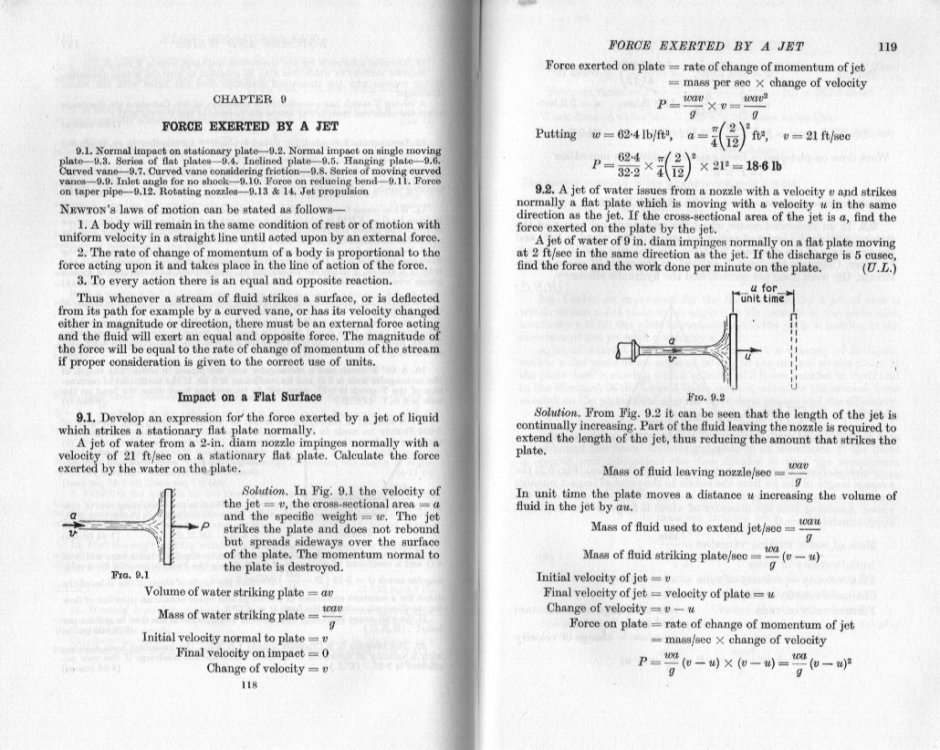
Every fluid element is travelling at the winf speed v, until it is brought to rest by the wall surface. Therefore every element has the full mass x velocity momentum There is no averaging factor of 1/2 for momentum, only kinetic energy.
-
Bernoulli is an energy equation. Unless the wall moves, which we are not considering here, there is no energy loss by the wind 1/2mv2 is conserved. Energy, pressure and volume are of course all scalars.
-
OK so here is my critique of the video. Firstly this question is not a high shool question it is university level. But at whom is the video aimed ? Well at the end he talks about the "Physics coolkids club", implying an intended school level audience. Yes I'm sure he knows and many of my comments would be quickly picked up by un undergraduate physics class. So he starts by introducing the index of refraction, as a measurement of the observerved slowdown, but then only uses that index for a flashy optical illusion that I rather like, though I question its worth in the explanation. He states, without support that the index is a measure of the slowdown. Then at 3 minutes in he says there are two completely wrong explanations going the rounds but does not say that both effects are actually observed fact, although, as he rightly says, they do not contribute to the slowdown. A junior audience might be forgiven for believing that neither scattering nor absorbtion actually occur. In dismissing both these explanations he uses both good animations with spreading or fuzzy light rays, and poor ones looking like 1950s atromic representations. In particular he shows both scattering and absorption by the nucleus only an fails to distinguish between the nucleus (red dots) and the whole atom. What makes it worse is that he lated describes glass as made of atoms surrounded by electrons. How's that for confusing the coolkids club ? Then he correctly introduces his explanation as a wave explanation and again correctly shows how two waves of different velocities can be combined to form a new wave of slower velocity than either of them. But in his explanation both his waves are going in the same direction. He ignores the fact that the electrons (which actually produce the random scattering not the nucleus) will be travelling every which way but loose ands so any wave their interaction produces will be just as randomly oriented. He also says that light is just oscillating electric fields, again suggesting to less experienced minds that there is no magnetism involved. At around 8.00 he correctly says that electrons experience a force from an oscillating electric field and move under the influence of this force, in turn generating their own electric field its their own new wave. But he does not say why this new wave has a different velocity from the driving field, which was his condition for the resultant being slower. At 6.37 he introduces superposition, but does not mention Huygens principle. So all in all I do not feel that this video provides a satisfactory explanation, although it does satisfactorily rules out a couple of others. Since he does say that a new wave is generated, he is marginally better than the others, but also hides missing pieces of his own explanation whiils overcomplicating parts of it.
-
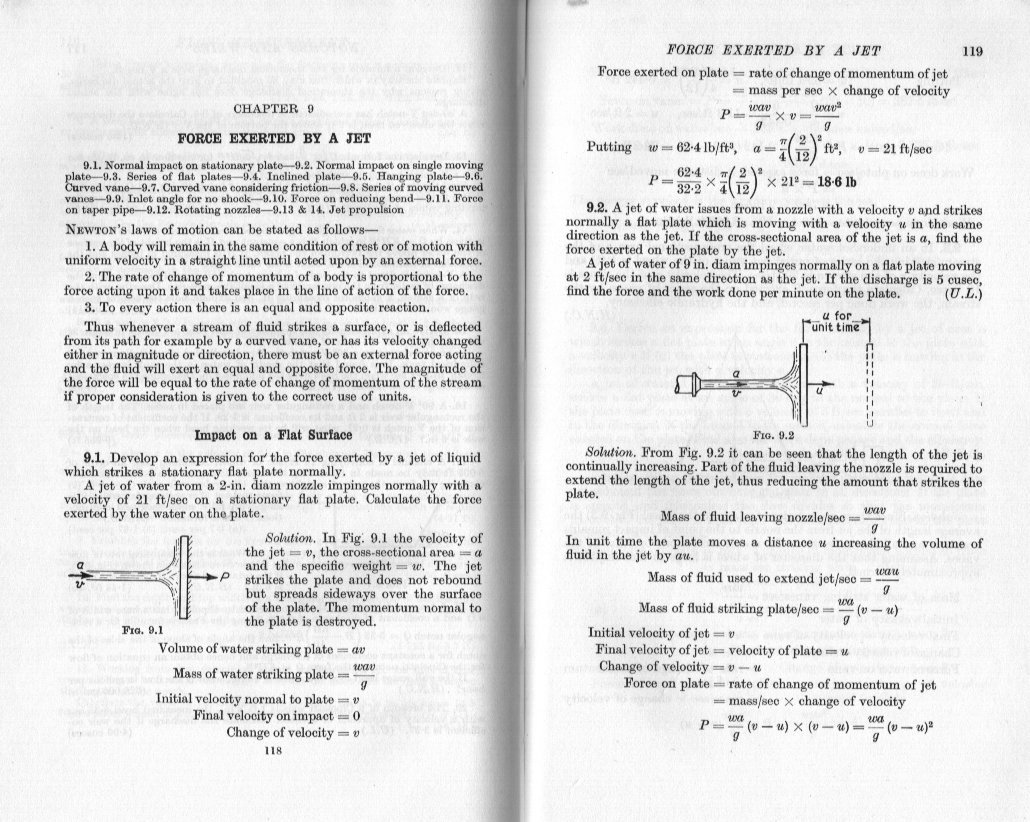
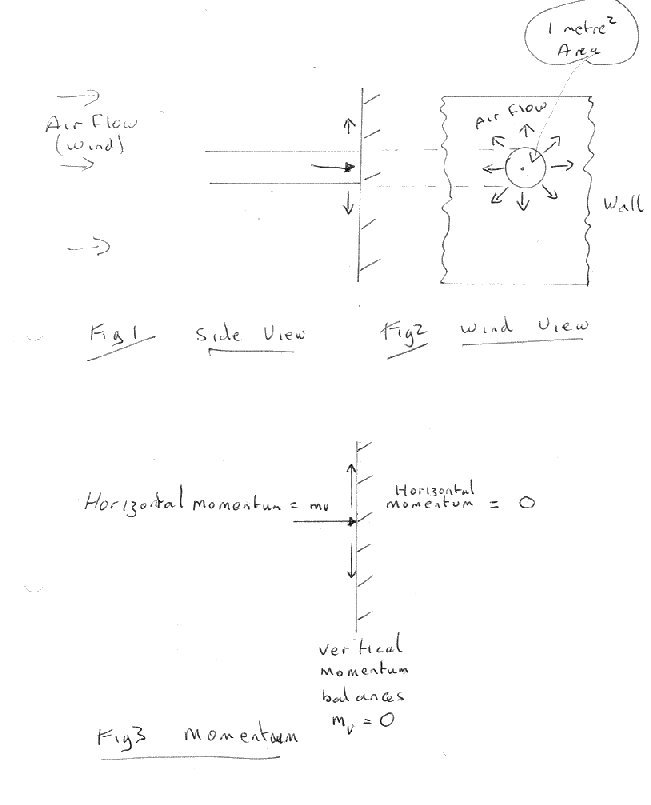
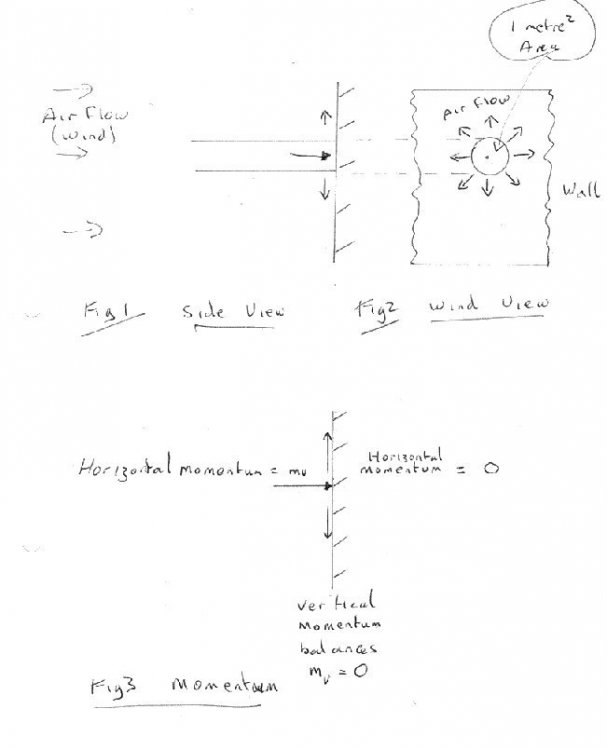
Smashing. I will try to work with that ans see how we can get to Seth's formula. First I would like to make it absolutely clear that The force on the windward face of the wall depends only on the winf at that face. It does not depend in any way on what happens on the other side of the wall. It may even be that the pressure and force on the other side of the wall is very much greater, for example if the wall is a dam wall. The windard force will be the same whatever happens in all cases. The wind blows horizontally for convenience and I would like to consider a round tube of air in this wind with an area of 1 metre2. The reason for choosing a round tube will become clear. Fig1 shows this tube and fig 2 shows how the airstream in the tube impacts on the wall. OK so the wind is travelling horizontally along this tube with steady speed v until it hits the wall face. Splat. Except that is is a continuous process. So the air must be diverted sideways along the wall face. If this did not happen then there would be a pile up of air at the wall face as more air continued to move along the tube. This is called continuity and we therefore have the equation Volume or mass of air arriving at the wall face = volume or mass of air spreading out along the wall face Now mass arriving per second = volume x density arriving per second = cross sectional area x length of tube arriving per second x density And the length of tube arriving per second is the speed of the air flow (speed = distance/time). And we have set the area of cross section to 1. So we have mass per second = 1 * v * d Where d is the density. You have mentioned that momentum = mass time velocity So the momentum per second = mass per second x velocity = v *d*v = v2d units of momentum. We have also specified a horizontal wind so all the momentum is horizontal. The vertical momentum is zero as is the sideways momentum. But at the wall fact the horizontal speed suddenly bcomes zero so the horizontal momentum suddenly becomes zero. That is all the horizontal momentum is destroyed or lost. Now you may have heard of the principle of conservation of energy ? There is also a principle of conservation of momentum. This says that momentum is also conserved, unless there is a force in which case the force is equal to the change of momentum per second. The change of momentum per second = (v2d - 0) so this equals the force acting on every square metre of wall the wind blows agains. I have tried to show this diagramatically in Figs 2 and 3. This also shows why I have used a circular tube. The vertical and sideways momenta start off as zero and no force acts so they must remain as zero. This happens as you can see in figs 2 an 3 by symmetry there is always a balance of momenta that sums to zero
-
He does indeed say exactly that and I gave you the time stamp. Although I was wrong in saying I thought he said it twice. Hes also says Glass is made of atoms surrounded by electrons, around about 7.58 But as G & S say "I've got a little list" It's coming, but I'm trying to reply to our newbie's question about wind forces first so it will be later today.
-
No one is laughing at you. You have some good thoughts. One definition of a dimension is "the number of independent pieces of information (co ordinates) you need to specify the position of a point. So you need for instance one distance from 1 point in 1 dimension, two distances from two points in two dimensions, 3 distances from three points in 3 dimensions and 4 distances from 4 points in 4 dimensions. But eyes are not points, as Genady says they have visual overlap - they are two dimensional patches. This is how the brain can get the extra information requires to measure in 3 dimensions. Again but as swansont says, 4 dimensions introduces extra complications so more detail is necessary.
-
Good morning, Rocks and welcome. Yes the wind speed may be constant and force does indeed equal mass times acceleration. But whilst speed is a scalar it is not the same as velocity, which is a vector as is force and acceleration. So the equation Force = mass x acceleration is a vector equation. I hope you know that vectors have both magnitude (the scalar part) and direction and that these two quantities can change indpendently of one and other. So the acceleration (at the wall) is not zero because there is a change of direction. To see how this works you need to consider yet another vector quantity called momentum, which undergoes significant magnitude change at the wall. The force arises as Newton has another equation Force = rate of change of momentum. Please let us know where you are studying momentum so we can finish off an appropriate reply, to show you how to calculate the force from the speed and mass of the wind. The other replies are true, but their effects are not really relevent to your question.
-
So far as I can tell no one here thinks you are a flat earther and noone has been mean to you, their replies seem to me to be quite helpful. I only introduced flat earth because actual flat patches on a planet's surface can and do occur and have geological significance, indeed there are several terms in geology reflecting this. Peneplain, plain, planation etc. I'm sorry if my comments confused you. However your discussion so far seems very nebulous so that I am unclear about where it is meant to be heading. What do you actually hope to do with the information ?
-
Thanks +1
-
Thanks for your input. +1. I thought he has stated that twice, but even once is not good when you are dissing other people, especially as the video was not properly checked (ie hurried). I will come back with my full list but, He seems to imply that photon scattering only happens off the nucleus. In fact My highlighting.