studiot
Senior Members
-
Joined
-
Last visited
Everything posted by studiot
-
I rather think we are talking at cross purposes here. My first thought in reply to the op was to note that you need more than the bare manifold to establish dimensions. In the model I originally proposed the manifold appears to correspond to the bare set of elements with one important condition. The condition that every element is of the same type. You also need at least two elements to have a metric. But this is still not enough to define or allow swansont's 'spatial dimensions'. In order to create the neighbourhoods necessary to support the maths involved you need to be able to order the elements of the manifold, ie the axiom of choice is required. Anyway I thought I was trying to discuss ways of determining the 'spatial' dimensions of the manifold when I posted my little question about non euclidian space. I wanted to get this one over quickly as it is the simplest case I could think of. So yes I am aware that there are points on the Earth, close to the poles, where one or the other journey is just not possible so to be more specific, The start point should be somwhere near the equator (anywhere will do) - I cannot see any points that would lead to the two journeys ending up in the same place. They would of course do so if the surface of the Earth was flat. This demonstrates that the surface of the Earth requires at least another dimension. Hopefully you both agree with this and we can move on to exploring what happens in more general dimensions. Much more insight is gained by studying stress paths in 1 , 2 and 3 dimensions and finding out ( as Hamilton did) that there is no 4 dimensional equivalent. I think the next dimensionality that supports this is 8, but I might be wrong about that.
-
I advocate the policy of going from the known to the unknown, rather than trying to guess the unknown. As such I offered a simple presentation to help you understand differential equations. Since you didn't bother to reply to my work on your behalf (your prerogative ) I feel justified in asking do you want my help or not ? I will leave you with the thought that your ratio project is generally not possible, but there are simple matters about area (and integrals) you could usefully get under your belt. It would take some drawing on my behalf.
-
-
So how do you address my comment ?
-
Can you solve this equation x2 = 9 I hope so because my next question is what is x2 ? My answer here is that is it a function of x f(x) = x2. There are lots of possible equations involving functions of x. A function is an expression or formula that tells us to do something with x. In this case to square it. Some are useles, boring or otherwise uninteresting. Derivatives are functions of x. So we can write equations involving the function that tells us to differentiate x. A very simple one is dy/dx = 5. Solving it tells us we have a straight line with a slope of 5
-
Suppose two people started at a point on the earth's surface: the first travelled 100 miles north then turned and travelled 100 miles east. the second travelled 100 miles east then turned and travelled 100 miles north. Would they be in the same place at the end ?
-
Yes I expect there are a fe people somewhere that consider this to be so. But in myopinion they would be wrong. Whatever else our universe might be of possess it is not empty. As soon as there is anything in a universe that anything must have a configuration and that configuration must possess energy of configuration, otherwise known as potential energy.
-
Wasted energy ? Is your consideration in terms of wated money or wasted Kw-hours ? On the subject of energy waste there are surely bigger considerations ? Are you cooking by gas or electricity or some sort of liquid or solid fire ? My current costs are £0.10 per Kw-hr for gas and £0.31 per Kw hr for electricity.
-
Yes you are considering the right things this time. As regards the start point, even simple counting has a start point 1,2,3........ But it has no end point unless you run out of numbers to count., which of course you will not. That is what is meant by infinity in this case. (remember there are other cases) An absolutely spot on answer to the series part of the question. Clear compact and brings out the essential points. +1 I would add to this that for further information @Boltzmannbrain should study Cauchy sequences as this is one good way of dealing with this subject. https://en.wikipedia.org/wiki/Cauchy_sequence
-
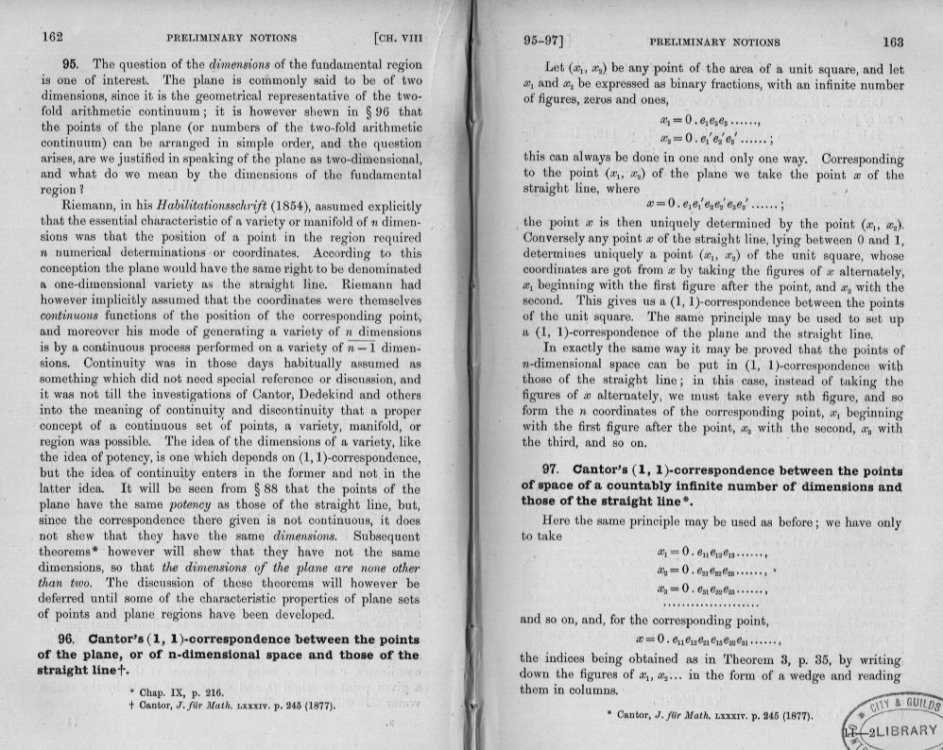
I meant to say +1 to Markus for his addition before. Mathematically ? see here since it was Cantor who I think first defined manifold. BYW I'm still not sure if you mean find out the dimension by observation in which case I would recommentd looking for shadows or considering the commutativity of rotations or by theory in which case I would refer you to the topological idea of shrinking a fundamental area to a limit as described in Needham's book we have been discussing.
-
I'm so glad you guys had this conversation whilst I was considering my answer. Like swansont, I originally thought you meant physical space and how you would measure the dimensions by physical observation. But 'space' in Mathematics is different from 'space' in Physics. Whatever the space you are referring to you would need to have more detail to proceed. In pure mathematics, space refers to a master or container set for several sets which make up the space. These are not subsets, since the nature of the elements in each is different. You need at least set of elements or points, a set of axioms and a set of relations between the elements. This gives rise to different mathematical spaces eg geometric space, hausdorf space, phase space and so on. These rules will enable the mathematical determination of both the meaning and number of dimensions of that space.
-
I'm not clear on exactly what you want to do. What do you mean by 'electrically conductive length' ? If, as you say, A and B are at fixed locations, and you wish to provide a current path from A to B a curve is the only way to provide variation. Are you aware of the difference between rheostats, potentiometers and variable resistors and their connections ?
-
Difficult because Gauss require a closed n dimension 'shell'. You can describe a closed sperical shell, which is 2D and curves in 3D. But it is not possible to surround an object in 4d with a corresponding 3D 'shell'. There is always a route through the 4th D from inside to outside. Flux refers to contours or imaginary equipollent lines in the normal way connecting points in the manifold.
-
last lines Gnoses mare Thebe trux
-
Is the constant factor mean over time? ⍙Y is just the change of the y axis over time Time doesn't enter into it. I foot is identical to 12 inches. If you prefer 100 cents makes one dollar, period.
-
One of the consequences of Gauss is that the view from outside a shell is independent of the disposition of the flux charge within the shell. Newton is not required for this and it also applies to fluxes other than gravity. In turn this leads to multiple, if not infinite, solutions. I see it as bit like the different between the moment of inertia and product of inertia. There are an infinity of solutions to question what disposition of mass yields a given moment of inertia, but only one to the question what yield a given product of inertia. Somewhere there is more to the story.
-
Wouldn't this contradict Gauss' shell-flux theorem ?
-
First day at school My kettle just died RIP boiling water You will be mist

-
This is where some very basic science comes in. You do not need college to know that there are many forms of energy and that all energy is measured in the same units. So the conversion of one form of energy to another is a quantity of energy, which is still measure in the same units. yes I know that over the centuries there have been many different measurings units for energy, just as with say length measured in feet, inches metres, links, chains furlongs and many more. But each can be converted into the other by multiplying by a constant factor, as the number of inches is 12 times the number of feet. Does this help?
-
emergent from what ? As I understand 'emergence' it arises because things have properties and emergence arises in very special particular cases of combinations of these properties.
-
Which is why you should put in the effort to study some very basic science. It took thousands of Men thousands of years to develop the knowledge and understanding of Physics that we have today. How long do you think it would take one man on his/her own ? Guessing is a very very ineficient way.
-
Very Euro-centric of you. The middle east and the far east had no such dark age. Overall, world-wide, there was no regression of technology. In fact, gun powder was invented during that period (9th century). Really ? I suggest you check your arithmetic. Let us say there was a small amount of progress in the largest continent, Asia. But this is only 31 million square kilometres. Set this against 29 for Africa, 21 for North America, 17 for South America, and 8 for Oceania (ignoring Antartica which has not been settled in human history) that makes 75 million square kilometers where no advances were being made.
-
If you would like to Stop, take a deep breath, and count to 10. Then try to reformulate your query so others can make sense of it it would be very helpful. Why do you think total mechanical energy would change over time ? The law of conservation of energy is actually more fully the law of conservation of mechanical energy of an isolated system and it states that the total mechanical energy of such a system does not chnage over time. Yet you have not stated what system and circumstances you are applying your thoughts to.
-
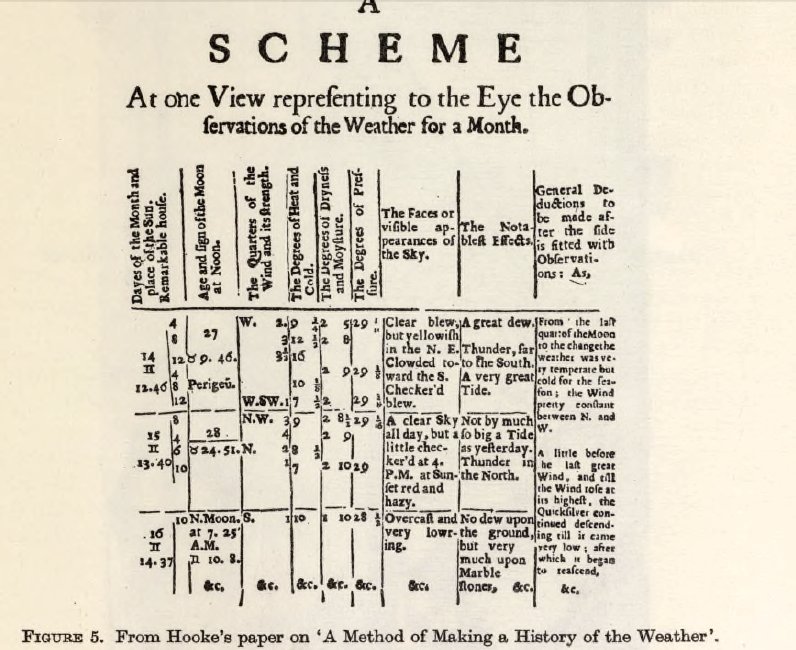
Good points, Ken. +1 But I think you should go back a little further than you suggest for the history. The groundwork was laid in the 1600s by Hooke and Newton and continued in the 1700s by the Europeans, starting with Farenheit. This lead onto Kelvin's Absolute temperature in the early 1800s. So by the time of the French- Spanish geodetic expedition to Peru temperature measurement was routine. They made the first systematically recorded temperature observations in South America. Hooke produced the first standard rain guages, wind guages, temperature gauges etc necessary for properly established scientific recording. Here is his scheme.
-
Yes indeed at one time there were lots of thermometers around. They were unevenly distributed over the globe, depending upon the resources of their nations in charge of their location. Also the readings were of uneven quality and some readings were more frequent than others. Readings were also taken at sea and more recently in the air by aircraft and ballons, manned and unmanned. Today we have the benefit of continuous near blanket monitoring by weather satellites using remote thermal imaging techniques. Both the average and local temperatures are known to affect various marker such as plant growth and pollen production, ice thicknesses and so on. Records of these from ice cores and fossils are used by paleoclimatologists to establish past temperatures. Does this help ?