
studiot
Senior Members
-
Joined
-
Last visited
Everything posted by studiot
-
Are you being deliberately obtuse ? What was unclear about my first and most important question? There were no spelling mistakes and it was written in textbook correct English. Since I placed 3 question marks in my first post I referred to 3 questions in my second post. So why do you reply in the singular ? Note I spotted and enquired about a contradiction in your original post. It was also unclear to me whether you main interest concerned the mathematics and or physics of infinity, as the title suggests, as against a particular effect in Physics.
-
I asked you 3 questions. All of which you ignored. One of those questions actually contains the answer to your reply question. Do you call this a discussion ? I can assure you the rules here do not.
-
Surely your title is contradicted by your first line. If infinity is not defined in Physics how could it be permissible to use it ? Of course it is well defined. And why to you need such an exotic example as the Casimir Effect ? What is wrong with schoolboy Physics. Density = mass/volume So what is the density at a point, which has zero volume ?
-
But did the makers pay anyone for the use of the older material ? That is the key question that was in the original article I linked to and even extracted the key paragraph. And that is what makes it different from the Luddites. The luddites were complaining because someone had found a machine that could make cloth more cheaply then they could. But actual cloth still had to be made. What the Managers are proposing is that once they have a single print of someone, they can had the punters a photocopy in future. Would you as a customer be satisfied with a recording of some opera star played to you, having bought a ticket to see the real mcCoy ?
-
Thank you for your reply. I would just like to point out that there are many other members interested in the subject as evidenced by their occasional posts and the best part of two thousand views. The diagonalisation argument is a direct result of the fact that there are more real numbers than there are natural numbers, even though both are transfinite. The ramifications of this fact are enormous and widespread so it is a good idea to review them and note the relevant ones. One area where phyti has already made a misstatement is that it means that for many sets, a set with more members that the original may be constructed. This was not fully grasped at the time of diagonalisation. But the killer conclusion is that it is not possible to form a list of all the real numbers, or even all the real numbers in a finite interval. This conclusion is the essence of diagonalisation. But because of this also leads to ideas of density and completenessnd more structure, there are other ways to prove the result. That this all hangs together is gives further support to the belief that we are on the right track, even though we know we haven't finished yet. There are still more queastions to be asked and resolved.
-
Something like this may have happened in the past when the Earth's atmosphere and was known as the great rust event, when much of the widely distributed oxides ov iron were formed. https://www.amnh.org/exhibitions/permanent/planet-earth/how-has-the-earth-evolved/banded-iron-formation +1 for trying to think out of the box. However I am firmly of the opinion that rather than employing more big business at great cost to clean up after the activities of other big business, it would be better if big business did not create so much carbon dioxide in the first place. Both the creation and clean up only benefit the greed of such business; the vast mojority continue to suffer the cost and pay for the enrichment of the few.
-
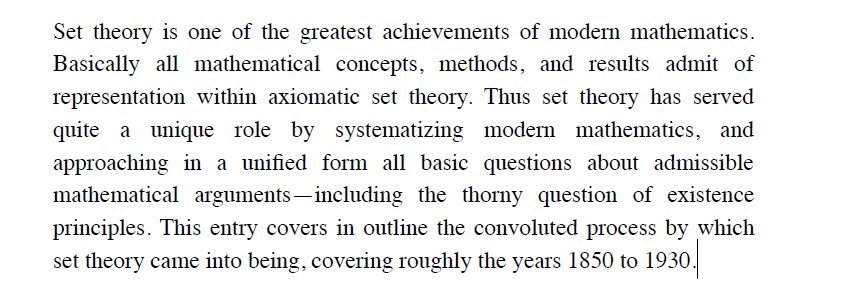
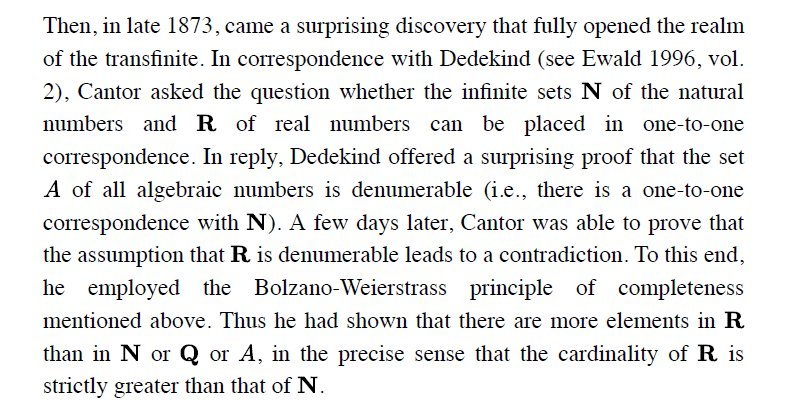
@wtf I was suprised to see that you are apparantly not even parsing the contributions of others here. It seems to me that everyone is concentrating on too narrow a view. It would be better to take a long term overview sincenot only was Set Theory not built in a day, but it has changed dramatically over more than 2 centuries. Cantor did not wite it down all at once. I am posting to short extracts from the Stanford Encyclopedia which are highly relevant to this discussion. Noting the years 1850 to 1930 as critical, though we could easily extend this timeline by 50 years or more if we wish to included the Bolzano theorem (1817) Cantor relied so heavily on for his first proofs or we wish to discuss computability which came well after Cantor's death and which is still a busy area of active reserch and debate. @phyti Simply declaring Cantor was wrong is not enough. He modified his theories quite substantially as he went along, and that process contues today. Here is his significant breakthrough, when he was first experimenting with sets and did not know about many infinities. In realising that the set of real numbers must be somehow bigger than the set of natural numbers he kick-started the whole thing off. Here is the link to the full Plato article https://plato.stanford.edu/entries/settheory-early/
-
Thanks. I hope this thread and your other one has been of use. Good luck with your studies, and don't be afraid to ask.
-
Interesting idea, but exchemist has done and exhaustive job of demonstrating it's impracticability. +1 However the idea of only carting 2g of hydrogen and not the extra 16g of oxygen with you, but finding it already there is one of these theoretically attractive but practically less useful, so should not be ridiculed. Some similar was shown in that great film "The Martian", as was the danger og burning hydrogen to get water.
-
Thanks for the reply, but the Luddite issue was different. Two people can't wear the same jumper. There will always be a need for roughly the same number of jumpers as people. If an AI can reuse the same image again and again for different purposes (as was done in later Terminators) there is no need for so many actors in future.
-
How does this answer the question in the OP, which was "explain why this may be the case" ? Actually the question was full of woolly qualifying statements such as may be etc., as is the article TheVat linked to I agree with Seth that the words in the OP were not well posed and the woolly words are not really meat for GCSE which is the first serious science exam taken in British schools at age 15/16. +1 Possibly a better article for this purpose is from Scientific American https://www.scientificamerican.com/article/what-causes-a-fever/ which offers simple simple but useful information Thanks also MrMack (+1) for pointing out that sometimes we wish to raise body temperature in a controlled way. Hot paraffin wax baths were once used as a cancer treatment, and are still used today for other purposes.eg https://www.medicalnewstoday.com/articles/paraffin-bath-for-arthritis There's lots more on the net. But for GCSE, I would expect the student to be able to ask themselves the question The question says "You may get a temperature" - that may again. How (by what means) does the body temperature rise? Which leads straight into the material I originally posted. General Science 101 "A body's temperature rises when heat is input or generated internally."
-
Possibly a lesser known bone of contention is the following claim (my emboldening) Comments and thoughts ?
-
Are these the actual words of the question or your reading of something? I ask because they are not strictly accurate. Yes you may 'get a temperature' from a disease but it does not have to be an infectious one. Arthritis would be a common example. Of course you always 'have a temperature' which may be raised or lowered from normal for many reasons. So strictly, scientifically speaking you should refer to raised, lowered or normal. You can also get a raised temperature from physical exertion. All these mechanisms of temperate increase have something in common. Simply, but scientifically they are due to an increase in metabolic rate, but for different reasons. Most biochemical processes generate or release energy as heat. So the faster the process is going the more heat is released. The body also has mechanisms for temperature regulation (sweating) , so some form of balance is struck. Biochemical processes also have an 'optimum' temperature and both the body's own processes and that of many infectious agents have similar optima. So as the body metabolism works harder in fighting the infection, the body temperterature begins to rise. Sometimes sweating is enough to control this sometimes it is a more runaway action we call a fever, depending upon whether the infection or the body is winning. Helping the body cool artificially increases its chances of success over that of the infectio. Additionally other body processes can also proceed more normally as they are also adversely affected by raised temperatures.
-
OK so we are going to work from general experience What holds up bouncy castles, lilos, air beds, bicycle tyres and the like ? I am going to answer this in a spoiler considering the circumstances and it is general science you will need to know something about. Now associated with the process we call osmosis, there is an increase in pressure of a fluid, which is not air. What do you think this fluid is ? You have obviously found your way round this site very well. Did you read any of the rules ? Two things. Firstly new members are allowed 5 posts in their first 24 hours. This is an effective impediment to the bad guys. Since you have one left, think very carefully before you reply. After one day you can have as many posts as you like and conversation can continue normally. Secondly, the homework section has some special rules. We are not allowed to just tell you the answer, as we could in the biology section. So is this actual homework or just part of your catching up. There are good folks here who would encourage that.
-
This is not a personal criticism, but can you give us some context to the biology questions ? I ask this because, from your comments around both your biology questions, you do not seem to have the General Science knowledge to be able to attempt them.
-
First let me say that everything stringy said is correct. However it is not the answer to your question. Animals and plants are 70% to 80% water. And what is food ? Largely dead plant and animal material. So it contains a substantial amount of water, even if dried out by cooking, and apparantly 'solid'. With regard to the olive oil, it will contain some water, but is it a solid ? Think also of gardening. You purchase a pH meter with a probe you shove into the 'solid' soil and get a reading for the soil pH. Why? Because of stringy's ions in the incorporated water. So the Quora respondent is just plain wrong in this instance.
-
I don't know the details of the naval architecture of the Titan. But it's design must be (or perhaps should have been ?) subject to the same stability/bouyancy considerations as other submersibles. The current speculation about the effect of loss of volume due to compression is relevant here. A general submersible is compressed as it descends and the effects are neither negligible on bouyancy nor stability. These are separate considerations. In order to maintain stability the distribution of the variable mass component must be considered. Some bouyancy force is derived not from Archimedes but from lift due to the motion of the hydroplanes. These must be correct or the sub will enter an uncontrollable nose dive. https://www.marineinsight.com/naval-architecture/understanding-stability-submarine/
-
Your list is woefully short, anyone would think we had not proceeded down to the DNA level since linneaus in 1700. eg the stabyhoun is a dog but it is picked out from other dogs by its genetics (it is also rare about 4000 in the world) But it is accepted as a separate category by the relevant authorities. https://studenttheses.uu.nl/bitstream/handle/20.500.12932/21271/PDA_LMVlutters_definitief.pdf
-
Good advice +1 Thank you for you confidence and for that useful information explaining what you want to do. As Seth says, the quadratic formula you quote comes from a specific solutions to Fick's 2nd law, using what is known as the error function. I see this as a longer term project for you than just a few days, or even weeks, but I am delighted than someone wants to get their hands dirty with an actual lab experiment. This is really Physical Chemistry or even Electro Chemistry, but sadly we don't have categories for these here. Anyway I was going to elaborate on my previous post with some more maths and elctrochemistry references but I will be away for a couple of days. If I posted the development details of Fick's 2 laws and the electrochemistry at what level can you handle it ?
-
Quite frankly I don't know and I don't care. The classification scheme is not in English, Russian or Hebrew, but is set by international agreement. The point is that I could ask the same question in any language. The classification scheme is a victim of its own rigidity. I believe you correctly recently pointed out to someone that a woodlouse has too many legs to be an insect. Now transfer that thinking to the classification of dogs. Somewhere at the head of that classification scheme you will be told that a dog is a four legged animal with or without tail, hair etc etc. Somewhere near the bottom you will find different kinds of dog. Choose one of the rare kinds with maybe 1000 examples throughout the world. Call it a bow-wow. Now consider the following. There exists a small percentage of dogs with only 3 or 2 legs. Sometimes this is a result of accident, sometimes disease, some are just born that way. In a small population like bow-wows a small incidence factor will lead to there sometimes being 2 legged bow-wows and sometimes not So in the times when there are no 2 legged bow-wows are they extinct ? We have already seen simplistic rigid definitions that would suggest this is the case.
-
Look up the difference between algebraic and transcendental. Algebraic Versus Transcendental Objects | Britannica
-
I also think there is a link between the classification scheme and the definition of words, especially ones like extinguish or extinct. But I think it is just more subtle, yet far reaching then MrMack said
-
Jawohl, plus eins.
-
In turn I am sorry if I was a bit harsh. As regards mathematical set theory I only said biological taxons to be similar, I did not say they were the same. The similarity I was meant refers to the idea that they are both head of a chain of 'trickle down' classifications. As far as I can see your comment, though true, has nothing to do with this thread. The main other definition I was referring to was about the use of the words extinct and extinguish in Science. Did you read the Wiki article I linked to ? One important point it made was that taxonomists themselves can't agree these classification schemes. So perhaps you can explain why there are many 'extinct' volcanoes in our solar system, or what the'extinction coefficient in Physics, Optics and Physical Chemistry means, following the 'definition' that has been laid down several times in this thread.
-
Since you chose to use ridicule in answer to an honest question but ignored the rest of my comments on definitions, I take it you agree with the rest of those definitions ? LOL +1