studiot
Senior Members
-
Joined
-
Last visited
Everything posted by studiot
-
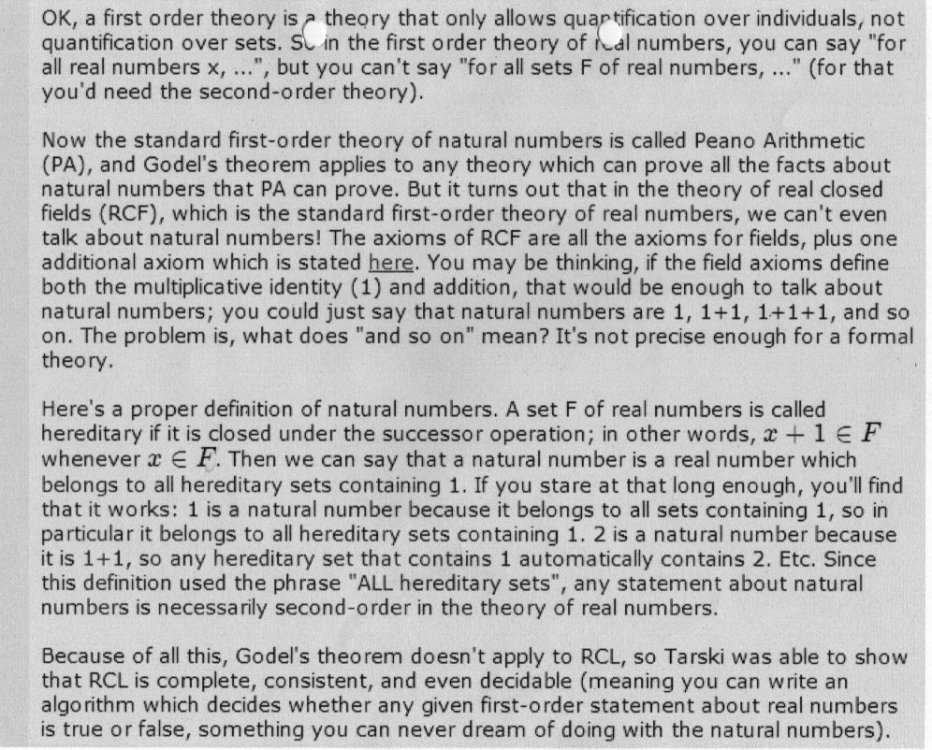
Oh interesting! I will have to read up on this. +1 Taking a tiredness break and then thinking out it a bit more is exactly the right way to go. +1 I have thrown away most of my old maths notes now, but came across this piece that you might find helpful about my comments on set theory, Godel, and the natural numbers.
-
This is why it is so important to be precise enough in maths. The correct expression is not 'equivalence' but ' into ' or 'injective' or perhaps stronger 'into and onto' or 'one-to-one' or 'bijective' We also come back to the sine function I mentioned earlier. For 0>= x < 90 the set of all values of sin(x) has an infinite 'count' of values, all of which are finite. But worse, the count of this set is uncountable if x is taken from the real numbers. So your correspondence in this case is merely injective, but not bijective.
-
It is an axiom that if n exists then (n+1) exists and so on. so our sequence should be written 1, 2, 3, ...(n-2), (n-1), n, (n+1), (n+2),... This is consistent with n being finite, but never the largest element and yet the sequence does not terminate.
-
Every natural number is finite. It is just that the count of them does not terminate, since there is no last natural number. The set, N of all natural numbers is infinite because it has no limite to the count of its elements. There is a difference between the allowable size of a set and the allowable size of any element of that set. But this also means that the list does not terminate.
-
Some infinite sets do, some do not. For instance the set of all values of the function f(x) = exp(-x) for all x >= 0 have a greatest element exactly = to 1 This particular infinite set has no least element. A different function, eg the sine function has both a greatest and a least element. Sorry, no.
-
I am sorry you felt like that since nothing could be further from the truth. You are most definitely not an idiot since greater minds that yours or mine have been baffled by this question. I have noticed since that I mistakenly assumed your set S to be a set of number when in fact I see now that you stated clearly a set of sets. This brings us to the crux of greater minds since this is exactly the situation brought about by Russel's Paradox. That is when you try to apply Cantor - ZFC naive set theory to infinite sets that cannot be members of themselves. This is why Russell and Whitehead introduced the theory of types or classes, which is basically a reclassification of sets introducing a hierarchy of set types. This also paved the way for 'orders of logic' so ZFC is first order, infinite sets of sets is second order which is needed to correctly analyse infinite first order sets of numbers. In general you need a higher order of logic than the one you want to analyse and there are an unknown, perhaps indefinite or infinite, count of orders. This situation lead, in turn, to Godel's famous theorems about the subject. The best plain explanation of all this I have come across is put forwards in Hofstadter's award winning book Godel Escher Back
-
Propeller (impellor) type pumps work by generating a pressure difference between inlet and outlet. They are limited to the height of a standing column of the fluid when pumping against gravity (about 10 metres for water) A greater pressure difference would actually push the pumped material backwards. This is a lot less than 60m A positive displacement pump like a piston pump works by being one way. A piston pushes the pumped material in one direction (and can be pushed with as much force as necessary) and blocks the material from returning or going the other way. (Your gas meter is another positive displacement mechanism so that it can accurately record flow) On the other hand Nature achieves this displacement by sheer brute force, dumping large quantities of material with sufficient kinetic energy to create the swirling and upwelling. This could be melting ice in the right season or as I mentioned we have now discovered it could be submarine landslides down the continental slope. The sediment in the water is insoluble so in in suspension. That was why it was a sediment in the first place. I will grant there is the so called halocline, which is about solutes, but there is already no shortage of these at sea level since entropy works to try to homogenise bodies of solution.
-
I did actually answer your question since your list was an incomplete representation of the stated infinite set N. Of course N does not and can not appear on your list since N itself is not a natural number. To put it another way the problem is confusing a set, N which is not finite, with its elements (natural numbers) which are all finite.
-
Well the average continental shelf depth is just 60m The bottom of the continental slop varies between 3000 - 4000m This affect your previous descriptions and arguments. Both of these depths require somn sort of positive displacement mechanism. It's your thread and idea, not mine. But it does require more than guesswork and wishful thinking to make it into a realistic preposition. You have far to many 'mights' in your words sir.
-
Perhaps not. You haven't responded to my comment about a positive displacement pump, (amongst others). Do you understand the significance of this ?
-
A truly excellent reply. Clear, compact and pretty complete. +1
-
And a nice pleasant discussion to you to. Since the list has no end, the convention if you are going to use 'n' , is to place it between two ellipsis thus 1 2 3 ... n ... The elli[psis is used mathematically as a symbol to mean 'indefinite continuation' . Normally the list would be displayed horizontally, but vertically is OK so I have followed your lead in presenting it this way.
-
I have been looking at some hard fact and figures. Most importantly there is only one type of pump that would move material (either liquid or sludge) from the bottom of the (shallow part of) ocean to the top. That is called a 'positive displacement pump'. The only such pumps of any size that I have any experience of are pumps for placing fresh concrete. Putzmeister say their pumps require 10 - 40 kg of fuel per hour to place 30 to 120 cubic metres of concrete. 10 kg of diesel releases about 24 kg of carbon dioxide in the process." So I ask again, "How much sediment needs to be lifted and what are the financial and economic costs of doing so ?"
-
That it works is not in doubt. But the thrust of my comments relates to the sheer scale of the pumping required. I note Ken Fabian has also picked this point up. I had hoped that some of our Chem Eng members might have useful information to add here ? But some further thoughts. Most of the waterculturally useful sediment is generated close to the continental shelves. In the last few years the effect of submarine landslides off the ends of the shelves down the continental slopes has been studied and it's extreme significance realised. The University of Otago leads in this. These landslides stir up and distribute the waters and sediments over wide areas, with noticeable increase in marine life activity. But this lead on to a comparison with the land. According to United Nations Sources, only 38% of the land surface is agriculturally productive, but worse this 38% is being annually degraded We also know from examples around the world that this process can (and should) be reversed. We also know the difficulties of farming in 'poor soil' and of improving that soil. So cost and effort comparisons need to be made between your pumping requirements and recovering and extending current agricultural land. Finally watching Attenborough's latest offerings bring out just how transitory these large schoals of fish are. How would you stop the fish just swimming away ?
-
Didn't you have a very long thread about this once before ? I thought we had cleared up your misunderstanding but you are making the same mistake again. There is no 'n' at the end of the list An infinite list does not terminate,, by definition. But trying to write an n at the end implies that there is a definite last number, n.
-
Thank you for the reply. The browser I was using was \m/soft Edge. This has been 'told' to many time to count, not to remember any usernames or passwords etc that seems to be reset to the default every time this browser gets forcibly updated, which seems to be about every other day. I can tell you some good news, however. Edge seems otherwise to be presenting much better view of SF these days, without all the interfering popups blocking views of the meat.
-
Interesting suggestion +1 To see how well it would/could work you would need to develop what amounts to a full business plan. That explores and answers questions like How much sediment would need to be pumped up to produce how much plankton which would deposit how much limestone over how many years. What would be the eco-nomics ( ie the gain over the cost of fuel) of pumping that much material. Nature already does it in the Southern Ocean; some figures are availble as a start here bg-11-2635-2014.pdf (copernicus.org)
-
That's good you know this point. But you have yet to understand it. Draw a vector triangle for the contractions, giving due consideration to the shape of your Vs. Parallel to the direction of motion you have a very short distance, just the thickness of the lines in your drawing.. So this component of the total length change will be very small indeed, as a fraction of an already small quantity. At right angles to the direction of motion, ie across the wings of the V, you will have exactly zero contraction. This is the other component of the triangle whose hypotenuse is the length of wings of the V as drawn or observed. Put these two components of contraction together and the result will be an almost imperceptible flattening of the V, until at light speed it appears completely flat. Conventionally we apply the length contraction to significant distance such as the distance travelled, not the size of the travelling objects, which are often considered as point particles, as in the PI-Meson example I gave and you did not reply to. I have set aside for the moment matters of this fluid until the basics relativistic mechanics of the travelling objects is resolved. I am sorry that I am no ,longer able to post maths or pictures on this website.
-
There is no paradox, just a failure of analysis. What exactly does 'Relativity (SR) say about length contraction ? How far have you studied it ? This scenario is a more complicated version of the PI-Meson first direct experimental proof of SR. Your analysis above directly violates the second part of the statement of SR, Notably "In the direction of motion"
-
I have just started a new thread. When choosing the thread name the computer offered the name of the previous thread I started in an automatic drop down box. What a pointless waste of computing power and resources. It could even encourage those who have been prohibited by a moderator from raising a subject again to break the rules an start another thread on the banned topic. I can't tell if this is part of the new site software or a W10 'Helpful' update. I also get a drop down list of every email address that has ever been used whenever I login to SF on this PC. What a security risk, not just to say that none of the entries on the list is helpful as my username is not an email.
-
A most interesting piece of conservation by the RSPB (Royal Society for the Protection of Birds) at a small river in Cumbria, called Swindale Beck. For the benefit of non UK members, the RSPB owns some very important wildlife sites around the country and has promoted some innovative and imaginative successful conservation projects. But what they say about the river and environmental change is very interesting and encouraging. How 'rewiggling' Swindale Beck brought its fish back - BBC News
-
Firstly there is no law of conservation of kinetic energy, only conservation of total mechanical energy. Secondly there is no need for magic or dragons as objects with mass obey the laws of mechanics without fuss or bother. This includes the common situation of variable mass, for example a rocket steadily looses mass when the motor is firing. Please study the proper laws of basic science more thoroughly before guessing.
-
I've been saying this for years. +1 I was told this by an American fellow student many years ago, "It used to be the duty of every citizen to waste as much as he can. But there has been a breakthrough and it has now been confirmed that Big Government can waste far more efficiently and in far large amounts, than any citizen. So all citizens can stand down from this duty as their government will do it for them"
-
Thanks to all responding. I obviously didn't bring out my point that old farts have grown up needing to exercise their brains, but yours folks less so. So the question might be rephrased, should they be concerned ? But please discuss around the subject, that was the idea.
-
I have several comments to make about your presentation. First and foremost, since your argument appears statistical in nature, the fundamental rule of statistics states Correlation does not imply causation. Further your correlation only appear to cover one solar year. A rather tiney sampling period for geological history. You offer some very pretty gnomic diagrams, and ask for sources of more data. This study covers solar wind data for a longer period, along with plenty of references. Three-dimensional exploration of the solar wind using observations of interplanetary scintillation - PMC (nih.gov) Further they call your 'spirals' ' - magnetic flux rope.' You do not ask for geological eruption data, but here is an excellent book Clive Oppenheimer Eruptions that shook the world Cambridge University Press 2014 I note you are still linking to off-forum websites in spite of being directed not to do so by a moderator in your previous thread.