
studiot
Senior Members
-
Joined
-
Last visited
Everything posted by studiot
-
For those who might be interested there is an interesting paper free here. (PDF) An indirect measurement of the speed of light in a General Physics Laboratory (researchgate.net) The indirect method this this paper discusses involves separate measurements of permeability and permittivity and the calculation of c from them both by themselves and some other workers.
-
Wood based translational materials science with a medical flavour ? Wow. You could try the following. There are a number of government and industry organisations that hold univeristy status and also have a publishing arm. COFI Council of Forest Industries | Forestry for the planet. Forest products for the world. (cofi.org) Wellcome Trust Home | Wellcome spring to mind. Also some universities with a strong materials dept also have publishing departments eg in the UK Exeter and UMIST Also some professional bodies publish occasional papers in their field. Try talking to the Technical Officers for these organisations. I used to answer questions like yours when I was Technical Officer for the IHT - an inappropriate body for your subject but the principle is the same.
-
You are right, after carefully only specifying reflections and distinguishing between total internal and internal and external an unwanted total slipped in. However I think for everyone's benefit we should review some basic optics and its terminology since your excuse for claiming diffraction should read refraction, which you also seem claim does not occur. However hopefully we are now agreed that the is no periodic structure that can cause diffraction. So we can rule out diffraction. Refraction is then the only mechanism that can bring about the observed colour separation. In particular reflection of the light in your bubbles example is white just because reflection alone cannot bring about colour separation. , One difference between refraction and reflection is that for reflection the light remains in one medium, whilst refraction requires two. Both the website I linked to and the one you linked state state quite clearly that the formation of a rainbow requires both refraction and reflection. This is because the actual mechanism is more complicated. If the colours were not split the observer would see only white light as with your air bubbles. The split occurs at the first refraction, that occurs as the light enters the raindrop, somewhere on the incoming sunshine side. Subsequently the red and blue etc paths are different in the passage of the now split light. So when the red and blue rays strike the surface on the opposing side of the drop, they will not strike at exactly the same place. When they do strike, as you say, some will be reflected back into the liquid water, to pass through it a second time. As you also said, this turning light away from where it was originally travelling to necessarily darkens that area. Again some of the light will pass out of the drop on striking the surface a second time. This also the difference spatial between the blue and red strike points will increase. Refraction then occurs at the exit interface for both red and blue rays. The upshot of this is that some of the blue light is directed out of the top of the observer's field of view and some of the red light out of the bottom. So you are correct there is not the fully developed fan of pure colours as with a prism.
-
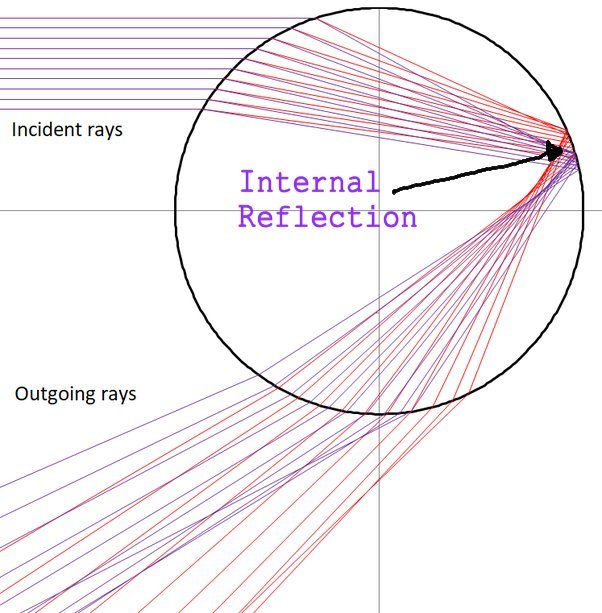
Did you make one when you posted this picture? I have added an arrow to show the region of internal reflection. If you wish to use the transmitted ray you have a problem since the sun and the observer need to be on the same side of the drops. Here are the conditions for observing rainbows as published by the UK Met Office. There have to be reflections, given the relative poitions of the bow, observer, sun and drops. Thank you for this link, it has some interesting sections, including the first none entitled Not all coloured patchesw in the sky are rainbows. They go on to give examples of coloured patches due to transmissive and also of diffracted origin. But when they come to rainbows themselves they offer the same explanation and caveats at I have ( and swansont did earlier)
-
Thank you for you attempt to explain further, but I disagree that your explanation is totally correct in that. 1) You claimed diffraction occurs, but there can be no diffraction. The numbers 40 and 42 degrees are about correct for the blue/violet and the red/yellow respectively and these play an important role in why the observer sees a rainbow. This is because of refraction alone and does not occur with the internal reflection either. The internal reflection does invert the stacking order of the rays. So you are correct in observing that the light reflected from the water droplet layer creating the return contains the full spectrum of the incoming sun's light. But the double refraction that occurs as the light first enters then leaves the droplet accounts for the fact the the light leaving the droplet has been split into diverging blue and red rays with the blue above the red. The result of this is that the blue rays from the higher drops arrive above the observer's head and outside the field of view, so he sees predominantly the red ones from the upper drops. Conversely the red from the lower drops falls below his field of view so he sees predominately blue. The light from a second total internal reflection within the droplet is inverted once again by the reflection so the blue is now on top and the second rainbow colours appear inverted compared to the first. Actually I couldn't find any of these 'unsatisfactory' middle school explanations, perhaps because the rainbow is no longer taught in UK schools. When it was taught it was on the old School Certificate syllabus for example . Theory very similar to yours can be found in Physics texts of the 1940s and 1950s for example Intermediate Physics by C J Smith or Higher Physics by Nightingale But it is important to remember that the geometryand positioning of the camera or eye that is also needed to play its part.
-
Are you sure you have got all your (ducks) (terms) in a row ? I find your explanation a bit garbled. Sorry. In would read that statement to mean that the light bounces off the surface of the drop, which is largely untrue. Strictly the light is only only reflected within the drop. Refraction is the only surface effect operating. Most of your other statements are true but very difficult to obtain a clear picture from.
-
I tried the link, and was taken to a comedy website. But because I am lucky enough to be using an old pc the website did not work for me just displaying the address and a blank page. However what you describe in you next post does not constitute waves impinging on material objects to create a permanent image of the wave. Sure you can record readings and plot them, but that is your observations creating the permanent image, not the wave itself.
-
Hello Jeffjo. and welcome Good to see some good solid maths being promoted +1 I'm (half) sure I've seen you on some other maths forums ?
-
Two facts about sounds for you to research. Firstly the sounds that create intelligible (human and i think other species) 'speech' are not the sort of sound wave you would see on an oscilloscope trace of say an orchestra. That is some sort of amplitude trace of varying frequency or frequencies. They are what is known as pulse code modulated. The information is actually contained in bursts or pulses which are pretty well independent of either frequency or amplitude. Secondly sound waves, whether pulse or continuous, do not substantially impinge on bulk objects to create measurable and lasting traces. But geologists recognise that waves can be literally cast in stone in slow sedimentation processes. As fine grained sediment settles, compacts and eventually solidifies it can bear the effects of gently passing waves. These are called ripple marks in the bedding.
-
This is not a silly idea but nature does not work quite like that however it does actually happen in nature. Since this thread has been split I will answer it in the split off thread. Instead I will simply reply to the thread topic which is about language. Firstly language is more than sounds ie speech. Language is also about the way we think of things. Even two people from the same culture speaking the same language often mean somewhat different meaning by the same language statement, Also spoken and written language tend to been a bit different as well. Secondly it is known (David Attenborough recently had a right up to date program on this) that many species communicate with each other by sounds and other means. So it would be unreasonable to expect that other hominoid species do / did not also do this.
-
Thank you for replying, but why do I merit the shortest response you made to anyone when I am only trying to help? "The core question..." That is a question not a speculation and in my opinion part of a larger issue that really belongs in Philosophy. Humankind has been wrestling with the issue of correct and incorrect for thousands of years. As a result many different approaches have been tried and some adopted. Your question seems to me to be about knowledge and what we can actually know, as I said a very important issue that affects every part of our daily lives. Be under no illusion that this only affects 'the micro world' , whatever that is. It affects pretty well everything from very specific measurements like "I offer you a length of climbing rope marked 1000lb breaking strength, and ask what load is required to break it?" To something intangible such as "I offer you some new food you have never come across before and ask Do you like it?" Both questions can be answered by measurement in only one way. But of what use is a broken rope ? Over time Humankind has come to understand that it needs a much more sophisticated system to handle real and apparent inaccuracies, and that there are some things we can never know. A good start is to consider the classification of inaccuracies into those which are inherent in tha measurement technique and those which are inherent in the system itself.
-
Thanks for the reply. You did indeed say that space must end since you asked where it ends. If you really meant something else please be more careful with your words. Yes 5040 is a really excellent number, but your response doesn't make any connection to 540, which you mention and is a different number. Small wonder I am baffled by ll this
-
1) I think 5040 is a particularly nice number for bas 10 work. 2) Why does there have to be anything outside space and why does it need to end ?
-
Goodness me this thread seems to have veered right off course. @wei guo I don't know what your first language is but seriously suggest it is a very bad idea to use words that have very well defined meanings but come from another language. Superposition and Uncertainty are very different phenomena indeed. At the simplest if you have two effects , call them F and G, they both relate to what happens when you combine them, but mathematically Superposition refers to addition and uncertainty refers to multiplication (or composition). Neither are confined to the 'micro world' and both appear in both classical and modern physics and engineering. However I am really posting to ask what this thread is all about as I cannot spot a focus to your discussion so far. So please just tell us in simple words what it is you want to talk about. We may then be able to help you find the correct English technical terms. If you wish to discuss the difference between superposition and uncertainty, start a new thread dedicated to that issue.
-
OK so I respectfully suggest your vocabulary of concepts is too limited. For instance 'end' is a one dimensional instance of a boundary. Go to two dimensions and you have for instance the edge of rectagular piece of paper. If that paper is now an infinite roll you have two edges but no ends Carry this line of thinkin g inot higher dimensions. So I have introduced some important new terms for you, boundary, edge, dimension. But the complexity of the matter does not end there. It is necessary not to confuse boundary with bounded. They are quire different concepts with confusingly similar names. For instance the function f(x) = sin x is bounded, yet x is unbounded. Neither have a boundary. Then again we introduce infinity. Some Astrophysicists like to argue that the Universe is 'finite yet unbounded', with no end or beginning. How can that be ? Well consider na circle. Does it have a beginning or an end ? If you travel round it is that journey finite or infini9te ? But have far do you travel if you make an infinite count of circumnavigations? If you wish your considerations to enter the later 20th/early 21 centuries then you need to consider porous and fractal boundaries (or ends). I don't claim my list of additional terms is exhaustive, just a good start. +1 for good topic by the way.
-
Let us get a few facts straight. 1) The underlying failings of relativity in classical mechanics were known and written about by Newton, along with the comment that he could not account for them. 2) Newton knew nothing of electrodynamics or electromagnetism. 3) Between Newton and Maxwell a sound theory of waves was developed culminating in the linear wave equation. 4) 50 years before Einstein, Maxwell noted that his 4 equations of electromagnetism lead to the same linear wave equation. He further noted that this equation introduces a mathematical constant having the units (dimensions) of a velocity and possessing the remarkable characteristic of possessing the same value as measurements from the time of Romer on, of the speed of light. 5) It is often forgotten to mention in discussion that this speed refers to empty space (in vacuo). Newton demonstrated (refraction) that the speed of light varies in a material medium. 6) Newtonian Mechanics does not conform to "The Principle of Relativity", without recasting as a measurement of differences. 7) Classical Electromagnetism (Coulombs, and Lorentz Laws) do not conform to the Principle either, although Maxwell's 4 laws individually do. This all affirms my point that to properly approach Relativity we need to take into account the precursor material and decide exactly what we want the theory to provide for us. A blinkered approach such as saying "I don't want to go beyond section 2 of SR" is a form of saying Don't confuse me with the facts, my mind is already made up. Isn't that wasting everybody's time ?
-
My apologies to @wtf ; I have been neglecting this thread but I see you have offered some excellent material +1 I will try to come back with my further thoughts as soon as possible.
-
I was concentrating on why Einstein had to do simultaneity first, rather than how he deals with it. This is particularly important since it takes him from page 8 to halfway down page 11 to complete that job, unlike say Semat who does the whole thing in a few lines. However all power to Einstein and whoever follows him for he did it the hard way as pioneers usually have to.
-
As in Hund's Rules ? - (yes I know there is also the Aufbau Principle). But Gauss's Theorem is distinct from Gauss's equation and both are literal translations. Anyway this was not tablets of stone, just musings. English does not tend to create new words to the extent German does by combining existing ones. I think the English system is better as a phrase is more versatile than a simple pre/suff - ix , allowing shades of meaning to be expressed. Thanks for the reply.
-
Of course, the modern presentation is easier. I think that someone (logic) who has made the effort to read the 1905 paper deserves a bit more if he will so allow himself. Especially since quite a few posts back he declared that he did not want 'interpretations', but preferred to follow through the actual chain of reasoning as originally presented.
-
I don't know if there is also a language dimension to this. Germans tend to use lots of synonyms when a person has many 'laws' to her or his name Eg Gauss's Law, Theorem, Principle, Method, Equation........ Compare with the English use of a qualifying phrase Newton's Law of cooling, gravity, refraction etc. The French, I think, were to first to go in for Principles eg Le Chatelier,
-
LOL There are two professional Physicists helping you with your Mathematics and here am I a (retired) professional Applied Mathematician trying to help with some basic Physics that they have even acknowledged modern physicists take for granted so never mention. I would also like to point out that the 1905 SR paper is not like a computer program. You cannot parse it line by line. It has to be taken as a whole. In particular it is customary today to state that one postulate is that "The speed of light is constant for all observers" or words to this effect. Einstein did not write this. He postulates for the source only. Compare this with the actual postulate 2 as it appears on page 1 Not only does he acknowledge that the onus of proof is on himself, but he also acknowledge another important issue that I have not yet raised. There are two postulates involved, so are they compatible with each other ? If so under what conditions ? It is such deeper considerations that make Einstein's chain of reasoning some much longer and more complex than the modern slick versions.
-
Thanks, I'm sure Australia is a great place and it's very useful to take note of the time difference. We have quite a few members in Australia, some are also retired.
-
You mentioned China. Are you perhaps staying up late in HK ?
-
+1 for an honest answer. In the words of Thomas Malory God hep Mordred! I think that neither you nor Mordred has English as a first language. Please Correct me if I am wrong.