studiot
Senior Members
-
Joined
-
Last visited
Everything posted by studiot
-
Feedback The rats are still trying I note that couple of new alphasoup members an hour ago, that joind and came back 3/4 hour later but came to nothing. Then just now another as member joined and successfully posted within 2 minutes.
-
This is a 20 years on edition with some additional material and comments.

-
I'm not sure if folks caught my meaning properly. If the word 'airlines' appearing in a new thead title automatically suspended the thread to the mods and the modes could also reactively change this word if the spammer changed to say 'insurance' , wouldn't that make life easier for them ? I have lived very happily for 20 years + without emails entitled ...SEX.... or .....Viagra..... or one or two other things.
-
Near the top of the page you will find the section the thread is posted in. This is posted in Suggestions, Comments and Support. Click on this and it will take you to a thread list for that section. Against each thread is a number of views counter. Hope this helps I will do a screenshot if you need it, but it is easy to find.
-
There were 19 views of my earlier suggestion on this matter, but no comments. I hope yours fares better. It is clear that the spammers have cottoned on to the 5 post limit.
-
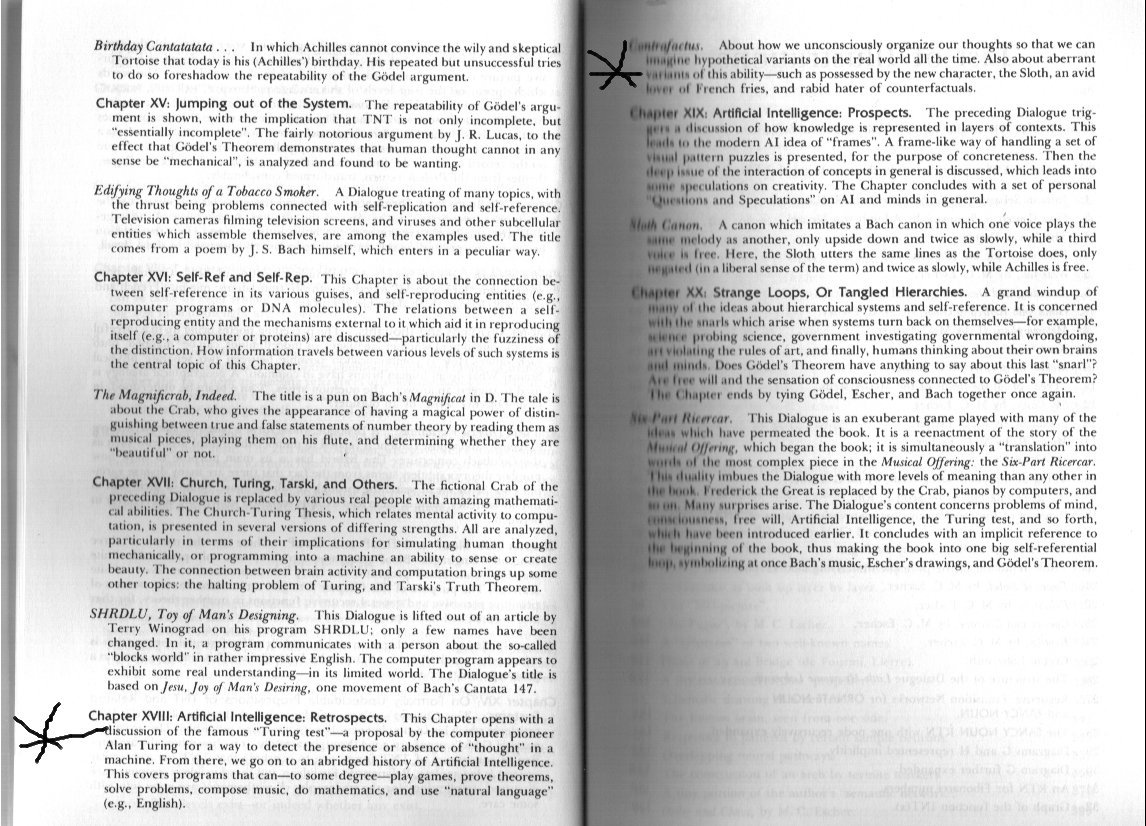
All contributions welcome. I'm glad the members are less polarised and more objective than your fears. I think it's too early to assess the depth of polarisation. Hofstadter has some interesting analyses of AI
-
There are two basic types of bond for atom to atom. Ionic and Covalent. Take your pick ? This appears to be homework and should be placed there please.
-
I note that the titles in the current spate of spam contain certain words - Airlines, printers ....... My old outlook express allows the use of filters that I can set up to simply block email with titles containing certain words and I see 20 years on viagra still comes in and is blocked. Could the admins write a small routine to perform the same here perhaps dumping/delaying them to a mod queue as is already done for some posts. Especially if the mods could easily add or remove troublesome words as the spammers react ?
-
Sure but I bet it gives more than just the greenpeace result. And I'm also sure you know how to massage google searches to widen the spread.
-
OK but I know you are quite capable of typing 'nurdles' into google.
-
Why bother ? Physics is what physicists do and possesses the characteristic that What physicists do today is different from what physicists did yesterday and what physicists will do tomorrow.
-
Thanks. +1 I remember "We'll spank the baby and feed the cat" and now you mention it, 'we also walk dogs'
-
To be brutally honest this whole proposition reminds me of a mid 20th century science fiction story about a company called General Services Inc. They were engaged to provide anti gravity (gravity shielding) vehicles for visiting dignitaries from other planets with greatly different gravity than Earth's. They too came up with a magical-mystical secret formula to solve the problem in time for the visit. I am not sure of the author I think it may have been Robert Heinlein.
-
Thanks you for the background, very useful apart from the missing answer to, what are you studying in parallel. Your stated personal history almost mirrors that of Hofstadter, if you substitute Bach for Shakespeare. He had the same doubts and wider interests but is older than you and 'went all the way'. The book I referred to is definitely for you. It's absolutely fascinating how he connects Art and Science and Metascience (he has a PhD in Physics).
-
You don't say anything about any previous academic or other background, which would be help to make useful comments. Also you don't say where your 'reading list' came from. Is it a course prerequisite ? Finally what are you studying philosophy 'in parallel' with and which is the main subject and which the minor ? I note a bias towards older philosophy with litle modern input is this a history of philosophy course ? A couple of suggestions. 1.) The Stanford Encyclopedia of Philosophy This is online and kept up to date. You can view for free, and download pdfs for the princely membership fee of $10 annually. https://plato.stanford.edu/ 2) An interesting balancing modern viewpoint, including many of your references, will be foundin; Professor Douglas Hofstadter Godel, Escher, Bach - an Eternal Golden Braid. This won a Pullitzer. Go well in you studies and I look forward to some interesting discussion in furure.
-
Th op said ammunition not a bomb. But for all we know, our new member may be sriting a scfi or james bond novel about some device to stop the hero being shot. Perhaps we should wait to find out what is really in his mind |?
-
Hello, you are more welcome than those spammers who try to clog up the pages with their rubbish. I also read you personal introduction, and the the short answer to your question is no it doesn't work like that. I seriously suggest you find some introduction to basic science to avoid wasting a lot of your time with fruitless dreams (don't stop having dreams though). What part of Science are you most interested in ?
-
An article on tonight's news about a lad who left his university course to start his own business doing exactly what sensei (+1) mentioned in another thread. Apparantly Nurdles are small plastic pellets that are used as a feedstock, but too many escape into the environment, causing havoc. This lad has made a machine that vacuums up stray nurdles cleans and processes them as new feedstock. The new article showed successful trials in the most nurdle polluted foreshores in Britain. A boost for environmentalists/conservationists, https://www.google.co.uk/search?hl=en-GB&source=hp&biw=&bih=&q=nurdle&iflsig=AOEireoAAAAAZCstnc6diqpUKPS2JRLwU0REk3y8r0tF&gbv=2&oq=nurdle&gs_l=heirloom-hp.3..0i512l2j0i512i433i131i10j0i512l5j0i512i10j0i512.1768.4648.0.6328.6.6.0.0.0.0.254.916.1j4j1.6.0....0...1ac.1.34.heirloom-hp..0.6.912.0HX6awL7JxI
-
Sounds a well rounded package until you unpick it and realise that some aspects are given far more weight than others. Why no separation into short, medium and long term strategies ? Why should be bust our guts trying to completely stop co2 emissions, yet say that removing the need for at least some of those emissions in the first place is to difficult or too unacceptable ? In past times humanity lived with all manner of filth and sources of pestilence, resulting in a high death rate. I have just watched a David Atenborough vid showing how the naturally very high death rate of rabbits is necessary to prevent overpoulation followed by sudden starvation and dramatic poulation reduction. Steadily improving technology has helped reduce the need for large human families (against the wishes of the catholic church and some men who still wish to enslave women). We don't reject the modern sanitary and medical technology that enables this and other improvements in our living standards, so why reject sensible attemps at population control over the long term ?
-
Exactly. Nobody knows. That was an important point for Roman to discover. The further back we go the less certain we become, and are still finding lots of suprises from (much) more recent history. We are no entering the difficult territory of what it means to be alive. We really don't even know that.
-
I don't know if this was a reference to my comments but I note that Switzerland was nearly the last country in Europe to give the vote to women (1971). But for @Peterkin's benfit my comments were really limited to this forum. How many women have posted an opinion in this thread ? On the choice of emission figures for Sweden and Switzerland v Canada and Australia, I view the counting methods with grave suspicion. How many 2000 mile train or road train journeys can you make in the former pair ? Both Canada and Australia are large producers and exporters of raw materials and foodstuffs. Who attracts the emissions of the tansport to other continents ? Both Sweden and Switzerland (couldn't you have chosen countries with short names ?) have extensive local hydro schemes, but little or no oil or coal reserves of their own. The movement of How would you power mass movement of goods to the rest of the world on the Australian or Canadian scale ? Norway would make a better example but it is above the World average at 6.7. However the story of Norwegian use of their massive oil reserves starkly contrasts with the UK at 14.7. They have made a so much better fist of it.
-
At what point did the chemical precursors of life combine to from something 'alive' and did that something respire ? This was something I meant for Roman to find out for himself, but have a look at this: The very recent discovery of anerobic bacteria in deep sea hydrothermal vents suggests possible alternative mechanisms for the beginning of life. https://pubmed.ncbi.nlm.nih.gov/16346061/
-
Well look further and deeper.
-
Who benefits most from this failure to address population issues, Men or Women ?
-
Watching last week's repair shop included a fascinating repair to a dented bugle. The repairer slid a cylindrical hardwood plug into the tube, followed by a metal weight about 15-20mm diameter by 15-20mm length. Then he shook the instrument up and down causing the weight to bounce up and down on the wooden plug, driving it through the flattened section of the air tube. This process took several hours, clearing the dents in the process. A fine example of the power of a steady small tap tap tap. As to the Repair Shop itself, I've noticed that in more recent episodes there are longer and better explanations of the whys and wherefores of what they are doing. Has anyone else noticed this ?