
Everything posted by studiot
-
The slip was too good to miss. Especially as the original proposal doesn't seem to have many (any?) backers for a variety of paractical, moral, social and legal reasons. Sadly nor has it had many admissions that there is a serious problem which I thought was clearly laid out in the OP, although I do not agree with the proposed solution. It is a pity that this thread has become rather entrenched hard line.
-
I didn't know it was random ?
-
Actually I wasn't suggesting that. Europe also suffers from this problem, though I have not seen any statistics to show the crime rate of homeless addicts is worse than many other sectors of the community. I am merely challenging swansont's assertion about construction costs. What do these include ? Interestingly there are quite a few do-it-up programmes on UK TV at the moment. One is just running a series on these €1 properties. They bought one (two actually) and have been doing them up.
-
In the US maybe. But I don't agree that it applies in more heavily populated Europe.
-
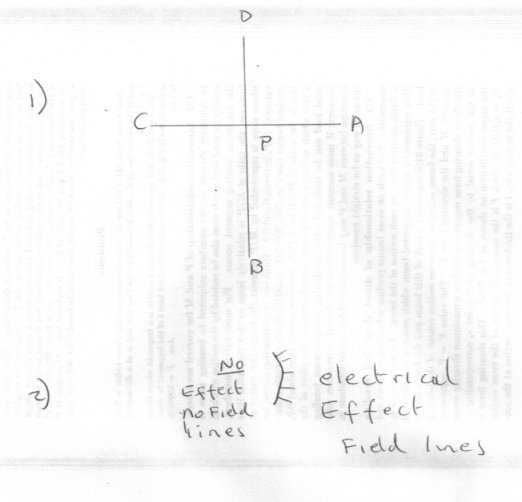
Interesting, but you didn'r answer my first question. Do you consider electric field line can touch, although they nmay not cross - Is there a difference ?
-
@Alex_Krycek If a heroin addict is someone who is addicted to heroin, What is a homeless addict ?
-
Looks green to me, thanks. Yes it is a good workbook so +1 to @joigus for remembering it.
-
Interesting, thanks. +1
-
No I had simply forgotten all about it. David Kay has done a good job as a specialist in line with the Schaum philosophy. There is many wrinkles in that book and of course quite a few exercises. But these are scattered throughout the book, there is no specific section or chapter explicitly on your desired topic, you will find bits and pieces all over the place.
-
Thank you for your replies. Sorry I spelled field incorrectly. 1. Yes I agree but not four your reason. All they have to do is for all four lines to touch (not cross) at P. 2. I'm sorry the diagram was not clear I was in a hurry The there is only one part of a field line shown the thicker continuous one. Yes It need to have started somewhere on a charge, but that is not relevent to my question. More fully my question was if you have a field line coming from somewhere is it possible to have what I called electrical effects on one side but not the other ? You could ask the same question of a charge. Can you have electric field lines in the space on side of a charge but not the other ?
-
Two questions for you. 1) Do you regard the diagram 1 as showing 2 field lines (BD and CA) or 4 fields lines AP.BP,CP DP) ? 2) Is the situation in diagram 2 possible with an electrical effect on one side of a filed line but not effect on the other side ?
-
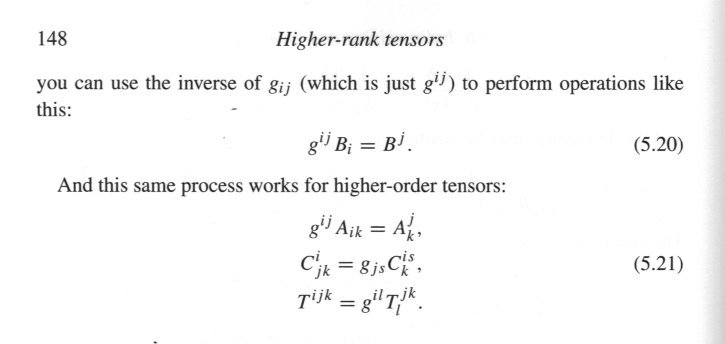
OK to answer this I would like to start with a bit of history. The first person to use the word tensor was Hamilton, I think in 1841, though he actually meant something different when he introduced dyadics. The first person to use the word tensor in the modern sense was Voight in 1898 for studies in crystallography. Inbetween those times the pillars of maths were changed substantially by many workers, Ricci and Levi Cevita being at the forefront of developing tensor maths, although they did not call it that. In those days and into the early part of the 20th century it was called 'the absolute differential calculus'. Then Einstein introduced his summation convention (1916). Again at first there was no standard but by the 1930s the convention of contravarient upstairs only , covarient downstairs only and mixed both upstairs and downstairs had emerged. But with no regard to index order or spacing. This convention carried on to the end of the 20th century and beyond. Some still use it today. But by the end of the 20th century the advantage of proper index ordering had become apparent so today newer authors are beginning to leave spaces where some indexes are not used for some of the terms, as in this extract from Fleisch Vectors and Tensors - Cambridge. OOps pressed the go button before I was finished so I am carrying on editing. So the moral of this history is that you need to have your date calendar about your person when reading the literature. Your second question about exercises is much more difficult as you presumably want exercise with answers and perhaps worked examples ? The idea of drill exercises is a very good one though. Here is a series of videos, this one in the middle focused on your question. https://cosmolearning.org/video-lectures/few-tensor-notation-exercises/ As to books, Fleisch is already mentioned, Sokolnikoff - Tensor Analysis - Wiley - is a good and clear mid 20th cent text with exercies and some answers Zafar Ahsan - Tensors - PHI learning Delhi is modern (2018) again with some exercises and some answers. Bickley and Gibson - Via Vector to Tensor - EUP again offers some exercises and answers. Lawden - Introduction to Tensor Calculus, Relativity and Cosmology Wiley or Dover - offers exercises but no answers. Sadly your Synge and Schild offers neither exercises nor answers it is a treatise. Finally there is the issue of associated mathematics - The Hodge star, wedge and V products the geometric v the algebraic viewpoint and so on. I hope some of this helps.
-
Herein lies the hidden difficulty of analysis. These velocities are not all in the same coordinate system. So if considering them as dx/dt the x refers to different coordinate axes So you cannot use the second derivative to get acceleration directly. Further at least one of v, u , and ve must be negative. The same coordinate sytem and sign conventions must be used for all derivational calculations.
-
At last. We are getting somewhere. No just air resistance of course. The conclusion is that By itself in free space the rocket cannot 'run the rocket engine' and travel at constant velocity. Alternatively the a working rocket muct be under acceleration unless it is also being acted upon by an external force for example gravity or air resistance. If it did not do so it would be breaking all 3 of Newton's laws.
-
To do what exactly ? I'm not being funny, this is a fundamental property of a rocket drive we are talking about. You have not directly answered my question which started - Is it possible ...? You have made nearly 10 pages of complaint about conventional analysis of the rocket drive. So exactly what value of ve would be required to maintain the condition V = a constant ? What is your mathematical relationship between ve and V that would make this happen ?
-
I didn't get the point... What exactly did you not understand ? If the rocket is moving forwards whilst burning and expelling exhaust is it possible to adjust the rocket drive so that its velocity, V, is constant ? If it is possible how would you achieve this ? Also please please read the rest of my post properly before making wrong guesses about coordinate systems.
-
Thank you for bringing that up, you have reminded me that I wanted to refer to your use of opn / closed systems. By a closed system you should actually mean an isolated system. Open systems allow mass and energy exchange with the outside world. Closed systems allow energy but not mass exchange with the outside world. Isolated systems do not allow either energy or mass exchange with the outside world. https://mechaengineerings.wordpress.com/tag/closed-system/ This is really as used in Physics and Thermodynamics, ansd does not take forces into account. Mechanics adds some additional concepts for Forces The free body diagram Force isolation Neither of which mean that no forces act on the body of interest.
-
There is much to be learned from the study of the rocket system including just how much is hidden in assumptions and definitions. For instance what is the coordinate system we are placing our equations in ? The centres of mass of both the rocket and the exhaust are not only moving, relative to a some fixed 'ground' observer, but also moving within the rocket and exhaust subsystems respectively. This makes the application of calculus more difficult, particularly if we stick to the traditional d/dx notation for space. Ther is not such issue with d/dt however. But where is the origin of x located ? Then the question of definitions By 'rocket' I mean the rocket plus any unburnt fuel, at all times. By exhaust or firing or burning I mean burnt and expelled fuel. There is no delay between burning and expulsion that needs to be considered. But a further interesting question that comes out of my earlier one. Can the rocket system drive forward under power at constant velocity? If so under what conditions ? I feel sure that overhasty appreciation (or not) of these fundamentals lies behind all the misunderstands shown in this thread.
-
No, pr is not constant, is just pr = p0 - pe . Both increasing in time with the energy of the combustion of the fuel. I'm glad you understant that. But what do you mean by 'both' ? I only asked about pr But since you mention it, what about po and pe ? It is necessary to make some assumption about pe ; it is usual to assume a constant burn so pe is then constant. But po is more tricky since po = psystem = procket at the start of the burn. But as the burn proceeds the rocket not only gains velocity, it looses mass.
-
Think carefully about what you just proposed. is pr constant ? If so why? If not why not ?
-
I said Edit correctly attribute quotation end edit So why oh why did you respond I even explained in some detail why I did not start with a stationary rocket. I also said that the analysis must nevertheless cope with the case of starting with a stationary rocket as with any other possibility. A further tip. Rocket engineers are less concerned with acceleration v momentum as they are with questions like How to maximise final velocity ? How to maximise acceleration ? How to maximise burn time ? These are not all compatible so they need a pretty flexible analysis for all that and more.
-
I do so love it when someone tells me something I don't know or reminds me of something I should know. +1 You are still not expressing you research goals and intentions very clearly or pehaps even correctly. I seriously suggest you accept this, ask to moderator to close this thread and let you start a new one with a half ways decent proposition. That way we could all stop bickering.
-
Yes your contention that p is necessarily zero. Consider the rocket (as I did) just moving along at velocity V, at time t. If the rocket engine is not firing this sytem has non zero momentum. If it is unimpeded by gravity or air or other resistance Newton's first law tells us this will continue indefinitely. If the rocket engine now fires and the rocket starts to accelerate (can you see why this must then happen ?) The rocket will gain extra new momentum equal to the negative momentum of the exhaust. But it will still retain at least some of its original momentum. This situation could easily occur in a series of rocket engine 'burns'. This is why I did not start the conditions at t = 0 or V = 0. These are conditions that can be added into the analysis, but many analyses start the rocket off fromstanding still. in which case its momentum will obviously be zero. However this last case can lead the unwary into a Zeno like paradox (have you heard of them?) where you can try to argue that no rocket can ever leave the ground since it cannot move until the exhaust start to move.
-
What is dp/dt ? I am asking what you thing the symbols mean mathematically, not what is momentum or the tim,e rate of change of momentum. You are confusing the derived function (derivative) with the value of that function at a single value of time in the case. Sometimes this distinction is unimportant, sometimes it matters very much. That is the case here. Not only is dp/dt a function it is a vector valued function.
-
Perceptive. +1 Taiwan ? I would just draw your attention to the current joint naval exercises off South Africa (with the ANC). The ANC have been spreading doctrine that the Ukranians in general and Zelensky in particular are dedicated zionists and also nazis (is that possible ?). You wouldn't believe the hatred I have heard from them. They are all gathering in their allies round the world.