studiot
Senior Members
-
Joined
-
Last visited
Everything posted by studiot
-
Since you have posted this in a true science section I suggest you go and learn the most basic law of 'chance'. An event with a definable probability, no matter how small, could be the next event in a probability space, no matter how unlikely that may be.
-
Having already acknowledged that your 3 electron radii are not all electron radii, I am disappointed you have not made the relevant correction either to your paper or to your postings here. In fact more "loose wording" has been pointed out by others. Also I don't know whether your speculation is mathematical or physical ? In other words can you provide a some physical reasoning as to why an electron might present as a two dimensional surface with less symmetry than a true spherical one. I worry about this because some behaviour of observed quantum mechanics (in spectroscopy for example) relies on the assumed spherical symmetry of the electron. That is it has no preferred direction in 3D space.
-
Welcome you seem to be observing the rules here and I for one woulf like to view you speculation. However I am puzzled by your introduction since my understanding of the Bohr radius is that it is an orbital radius. The other two, of course, refer to measures of the electron size in interactions.
-
I understand jellyfish can learn, despite having no brain. How does that play with theories of intelligence and consciousness? https://neurosciencenews.com/jellyfish-learning-memory-23967/
-
Where else would the end be nigh ? 😀
-
Because that is incoherent nonsense lacking further contextual parallels. I was intending to discuss natural and artificial patterns with you, since you introduced them, and following Markus great example. However I see your response to a patently true statment is an obvious falsehood so I am out of here.
-
This is a Science site. Which means we use scientific definitions where appropriate. And that does not include correspondence, which is another concept with a special scientific meaning. If you wish to promote mystic woo then I suggest a religous site, rather than coming here and calling another members comments silly.
-
Please think about your use of the word coincidence. All that it means is that wo or more things happen in the same place and/or at the same time. Since there are billions upon billions of things happening at the same time and or place at every time and place and each and every one of them is a coincidence there is nothing special about this.
-
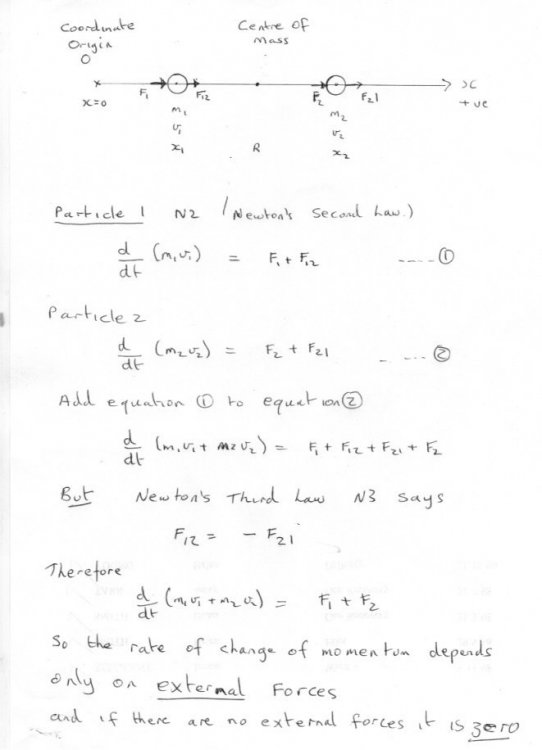
Indeed. But this is an analysis of Newtonian gravity. Have you given up on this subject? We can now make a start on analysing your thought experiment, from first principles. We will need a coordinate system with an origin that we can define along with a sign convention. This situation is very common in mechanics and the sign convention is often not mentioned. But it is very useful as it tells us which way thing are moving an also since we don't necessarily know all the directions at the outset, it tell us if our initial guesses (assignments) are correct or not. OK so the attachment offers all this for two particles moving only along the x axis. The sign convention is that left to right is positive. I have drawn the most general situation in which both particles have a velocity and two forces acting on them. One of these forces is an external force the other shows an interaction force between the particles for each particle. If our assumed directions turn out to be not as shown then the particular forces or velocities will be negative, not positive. First we write Newton's second law equation for each particle in the form force = rate of change of momentum. Remembering back to simple differentiation we can add these equations up as shown, since the derivative of a sum is the sum of the derivatives. After adding them up we bring Newton's third law into play to show a very important fact. The total momentum change due to the total external forces is unaffected by the mutual interaction. This is of course conservation of momentum. Note a similar argument applies in statics to allow us to discount all the internal forces of a system and only work with the external loads. I have also included the position of the Centre of Mass, at a distance from the origin, in preparation for the next stage in the analysis.
-
What I am not sure about is how various 'copying' processes handle the new hidden partitions that Windows has.
-
Interesting, thanks. +1
-
Thank you for pointing this out; I'm sure I made this mistake a few times in ignorance. +1 Perhaps this LIGO article might help the discussion @Growl did you mean the third one on the list inspiral ?
-
I think Genady has a good point in However I don't quite see the point of this thread.
-
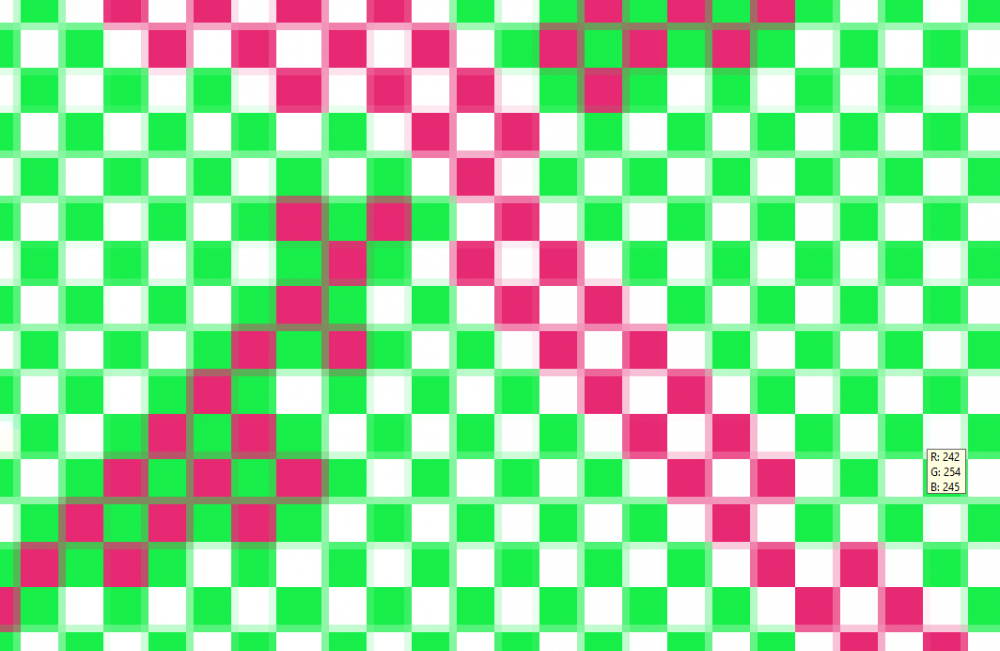
Well I agree there is only onle red, but I note there are also some aliasing bars on you grid Of course red plus green makes brown.
-
Yes in general I agree. The Brain is the most complicated thing in our known universe so it is little wonder that we have barely begum to get a handle on it. Even more so when you realise that the brian alone is only part of the whole human consciousness system. We have at least found that bit out. As regards the weather here is a true story from my experience. We have also found another way to predict the weather. Weather prediction is quite important to many industries not least the gas supply industry, especially in the winter. So some years ago British Gas, which normally uses the met office predictions, wanted a backup system if for any reason the normal weather forcasts became unavailable. So they experimented with statistical methods on the basis "Null hyypothesis : Tomorow's weather will be the same as today's." What are the chances ? Conditional probability, Markov and Bayesian methods allowd them to conclude that the developed statistical calculator "Was at least as accurate as the met office in predicting the temperature in the next 24 hours and therefore the gas demand".
-
+1 Fruit fly consciousness is actually very interesting on account of their behaviour, as you have already observed. I already said that I don't know about US law but the point is that UK law require the fabrication of tyres to incorporate tell-tale markers at the minimum legal tread depth. Hence the tyre self diagnoses when it is too worn. However the tyre in this respect is not even a machine, let alone living or conscious so can take it no further. We have been through all that with the discussion about my accidental wedge. This whole thread appears to be one long litany of rejection. The opening post starts with a hypothesis of rejection "Artificial Consciousness is Impossible" and carries on from there. You seem to have rejected pretty well all matters germaine to the discussion of this hypothesis, at times quite rudely to others. Your current score of matters germaine appears to be You nearly 100% Others nearly 0% Do you think this likely for any human analysis ?
-
OOps what amistake The equations for gravity should be proportional to inverse square of the distance. [math]F = G\frac{{{m_1}{m_2}}}{r^2}[/math] and [math]{a_1} = \frac{{{F_1}}}{{{m_1}}} = G\frac{{{m_1}{m_E}}}{{{m_1}r^2}} = G\frac{{{m_E}}}{r^2}[/math] [math]{a_2} = \frac{{{F_2}}}{{{m_2}}} = G\frac{{{m_2}{m_E}}}{{{m_2}r^2}} = G\frac{{{m_E}}}{r^2}[/math] My apologies
-
If you really want a discussion you must respect the other side and stop this dodging and diving. I SPECIFICALLY CALLED THE CAR TYRE A CONSTRUCT NOT A MACHINE. If you can't stop trying to put words I did not say into my mouth I will stop here and now.
-
Several members have congratulated @Alkonoklazt for bringing this paper to our attention and I believe it is so interesting it deserves adiscussion thread all of its own The Empty Brain Robert Epstein https://aeon.co/essays/your-brain-does-not-process-information-and-it-is-not-a-computer The paper is short but I am not sure I have permission to reproduce it here. Perhaps a mod would advise please ? I have a couple of reservations about the paper in that it makes absolute declarations or assertions although I do appreciate the 'market' in which the concepts are being promoted. For instance it says there is no 'memory' and no algorithmic programming. In this case I wonder how I can correctly produce long numbers such as social security numbers, telephone numbers and the like on demand.
-
Thank you. When have I ever said otherwise ? The only thing I have said about machines is that they have no business in this thread and that you were misusing the scientific and engineering definitions of a machine. I did offer you a more interesting concept - That of a self diagnosing construct. In this case it is not programmed but is constructed to be self diagnosing. This is the car tyre I asked you about and you did not reply to. Thank you, I had not heard of this so I will have to look more into it. +1 However it does introduce another interesting concept, relevent to consciousness, intelligence, etc. The concept of life. Again we have an ill defined concept but one characteristic I was taught is that of 'response to stimulus' However I observe many such responses in what I would call non living things. For instance rocks in the desert respond to the stimulus of thermal cycling in the hot sun and cold desert night by exfoliating due to alternate expansion and contraction stresses. So no I do not accept the continuum concept for these because it is demonstrably possible to have life without consciousness, with or without intelligence, with or without self awareness (my car tyre exmple provides an example of non living self awareness) What I was leading up to with my venn diagrams was that we have lots of concpets or categories, with some overlap but some separation. My initial criticism of thie opening of this thread is that it tries to be absolute ie all and to me therin lies its downfall.
-
As I am not sure what your theory is I can't say. By the way (BTW) please use the correct word which is' hypothesis' for your proposition, 'theory' has a special meaning in Science. Dr Swanson has pointed out that your hypothesis about falling bodies (presumably to Earth) is quite independent of the gravitational attraction of two isolated bodies of similar small size,so that they may be considered as 'point masses'. So let us continue through some calculations that can be covered in 11th grade mathematics. First we will look at the statement you queried Let mE be the mass of Earth, m1 be the mass of A and m2 be the mass of B For any single mass N2 say that [math]F = am[/math] where a is the acceleration and F is the force. Also we have for any pair of masses Newton't law of gravitation says that [math]F = G\frac{{{m_1}{m_2}}}{r}[/math] where r is the distance between their centres and G is a universal constant. So for masses A and B, both at distance r above the surface (or therefore the centre) [math]{a_1} = \frac{{{F_1}}}{{{m_1}}} = G\frac{{{m_1}{m_E}}}{{{m_1}r}} = G\frac{{{m_E}}}{r}[/math] and [math]{a_2} = \frac{{{F_2}}}{{{m_2}}} = G\frac{{{m_2}{m_E}}}{{{m_2}r}} = G\frac{{{m_E}}}{r}[/math] Therefore we have that the accelerations due to their gravitational attraction to the Earth are the same. [math]{a_1} = {a_2}[/math] Therefore they fall at the same rate. Once we have agreed this we can move on to the question of A and B attracted to each other in isolation, where the accelerations are not the same but depend upon distance r. This is an altogether more difficult question.
-
Rather than a tart reply, I will just ask for a link to your passage on catapaults. Perhaps I could understand that.
-
Energy is a property so energy of what ?
-
We have both French and Dutch Speakers here so please post the original question entirely.
-
Well you haven't post the original question verbatim.