studiot
Senior Members
-
Joined
-
Last visited
Everything posted by studiot
-
None of them have two competent ministers in their cohort to rub together. And none of them will address the real issues that so desperately need putting right. So I am hoping for a hung parliament. At least that way nothing will get done, which is marginally better than the hugely expensive gaffs in recent years.
-
More news on this subject I sincerely hope the labour party will not take 'control'. And look at their planning record. Their man is "Going to build 5 new towns in the next couple of years to solve the housing crisis". How ? This will be after radically removing the 'planning' from the planning process, instead of changing that process from a bureaucratic game of rules and hurdles and hoops and obstructions to nothing at all. How will that ensure that what we actually need will get built ?
-
I note you haven't acknowledged swansont's correction so I will amplify it as you have made several mistakes that you could learn from. Secondly This not actually a photo. No one could ever take such a photo because there are no nets or grids around the Earth as shown in the image you posted. In fact the 'gooves' you speak of are not in either space or spacetime, anymore than there are nets as depicted in in your artificially generated image. The image is a representation of function space, which describes the values of a function at points in space. It is an attempt to display a representation of a four dimensional graph on a two dimensional piece of paper. The geodesics referred to are the paths of extremal values of these functions. These paths do not move about in space so cannot realisitcally be called either grooves or waves. You haven't distinguished between travelling waves and standing waves. Only standing waves could be imagined to possess 'grooves' that must be followed since the peaks and troughs of a travelling wave necessarily move about in space, by their very definition. So how do you think standing gravitational waves can be generated ?
-
So you can perform the following simple calculation, without using energy. Please show me how. I have a 1kg bar of lead that I wish to melt. I have a bunsen burner and a suitable steel pot to melt the bar in. How much gas to I need to fully melt the bar ? Please ignore losses for this calculation.
-
https://www.bbc.co.uk/news/science-environment-67101176 Towards the end of the article there is almost a footnote But noting the political situation here and what has already happened to HS2 is this really the first step (sorry about the pun) towards cancelling ?
-
This is neither a speculation nor a question it is a tirade so it belongs in the trash. A real question would be something like Are there any circumstance where energy methods are easier and or more efficient than other methods of analysis ? To which the answer is a resounding yes.
-
As exchemist says, one purpose of homework is to make you think. So some things for you to think about : environmental science draws on many sicences disciplines. I molecule of water produces 1 molecule of hydrogen on electrolysis. The molar volume of water is about 18 x 10-3 litres and the molar volume of hydrogen is about 22 litres so occupies over 1000 times as much volume as the parent water. Electrolysing water produces what else. Does it make a difference if that water is salt or fresh ? How would you handle these other products ? You said the hydrogen produced was destined for use as a fuel (in a fuel cell or otherwise) What is the result of using hydrogen as a fuel ? So why are you worrying about abstracting water ? Have you studied natural environmental cycles such as the carbon cycle and the water cycle ?
-
Don't know how @Daedalus got on with his operation, but he spent a lot of time with a long thread working on this. (as have quite a few other members)
-
I originally wrote anthill, but changed it because I was worried you would argue with that terminology as some ant colonies are not hills at all. Some ants create their colonies underground, under rocks or in rotting tree wood for example. Either way your reply doesn't address my actual example at all, which was how to achieve a design without a designer. Microprocessors have to be connected to some sort of circuit board. The connection process invariably involves wetting (although not by water). It is a detail of Science you therfore may not have come across, so I apologise for presuming. However if that is the case then I remain surprised that you seem uninterested in that particular area of Science.
-
Something I forgot to mention before, thanks CharonY for reminding me. The correct terminilogy for the inactive ingredients of the pill or preparation are called excipients.
-
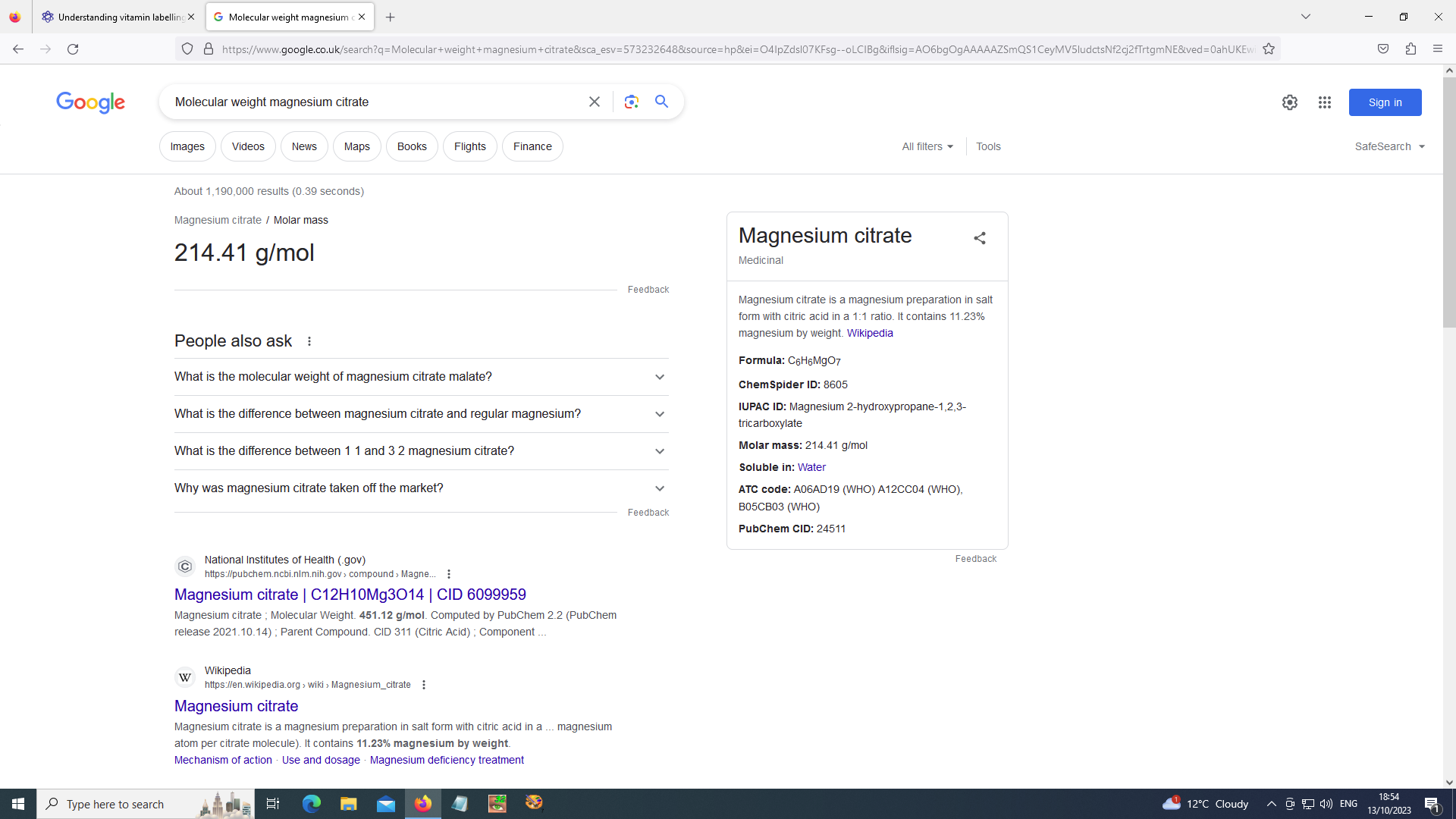
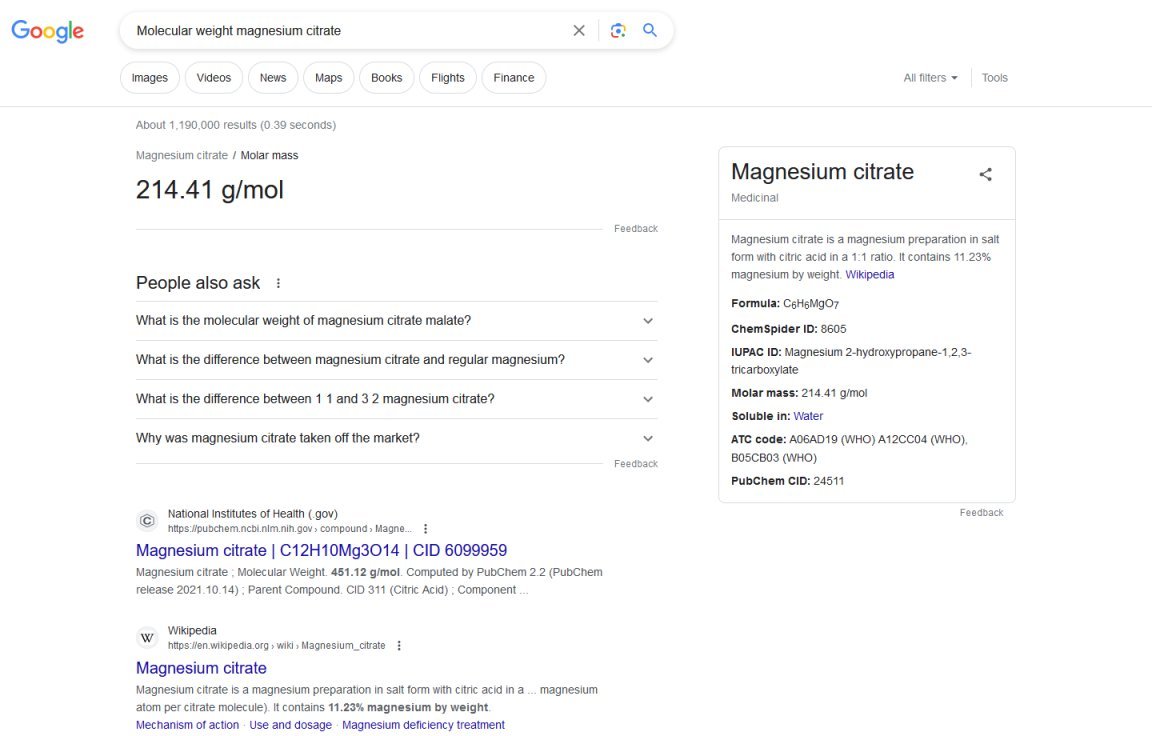
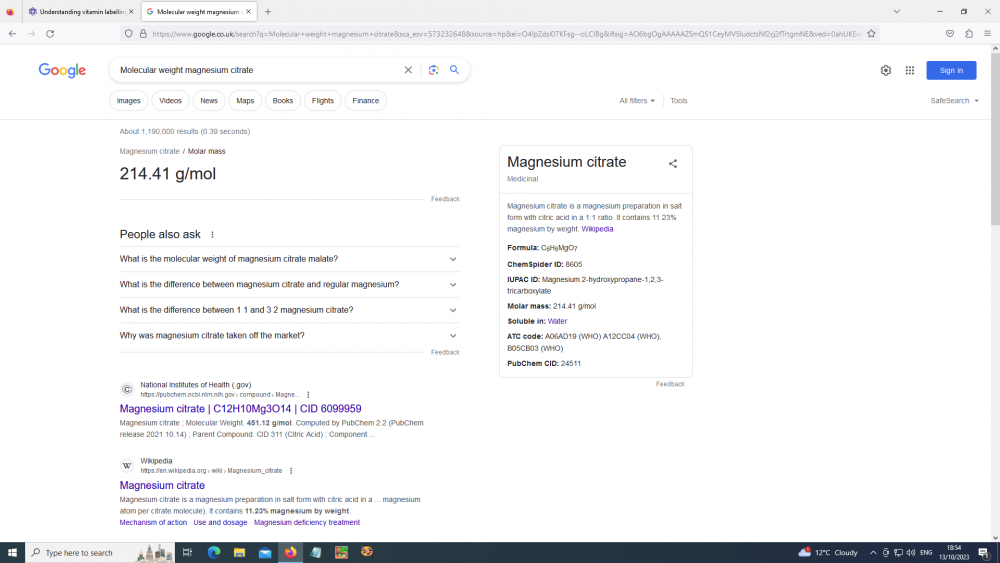
Shall we start by noting that neither magnesium nor zinc are vitamins > They are minerals. Now I agree that the information is designed to impress the punters rather than inform them. So look at the zinc citrate dihydrate. This is a better description because crystals of salts require what is known as 'water of crystallization' to form. This water is made of water molecules incorporated in the crystal structure. The dihydrate tells us that there are 2 molecules of water for every molucule of zinc citrate. So when reporting the weight of the stuff this includes this weight of this water. Now looking at the Magesium citrate this presents an immediate problem as they have not told us how much water there is. A quick google search reveals that there is a lot of it. Note that the molecular weight declared by google as 214 g/mol is much less than the official government value of 451 g/mol I'm sorry Im not familiar with US government labelling practice and terminology so someone else will need to help with refernce intake and nutrient reference values.
-
I'm not sure about squid, octpi and cuttlefish but I learned recently that jellyfish have no brain.
-
It is often said that examinations in the human world are a test of memory not of learning or intelligence. So is learning necessary for artificial intelligence ?
-
Pick you up 8 o'clock.
-
I agree. +1 I further think that a design need not be as complicated as an ant colony. My pepper and paper automatic leyline generator would suffice.
-
Do you not need to deal with the theory of physical wetting in your role as s circuit board designer ? This is an subject with little mystery and well defined properties.
-
Notaries are not as common in the UK as where you obviously are. One of my friends who is a solicitor also has a notary qualification, for which he had to do an extra course and examination. In lean times, and there have been many in recent years in the legal world, that brought in useful extra income as most solicitors are not so qualified. There are also other officials who offer officially certified copies of particular official documents. In the Uk these officials are often known as registrars, as we have many different registers. Of late, like other departments of government, they have tried to extract as much money as possible through fees.
-
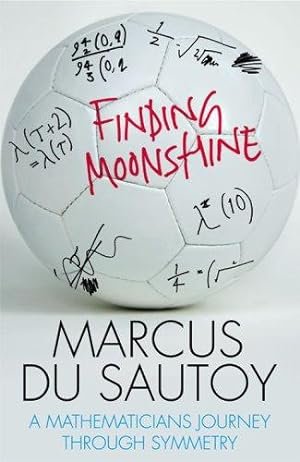
I sincerly hope this is not another preaching attempt, so I will take your question as genuine. You might find reading Marcus Du Sautoy's book interesting in answer to your question Other books of interest might be the wooden books series,particarly sacred deometry by Mirand Lundy and Symmetry by David Wade https://woodenbooks.com/index.php
-
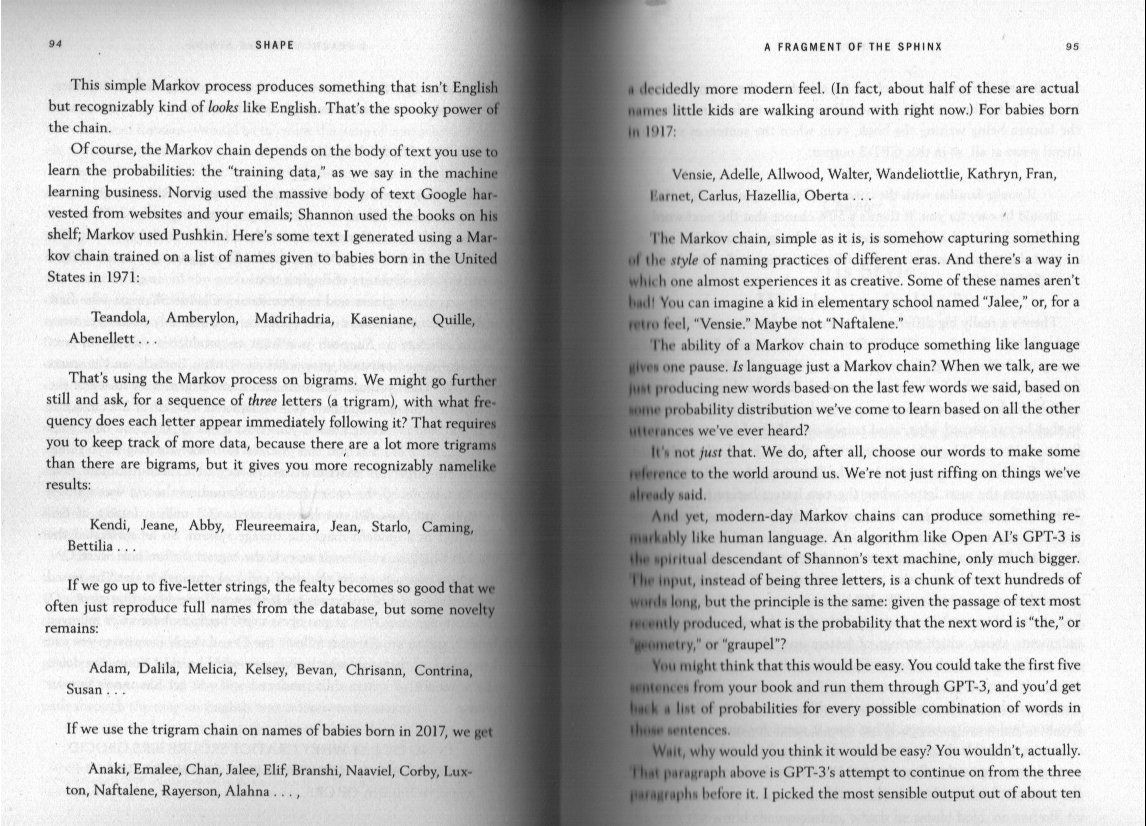
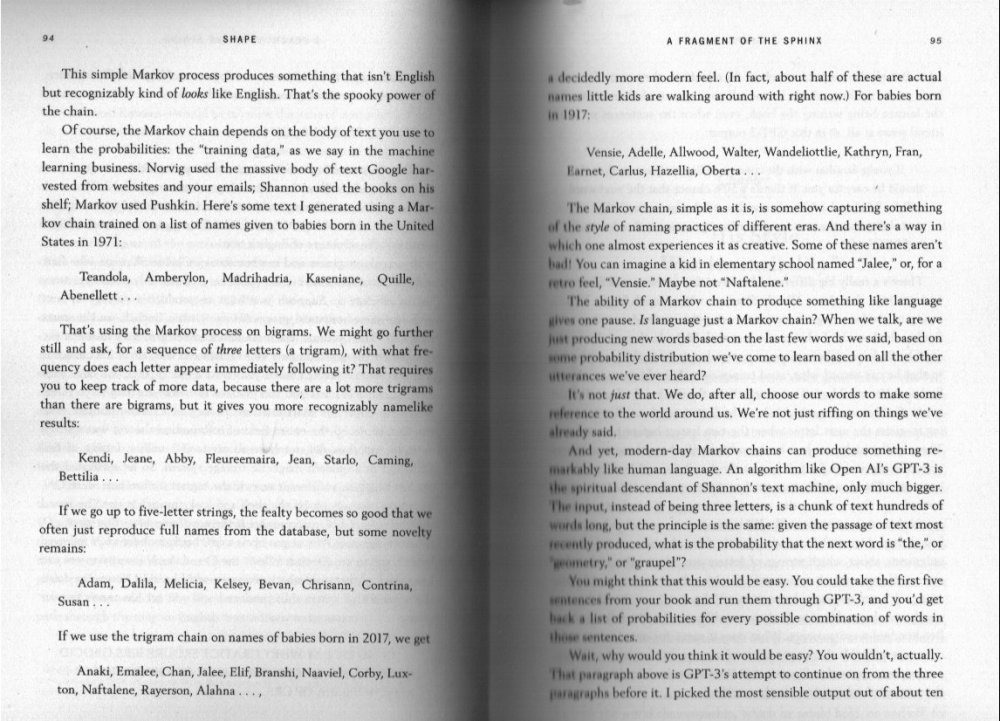
I posted this excerpt from ellenberg whcih explains the essence of language models.
-
Why do you say this ? There was nothing in my example to suggest it. Yes, this is more the gist of what I was trying to get to. Note time (small t) in these posts tends to refer to relativistic time. Whereas my 'time' is Time (big T). But this would suggest an axis not defined by relativity (??) and I think we need to be very careful here. Time is not a coordinate in spacetime as @Halc implies. And my description does not even make it a coordinate. @julius2 One of your other respondents asked if this was more properly a question in cosmology and Astronomy since you seem to want to concentrate on bangs, but you haven't expanded on this or helped me choose an appropriate level to pitch a response.
-
Thanks and I agree that CHATGPT is a language model. How many know what that means ? However I think @swansont deserves the credit for the quote here.
-
One factor not yet considered here is the age of the car. Electric cars have only really started selling in volume about 2 years ago. Before that it was only specialist and nich market stuff. In order to grow their market volume ev manufactures have been offerening discount insurance to buyers of their new vehicles. A couple of years on and those owners now looking around for a better deal may well have a shock. As a matter of interest Kia include a 5 year repair deal so the sot of parts may not be such as factor, They also claim that their own insurance prices for IC and EV vehicles are very similar.
-
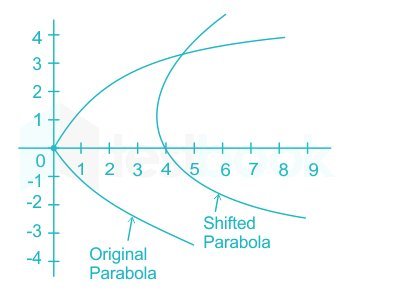
Good morning Julius and welcome. I see that the response to your question so far has been rather cool. Perhaps you are a youngster just beginning to think about such things, perhaps you are older and still thinking about such things. Either way thinking is good. So don't be put off by the adverse replies the members are only trying to help. One way to think about this is to regard time as what mathematicians call a functional parameter. When we have several independent variables a parameter is a single variable that allows us to tie them all together by means of some formula (or function) between the parameter and each variable. The Universe is Space which has 3 dimensions. That means that we need three independant variables to refer to any part of that space, usually x,y and z. Time can then be considered as a parameter that specifies where in Space an event occurs, by means of some formula such that x, y and z are individual functions of the t parameter. Time is so useful as a parameter that the symbol for a parameter is usually t. Here is a simpler example in 2 dimensions. The standard equations for a parabola are a = at2 ; y = 2at. Ask if you want more detail or dicussion. Be warned also that as an anti spam measure new members are only allowed 5 posts in their first 24 hours. Afer that it is unlimited so long sas you are reasonable in what you post.
-
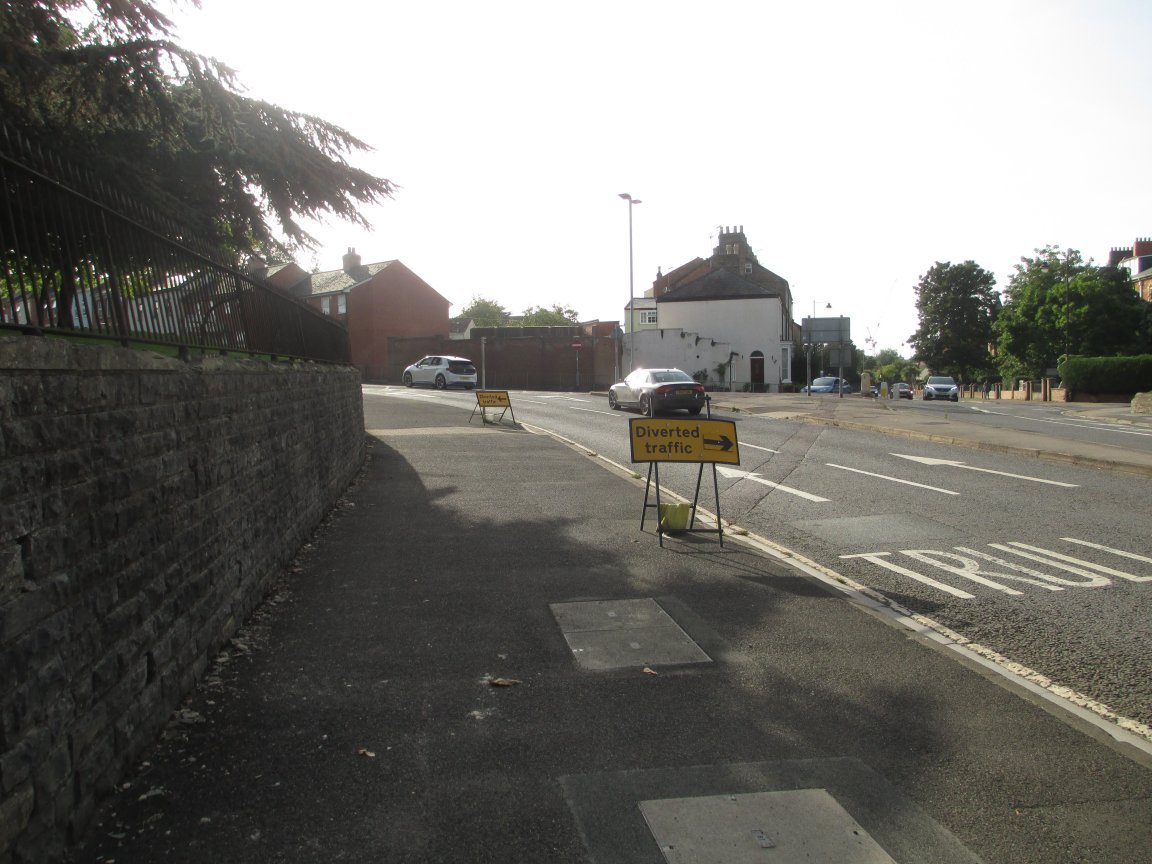
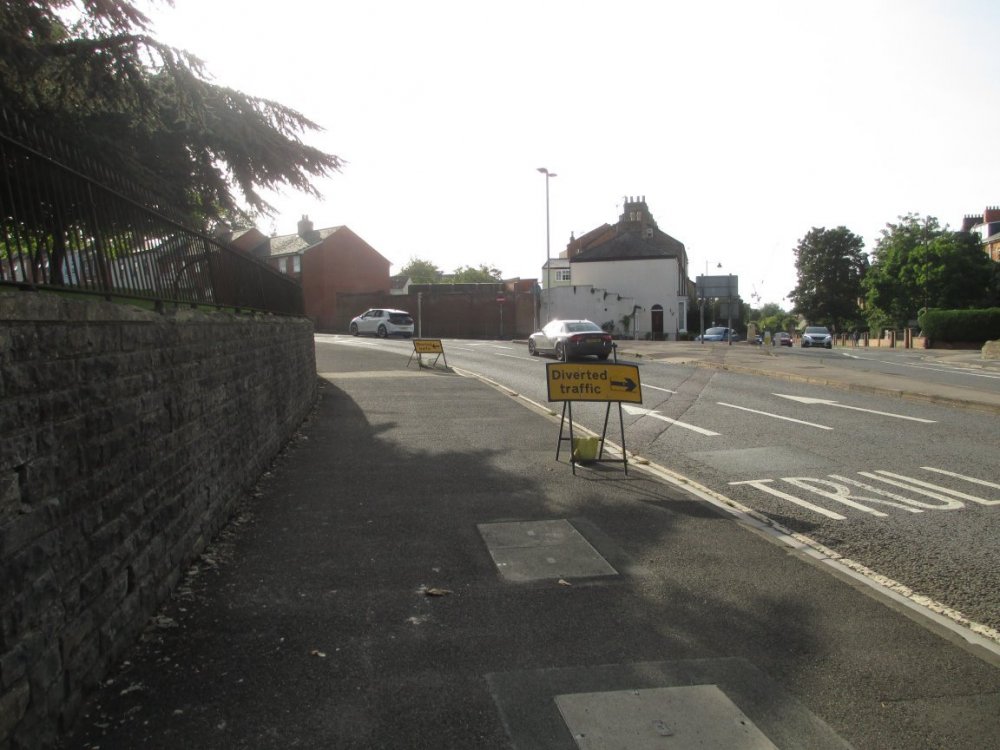
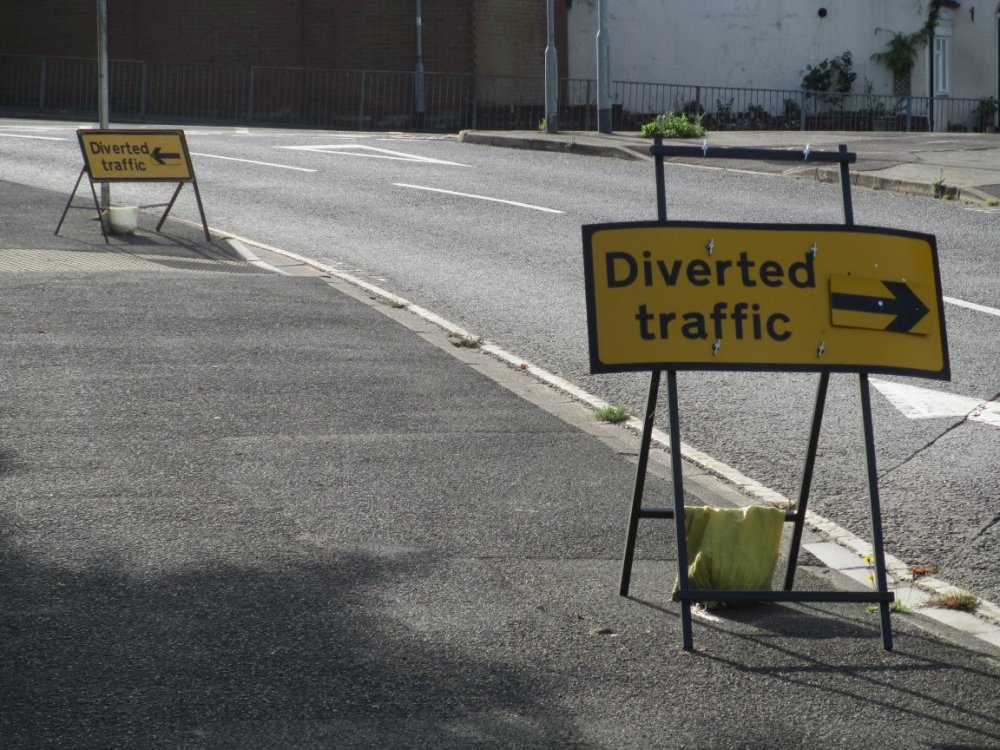
It seems to me that that this question might be resolvable depending upon the response of an AI to something it has not been taught. For example I don't believe a human would have much trouble understanding this One of the earlist proposed uses for AI is as a robot driver. So what would such a driver's response be to the following

-
So just exactly how common is it with references. I would suggest distinguishing between how common in settled communities, like say Denmark and war zones like the setting for your video. But fundamentally people need to take more responsibility for and care their own actions. How does the frequency of this type of misadventure compare with say the frequency of an ordinary joe clearing the rubbish bins or alleys and receiving an unwanted 'needlestick injury' ?