Genady
Senior Members
-
Joined
Everything posted by Genady
-
Real numbers can be constructed directly from integers, without a construction of rationals.
-
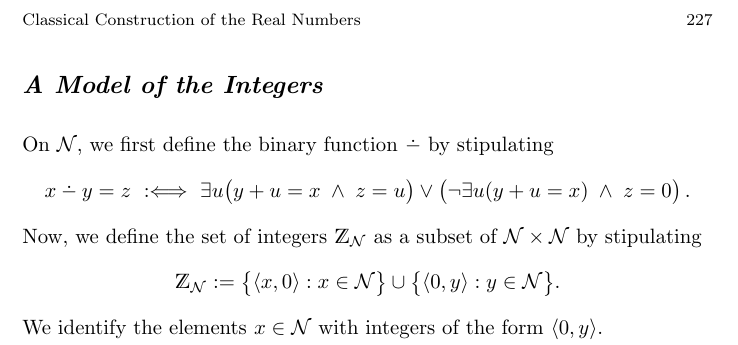
Given natural numbers [math]\mathcal{N}=\left\{0, 1, 2, ... \right\}[/math], Why do they identify [math]x \in \mathcal{N}[/math] with [math]\left\langle 0,y \right\rangle[/math] rather than [math]\left\langle x, 0 \right\rangle[/math]? Does it matter? If yes, how / when?
-
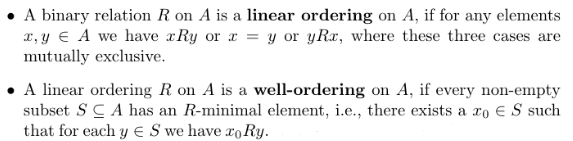
Right. As they say in the first part of the definition, xRy and x=y are mutually exclusive.
-
-
Ha, that's too. Still, there is another one, related.
-
Without going into any technical details, the short answer is,

-
No. (Check your notes or references about basics of algebra.) I've checked. Turned out that I am right. Can you find what is mistaken in the quoted definition? (Read it carefully in the OP.)
-
No topology here. This is pure set theory, more specifically, ZFC. There is no requirement that a set has to be well-ordered. It is only a definition, when it is. I claim that the definition as stated is meaningless, i.e., no set so well-ordered exists. (I don't remember which quiz/riddle on divisibility I posed months ago ☹️ ) P.S. I like your "Location." 🙂
-
Consider these definitions: I think, there is a mistake in this definition of well-ordering which makes the latter impossible. Am I right?
-
It appears that you have three unknowns: [math]x, y, \alpha[/math], and you have one equation [math]yx=\alpha[/math]. You need two more equations to solve the problem. If I understand your sketch correctly, one equation could be that two red areas are equal, and another that the brown area equals sum of the red and the green areas. If so, the rest is some trigonometry and some algebra.
-
There is a theorem in logic that says that given a countable formal language, any consistent formal theory in this language has a countable model. What is paradoxical about this statement? For example, the language of the axioms of Zermelo-Fraenkel Set Theory ZFC only consists of the membership relation ∈. Hence, if ZFC is consistent, it has a countable model. However, it is easy to prove from the axiom system ZFC that there exist uncountable sets. How is it not a contradiction?
-
I am really glad that this misunderstanding has been figured out. Thank you for clarifying its origins. I wondered and did not see where it comes from.
-
For two reasons: a) there is no requirement for a set of axioms to be finite; b) there are many complete axiomatic theories. It is not a problem. There is no need in such differentiation.
-
This is correct. However, such definition has to be added as an axiom or axioms because there is no way to express it logically using only axioms of addition.
-
However, this is what axioms are. All the deeper stuff is not even wrong. This understanding is wrong. This conclusion is wrong, too.
-
I am sorry.
-
What is completeness or incompleteness of a theory in your understanding?
-
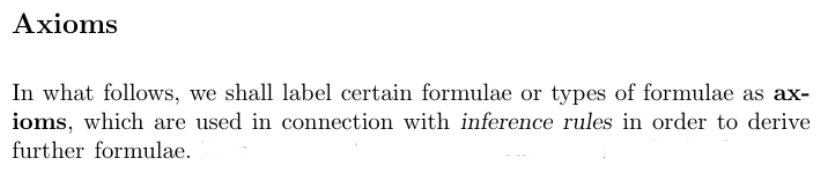
You provided a set of axioms which define multiplication. Together with the other axioms they make Peano arithmetic. This arithmetic is incomplete. The Gödel's Incompleteness Theorem says that axiomatic sufficiently strong consistent theory cannot be complete.
-
It is so because sentences that cannot be decided (incompleteness) in a stronger theory with addition and multiplication, cannot even be formulated in the weaker one which has only addition.
-
It and also anything else can't be used for defining multiplication in terms of addition. Here is one proof of this fact. Per the Gödel's Incompleteness Theorem, Peano arithmetic is incomplete. This arithmetic contains the axioms for multiplication, as discussed. OTOH, Presburger arithmetic is complete. This arithmetic contains the same axioms as Peano minus the multiplication axioms. If multiplication could be in principle defined in terms of addition, these two arithmetic theories would've been equivalent and thus would've been both complete or both incomplete.
-
Using the formula above the recursive and other properties of exponentiation are derived, and then the derived properties, i.e., the theorems are used for practical calculations and for other derivations.
-
That's correct. The question is then, how to define the Cartesian product AxB so that AxB≠BxA.
-
where the relation seq and the function lh are previously defined via G¨odel’s β-Function.

-
As I said, it is not in the form [math]a \times b =c \Leftrightarrow \varphi(a,b,c)[/math], i.e., it is not a definition from addition.
-
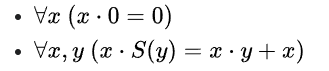
This is a set of axioms added to the system (and a symbol added to the language) to define multiplication. (In fact, in Peano arithmetic they are: ) A definition without adding axioms would've been [math]a \times b =c \Leftrightarrow \varphi(a,b,c)[/math], where the RHS is some formula without multiplication. The point is that such non-axiomatic definition is impossible. When multiplication is defined axiomatically, definition of exponentiation is possible as [math]a^b =c \Leftrightarrow \varphi(a,b,c)[/math], i.e., not recursively.