Genady
Senior Members
-
Joined
Everything posted by Genady
-
I thought of {a, {a, b}}, but your solution should work, too. Both solutions are different subsets of [math]\mathcal {P}(A\cup \mathcal {P}(A))[/math].
-
If you think it makes it clear, fine with me. Would you add something like that to the title of this thread?
-
You are right. My issue with putting it in any other category is that then it appears as if I'm asking for help with this question, which I'm not.
-
Let A be a set with elements {a, b, c, ...}. With these elements we can make sets of pairs, e.g., {a, b}, {a, c}, {b, c}, ... These pairs are not ordered, i.e., {a, b} = {b, a}, because by definition sets which have all the same elements are equal. How can we make ordered pairs, say <a, b>, such that <a, b> ≠ <b, a>?
-
There are two beautiful proofs for the above, but I have also a semi-intuitive "explanation" for it: We learned that multiplying n by m is adding n to itself m times. The problem here is that the notion of m times implicitly refers to multiplication. IOW, such a definition is circular. OTOH, when we already have a multiplication defined in the system, defining power, or exponentiation, as multiplying n by itself m times, is not a problem.
-
TIL the curious fact that although power function can be formally defined from multiplication, the multiplication cannot be formally defined from addition and thus has to be added to axioms, if needed.
-
(deleted - not important)
-
As Leonard Susskind used to say, "If one electron is in Massachusetts and another is in California, they are not in the same state."
-
My 5¢ or rather



-
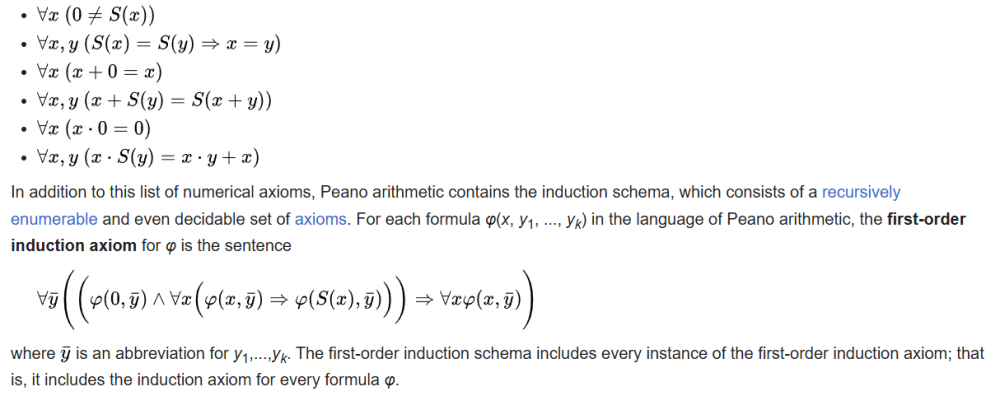
Here is an explanation: Peano axioms - Wikipedia
-
Well, the answer is simple albeit probably surprising. There are infinitely many axioms in that list, three posts above.
-
Here are How many axioms are here? If the answer were "seven,"

-
No, I mean axioms of natural numbers, the ones that govern the arithmetic of 0, 1, 2, 3, ...
-
That's a good system. I want to see.
-
This is why I've clarified that I specifically mean natural numbers.
-
How many axioms are there in a theory of natural numbers?
-
A bit of a mess here: "A Canadian journal has issued corrections on 138 case reports it published over the last 25 years to add a disclaimer: The cases described are fictional." "The articles usually start with a case description followed by “learning points” that include statistics, clinical observations and data from CPSP. The peer-reviewed articles don’t state anywhere the cases described are fictional." "The versions on PubMed Central also do not bear any indication the case reports are fictional." A medical journal says the case reports it has published for 25 years are, in fact, fiction – Retraction Watch
-
Interestingly, in my personal experience from several companies I worked for, from small firms to huge corporations, the BS existed for clients. I didn't see it anywhere inside.
-
Right, that's what I mean. Also, to skip all the "philosophical" BS.
-
This is another common myth though.
-
The goal is relevant; the intuition is not.
-
Not only "emergent geometry" requires definition, but "fixed geometry" as well. It is not clear without definitions that these two properties are exclusive.
-
Exactly! And as I pay taxes in two countries I get to vote in both.
-
This out of context quote does not tell me that "Einstein struggled with the idea that geometry shouldn’t be a fixed stage."
-
Did he?