
joigus
Senior Members
-
Joined
Everything posted by joigus
-
 I find pretty much the same problem with any proposition including the words 'as it really is.' As if there's some bogus way, and then there's the 'really real' one. That's as much as I can say without actually reading the book.
 -
There have been so many puzzles in theoretical physics, and so many more people working on it than ever before, that almost every conceivable idea of that kind has already been tried. Dirac tried with his sea of negative-energy electrons, but it was proven that Dirac's vacuum would be unstable, and wouldn't last. A vacuum in quantum field theory with negative-energy quanta is nothing like our universe's.
-
Only true knowledge brings you true emotion. So I understand. Other people experience it with less of an outpour, but every bit as intense and authentic.
-
Sorry. Wires got crossed with another conversation.
-
CaO2 is a peroxide, actually. Just to be precise.
-
Good point.
-
I'm out of my depth here --no pun intended. I'd heard that when temperature in the mantle goes down below 650º, water can start leaking into the deeper mantle and essentially disappear from the water cycle. If I understand correctly, the formation of hydrous minerals is essential for this removal. I understand @exchemist's example of CaO2 as simply an example that if you include oxides, you can account for this. I've been looking for online credible literature about the subject, and I've found this: https://www.sciencedirect.com/topics/earth-and-planetary-sciences/hydrous-mineral#:~:text=The hydrous minerals like rock,water in a shallow sea. I won't pretend I understand every argument there, but it seems as if we're at some point in a shift of paradigm here, and people are pushing the boundaries of the depths at which it's thought that this hydration can occur. Am I reading this correctly?
-
Brilliant point. I hadn't thought about it.
-
As @Sensei said, regolith is not a true soil. Google: "why is regolith not a true soil" https://en.wikipedia.org/wiki/Regolith Even on Earth, where molecular nitrogen is very abundant in the atmosphere, we need nitrogen-fixing bacteria. Only physical processes and few and very special organisms can break the N2 triple bond. I suppose @Genady's picture is correct that, once the nutrients from the seeds run out, the plant cells simply didn't find the nitrogen to synthesize their proteins and nucleic acids. I would assume lunar regolith is poor in phosphorus too, but I'm not sure. Interesting news.
-
Thanks. Very interesting!
-
It's a minor effect in comparison to volcanism, only noticeable at the time-scale of hundreds of millions? billions? of years. A part of the water gets recycled to the atmosphere as you say, but a small fraction is incorporated as hydrous minerals, from what I know. I think this is the original find: https://agupubs.onlinelibrary.wiley.com/doi/full/10.1029/2019GC008232 Does that check with you? I'm very interested in learning what you think.
-
Just to add to what other members have said. It's perhaps interesting to use Venus as a comparison: a planet that should have had plate tectonics --it has very active vulcanism, has the right size, etc-- but doesn't. Google: "why doesn't Venus have plate tectonics?" As stated above, the role of water as lubricant in the subduction zones is thought to be of critical importance. It also leaks into the mantle, so the oceans are ever so slowly being depleted.
-
Totally spot on. In fact, part of the light that we see is just behind the BH from the observer. The back of the BH from the observer may be the worst place to try to hide from them.
-
To my --totally untrained in interpreting astrophysical data-- eyes, I would say accidental changes in density in the accretion disc are to be expected. From the video talk that @Genady linked to, the experts make more of an issue of the way in which those gradients move --than of the fact that they're there at all--, if I understood correctly. The more mathematical-physicist type that talks there --Ziri Younsi-- states that all observations agree with Einstein's version of GR impressively well. The 'groundbreaking' part of it is more due to the achievement than to any big surprises, I think.
-
Thanks. Merging suggested:
-
Thanks!
-
Does 'me' have parts?
-
If you're being digested by a bank? You've earned it!
-
Oh. I think that's because you're a bit particular about insects. I'd love to have a male fig-wasp tell me if this is a good deal: 1) Be born 2) Have sex 3) Die and be digested by your house They don't even know what having a meal is like. Yet, they've been around for hundreds of millions of years. Far longer than primates. But we humans have come up with and interesting alternative to 3): Buy a house, be digested by your bank, and die.
-
There's more art in Puffy Pufferson here than in many a student of Art I've met. Whether he does it for love or for a one-night stander, he only knows. I agree with you 80 %. The other part that humans add to the artistic equation is, IMO, awareness of death. Awereness of death in humans --and, don't tell anybody, but also I suspect probably in corvids and other primates at least-- has given art a compelling character for us as a species, that only the urge to procreate can rival with. I don't know where this feature puts us in relation with fundamental biological principles, or even among other species, that I suspect present us with the slightest inkling of something like that.
-
This idea that sexual selection is at the root of art I find very intriguing, and I would be pleased to know more about your idea and how you came up with it. It kinda makes sense, as there are examples in Nature where animals display and preen --to the point of risking their lives-- for the only purpose of attracting a mate. If that's the case, it obviously has grown into something much bigger than that. I've once read everything we do, we do in order to mate. Now, I think that's an exaggeration. But I'm diverting again... The paleolithic though goes as far back as 3.3 m.y.a., so it's not off the boundaries you propose. Paleoanthropologists have pushed the boundary much farther back than we used to think even a couple of decades ago. What I do know paleoanthropologists have said is that the first manifestations of art come from about 75,000 y.a. Circa the Toba eruption. Before that, it's as if we have modern humans from the anatomical point of view, but no art, no simbolism, and no traces of any religion. Sure. I agree. I didn't mean to say photography is not art. It is. I meant that, once the possibility arose to faithfully represent what we see by imprinting it, simply depicting what we see became not such a compelling artistic drive for painters and sculptors, and other, more abstract forms of 'depiction' became more relevant.
-
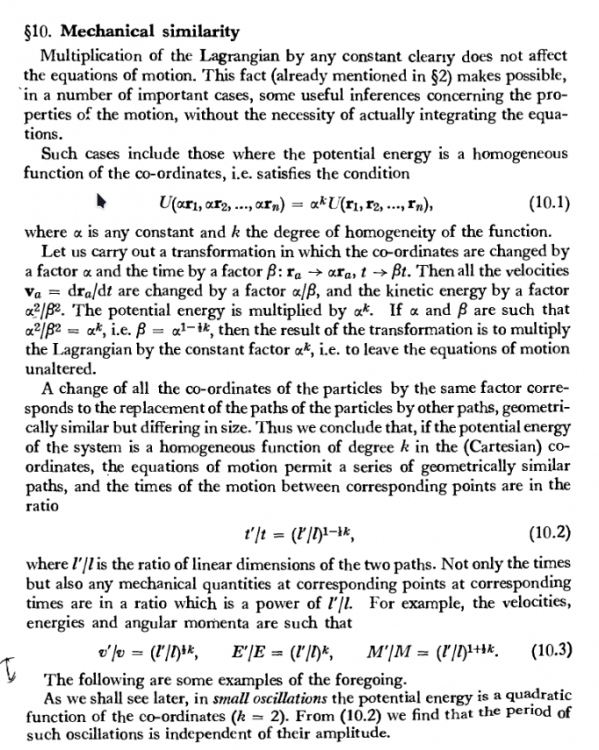
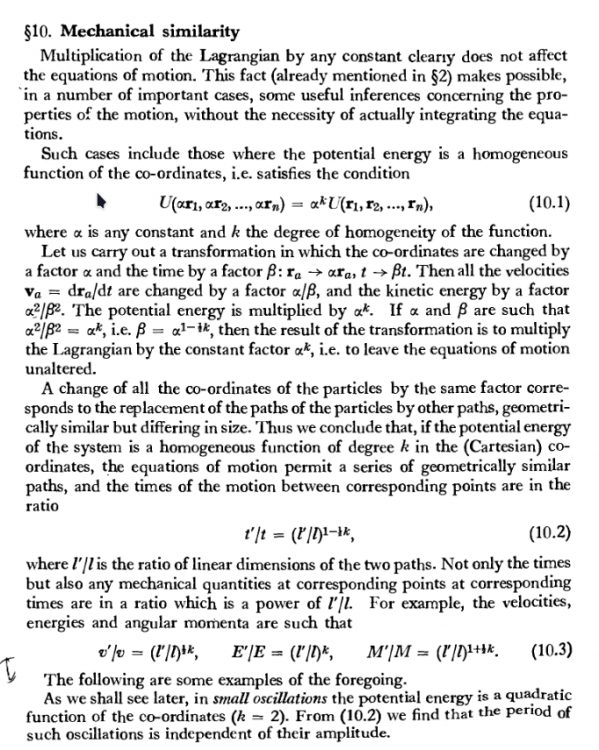
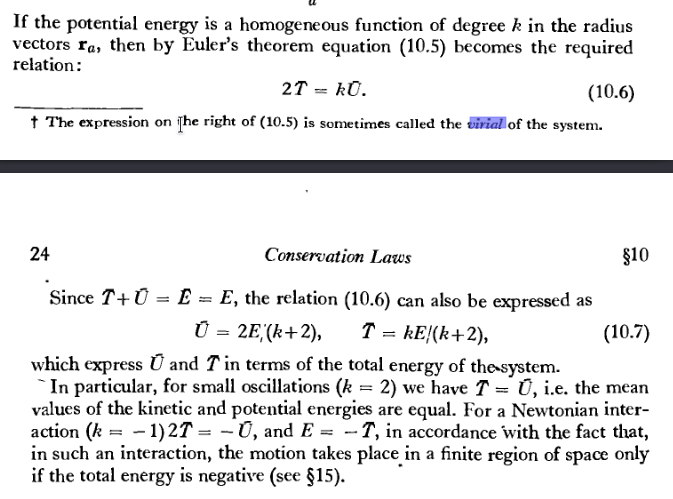
I would follow @studiot's advice here to disentangle physics and mathematics. There is a relationship to be sure, but there are many dangers in thinking one is the other. As to the virial theorem, in case you're interested, I'm going to follow Studiot's example too and give you a piece of a very commendable book. Landau-Lifshitz, Course of Theoretical Physics, Vol. 1. Mechanics:
-
Yeah, I think there's something at the root of art that's to do with the unattainable, with longing. I think when art was jump-started, back in the paleolithic, the main motivation must have been to conjure up those things that mattered most to our ancestors, but were not there and they could hardly wait to see again --mostly pack animals that constituted their main resource for survival, when they were gone and they knew they would have to wait for another year for them to come back. Curiously enough, they didn't depict predators nearly as much as they did their favourite prey. Then it became more about gods and human authorities. 'Think of me when I'm not here.' Sure that was what Roman emperors had in mind when they had artistic renditions of themselves put in place hundreds and hundreds of miles away from the place from where they exerted their authority. It's when photography became possible that art started to become more abstract, and more of an interior journey. Thanks for the link, BTW. I'm not surprised that, when people can be taken at their word that they like the art the see or hear, a rush of neurotransmitters goes with it.
-
You can do worse than being called a philosophical minimalist. The truth is I share your sentiments. Philosophy --the axiomatic approach-- has made my head spin in the past. I prefer hard-scientific, fact-based approaches. To a question such as 'what is art?', I think anthropology, paleoanthropology, and the like; have a lot to say about it. Also neuroscience. We cannot possibly understand what it is without understanding what paleolithic art was, as well as what it is that art does to our brains. What were those people trying to tell each other, themselves, or us? What does art do to our brains?
-
By the artist(s), of course. You are a philosophical minimalist, @Genady.