
joigus
Senior Members
-
Joined
Everything posted by joigus
-
If you mean call you to task for ignoring the rules of the forum, yes.
-
Maybe that's what's in order. Or maybe a diagram will be necessary to explain this to the author.
-
OK. I see the first try didn't hit the target. Could you answer to any of @Markus Hanke's objections to your idea? Or will you just ignore them and keep freely and anabashedly playing with words and pictures?
-
Another WAG. Could you answer to any of @Markus Hanke's objections to your idea? Or will you just ignore them and keep freely and anabashedly playing with words and pictures?
-
No, they're not based on EPR. EPR published their paper hoping it would settle the question. They thought quantum mechanics is incomplete. Murray Gell-Mann thought otherwise. It's not discredited. EPR was conceived to coin a concept that would be able to discern if quantum mechanics was right or he --and other critics-- were right. Non-locality is not a long-established reality. It's sometimes actually used --wrongly, because many people do not understand what it means-- to discredit new ideas on the grounds that they would be non-local. Then you certainly don't understand the question. \( \frac{1}{\sqrt{2}}\left(\left|\uparrow\downarrow\right\rangle -\left|\downarrow\uparrow\right\rangle \right) \) independently of the space-time factor of the state. In fact, the space-time factor of the state is completely omitted. Don't you find that peculiar? OK. Let me stop you right there, because it is plainly obvious you don't understand quantum mechanics here. Quantum particles have no identity. They are indistinguishable, and they are in a way much more profound than macroscopic objects can be made extremely difficult to tell apart. Not even Nature "knows" which electron is which. There is no "which electron." They're just instantiations of a quantum field. It's actually more profound than instances of a computer program, for example, which have a process tag and a time stamp. Electrons have no tags. GHZ in its original form is about three particles, and the GHZ state is \( \frac{1}{\sqrt{2}}\left(\left|\uparrow\uparrow\uparrow\right\rangle -\left|\downarrow\downarrow\downarrow\right\rangle \right) \). The observable to measure here is \( \sigma_{x}\left(1\right)\sigma_{x}\left(2\right)\sigma_{x}\left(3\right) \). You can extend that to more than three particles, and I'm sure people have been busying themselves doing that. But again, there is no mystery but the mystery of quantum mechanical correlations. It all comes from a local conservation law, which is conservation of angular momentum. In this case, spin angular momentum. The GHZ observable is a diagonal (eigenvale-to-eigenvalue) function of total x-component of angular momentum, which is locally conserved. A lot of people are still confused about this? Sure.
-
Good job! Poor old late Einstein is falsely quoted more than anobody else in science, probably.
-
Then Don Lincoln would be well advised to read my comment: And do QM calculations for ten years as a punishment for making the widespread foolishness that Gell-Mann talked about, even more widespread. The gloves example serves the purpose of showing that initial correlations don't require spooky action at a distance. Nothing more. They differ --very importantly-- in that left or right-handedness, colour, material, etc., are well-defined at all times. Contrary to quantum mechanical systems, for which the mere assumption that these properties have a definite value would lead you to untenable assumptions like non-locality or existence of negative probabilities, or both. Because we think quantum mechanics is correct, we don't need to assume such foolish things. Do you see my point?
-
No, it's no hidden gem. It's already implied by the maths of a simple exact solution of the theory. Let me try an analogy. A physicists who's given the solution for the quantum harmonic oscillator tries multiplying the energy of the ground state by the period for different harmonic oscillators. It always gives the same value!!! Yes, it does because it's h-bar (Planck's constant), as (h-bar)x(omega)xT = h. That "same value" is nothing other than Planck's constant. It was there from the very beginning. You feed G and c into your theory. You calculate solutions. They depend on G and c, of course. You get back a certain combination of G and c. No mystery, is it? Be careful, because physics has a way of tricking you into thinking you're getting something new when you're actually going in circles.
-
I did. And this is the reason: Fabricate: to invent false information in order to trick people Then, you didn't address any of my concerns. I do yours though: What do I mean by "fixed"? The same as "number 3 is fixed." Or do you think number 3 expands too? Eigenstates do not expand. So far, you haven't made a smidgen of sense. No, we can't start there, because you don't understand even the first thing about quantum mechanics. All the elements of a Hilbert space that have physical meaning have a measure of 1, because they are interpreted as probability amplitudes, not points in a topological space. You don't understand anything, can't be bothered to ask, and don't answer to any objection. I'm out too.
-
No, the inner dot product in the Hilbert space is not a fixed reference. It can change with time. It's the eigenstate that doesn't change. "Eigenstate" means "proper state" or "characteristic state" in German. It is a fundamental ingredient of quantum mechanics. Eigenvalues ("proper values" or "characteristic values") don't change either. Let alone "expand." The Higgs field has nothing to do with curvature. It's a quantum field defined on a flat space-time introduced to explain mass (rest energy) in the standard model of elementary particles. A field is more like an arrow rotating in an abstract space, and sitting on a geometric space. A quantum field is a similar thing, but jumps up and down between different levels that tell you the number of quanta. Einstein never knew anything about the Higgs field. Neither did Newton, of course, because both were dead when it was introduced. Field variables don't have curvature. They're not even "numeric" things. They're non-commuting things. Eigenstates don't fluctuate, though they are defined up to a global phase (a fixed complex number of length 1.) Eigenvalues are not conserved quantities in general. E (eigenvalue of the energy operator) corresponds to a conserved quantity in some contexts. X (eigenvalue of the x-position operator in quantum mechanics) never --repeat, never-- does. I'm sorry, but you're not making any sense in the context of standard physics.
-
Not even the froggiest idea, mate. But I will quote @TheVat:
-
Eigenstates are fixed references in the Hilbert space. They'd better not change... at all. I think you mean something else.
-
I can't make heads or tails of your diagram really. What's eigenstate expansion to you?
-
No. The singlet state is totally trivial under rotations. Rotations act on it trivially: they don't change it at all. That's why it looks like (up)x(down)-(down)(up) in any representation you choose. It does not code any orientation in it. The matrix that rotates it is the identity matrix. It is blind to rotations. I can try to rephrase this over and over... That's all I can do, I'm afraid.
-
Kind of... What Bohr argued was that the very nature of the measurement process somehow produces the results themselves, in such a way that the statistical constrictions on the outcomes and the measurement process itself were inseparable. Analysis of measurement in later decades clarified that even if you have filtering measurements, preparations... (no intervention with an interacting piece of equipment) quantum correlations are there. So they're not due to intervention during the measurement. The question of hidden variables really started with David Bohm (pro) and John Von Neumann (against). It was David Bohm who, to the best of my knowledge, started to work on "hidden variables", and Von Neumann who started thinking deeply about this problem, and formulated a first version of a theorem of impossibility. Then came Gleason with a theorem about the impossibility of assigning a binary function (true/false) which was continuous on the Bloch sphere, and from there, the last --more powerful for some-- version of that is the Kochen-Specker theorem. Bell's inequalities are a further refinement of an argument by Clauser, Horne, Shimony and Holt. There is another argument of impossibility by Greenberger, Horne and Zeilinger, that Mermin simplified, with just one observable. There is another argument by Conway and Kochen... To this day, there's so much literature about the subject that it's possible to spend a lifetime's worth of study learning it. As Swansont said: If you know some Pauli-matrix and angular momentum algebra, it's an interesting exercise to write down the singlet state and rotate it. People normally write it as |up, down> - |down, up> with a normalisation factor, and referred to the z direction. As if the z-direction played some kind of role in it. I doesn't. The states really are indeterminate. You can use any axis you want and it has the same form: |upx, downx> - |upx, downx> = |upy, downy>- |downy, upy> = |upn, downn>- |downn, upn> = etc. It's all a whole quantum state with like "no parts in it", "no internal arrows", so to speak. That's entanglement for you. Try it, it's very illuminating. The only thing that's physical is the whole vector. Then you obtain the expected value of spin along any direction you want and it always gives you zero for the sum. Then you do some further quantum mechanical calculations and consider the evolution operator from, say, t=0 (when the singlet is prepared and the particles are next to each other) and a time T when the particles have come apart, and you will see that no expected value depends on the fact that the spatial factor of the states has taken them apart. It's all in the maths of QM. As I said: The correlations are there when the singlet is prepared, they're there a minute later, they're there until you perform another measurement. And no experiment that I know of contradicts this. So yes, it's like the gloves in the sense that the correlations are initial. No superluminal action at a distance. Period.
-
No problem. Part of the reason why this is all very confusing is because so much nonsense has been spread for so long that we think these theorems, as well as the experiments, say what they actually don't. The abstract nature of quantum mechanics makes it quite difficult --if not impossible-- to get any intuitive picture of the part of it that's really bizarre. So we forget that another part of it is just propagation of waves.
-
If the EP breaks down, then we no longer have GR. If so, why bother with Schwarzschild solution? It would be misguiding us all along. Sound, as well as strong forces, do not exist in that region of space, because it's a vacuum solution. And yes, tidal forces are important, they're coded in the connection coefficients, and they become the more relevant the farther away you get from the point you choose to expand your metric. The Doppler effect is like the "time-component" of these tidal forces, so to speak. It's coded in the \( \Gamma^{0}_{00} \) of the connection. You can obtain this from the geodesic equation. And sure enough, the observer would notice something funny going on with all kinds of optical effects. What he wouldn't notice is any ficticious forces due to acceleration --provided the horizon is big enough in comparison with his own size. Generally, the 0-component terms are far more noticeable because of the large value of the speed of light. It's quite an exercise of imagination to picture how an observer might experience such a voyage, but certainly I would expect all kinds of strange optical phenomena. Mirrors not reflecting properly probably being one of them.
-
You do sound like a bot, but thanks for the clarification. How can two incompatible notions of space be both correct? What appearance? What does a Hilbert space look like? And a Higgs field? Space-time is a background, while the Hilbert space of a particle is the space of all possible states of that particle that take values on that background. How could they be indistinguishable? They're very different things. No. A Hilbert space does not expand. It had better not, as you get probabilities from it. Neither does the Higgs field. It had better not, for good reasons too. Why do you say these things (and more) that don't make any sense? I'm sorry for trying to test your human nature, but you made very loose connections, and sounded to me like a bot. Also, personal opinions don't play any role in mainstream science.
-
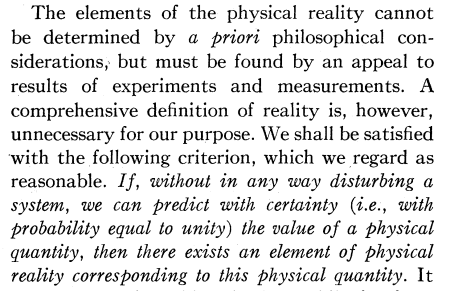
OK. I know where the trouble is. Yes, Bob could in principle determine whether a measurement has been performed. Mind you, I say "in principle." Whether there is any viable way to do that is another matter. But this change in the state is subject to propagation as the interaction it actually is, and is therefore subject to delay, as any other actual interaction. IOW, if you really "touch" the system, the influence will propagate causally. But Bob would learn about it no sooner than d/c, where d is the distance between him and Alice in their inertial system. I didn't say Bob would know it instantly. This makes sense, doesn't it? Don't forget that Einstein's criterion for what an "element of reality is" means: (from the famous EPR paper that gave rise to the whole debate: https://cds.cern.ch/record/405662/files/PhysRev.47.777.pdf) Now, what's troubling you, I think, is that we've heard these terms "non-locality", "superluminal action at a distance", "spooky" this or that, that we can't help but think that every time information is obtained from a quantum system, the question of non-locality is at stake. This is not the case when coherence loss is the issue. Without realising it, you're assuming this influence must be superluminal, or instantaneous. Why? It doesn't. It's an actual interaction! Pay attention to the words "without in any way disturbing a system" in EPR's paper, because they're essential. The verification that somebody has performed a measurement on the other particle would propagate at a finite speed, because the observable, if you will, "whether someone has performed a measurement" does involve an interaction. So it is not what Einstein called an element of reality. It is only on those elements of reality (values of which information can be obtained without in any way disturbing the system) that the question is, at least, at stake. This part is a bit more technical: The evidence of that interaction would be reflected in what we call the density matrix, which essentially consists of statistical weights: the probabilities 1/2, 1/2 that I mentioned before (and constitute the diagonal elements of the density matrix: those would not change) plus the relative phases between the states "up" and "down" (which constitute the non-diagonal elements: those would change). But those coherences are a part of the wave function that is affected by the interaction, and they would take some time to reach Bob. Nevertheless, after enough time has passed, Bob would be able to tell (in principle, I repeat) that someone's been messing with the state. Nothing more. In fact, he wouldn't be able to tell whether it was Alice, or a gust of wind, or what the output of the experiment was unless he measured the same projection of spin they agreed to measure. --- (end of the more technical comments). The point is perhaps subtle. But the take-home lesson is: Not every time a leaf falls to the ground is locality at stake.
-
That sounds right. I wasn't very assertive about it, though: How do you devise such an interference experiment? I was thinking about this for a while, and couldn't come up with any way to do that. The question boils down to: How do you know a beam of particles that give you random spin projections is in a pure state or a mixture state? On second thought, I don't think you can, unless you gather information of all the parts. But then the superluminal character is no longer an issue. Yes. Thank you for pointing that out. We almost x-posted. I would like to think about that a bit longer...
-
1) 重點是什麼? 2) Who died cuatro days ago? You answer those two, then we talk about the universe. Sorry for turning all Voight-Kampff on you. Indulge me.
-
Then you absolutely have missed the point of what's going on, and are still living in the confusion. This is what Murray Gell-Mann calls the "widespread foolishness associated with the EPR effect." Go back to the example of the gloves that MigL was talking about. One glove goes to Australia and the other stays with me. I open the box and find out that it's LH. I thereby know immediately that hoola got the RH one. Would you think for a moment that one glove corresponds to the right hand and the other to the left hand because some "spooky action at a distance" has taken place between them? That's what's foolish to say. The gloves are perfectly anti-correlated just because the correlation was there from the beginning. I can repeat the point over and over if you wish, but I can't make it any more clear. The story of the argument is somewhat contorted, because Einstein thought of a different example, with position and momentum, and then David Bohm proposed one with spins. But you got the story wrong too. That's for another post, though.
-
thanx
-
You're confusing correlations between observables being there (and actually not changing at all during evolution) with observables being indeterminate. It's not the same thing. In the singlet state, correlations are very well defined, yet the projection of spin along any direction is expected to be zero on average. I said it before. It's about a couple of variables having zero expected value for each one of them, and yet being perfectly defined and with zero dispersion (no statistical variance, standard deviation, dispersion, as physicists say) for the sum of both. Schematically, if A and B are the respective projections of spin along a fixed axis for both particles respectively, Average values of both: \[ \left\langle A\right\rangle =0=\left\langle B\right\rangle \] Average value of the sum: \[ \left\langle A+B\right\rangle =0 \] Dispersion of each: \[ \sqrt{\left\langle A^{2}\right\rangle -\left\langle A\right\rangle ^{2}}=\sqrt{\left\langle A^{2}\right\rangle }=\sqrt{\frac{1}{4}}=\frac{1}{2} \] But, (and here's the rub) dispersion of the sum of both: \[ \sqrt{\left\langle A^{2}+2AB+B^{2}\right\rangle }=\sqrt{\frac{1}{4}+2\frac{-1}{4}+\frac{1}{4}}=0 \] So, as I said earlier, each one of them is as indeterminate as it can be, but the quantity formed by the addition of both is sure zero every single time we measure. Does that clarify the discussion? Sorry, I wasn't clear here. It's about a couple of variables (which have zero expected value for each one of them) having big dispersion for each one of them, while being dispersionless (zero dispersion) for the sum of both. Dispersion is a measure of how "statistically spread" the results are.
-
Yes. It's a physical constant altogether, and let's see what it's equal to: \[ R_{S}=\frac{2M_{BH}G}{c^{2}} \] \[ \frac{M_{BH}}{R_{S}}=\frac{M_{BH}}{2M_{BH}G/c^{2}}=\frac{c^{2}}{2G} \] It's a universal constant just because it's the quotient of two universal constants. It happens to have the dimensions of a linear density. That doesn't mean anything in itself. Tidal effects begin to be important long before you reach Planck's scale. Planck's scale is more about quantum effects. The h-bar is giving it away, isn't it?