
joigus
Senior Members
-
Joined
Everything posted by joigus
-
I agree. That's why the statement that decoherence is instantaneous I find very suspicious. The correlation with parallel magnets/polarisers you would start seeing very soon: (+,-), (+,-), (-,+), (+,-), (-,+)... Every once in a while you would get a (-,-) or a (+,+) that are atributable to noise. Yes, you're right. It's just that when you think too much about this, you end up considering stupid ideas. Bell's theorem excludes even the possibility that the hidden variables are not correlated at all with spatial directions. They could be correlated with whatever you like... As long as they're yes-no variables --no superpositions of yes-no-- they satisfy Bell's inequality, and therefore QM violates them. I noticed. I'm paying a lot more attention to this thread than previous discussions we had, because of my interest on it, and because I think I can contribute more significantly.
-
Absolutely. That's what's strange. I've racked my brains in the past thinking about this. For example: Suppose the photons are some kind of "magic marbles" that have the property of responding to different colourful filters, but what they have in their innards is actually a simple-minded, totally stupid tag that says "yes" travelling in one direction, and a tag "no" traveling in the other direction, having actually nothing to do with their world of colourfulness. If you wanted to rule out something like that happening, you would have to go to non-parallel polarisers, and check whether they're giving correlated answers to uncorrelated questions, so to speak. I'm not sure that Alain Aspect did rule out that possibility, but I would be very surprised if he didn't. I'm not sure if my point is clear either. If that were the case, we would all be as good as idiots, and Einstein would be laughing in his grave. I don't think for a moment that's the case, but it goes to prove the kind of logical maze this kind of thing gets us into. I'm glad you recovered your strength, Eise. I don't think that would be consistent with quantum correlations either. In fact, what I've just said is stupid, and now I remember the reason why.
-
Some aspects of correlations are manifest only when you do thousands upon thousands of experiments. But every single time the anti-correlation is exact --within the allowance of detectors noise. It's like: ++-+-+--+-++-+- average = 0, sometimes +, sometimes - (random) --+-+-++-+--+-+ average = 0, sometimes +, sometimes - (random) See? Every column is one run of the experiment. Each row is observations for one particle. But (+-)(+-)(-+)(+-)(-+)(+-)(-+)(-+)(+-)(-+)(+-)(+-)(-+)(+-)(-+) average = 0, every single time = 0 Does that help?
-
Boy, I don't know. Could that be because it's classical? There's no classical analogy of a bipartite system of electrons/photons. Swansont's example I had never heard before, but it illustrates perfectly that there's no such thing as two states. There's only one state. It also illustrates that there are states of the bipartite system that neither up nor down. So it also illustrates superpositions of sorts. That's what I like most about it, and I'll keep it in my toolkit. It can't illustrate every aspect because coins are not quantum; they're classical. Quantum identities? I don't know of any such thing. In fact, for all we know there isn't any such thing. I would punish you for all you're saying to do quantum field theory in the Fock representation for the rest of eternity. Then you would understand!!! It's actually more natural to describe a two-particle state in terms of the occupation number: This state is twice "busy." These are difficult ideas, I'm not saying they come naturally to anybody. The danger --of discussing these things forever-- comes from people who have only half-understood QM. You never see the end of it.
-
You keep saying this over and over, and it's just because you don't understand. It's not more true just because you repeat it. Here (again): The coins were made in Hamburg, and then taken to Ukraine and Andromeda. The results correlations are random whatever way you decide to toss them. Now, and here's the point, if you measure the same observable, the correlation is perfect. But if you measure incompatible observables, they're totally non-correlated. You can't do that with coins. The correlations are strange, for sure. But because they were made in Hamburg the very same way, had you made the measurements in Hamburg at the very beginning, you would have found exactly the same correlations.
-
Interesting. I thought he was just suffering from hay fever and went to Helgoland, where he went through an epiphany... That's what he says in his book Encounters with Einstein, and Other Essays on People, Places and Particles.
-
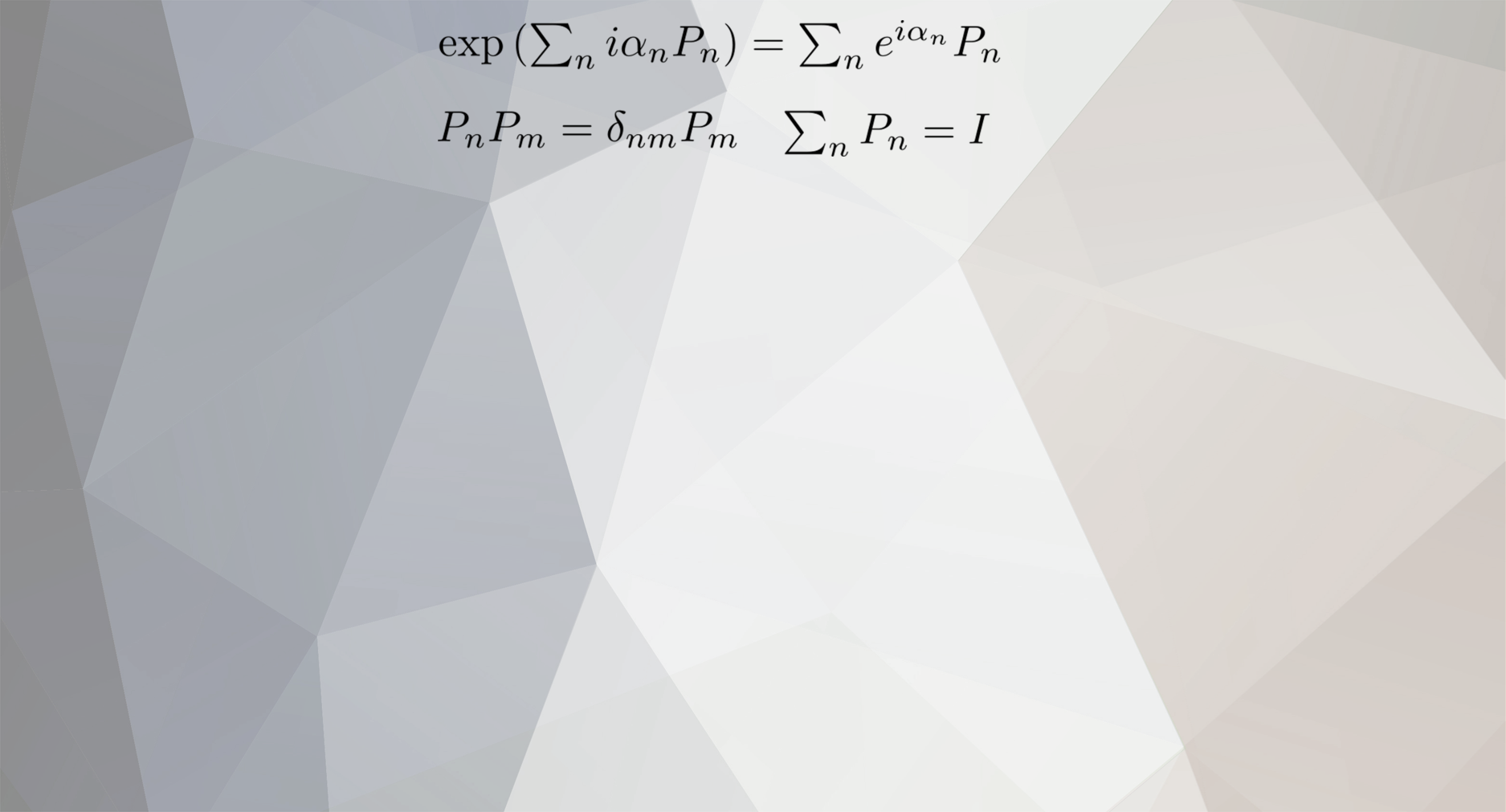
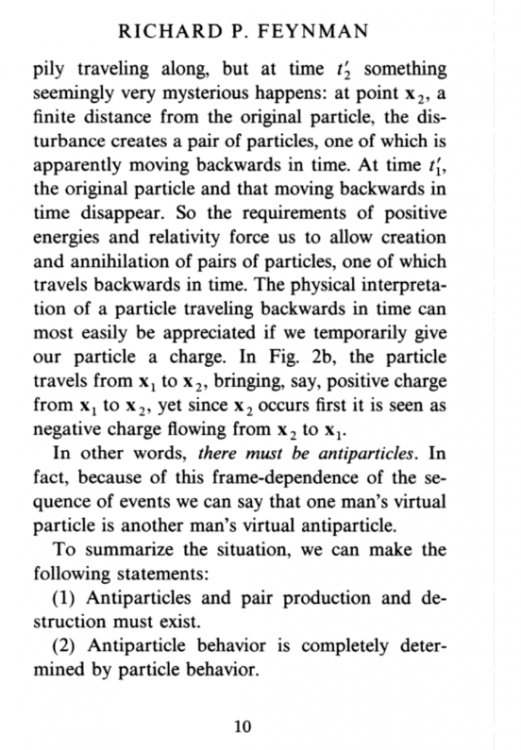
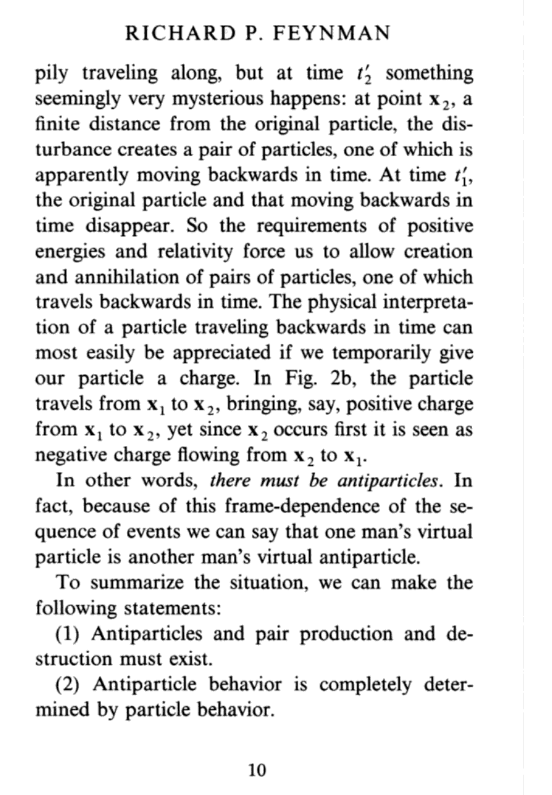
I think you mean non-separability in space. I haven't the foggiest idea what separability in time means, as separable or not is an attribute of the state that depends on how it factorises --or not-- in the particle-identity tags* (state)12=(state)1(state)2 --separable-- or, as is the case for the singlet state (state)12=(state)1(state)2-(state)2(state)1 --non-separable. Once an inertial system is chosen, there's only one coordinate time. On the other hand, it's perfectly possible to make a classical-mechanical model of interaction non-local. Newtonian interactions at a distance are a perfect example. So no, it's not a discriminating attribute between classical and quantum. It's just an artifact of the approximation. If someone removed the Sun from its place, it would take us a little over 8 minutes to be able to tell. We have no experiment that says that, but we're pretty sure it's true. * Even though particle identity doesn't really mean "identity" as we understand it in the classical world. It's a dummy tag, really, a labelling artifact. (My emphasis.) I think you mean local, but that's probably a typo. FW theory. This is a theory of classical (not quantum) electrodynamics in which Feynman, for reasons that were purely heuristic --see below--, wanted to dispose of the field altogether, and assume a direct interaction between charged particles that gave rise to a completely local, relativistically causal electrodynamics. Google: "Heuristic hypothesis" In this method Feynman, after a suggestion from Wheeler, imposed the condition that the force per unit charge (the field in disguise) be half-retarded and half-advanced. But of course, the final constriction is that the total solution from all the electrons in the universe propagated in a retarded way and be totally causal and local. Feynman found that he had to impose the condition that spatial infinity be a perfect absorber of EM radiation. Pretty weird, but it worked mathematically. Observation: You can perhaps always introduce an interaction between pairs ab initio that is formally non-local, and then impose boundary conditions that restore locality --in this case, the perfect absorber at infinity. You can always have an infinite expansion in spatial derivatives of the interaction (and therefore, non-local) but you impose that the sum of all the infinitely many terms be local. You can play with that ad infinitum. It's just a change of variables. In fact, I know of another perfect example in which the separation of variables makes locality non-manifest. The so-called MHV approach to solve quantum field theories. The reason that we today do not believe that the WF model is telling us anything significant about non-locality is, of course, that we happen to know that the world is quantum, and not classical, on the one hand; and on the other hand, that the alleged non-locality has no observable consequences, because of reasons I've just explained. When you study quantum electrodynamics, you see very clearly that the advanced waves correspond to antiparticles, not to any bizarre waves propagating backwards in time. If you're surprised by this mathematical fact, it's very understandable: In quantum field theory, if you want to have field variables that commute at space-like intervals --and therefore have a theory that preserves causality, and forbids superluminal propagation-- you actually need positrons. These are not actually waves propagating backwards in time, they're only degrees of freedom of the field for which the amplitudes have to be "interpreted" backwards, so to speak. This is key to the Feynman prescription for the propagator. Feynman explains this point --not very clearly, I must say-- in this famous Dirac-Memorial conference --he starts at 10' 35'' with the words "now, here's a surprise": Here's the most revealing part of the transcript. Pay attention, please, to the words "apparently moving backwards in time." So that's all there is to it in the quantum version. You need antiparticles if you want to guarantee locality and causality. Feynman, of course, never doubted locality and relativistic causality. Well, I'm sorry. It does. They all are quadratic expressions in the wave function, and satisfy local conservation law of energy, momentum, and angular momentum (both orbital and spin.) This is all mainstream. See below for local conservation of probability density and continuity equation, plus Wiki reference added. What you're measuring there is a correlation that was there from the get-go. No wonder it "is superluminal" to you --and perhaps others who don't understand this particular point--, as it is not the speed of anything. I've told you before. The Book of Psalms is the same everywhere, not because different versions of it are communicating telepathically with each other, but because they were written long before the present time. Correlation is not causation, nor necessarily interaction. You've got a point there, but that's not totally true. We always have our reliable good old Ockam's razor. There are also TIQM (transactional interpretation of quantum mechanics), DH (decoherent histories approach), Nelson's SQM (stochastic quantum mechanics), etc. None of these models have been proven falsifiable, which is not the same as saying they are not falsifiable. What's SD? That is not correct. So local it is that a simple calculation from the Schrödinger equation allows you to derive the continuity equation for the square of the absolute value of the wave function. Probability satisfies the accepted paradigm of a local conservation law. Probability flux getting out of surface = - time rate of variation of probability inside the surface Totally dumbed down: No probability can get out of a volume without going through its surface. This is a theorem you can prove from the Schrödinger equation. Here it is: https://en.wikipedia.org/wiki/Schrödinger_equation#Probability_current I've tried to simplify the maths, but I can provide you a complete and detailed proof, if you're interested. If you sample the web for opinions on this, you will find lots of confusion. For example: And more high-level: https://physics.stackexchange.com/questions/18762/locality-in-quantum-mechanics Etc. Even if you don't understand the maths, quickly skimming through the previous forums will help you size up the level of confusion. ... ... And finally, Hugo Tetrode, 1921-22? Well, yeah. Quantum mechanics was completed around 1926. So I'm gonna pass on that.
-
The mathematical "engineer" (I prefer that to "father") of GR was Bernhard Riemann. And the mathematical "engineer" of QM is David Hilbert. By that I mean the people who introduced the "mathematical scaffolding" that later accomodated the physical theory. But I don't think either one of them would have come up with the respective physical theories without experimental or theoretical physics input. In fact, when the essential ideas of both theories were formulated, the physicists that did it couldn't imagine the mathematical tools were there already. That realisation, as always, came later. I think there's always a cycle that goes something like --example: electromagnetism--, 1) Induction: Observation of patterns, or "crude" observation: Lenz, Biot-Savart, etc. 2) Inference of a mathematical or pre-mathematical simple relations: Faraday. 3) The big picture in mathematical terms: Maxwell 4) Experimental confirmation of further predictions: Hertz Something like that. The history of the development of electromagnetism is a great example of how this works. But, of course, it's more complicated than just that. The different "branches" feed each other in a complicated way. Once we get the mathematically-closed form of the laws, the great generalisation, it's a matter of pushing and pushing the mathematical model until we find where it contradicts the experiments. It's also a matter of doing more and more refined experiments to check everything's OK. In the case of quantum mechanics: 1) Wien, Stefan, the spectroscopists (Lymann...), etc. 2) Planck, Bohr, Einstein 3) Heisenberg, Schrödinger, Dirac, etc. find out about a previously-existing mathematical scaffolding -> matrix algebra, Hilbert spaces, Poisson's formulation of mechanics... 4) Anderson finding positrons, which is a prediction of the relativistic version... Etc. Sometimes it goes the other way. We find a puzzling experimental discovery, and the theorists must rack their brains, within the mathematical scheme we already trust, in order to understand the unexpected result. If it doesn't, the mathematical scheme must be generalised minimally, ie, in such a way that the treasure of previous results is preserved. Example: discovery of the neutrino. So it's complicated. We may differ a little bit in what stage is what, but I think we agree in general terms.
-
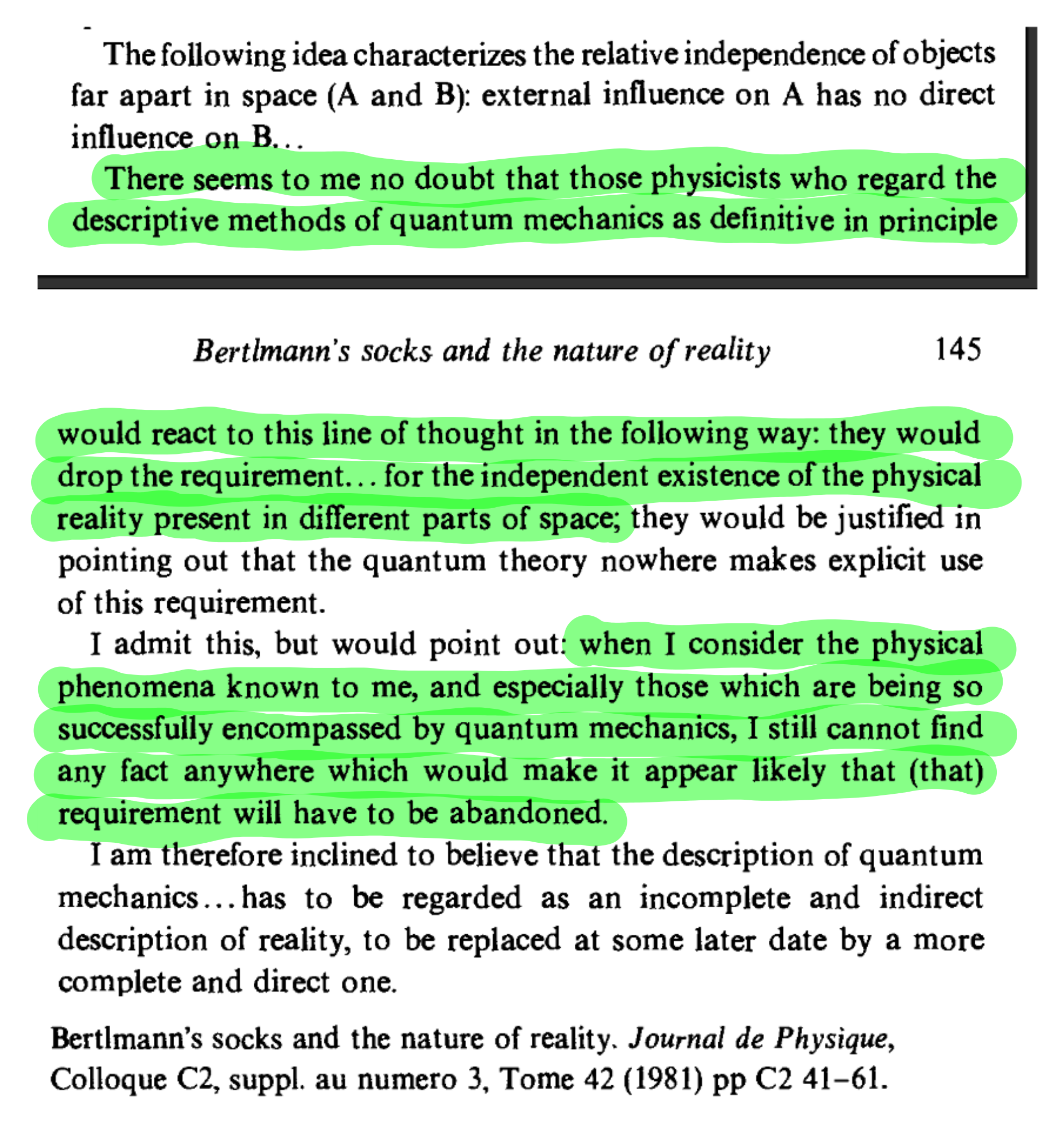
Fair enough, @Eise. If not satisfy, I will try to answer to all your concerns. But 1st of all let me tell you that there are two statements of yours that worry me a bit, as they seem to "protect" some kind of future dismissal on your part of anything I can say. I'm sure that's not what you meant, because of your proven intellectual honesty: 1) and 2) You clarify the second point later, but I hope that doesn't mean 1) I cannot refer to quantum mechanics itself, in its closed mathematical form, in order to argue about what quantum mechanics itself means or implies. And 2) There's something about my statement of the EPR argument you don't agree with, but you reserve the right to bring it up later. Again, I'm sure that's not what you mean, but I need to be sure. Nothing would give me more intellectual satisfaction than giving someone like you full intellectual satisfaction. Then you go on to say, Sorry, bad choice of idiom on my part. "Sets the record straight" is too strong a statement if we want to be historically accurate. The reason is that Bell's observation on Bertlmann's socks whas a real epiphany for my own understanding, but I assume it's not necessarily so for everybody else, perhaps not even for Bell himself. Although it was for Murray Gell-Mann, as I think I've proven with the posting of the interview. It's only 4' 44'' and worth every second in diamond's carats. Particularly revealing is what he says at 3' 00'': This completely coincides with what @swansont has manifested elsewhere on these forums. It also agrees with my understanding of the question. And Bell's example of the socks personally was my wake-up call --or bell, if I may be allowed the pun. In my life, I've gone through two major epiphanies concerning these matters: E1) I was trying to explain quantum mechanics to my little sister circa 1995 when I suddenly realised you don't need to have any reduction of the wave packet if the wave function objectively represents infinitely many electrons from the get-go. I went to my trusty QM teacher and he told me Leslie Ballentine had already thought of that. Bummer, but nice. E2) I realised John Bell's observation on Bertlmann's socks clearly suggested/implied that the correlations --potentially, if you will-- say nothing whatsoever about locality or the lack of it. Was John S. Bell aware of it? I don't know, and I don't have access to his deathbed words, so... Then you say, This seems to be the subject of your "misgivings" concerning my statement of EPR. Well, Clause, Horne, Shimony, Bell, Von Neumann, Gleason, Kochen, and Specker, at the very least, took care of that. And that's because they assume a dependence of definite variables of any kind of which the all the possible observed values (eigenvalues) may be a function of. A local (meaning numeric value to numeric value) function (not involving non-commuting stuff amongst each other of any kind). In such a way that you can map hidden variable to eigenvalue point-to-point; value-to-value. The irrefutable consequence is that you can't. You need non-commutativity from the beginning. Von Neumann understood this. Coleman understood this. Gell-Mann understood this. But the message is sooooo incredibly difficult to get across, as Gell-Mann shrewdly points out. Let's call those quantum correlations colourful correlations if you will, just in order to see they imply nothing about spacetime. Colourful correlations are colourful at t=0 when the singlet state is prepared at one point in space. Colourful correlations are colourful at t=1 when the singlet state has evolved 1 light-second apart. Colourful correlations are colourful at t=2 when the singlet state has evolved 2 light-seconds apart. ... Etc. Are we there yet? Because if we are, we can proceed from there. Now we perfom a measurement, and all hell breaks loose, the worms get out of the can, and Alice's rabbit is deep down the hole. It's then when your comment about what the wave function objectively represents or to what extent it does is invested with the utmost relevance, and we may never be able to agree on what happens to the wave function, especially if you stick to your guns that the wave function objectively represents just a human idea, and nothing more. I do not hold that view, for reasons I may be able to explain later. It's such a pleasure to discuss the matter with you, @Eise.
-
This is a bit too strong of a statement for me to subscribe it, but once the mathematical basis is well established, yes, we should trust it. But experiments are the final deciders of everything in science. What I may have said is that arguing with just words is dangerous, because sometimes words carry hidden assumptions with them.
-
Not exactly or necessarily. I understand these things only in a very very qualitative way, so I can't help you much. Let's say I'm just an assymptotic observer . From what I understand, this dictionary has to be built with a lot of guesswork for each case. Doing a quick google search, and after filtering non-related stuff, you can find papers and seminars under titles like, AdS2 Holographic Dictionary Holographic dictionary for generic asymptotically AdS black holes Building a Gauge-Invariant Holographic Dictionary etc. I learnt about the holographic dictionary on Jacques Distler's blog, Musings. He's a mathematical physicist, string theorist, bitter enemy of Lee Smolin and the LQG people, so much/most of what he says goes right over my head. But it's interesting to take a look at what people with irreconcilable views say. You take a look at one, take a look at the other, and maybe the homotopy that connects both enlightens your mind. In a theory that's invariant under deformations, ascertaining what the observables are is no piece of cake, because coordinates don't mean anything much, and you have to find (bulk/interior) invariants --like the ones that Markus talked about many posts ago--, and relate them to invariants on the boundary. Or, perhaps, if the boundary theory is well-behaved, the other way around. I'm well out of my depth here.
-
CAVEAT: These words are absolutely key. Copenhagen's prescription that we do a normalised projection of the amplitude that's valid in all of space at one particular time --so that components of the wave function that were propagating away have to be killed off instantly or die down quickly enough-- is why the illusion of non-locality persists. It has no observable consequences for obvious reasons: The components that die down don't carry any observable consequence, as zero times anything gives zero. Now, we can say infinitely many things* about those components, that essentially are the same in minimal semantic terms. A very popular one is MWI. Those components are taken to an alternative universe. Bohm's double solution: Those components propagate away, like lost astronauts, without ever being seen again --empty waves. Let me give you another one: Those components become "transparent." "Transparent" being another fancy meta-variable that tells you they can never be measured. Etc. You can invent your own. That's what we call "the many interpretations of quantum mechanics." * If we want to save unitarity, linearity, and unblemished locality = Schrödinger equation
-
I don't think the Bible is so much concerned with swingers, as Abraham, Sarah and Hagar were the first "documented" swingers in history, if I remember correctly. On the other hand, I don't think the Bible took public nudity so lightly, to be honest. It was as much lenient with genocide as it was with swinging... You see where I'm going. I guess what I'm saying is: Do what you want to do as long as it doesn't harm or humiliate, or greatly embarrass, or create unnecessary problems, etc. to others. Same here. If we're talking about sex. If, we're talking about having a nice day at the beach, I agree with moon-tan-man. Not that I get many chances to tan my moon.
-
You caught me. It's Einstein speaking there. +1 My only excuse is that I was pressed to answer to a rather "entangled" physical question in terms of quotes of famous people, a field in which I'm anything but confortable. I'd rather discuss things in terms of mathematical statements under premises that have passed the test of time, both because they've been analysed by many competent people --theorists and experimentalists alike--, and because they've passed the experimental tests themselves. It is clear to me though that Bell --especially in his last years-- preferred to save locality and work instead on alternative extensions of quantum mechanics. I also know that from biographical testimonies that attest to the fact that Bell was very ambivalent about the interpretation of his famous theorem. Feynman and Gell-Mann, for example, shared the view that quantum correlations express nothing peculiarly non-local, but only carry with them a version of non-separability that's intrinsically quantum, and cannot be reproduced by any classical model. Most other important people in the field of theoretical physics, TBH, look at this with an absolute lack of interest. The reason why I cannot accept that this problem can be ascertained in terms of celebrity-quotes is, of course, that the views of different experts do not completely overlap, that sometimes they are ambiguous when in the process of understanding a particularly confusing topic, and that, perhaps as a consequence of that, their opinions end up changing with time. Because I'm not allowed to use mathematics, apparently, I will try to work on diagrams and logical outlines to further clarify my points. I do agree with your definitions 1 and 2 of --respectively-- action and correlation. My main point is that the implications of quantum correlations say nothing about locality, as they are encapsulated in the quantum state at t=0, when the singlet state was prepared, so they were there all along, and that I will stand by no matter what Bell, or anybody else, said at a particular time in history. What happens to the wave function after we make a measurement? We can discuss that if you, or anybody else, want. But that's a different matter. Let me add something else: Only people who adhere to the projection postulate of Copenhagen have this problem. That's where the fiction of non-locality arises. Why Bell might have been "fooled" by that at some point? --if that's the case--. I don't know. My best guess is that he was a pioneer in these things and he was still in two minds about some aspects. Do you agree with my statement summarising the EPR argument? If you do, we can go to the next step: Why David Bohm took the discussion to the case of spin, because in its original formulation in terms of position-momentum, the argument is flawed:
-
I agree, and they're all yours. What Mach thought about anything that can be applied to the interpretation of quantum mechanics interests me about as much as Heraclitus's views on the imac. You, as always, choose not to address any criticism. If this interaction that you claim is not physical, what is it? Metaphysical? Does it belong to an alternate reality? Is it the result of a midsummer's night dream? Will you finally answer at least to that? Quantum correlations that reflect non-separability. @MigL has told you, I have told you, @swansont has told you, Alain Aspect has told you, Murray Gell-Mann has told you, Sidney Coleman has told you. Will you finally take it home? The only thing that looks non-local is Copenhagen's old projection postulate, that require you to kill off all the components of the wave function that are ruled out by a measurement. But it is incompatible with the Schrödinger equation. So people don't believe it anymore. And again you're wrong. Newton did postulate an action at a distance. Newtonian physics has action at a distance written all over it. He did find it weird, and tried to defend himself from possible philosophical criticism with his famous hypotheses non fingo. I already did. Now you go back and read. I don't want this to be me doing all the work, while you dash off a note declaring your incredulity and proving to everybody that you haven't read anything. However, you should notice that physics is not resolved in quotes by famous people. It's more complicated. What are you saying? A photon is not a valid observer. The proper time of a photon is not a valid observable. The observed time is different for different inertial observers..., etc. If you ignore basic physical laws, I have no business with you anymore. I'm wasting my time, and I am no photon. Again? Really? How stupid do you think I am? I've given you the definition, and you've done nothing but dismiss it from an argument of incredulity. And you've done nothing but mumble something about a non-observable time. I'm not going to address any of your questions again. You stick with your unsupported unscientific incredulity. I'm trying just to honour @Eise's more than reasonable request to make the main points clear. Is this some kind of social experiment?Agreed. I would only add that, on top of all that, quantum systems force us to think in terms of amplitudes, which are meta-probabilistic, if I may be allowed to use the term. And we don't exactly know what amplitudes objectively represent. Behind all this confusion, lies the question of the interpretation of quantum mechanics, ie, the several implementations of the principles of quantum mechanics that make no difference as to the experimental results, while at the same time seem to have completely irreconcilable ontologies underlying them. I think the confusion of many people with such issues as "non-locality," "collapse of the wave function," "Schrödinger cats" (macroscopic superpositions, etc.) comes from the fact that we haven't, as yet, totally understood what amplitudes are representing, how to implement measurements in a non-ambiguous way, etc. If I may be allowed to present a contention here --after all we are on the Speculations section-- is that we haven't totally understood the objective role that the gauge principle plays in all of this, but that's a topic for another --hopefully engaging-- thread. Please, mind my use of "objectively represent" instead of "is."Not to mention that, according to @bangstrom, non-locality is. (drums for dramatic effect...) ... ... A non-observable time!! Ta da!! I would add, if it's non-observable, why bother with it at all? Again, let's strip it to its bare minimum: Bangstrom says: 1) Non-locality is a time 2) It cannot be observed Could it be that we agree in the end? Even, in a Donald Rumsfeld way, we may propose that we: a) Agree to agree b) Agree to disagree c) Disagree to agree d) Disagree to disagree Let them do their cleaning up their own house a little.I agree through and through. What seems peculiar to me is that, if you insist on forcing the maths tell you something, and try to get S(entropy)=0, which would be sensible for a classical approach, you end up getting S(entropy)=infinity!, pointing to a, perhaps misleading --maybe just an artifact of the approximation--, "entropic catastrophe," instead of an entropy-less picture. I do too. What I find intriguing in the holographic approach is that, quantities that make sense in the bulk, perhaps do not in the complementary of the bulk* (the exterior bulk, STS,) but have a counterpart on the horizon. This, of course, must have to do with the hyperinteresting question of the holographic dictionary: How to translate observables that make sense in the bulk to observables that make sense on the horizon. This takes me back to mutterings that I've suffered for years now, and I will express here. What if Einstein's equations are valid locally** in the exterior of a certain compact surface, but not globally? Most fundamental static field equations have the form (schematically): [2nd-order differential operator](fields with assymptotic constraints)=(coupling constant)x(sources) (delta)F=S In the case of Einstein, delta is the non-linear combination of 2nd-order derivatives that constitutes the Einstein tensor G when acting on g (the metric, say the field), formally constructed in such a way that covariant differentiation D produces an identity: D(delta)g=DG=0 and, DS=0 In the case of Laplace, delta is the Laplacian, F is the electrostatic field, and S (the source) is the charge density. This makes sense for smooth charge distributions with spatial extension, but gets dramatically silly when S is a point charge. Could it be the case that this "approximation" can be made valid once a surface is chosen, but not extrapolated to be valid globally? (shrinking the surface to one point so as to express the field everywhere, as the singularity is suggesting.) * Maybe they do. I don't know enough to know. ** Or even only on charts.This is not a definition. It works for you just because --no offence-- you seem to have very low standards on what constitutes a definition. "Spooky" is not a physical term. If you paid even the slightest attention to the mathematical formalism of quantum mechanics, you would understand this perfectly, as both any "blips" of information, or any "blips" of energy would have to travel in the form of "blips" in the square of the absolute value of the wave function --or the square of the gradient too, in the case of energy. That's what the quantum dynamics doesn't allow to do superluminally. (quoting your quote) Yes. Therefore => there can be no non-local interactions. Maybe we would have to go a step down and discuss what an interaction is. You say things like, What? The interaction is not physical? What is it then? Metaphysical? Because I'm keenly aware of the dangers of letting hidden assumptions slip into your arguments, I've found that it may be useful to strip the ideas to their bare minimum, and say only what they say, and nothing more. What comes next is a sketch of the history of these ideas. This is in order to satisfy @Eise's demands that we be clear. EPR: If you can predict with absolute certainty the result of an experiment without in any way disturbing the system, there must be some element of reality underlying it. Quantum mechanics says that certain pairings of observables are incompatible, say A and B. If I can exploit a conservation law that's valid for at least one of them, say A, in a bipartite system (A1+A2 = constant) and measure A in part 1, and B in part 2, I can infer what the value of A2 is without actually measuring it. I can, at the same time (within a space-like interval) measure B for 2, that is B2, with as much precision as desired, and I would have proven that quantum description of reality is incomplete, because I would have the values of A2 and B2, which quantum mechanics declares as incompatible. In a nutshell: Either quantum mechanics is incomplete, or your wave function would have to be updated superluminally, to make this incompatible character of A and B persist. I hope that is clear. If it is, we can all jump to the same page and proceed to Bohm, CHSH-Bell, Aspect. That means: why Bohm shifted the discussion to spin, what do the CHSHB correlations say and don't say, and what Aspect actually found. Then, perhaps, a discussion of science as perceived by the masses as well as relatively learned non-experts, and why this non-locality nonsense proves to be so persistent, the very same way that thousands and thousands of claims of possibilities for perpetual motion kept coming long after the question of its impossibility was perfectly understood by the theorists.This is simply false. There is no such thing as non-local interactions. Please give references or stop repeating things you think you've heard or read. Your argument is logically indistinguishable from accounts that bigfoot is real... I'm sorry... "real." This reminds me of someone who once said something that was totally wrong. Come on. You can do better than this. Oh, wait... No, you can't.When the quote function is playing up, I've found that copy and paste works better. But there seems to be a problem quoting, editing. Some functions seem not to be working.Yes. Sorry. Same letter, different things. It's tradition, plus too few letters in the alphabet.How h could possibly go to zero ? It's a constant. What we mean by that is the action (frequently named S) is enormous in comparison to h. This generally works fine when you take the solutions of the equations and make an expansion in powers of (h/action) or action+ h(something of order 1) etc. It's not to be applied directly to the equations of motion, for example. The Schrödinger equation would be meaningless. So it's something to do at the end, after having solved a problem, or in intermediate steps, but more carefully --like in the WKB (semiclassical) approximation, where you ignore terms in powers of h only when the powers are high enough.Sorry. I wasn't clear. I totally agree with you that a classical BH has no entropy. The no-hair theorem guarantees that there are only three parameters that characterise a static BH: mass, charge, and angular momentum. IOW, there is only one state. IOW probability(Q,M,J)=1, and the probability of any other state is zero because there is no other state. Therefore, \[ S_{\textrm{CBH}}=-1\ln1=0 \] On the other hand, \[ S_{\textrm{QBH}}(A)=\frac{c^{3}A}{4G\hbar} \] and, \[ \lim_{\hbar\rightarrow0}\frac{c^{3}A}{4G\hbar}=+\infty \] So, considering a classical BH, "dressing" it with entropy, and trying to get to the classical version by (perhaps simplemindedly) having h go to zero, doesn't make a lot of sense. I'm willing to admit I may be just chasing shadows here.

Important Information
We have placed cookies on your device to help make this website better. You can adjust your cookie settings, otherwise we'll assume you're okay to continue.