
joigus
Senior Members
-
Joined
Everything posted by joigus
-
Of course, because in natural units (G=1, c=1) M = RSchwarzschild. In natural units M/RSchwarzschild = 1 (I think I'm off by a factor of 2. Little wonder it always gives you the same thing. There's nothing mysterious about it. Well, not everything would be completely normal. The equivalence principle (EP) does tell you that the laws of physics are locally the same. Placing things at some distance and expecting they're gonna work the same is not whe the EP tells you. Perhaps mirrors ceasing to work as mirrors is another kind of tidal effect. Suppose you have very long arms, and extend them while you're crossing the event horizon. I would expect tidal forces to start manifesting themselves at some point. So not everything is the same.
-
You're on the right track. You may be just a sign/and a power off? I don't have the time to check it now, but you got the main 2 ideas for solving it. Yes, please don't spoil the fun in case people want to give it a try. It's not a standard derivation technique because the function is so weird, but I'm sure someone's solved it somewhere else.
-
x * (x-pi) * (x + pi) * ( x-2pi) * (x + 2pi) * ( x - 3pi ) * (x + 3pi) ..... (x - n pi) * ( x + n pi)... seems a non-convergent sequence. I wouldn't dare to touch this with a barge pole. But if I were in the mood of playing "being Euler", I would try to group (x-kpi)(x+kpi)=x²-k²pi² for integer k (not guaranteed to work, as reordering of infinite divergent sequences is dicy at best), take natural logs (to have sums instead of products) and work in the complex plane to see if I can "regularise" it somehow. For example, it seems more sensible to me would be to introduce (guess at) some regularizing quotiens from the get-go. ... Funny, I was thinking "this reminds me of something I've seen before" when I've come across this: https://math.stackexchange.com/questions/674769/sinx-infinite-product-formula-how-did-euler-prove-it But it's not just one m that you need. Every single factor needs a different m. Those would be the "regularising quotients" I suggested.
-
I'm not sure what you mean here. The linear density? I'm not familiar with the concept of temporal density either. I'm having problems understanding "the interface between them (BH's?) and the universe." I'm not saying it's meaningless; I'm saying I don't know what it means. I think I understand what you mean here. This is similar to questions about how a man sees his own body as he crosses the horizon -if he enters feet first, he wouldn't be able to see his own feet. My best guess is that he would see the mirror as a shape obstructing the light from behind, but not reflecting his own image. So it wouldn't be able to work as a mirror for him. But again, for all he knows, the space around him would "feel" quite normal if the BH is big enough that tidal forces are negligible.
-
Seems like you're suggesting a random-number generator, not exactly an algorithm... That's precisely when you get into trouble with locality. Don't you see? These "random-number generators" should agree to produce perfectly correlated random numbers at Alice's and Bob's position when asked the same question, and totally uncorrelated random numbers when asked different questions.
-
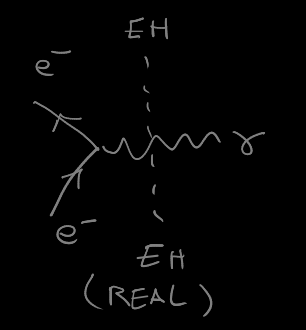
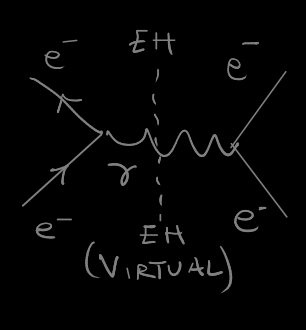
This is because electromagnetic radiation is very different from an electrostatic field. Likewise, gravitons, and also gravitational waves, are very different from a gravitational field. Quantum field theory gives you a picture of this. Can't happen. Can happen. Virtual particles can do... well, practically anything they want. In QFT lingo, virtual particles go as far as they want to go in the phase space. They can have mass, they can go faster than light, etc. As long as they disappear well within the domain of Heisenberg's uncertainty principle. It's only external legs in Feynman diagrams that must behave. https://physics.stackexchange.com/questions/937/how-does-gravity-escape-a-black-hole Very good question, by the way.
-
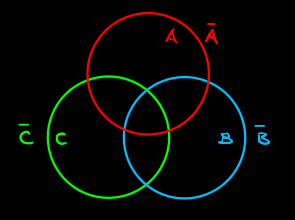
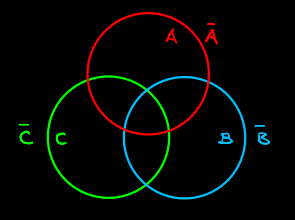
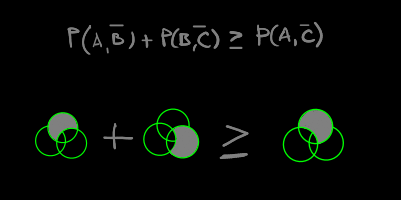
It is correct to describe classical gloves, the gloves we are familiar with. Exactly. It's not a property of ordinary gloves to be in a state that's neither left-handed, nor right-handed, but in a quantum superposition of both. That's what ordinary gloves can't do. A system that did this --hypothetically or actually--, as you well know, is called a Schrödinger cat. People call Schrödinger cats other kind of systems that are macroscopic, but keep quantum coherence. But I think there's a slight shift in meaning there, because ordinary cats (which are always either dead or alive) don't keep quantum coherence. Exactly. That was Bell's point in is paper Bertlemann's Sockets and the Nature of Reality. The point being: You don't need information transfer at a distance in order to have perfect distant correlations. You only need to prepare the system with those correlations built in. In what sense are you using the word "box"? In science people talk about a black box when there's some internal mechanism we can't see, or we don't care about, except for its input/output workings. You could call the evolution of the wave function a "black box" if you want. It all depends on what you mean by a "black box". When I said: what I meant is: You can't reproduce quantum behaviour by means of any classical and local internal switches, so to speak, that do the trick. For example, MigL's gloves is a perfect example that illustrates that there doesn't have to be anything funny (non-local, superluminal) going on with one classical observable (handedness of a glove) and a pair of classical (non-quantum) systems (the gloves). John Bell provided a similar example that he called "Bertlemann's socks": One is pink, the other is green, or so I remember. What it illustrates is that perfect anti-correlation, or correlation between two distant things is not the problem. The problem with quantum systems is evidenced when you consider at least 3 observables. And not just any observables; you have to pick them cleverly. Otherwise, you fall back to a range of variables where the classical explanation could work. So let's make a pair of "quantum gloves." Handedness: When one is R-handed, the other is L-handed Colour: When one is B (black) the other is W (white) Material: When one is N (nylon) the other is F (felt) Whenever you take a look, the gloves are either RH or LH, either B or W, either N or F. But you're only allowed to take a look at any one of these properties at a time. All of this happens only upon observation. If the system's not being observed, the quantum state allows you to be in so-called superposition states, in which the system is neither totally RH, nor totally LH, etc. ---------------------- Bell's Theorem Bell's theorem is a very simple constriction on the probabilities of three independent assertions that are subject to classical logic (at all times, they're either true or not true.) A: Possible outcomes: A is true | A is not true B: Possible outcomes: B is true | B is not true 😄 Possible outcomes: C is true | C is not true We can represent these outcomes as A, and A with a bar on top, etc. Like this: The probability of A being true is the interior of the red circle. A not being true is the exterior. Etc. Now, it's pretty clear (in images) that, p(A,B-bar) being "probability of A being true and B being not true, etc., and, next to obvious* that, This is what, quite "simply" quantum mechanics doesn't obey. There is this interesting case: A = "the x projection of the particle's spin is up" (not A, or A-bar is read by substituting "is up" for "is down", etc. B = "the y projection of the particle's spin is up", etc. C = "the projection of the particle's spin along a direction 45º with respect to both x and y is up". Then you use some so-called sigma-matrix algebra and voilá, Bell's theorem is violated. Experiments, BTW, confirm this within detector-noise tolerances. It's been checked upwards and backwards. What's wrong? Nothing's wrong. It's simply not true that propositions A, B, and C all have a definite answer, true or not true while the system is evolving. It's all withing the very simple, transparent box of quantum mechanics. The tricky thing is "what happens to the quantum vectors when I perform a measurement?" But that's another story. *Actually, not that obvious from the picture. I have a better proof elsewhere.
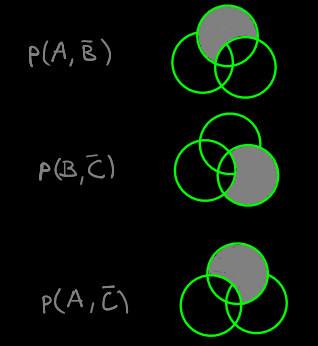
-
The black box is in the mathematics of quantum mechanics. A particle can give you binary (up or down) projections of spin along any direction in a continuum of possible directions. So you would think, aha! the spin must be lying along some of these directions pointing in a certain way (up or down). If you assume this kind of classical logic, as Gell-Mann says, you're gonna have to conclude that there are negative probabilities, or instantaneous communication (non-locality), or both. None of that happens. What happens is quantum mechanics. Bell's theorem is a proof that whenever you have 3 propositions that are either true or not true (classical logic), eg: A, not A B, not B C, not C then the probabilities satisfy the following constraint: probability(A,not B)+probability(B,not C) is greater or equal to probability(A,not C) Bell found a set of propositions that violate this constraint according to quantum mechanics. So it's not that anything travels faster than light. It's just that it's simply not true that some propositions are either true or false. This condition, if you will, "that something that could be true (has non-zero probability of happening) has become true" cannot be made into a signal. Think how delicately all depends on the results being actually random: If Alice could decide what the outcome is going to be, her sequence of up, down, up, up, etc. would be read by Bob as the negative image of the message: down, up, down, down, etc.
-
Very fine point, but I think you're right. He may be able to devise a clever interference experiment though, to determine that someone's been messing with the state, because coherence has been broken. So he could determine in principle that Alice has performed a measurement, but he wouldn't be able to tell which outcome Alice got until he made the measurement.
-
LOL. I'm afraid so.
-
No, it's not deterministic. Quantum mechanics is fundamentally non-deterministic, and sure enough Gell-Mann adheres to it. He does argue at the end though in terms of his favourite interpretation of quantum mechanics, which is that of decoherent histories. See how non-deterministic it is: Alice: "I'm gonna go there and measure the x-component of spin" Bob: "OK" Now each one goes far away from each other and they conduct the experiment. Alice measures the x-component of spin. Before she measures, she has no idea what it's gonna come out. See? Non-deterministic. It happens to come out as "up". OK. Now she knows. At the same time --in a reference system in which both are at rest-- Bob measures the x-component of spin. It sure turns out "down". Alice can tell him nothing, but now he can predict that Alice must have obtained "up" in her experiment, even though they're miles away from each other. He, of course, couldn't tell beforehand what he was gonna get. See? Non-deterministic on Bob's end too. Both results are totally random separately (in fact they have maximal dispersion). Yet the Sx1+Sx2 is always zero. They're perfectly anti-correlated. Each spin is random, but the sum is non-random (zero dispersion). See how it works? Did that help?
-
No, there is nothing superluminal going on between both parts of the bipartite state in Bell's theorem. All the correlations are initial. Quantum correlations were there when the state was prepared. They're there a Planck's time later. They're there a millisecond later. And they're there two hours later as long as you don't measure spin and let the state evolve coherently. The moment you measure a spin component of one of the particles, correlations appear that cannot be explained in terms of the logic of three independent propositions in classical logic. Physicist Alice measures something. If physicist Bob knows what she is going to do (assuming he trusts her), he can tell some things about the state he wouldn't be able to tell if Alice didn't measure. Nothing is superluminal. Everything happens in the very weird internal space of elementary particles that we like to call the Hilbert space. If you don't believe me, perhaps Murray Gell-Mann will convince you:
-
Yes, but countries are not machines. The key is countries are always running. That's where the analogy ends. It's the while it's running that I mentioned --and apparently someone didn't like-- that's key to what I meant. I didn't mean to defend monarchy. I oppose monarchy. I'd rather see it gone for good. The problem is sometimes I try to be so suave that I come across as thinking the opposite of what I really do. OTOH, I didn't interpret this thread as one about "pros and cons of monarchy", which it seems to have become. I tried to be respectful while at the same time do my best to help you understand why Europe works differently, which --very understandably-- puzzles Americans, and you were expressing yourself in those terms. Because I'm very familiar with the arguments, I tried to tell you why many people in Europe are wary of changing core pieces of the political system overnight. I know the argument because I've been told to ponder it while I was arguing against monarchy in the past. I understand the pickle Britain is in. In some respects it's similar to what happens in Spain. Suppose 200 Km from where you live there are people who have a different language, traditions, with deep historical wounds, misgivings, etc that go back many hundreds of years, if not thousand plus --or thousand upon thousands, in the case of Basques. History is not something you can reverse-engineer in a couple of months, sign an agreement, and live happily everafter. A formula that's stood the test of recent decades has been to gradually deactivate monarchies from their old absolutist role to the role they play today: The visible --and mostly symbolic-- head of diplomacy, the Army perhaps and, in the case of Britain, the Anglican Church. In a way, you Americans have been dealt the lucky hand of being able to more consistently engineer your political system from almost scratch at a time when this kind of debate was already possible --free thinkers were no longer persecuted. As an example of what to me is an almost reciprocal feeling, when I look at you guys, with your Mormons, and Amish, and all those religions that seem to mushroom out of every corner, I stand in disbelief. Yet, freedom of religion belief is one of your most important principles for reasons that are mostly historical. To summarise: I respect your freedom to roll your eyes at us, as long as your respect my freedom of rolling my eyes at you.
-
The rarer the air, the faster the speed you need to sustain the pressure difference between both sides of the wing. Crank up the speed, and you will crank up the pressure difference. But, as studiot said, it's not because the air is made of atoms, but because of energy conservation. Think of the pressure as some kind of internal potential energy. Fields (continuous media) also have this "internal tension." And they're not made of atoms; atoms are made of fields.
-
They say she passed peacefully. She must have thought the 20th Century was but a bad dream. Rest in peace. @zapatos, Suppose you're the owner of an old machine. It's been working for many centuries. It's old, but reliable. Would you re-design it while it's running?
-
"Ta da!" "Ta da what?" "Ta da!" "What?" "Ta da!" "Bye."
-
No. Space-time pulses have no charge. Gravitational waves are transverse, massive quantum fields are not. Gravitational waves have different number of components (tensor) than spinor and boson quantum fields. Gravitational waves do not have spin. I'm not sure that even makes sense. Space-time pulses (gravitational waves) do not scatter off matter. Rather, they are like blips of space-time stretching going through matter. Nothing moves faster than light. Expansion speed can exceed the speed of light because it's not the speed of anything moving from one place to another; it's rather the rate of space itself stretching. I don't know what you mean by "time going infinitely fast". I find it very difficult to understand what you mean, especially when you say it all in words. You can say sentences full of meaningful terms like, for example "time catches up with space" or "energy is cooling down" and yet, don't mean anything because all the terms are used improperly. That's what's happening here.
-
It's not about feeling good, as I made clear in the following lines you didn't quote. I explained why I have reasons for optimism. I don't wish this debate to be eternal though... You strike me as overly pessimistic. Enjoy the songs of birds while we share the planet with them. Not even cocroaches will last forever.
-
The scattering properties of gravitational waves are completely different to those of every other quantum field --they actually don't scatter, but go through like the distorsion of space-time they are. How do you "code" the properties of massive fields into a gravitational wave? Nothing you say makes sense in the context of known physics. You haven't even mentioned temperature, and simple considerations of how temperature affects the average value of speed of elementary particles simply rule out almost everything you're saying. And so on, and so on. As @Ghideon has said, it doesn't take much to know for sure that you can't be right. In fact, you're so badly wrong, it's actually a daunting task to list all the mistakes. Why don't you ask some questions instead?
-
An electron moving around the nucleus cannot exceed the speed of light. It can get close to the speed of light though. In fact, if you assume just that, you can get a limit on Z (the atomic number) for a hydrogen-like atom which happens to be of the right size (somewhere over 100). This matches the experiments. OTOH, fast-moving objects have a much slower coordinate time (measured from the inertial system from which their speed is perceived as "fast") than their proper time (measured from a reference system that moves with them). That's why high-energy muons from cosmic rays have much longer decay times as perceived from us.
-
So the meek shall inherit the Earth? Where have I read that before? I see lots of forks on the road where we could lose our wits, but I prefer to be optimistic. Common sense can be whipped into, hammered into people's minds. Or perhaps you can kill them softly with your song. Human intelligence gives you at least a capacity to change behaviour or attitude based on intelligence and --let's not forget-- human emotion and empathy. Maybe it's the whistle-blowers that need to change their discourse so that the message is finally brought home. I'm not suggesting they (we) should; I'm just saying it's a possibility that non-intelligence doesn't afford you. Somehow, I don't see that coming from the ants. Very interesting. The only argument I'm missing here is the possibility of a spandrel: An evolutionary change that could apparently (or actually) be pointless, because it's just accidental, or perhaps associated with a re-location of traits in which it's just making room for another (crucial) trait.
-
Yes, now that we've been properly teased, lay it on us.
-
I'm constitutionally incapable of praying. But if I were to bet on what stands a better chance of successfully tackling the effects of rapid changes in the environment, intelligence or..., say, something like a thicker skin, more efficient thermoregulation etc, my money is on intelligence. Collaborative human intelligence to be more precise. Honestly, it feels like I'm stating the obvious here.
-
Yes. But speed, power, stamina, and other adaptations more "mechanical" require optimization of the organism with respect to environmental conditions in a more simplistic way than intelligence. Thus, they need environmental conditions to be varying relatively slowly as compared to speeds of molecular evolution (mutations.) The evolutionary bonus about intelligence is that it gives you a fighting chance to win the game even when environmental conditions are changing very rapidly. You can avoid your disadvantage if you are able to predict it somehow. That's where big extinctions would raise intelligence above any other adaptive advantage. It is in that sense that I say that maybe increase in intelligence has been favoured along different lines of evolution (more an homology inter-species than a wonderful supercalifragilisticexpialidocious property of humans.) If that were true, dolphins and sharks, humans and gorillas, koalas and mice of today, all of them, would be in some sense more intelligent on average than the species that occupied the corresponding environments in, say, the Jurassic.
-
(My emphasis.) Not a sine qua non, but certainly gives you an advantage. If I chase after an animal repeatedly, there comes a time when it gets exhausted and I can chase it more easily. I don't need to be that fast. It's the seeds that give rise to a plant. If I carry them with me, I can make them grow somewhere else. If the animal thinks I'm a plant, it won't notice me (theory of mind) When the stars come back to this position again, I should expect rain... Etc. Ideas of cause and effect, mind, etc. seem to me to have been quite useful when it comes to improving reproductive chances. Survival is in the equation only because it increases those chances. The engine of evolution is advantage. You only need to be more efficient at producing offspring that's more efficient at producing offspring than the next fellow. Evolution is not really so much about survival. Sometimes, it can be very helpful to the species to consider own sacrifice.