
joigus
Senior Members
-
Joined
Everything posted by joigus
-
I wonder if we've been looking at intelligence the wrong way (one species vs others), and it's really a (homological?) feature that will be favoured once a certain threshold (of basic "lower-level" (immune system, and similar more "mechanical" aspects) has been conquered from an evolutionary point of view. Does that make sense?
-
There are quite a few polyglots among birds. I'd put cuckoos, corvids and parrots among the most intelligent[?] We should never forget they're the clever dinosaurs who didn't get extinct. I wonder if every time there's a big extinction on Earth, that creates a sieve for intelligence/resourcefulness more than anything other adaptive feature. Last autumn I was with a friend on a biking outing. During a stop, he produced a bird-sing app and played the Eurasian-wren territorial signal. Sure enough, a male Eurasian wren came out of the bush and he looked quite disgruntled. It was wren territory, sure, but there was none in sight before. I've watched videos of naturalists playing the alarm signal of some species. In a matter of seconds you see the bird unmistakably displaying sentry behaviour.
-
I don't know. I'm better at asking questions than answering them. But I don't think Dawkins is very much to blame for being delusional. I'm sure he's thought about God far deeper and far more seriously than many a religious type. Plus he's shown he's ready to accept he's wrong from time to time.
-
I agree. I'm not implying that horizons are not real. I'm implying that choosing a coordinate chart in which the horizon is manifest will not necessarily tell you anything useful about the global aspects of ST, or some other aspects. Eg, coordinates that are locally Minkowkian along the trajectory of a falling observer, tell you nothing about the horizon. For all he knows, his signals are reaching the totality of space behind him. A falling observer through the horizon of a BH that's big enough that tidal forces are small, will notice nothing peculiar; will see no horizon. This question of local charts is deeper than it looks. It's even possible that the question is more general than it looks...
-
Make it more a nuance in egg vs other egg. Eg.*, I doubt cuckoos would make any corvid their target. Crows would see right through it. * No pun intended.
-
Indeed. But not everybody aspires to be a scientist. I'm talking more about the regular fellows. If you asked me, I'd recommend everybody to make room for a little scientist and a philosopher of sorts in their daily rut-driven minds. Questioning things is a healthy habit, I think.
-
No doubt. But I think some birds would be more likely to have something similar to a debate than others. More aspects, more nuances, more "cerebral room" for if-then clauses.
-
I'm sure there's a gradation here too. It stands to reason that the signals of corvids be more sophisticated and nuanced than those of wrens or tits.
-
I think philosophy has no point, perhaps because its focus is most everything. Some of the overriding interests (historically) have been: What is real? (ontology) What is knowledge? (epistemology) What is "I"? (the problem of the self, a continuation of ontology) What is change? (cause and effect: teleology and its alternatives perhaps?) What should we do? (ethics) Everybody feels a call at some point, but nobody's forced to follow that call. And it's a tiresome exercise. Science tends to clarify in some measure those question, and supersede them with (perhaps) less ambitious questions. Thus, What is real? --> What is objective? What is knowledge? --> What is information? What is change? --> What are the physical laws? What should we do? --> What should we do? I think.
-
OK. Let me tell you you've been raising some interesting points here, and you're considerably better informed than the average occasional "speculative people" that come and go around here. I'm sorry that I was a bit grumpy some posts above. GR is not at all about "mass." It's not even about "energy" really. If you stick to your guns in this way, you're going to get very confused. IMO --and I make room for other member's disagreement here--, it's about curvature, perhaps torsion, and the weirdest elements of all: Diffeomorphism invariance (smooth distorsions of the coordinates that preserve the essential information coded in the metric.) It's also about singularities and horizons. Horizons are a peculiarity of geometries with non-definite metric. Trivial observation, but important to keep in mind. Horizons appear whenever there is a singularity in your theory. They always hide a singularity behind. Horizons always have an entropy associated with them. Horizons always appear when we try global coordinates that are assymptotically or locally flat. I'm a firm believer in Dirac's motto: The equation knows best. What did Dirac mean? I think he meant something like this: Once you have the right equation, it's never gonna lie to you. If it gives you a headache, don't despair, because it's a symptom and a clue that your initial intentions were corrupted in some way. So it's a priceless instrument in pointing to the limitations of your initial assumptions. Mass arises in GR because we insist in obtaining a set of coordinates that is closest to solving ST globally, is locally or assymptotically flat, and on top of that, is a solution to Einstein's vacuum field equations. Now, isn't that perhaps asking too much? Not totally happy with that, we even demand that the solution be spherically symmetric. So the equations behave as best they can. They reach a compromise. They give you back this parameter, M, which is totally meaningless in any real situation, but encapsulate all these properties in one parameter. When you stick to the overly-demanding program that I've just described, you end up with more than you initially bargained for, because the theory gives you things that are completely extraneous to your initial dream (describing everything in terms of pure geometry.) You're stuck with this "mass," horizons, and entropy. What does entropy tell you (always, always,...) in physics?: That you're missing something; that there are some variables that, quite simply, are not in your description. That you want to describe your phenomenology in terms of, say, (A,B,C,...), but there are other things, say, (p,q,r,...) that are not in your equations, but some fundamental principle operates in such a way as to impose constrictions on them. I've left out vacuum energy, not because I think it's unimportant, but because it requires another discussion of itself. Agreed. Apparently it was Heisenberg who said this. Opps. James Gleick, Genius; the Life and Science of Richard Feynman.
-
(My emphasis.) One example? Easy enough: An Ising magnet. You get a reasonably good treatment of it with the mean-field approximation, in which you consider each magnet interacting with the average field of every other magnet in the crystal. The approximation gets better and better every time you extend the number of nearest neighbours (1st nearest neighbours, 2nd, etc.) in order to calculate the mean field. Another example? The N-body problem in gravitation. Another one? A Bose condensate. Another one? Superfluid Helium Another one? A proton (3 quarks plus gluons) Do you want more? Studiot already mentioned chemical reactions with 3 molecules. Any gas that's not ideal, and therefore presents phase transitions... I think I've made my point. In fact, there are practically no actual 2-body problems in Nature. 2 bodies is just an approximation that's useful only because it's exactly solvable, and because there are instances in which it's close enough to what's going on that it's worth studying in detail. It almost never happens in reality.
-
Yes. It's all a big resounding, reverberating mantra, with no physics in it, no mathematics in it, and full of embarrassing contradictions with many things we know --see picture from @Bufofrog above. We've seen it before. The only question is: How long is it going to take? And BTW, I'm still waiting for anything even remotely shadowing "quantitative". Not a chance.
-
Here's an explanation that's as good as yours: Light is not reflected, there's no reflection of light. Photons know all along where they have to go. There. Now prove I'm wrong.
-
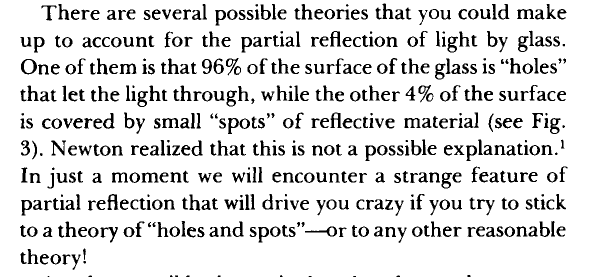
If a photon is a material point, how do you explain the paradox of partial reflection of light by a thin layer of glass? From QED, the Strange Theory of Light and Matter, by R. P. Feynman. If a photon is a material point, how does this bouncing point, reflecting/not reflecting on the first limit surface of the glass layer react to the existence of a second layer, farther within, so as to reflect/not reflect on the previous surface? Quantum mechanics explains this easily. Unfortunately, physics takes more than the recitation of mantras, no matter how many words from topology or other branches of maths you use in your incantations. You might as well say that everything's made of two elements: mumbo and jumbo.
-
Stop right there. Avogadro's number is not a fundamental constant of Nature. It depends on two arbitrary choices: 1) The choice of an arbitrary mass unit (the gram.) 2) The average mass of nucleons (protons, neutrons) as to their abundance when participating in making up atoms and molecules in this galaxy. Ignorance, when combined with hubris, is louder than a siren.
-
You read my mind. I was thinking of the Amur tiger. Korean researcher Sooyong Park spent months in the Siberian and Chinese forests, eating rice, nuts and salt, and removing all traces of his own poo, hiding in a hole underground for years to film them. Yet we have extensive footage of these animals and their family life. And they had been seen and captured before. Also, bigfoot must be the only primate species in like 55 million years that's not highly social, curious, extremely boisterous. Isn't that peculiar? And lastly, we're aware of the existence of a ancient species of ape (the Denisovans) thanks to a tiny fragment of a phalanx from the pinky of one hand, including sequences of their DNA. And we can't obtain definite proof of the existence of a big hulking ape who inhabits the Earth now?
-
Is the answer not here?:
-
Good point, zero probability does not imply impossibility if the continuum is a reality. In maths it's to do with the measure problem, as I'm sure you know. The measure of an interval can be zero or not, but the measure of a point is always zero. The measure of any denumerable set in a continuum is zero. Lo and behold! (My emphasis.) The integral of Dirac's delta distribution is finite. If you want the probability of a denumerable set to be non-zero, you must construct a combination of delta distributions. For example p(x)=p1delta(x-x1)+p2delta(x-x2) with p1+p2=1. The derivative of delta makes sense, but the square doesn't... Think of that. It's a subtle business. Very interesting. Fractality makes me wonder so much...
-
Agreed that the cosmological constant problem is probably the most significant problem faced by modern physics. I'm not so sure it's related with singularities. Singularities seem to have to do with very strong local fields. Vacuum energy seems to have to do with global properties of ST. In any case, I think it's a topic for discussion in a separate thread. Why don't you open such a thread and present your concerns there?
-
This is liable to be considered a hijack of another post. Why don't you open a new thread instead? https://www.scienceforums.net/guidelines/
-
Oh, this is a bad analogy on so many levels... It's more like: Somebody owns a wall. Everybody's free to write on the wall, but the wall is not yours. The rules are: You may paint on it if you want, but we reserve the right to keep anything we want. Because you can't be bothered with reading the rules, you write on the wall, and then regret what you wrote. Finally, you whine about your writing not being removed. Whether your name is Van Gogh or Van Morrison is irrelevant. Also, the arguments by Phi and iNow, which give you a practical reason that makes a lot of sense, doesn't it?
-
(My emphasis.) Oxford Learner's Dictionary: I wouldn't call it 'cruel.' Composing a bad song is not cruel. Publishing a bad song is not cruel. Keeping copies of it is not cruel. OTOH, forcing you to listen to it over and over can be cruel. But that's not what's happening here. It happens to me every single day.
-
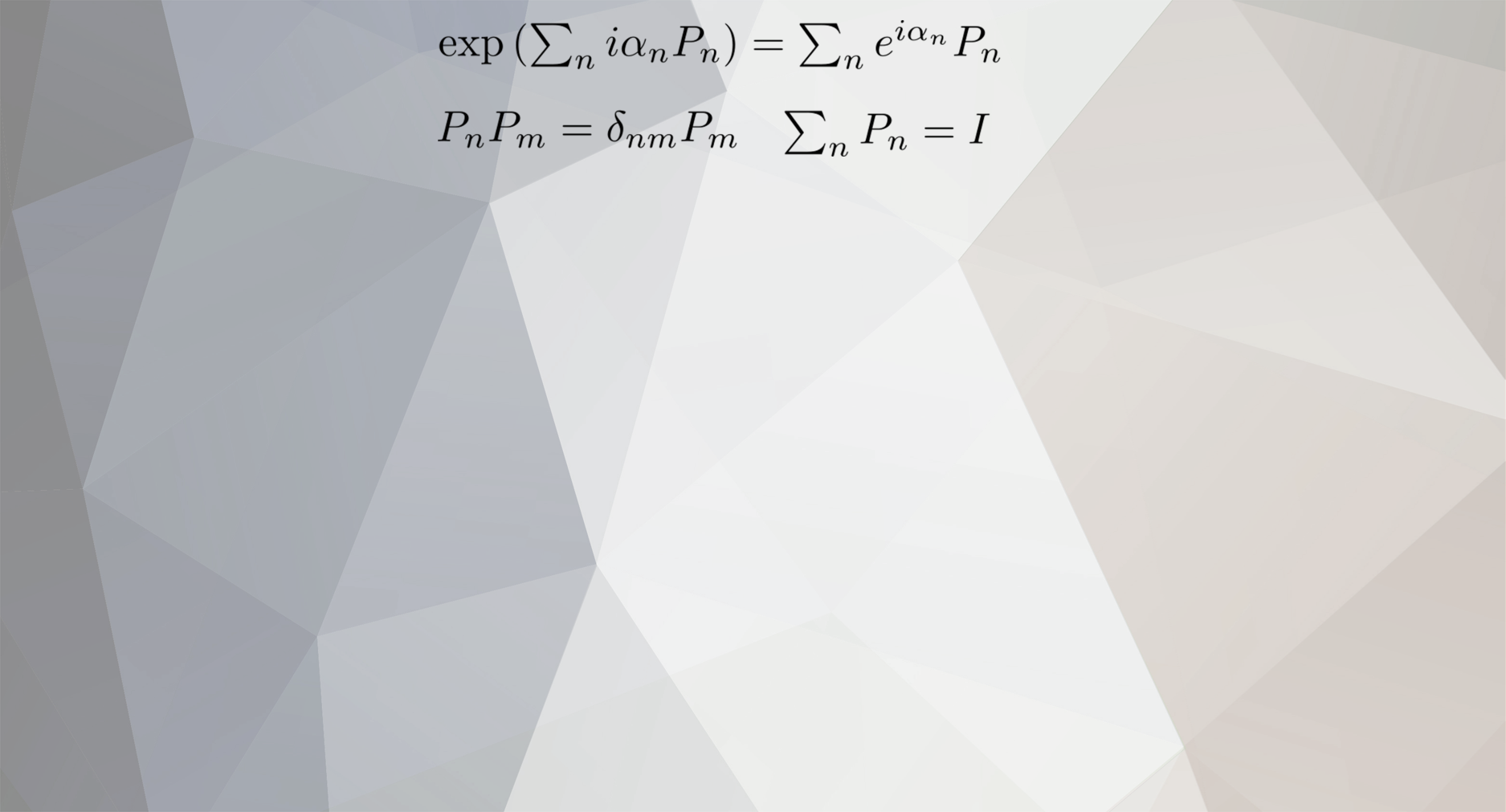
A final embelishment:
-
Differentiate: \[ f\left(x\right)=\log_{x}\left(\sin x\right) \] Solution: I hope I didn't make any silly mistake. If you find any other fun way to solve it, please let me know.
-
Actually, you're right. I stand corrected. Hubble --> Expansion; Penzias & Wilson --> CMB Those are different things. Confirmation of CMB is considered the last stepping stone in proving the standard cosmological model (previous to inflation), but the expansion was observed first. Thank you. Nevertheless, the Bondi-Gold-Hoyle model is to do with a steady universe. The idea was, if I remember correctly, that a tiny amount of matter is produced at a constant rate uniformly throughout the universe, compensating for the dilution of matter due to expansion. My details are hazy, as it's been such a long time since it was made irrelevant by experimental observation. We're getting farther and farther away from the topic of singularities though. Maybe a split is in order?