studiot
Senior Members
-
Joined
-
Last visited
Everything posted by studiot
-
Yes it is, but I do not think you mean linear, I think you mean sequential. Yes I agree but not only is it not linear it is not always in the forward direction. Have you heard of the dark ages ? Interesting comment and welcome. I see from your postings that you have a wide interest in the Sciences, so with respect; When you say "This likely occurs" it is not very scinetific unless you adopt the scientific rigour ot backing up you statistical assertion with some facts, references or reasoning.
-
Thank you for posting this update, +1 I note that right at the beginning the authors acknowledge difficulties with solid-penetrating radar and later introduce ulltrasonic tomography. I too have had better reliability and accuracy. looking into solids with ultrasonics than with radar
-
If and only if you are genuinely interested in discussing this you will have to work harder yourself. Yes swansont says this (ie some) statement is a tautology. So what ? Under what system of logic, propositional (first order) or predicate (second order) or what? Since I consider examples are really helpful I have given you several, and again you have not responded to any of them. Why not ? swansont also said to which you responded Well I suggest to you that 'how?' is answered by providing an example for discussion. Here is an example of a first order logic being defeated by a second order answer In Irish Mythology there was a superhero who was apparantly invincible. So magic was cast so that he could not be killed either inside a house or outside one. Yet he was eventually slain. Would you like to discuss how and is his invincibility a tautology ?
-
I am away for the w/e Try the following articles. Ogden R W (1972) Large deformation isotropic elasticity - on the correlation of theory and experiment for incompressible rubberlike solids Proc Royal Soc London A326 565 - 84 Ogden R W (1972) Large deformation isotropic elasticity - on the correlation of theory and experiment for compressible rubberlike solids Proc Royal Soc London A328 567 - 83
-
Yup, but only after considerable creation, organisation and optimisation effort by humans. Which is why they are so useful for repetitive drudgery, once that spadework has been put in. Edit I did mean to ask why noone seemed interested in my debunking the AI wave height measurer, but then I discovered that the thread wqs moved to trash so I could not post there anymore. Considering the current debate is no one interested in my comments there ? My back of envelope calculation suggests that the deflection angle of the horizontal for an instrument set up 1000m from the wave is about 36 seconds of arc which makes the height error 0.2 m. aft5er that the error grws rapidly with distance.
-
Does this address any of my comments on so called AI ? If so how please ? for example
-
Are you sure it was a short circuit failure ? https://academy.gs-yuasa.eu/wp-content/uploads/2019/03/Battery-Failure-Modes.pdf
-
My question was a rather tongue-in-cheek oblique reference to the long running row between the opponents and proponents of bayesian statistics as a way of highlighting the fact that, to the best of my knowledge, no AI yet constructed has ever discovered anything by itself nor had an original 'thought' of its own. How could it , when it is programmed to weigh up the most probable response to any given text string, based on what has already been written (usually in English) ? In other words at the higher level you are talking about student were (and I hope still are) taught by people who have actually discovered (new) things.
-
If the AI has never read the early work of the Reverend Bayes, but only been trained on Pearson and Fisher and Gosset what would it teach ? After all this thread is entitled statistics in science.
-
That still has to obey energy conservation.
-
That would not work well due to the Law of conservation of Energy, assuming the panels were optimally laid out in the first place.
-
And did you ask Chat GPT why this method would yield fallacious answers ? AI 0 ......... Surveyors 1
-
Here is some explanation that may help. The Earth is not 'all there is'. In other words there is space and time along with contents and the stuff that makes it all up beyond or outside the Earth. However the Universe is defined as 'all there is'. In these circumstances both space and time may be part of this 'all there is'. We don't know if either space or time are finite or infinite. We don't even know the nature of this infinity if it is there. We do know of other infinities which which have no boundary but yet can't be reached. For instance absolute zero of temperature. As you approach AZ it becomes harder and harder to take the next smaller and smaller temperature step towards it such that it can never be reached. Another example, if you know any maths, is exhibited by numbers. Take any real or rational number you will find there is no such thing as a nearest number to it. You can always find a nearer number than any propest 'nearest' and can go on indefinitely getting closer and closer to the proposed number, without ever actually reaching it. So if our finite is bounded in space, why not also finite in time ? Nature has shown itself more varied and unwilling to fit into our human conceived boxes and is therefore constantly suprising us with new stuff.
-
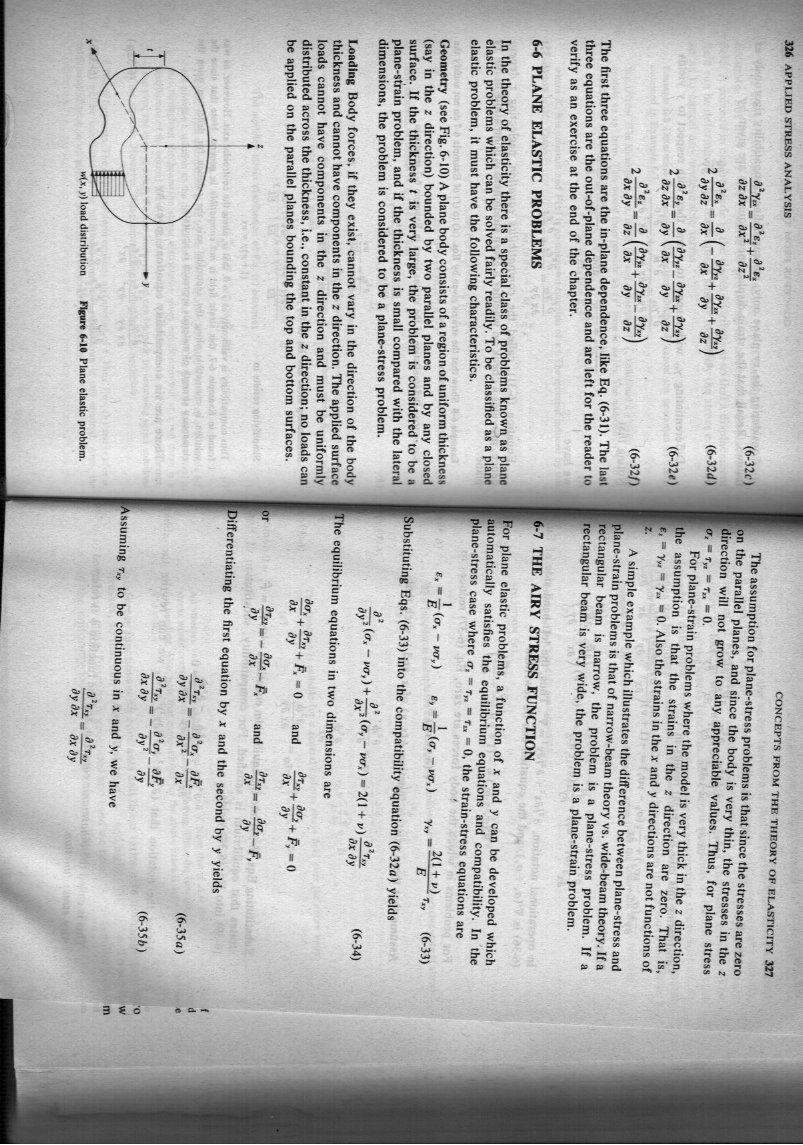
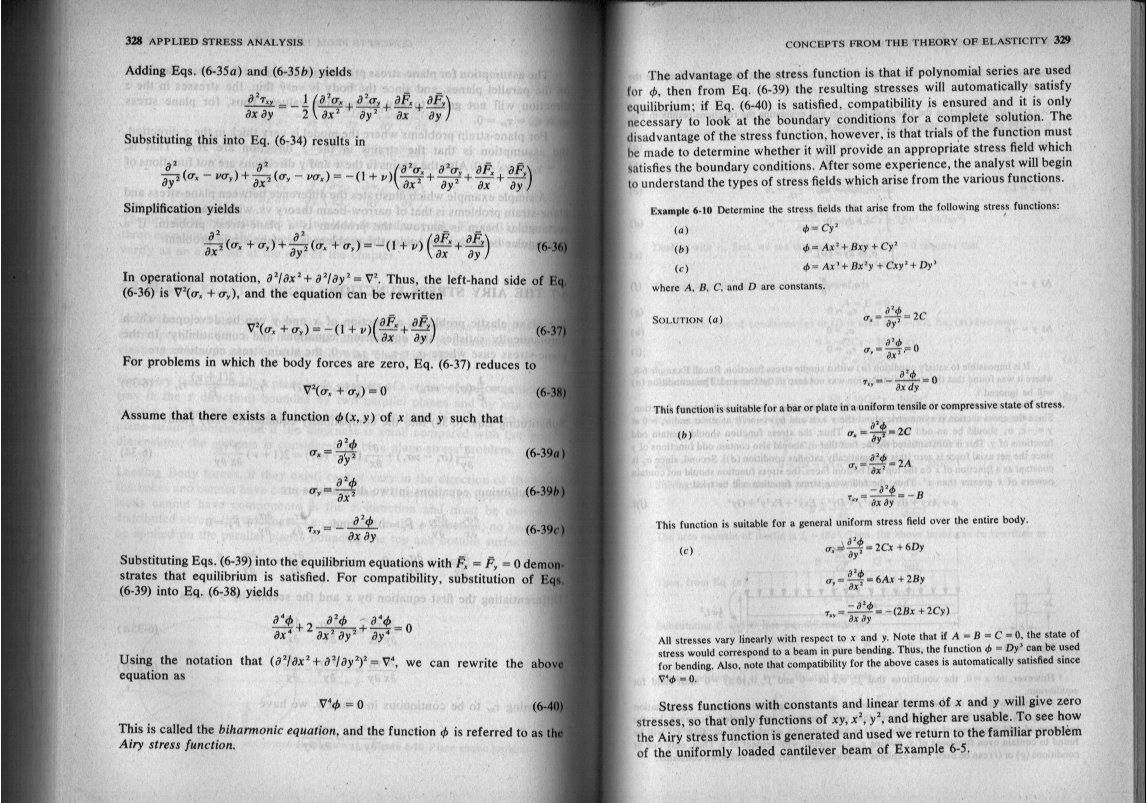
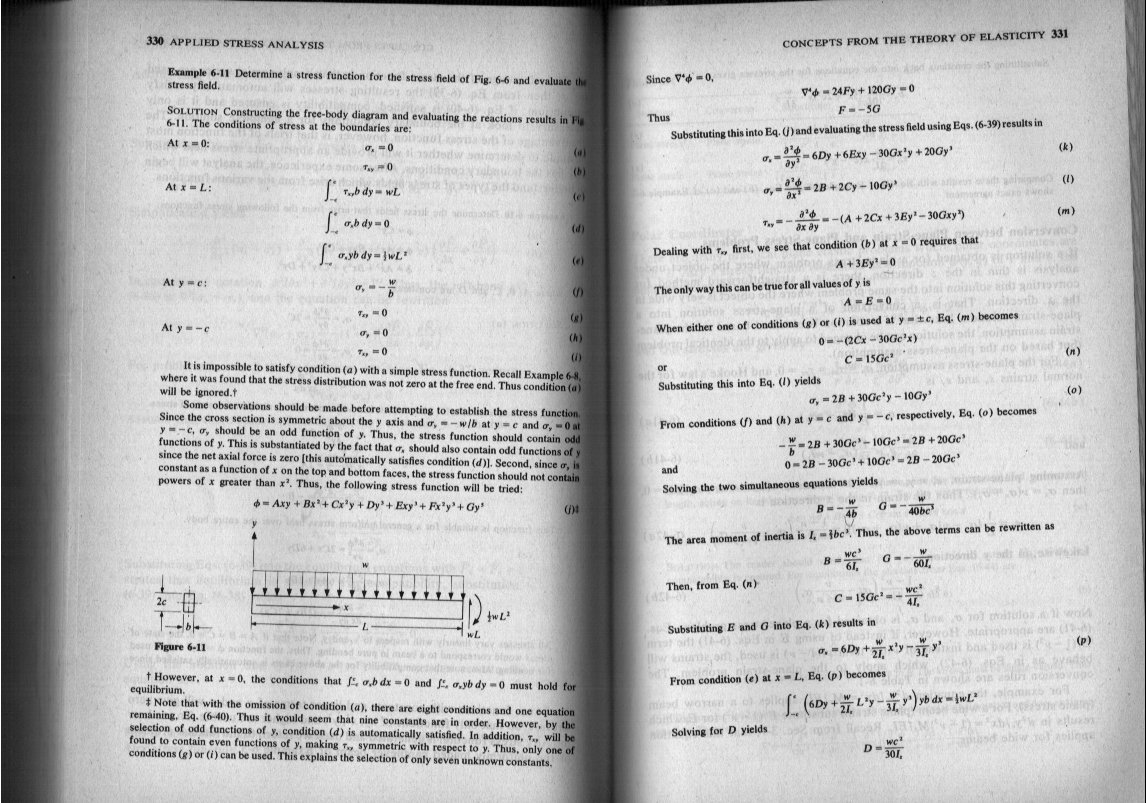
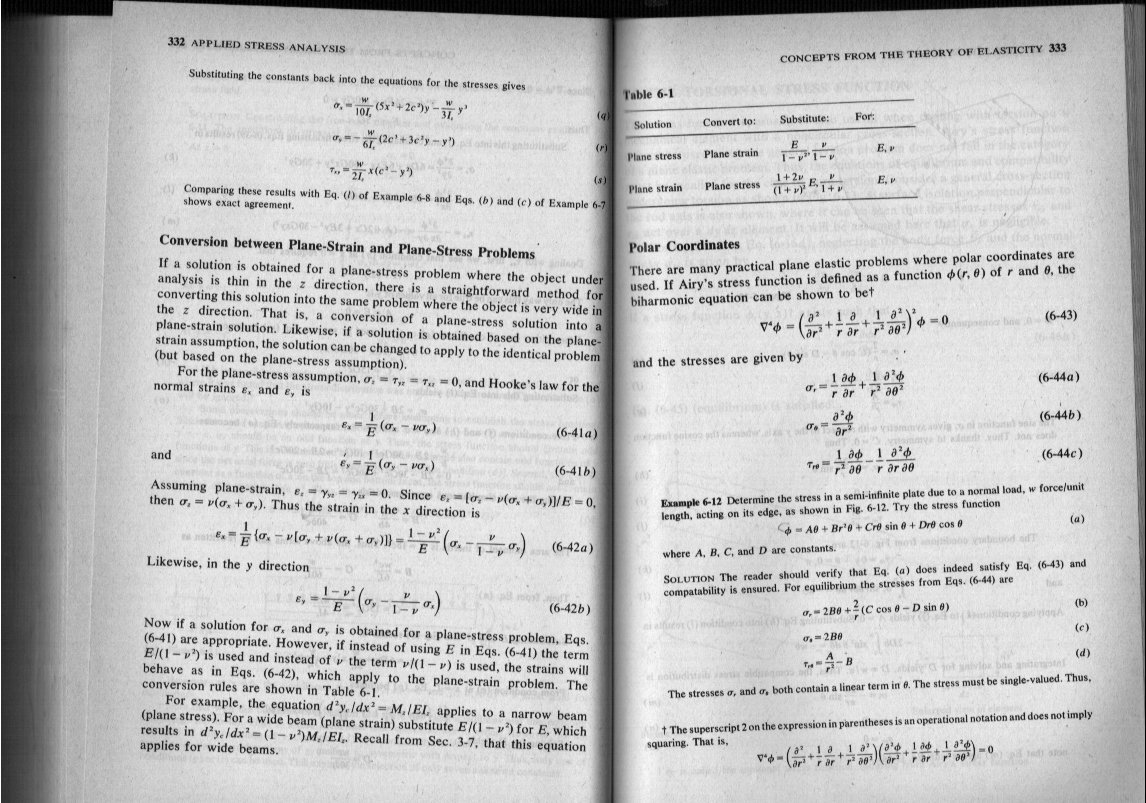
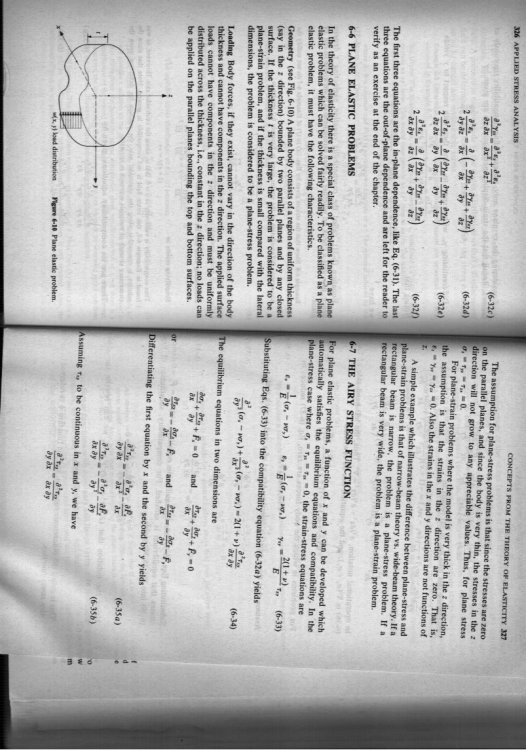
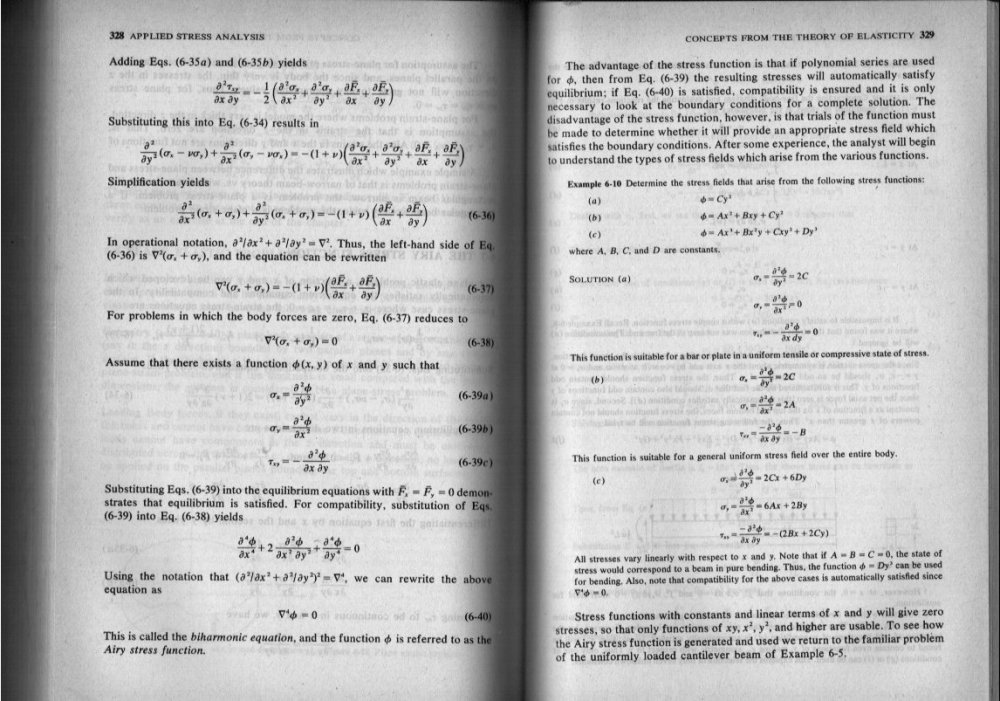
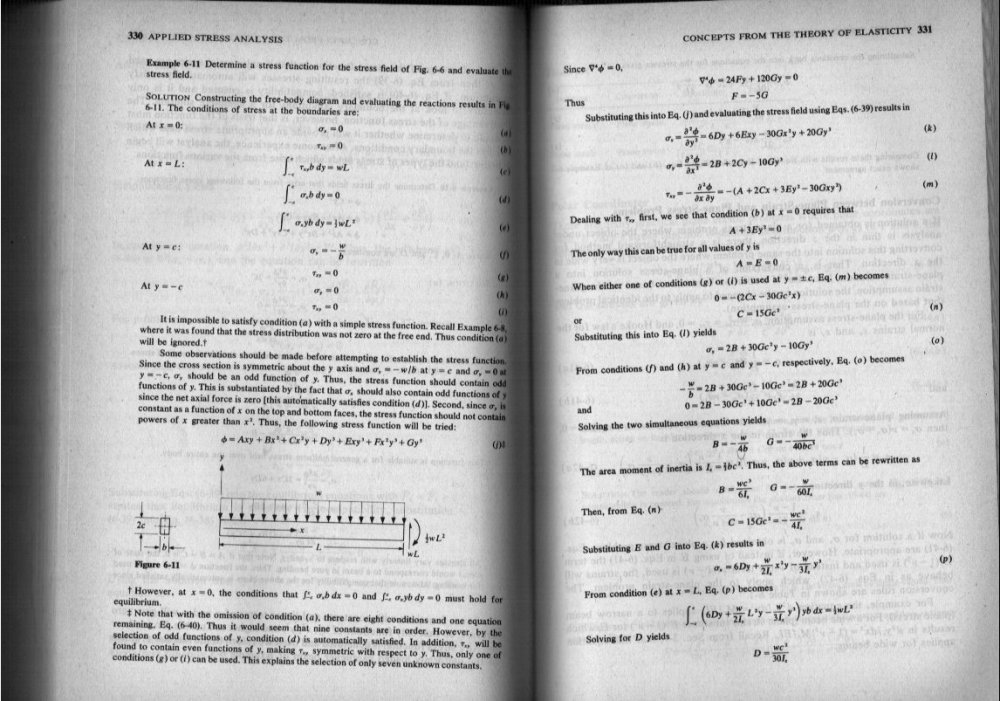
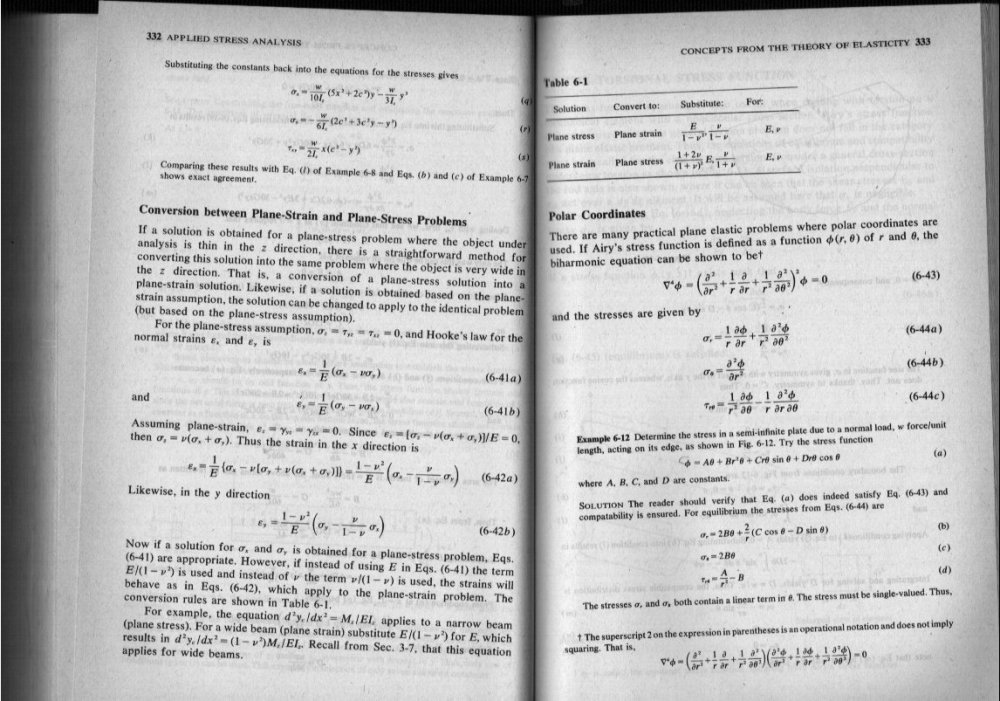
Your question - A good one - seems the sort of question that might (should) pop up in class when you have all the background of the course and its notation. So it is a very good idea to give as much information as possible about where you are coming ffrom and where you want to go. We normally like to place replies into the body of a thread, to benefit any member who might be interested. There is nothing confidential abolout this. The honest answer is that we are looking for solutions to Airy's equation. There is no pat answer as with say linear differential equations, each solution must be worked out for the specific situation. Airy's original was an inspired guess as are pretty well all other known solutions. This is the drawback for this method and the reason it has never proceeded very far. Complex analysis and conformal mapping techniques have largely replaced it as an analytical technique. Anyway here are a few pages from a book that is ideal for engineers studying stress analysis. It works from an engineering point of view and explains, when it comes to it, that we 'guess' the form of the solution and back substitute to check it fits the equations of constitution and discusses this for several example cases. Are you familiar with the idea of the equations of constitution and compatibility ? For Constitution either the equations of equilibrium or the equations of motion may be employed, but these alone will not give enough equations to produce a solution. That is where compatibility (or configuration or constraint) come in. Advanced Strength and Applied Stress Analysis R G Budynas
-
Is the 'Gap' getting smaller ? I invite you to explore this report on a computer closing the gap. Note this is only one of a line of bionic implants. Is the computer-brain one an advance on the well established computer-heart one ? https://www.bbc.co.uk/news/articles/ckgn49r069wo
-
I caught you previous howl of anguish over my previous post, but it is taking a few days to prepare something simpler. I had hoped that by pinching someone elses' drawing I could offer a quicker answer. Never fear, we will get there.
-
Not sure if you want a physical or mathematical explanation. The physical one is easier so I will start with that. When you integrate the differential equations you get many or infinitely many solutions that differ by an arbitrary constant. (actually since you should be using partial derivatives for this, you get an arbitrary function). Physically what we want is for that arbtrary function to affect all parts of the region and its boundary equally. Then its effect may be discounted. Finding a suitable function requires differentiating ande substituting the derivatives into the proposed stress function as you have indicated. The only way for the arbitrary part to affect all parts equally is for it to a constant function or at most a linear function, whose derivatives are zero or constant.
-
Well I am not claiming that there is a single object, but a simple example would be a shadow.
-
Given that the building blocks of life are molecules, it seems reasonable to assume that life arose from molecules in a "primordial soup". Well I agree with Luc on this. But only partly since he has made the basic mistake of trying to combine two separate statements, each with their own independant veracity, "Arising from molecules" is about source. "In a primordial soup" is about place.
-
Is anyone claiming that there are no immaterial objects in the known universe ? I claim that there are such objects, some of which actually admit of some Science of their own. Further, at least some of these objects can affect material objects.
-
Most approach this by extending Timoshenko theory. Here are some links. https://www.sciencedirect.com/science/article/pii/S0020768316300725 https://ntrs.nasa.gov/api/citations/19910000994/downloads/19910000994.pdf https://jresm.org/archive/resm2015.19me0827.pdf file:///C:/Users/somerset_2/Downloads/Mit_2001-06.pdf https://www.ias.ac.in/article/fulltext/reso/007/10/0054-0058 https://classes.engineering.wustl.edu/2009/spring/mase5513/abaqus/docs/v6.6/books/gss/default.htm?startat=ch06s02.html
-
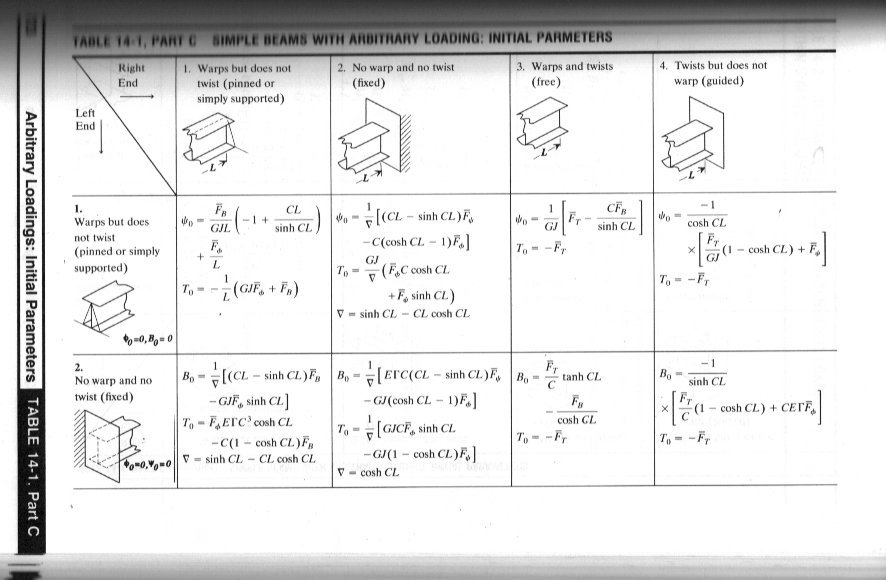
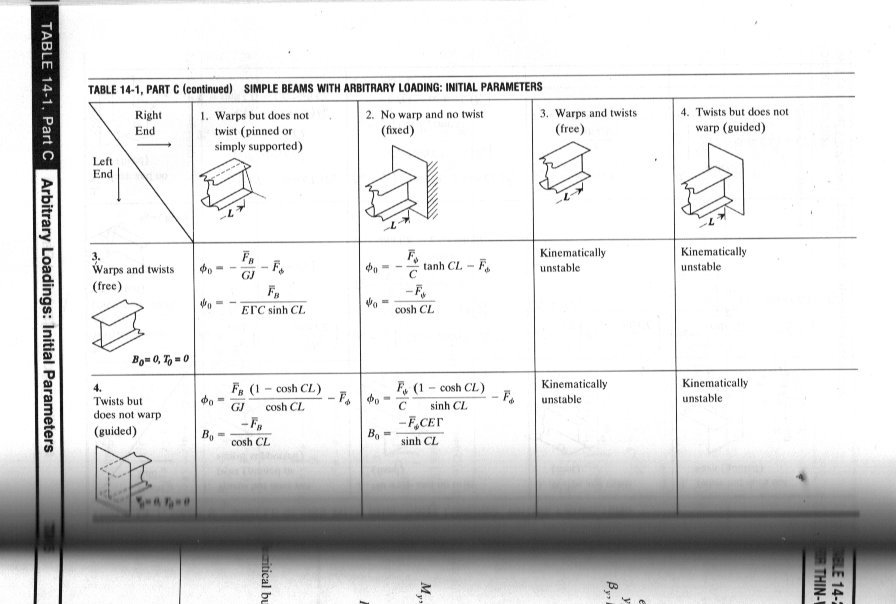
Pages 700+ are right in the middle of a 1450 page book so it doesn't scan very well, but here is a table from chap14 if it is of any use.
-
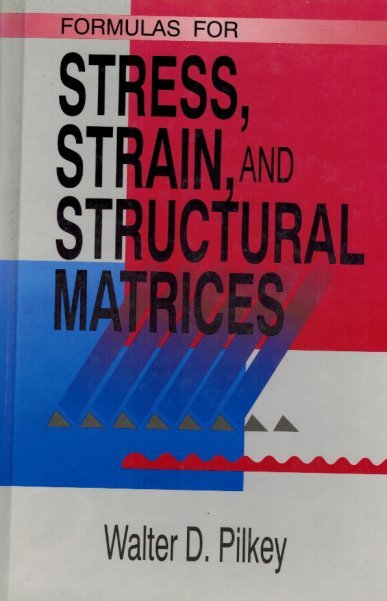
This large more modern book deals with both analytical and FE methods for warping, and has tables along with some discussion and some useful references. Pilkey chapter 14 page 705. Please note the special notation used in this chapter as there are cross references to the rest of the book, including more twisting and torsion. This chapter includes a tables of equivalent symbols. This large more modern book deals with both analytical and FE methods for warping, and has tables along with some discussion and some useful references. Pilkey chapter 14 page 705. Please note the special notation used in this chapter as there are cross references to the rest of the book, including more twisting and torsion. This chapter includes a tables of equivalent symbols.
-
Glad you came back, because I am not sure what you mean by warping functions. I think I must call them something different. I'm sure there must be an old name for what you want. So Are you referring to torsion ? Are you doing this for analystical solutions of finite element analysis ? Are you aware that any analysis is only valid for a range of width to length or depth to length ratios. There is things called wide beam theory, slenderness ratio and so on. or are you referring to products of inertia as opposed to moments of inertia ? Please elaborate a bit. Can you give an example? My original references came off the top of my head, near my midnight as I was about to shut down. Just some I could grab quickly.
-
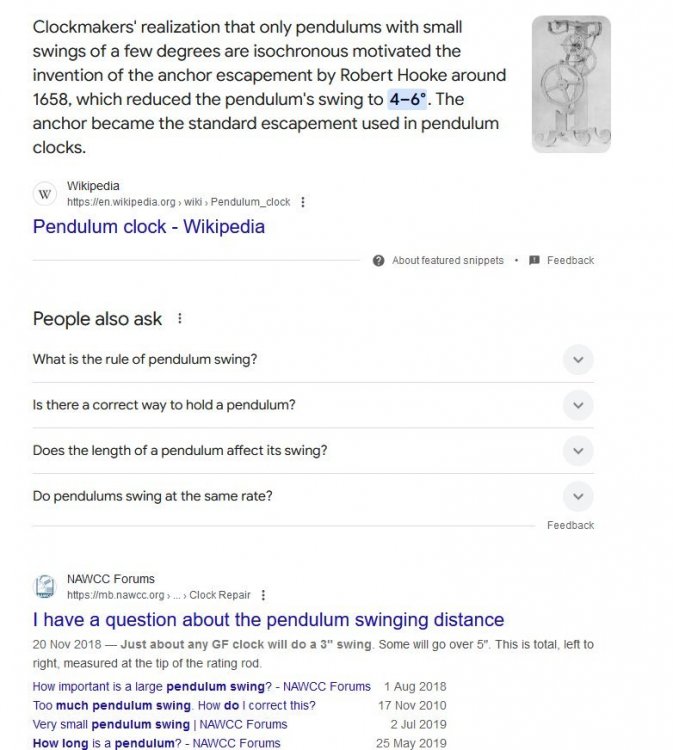
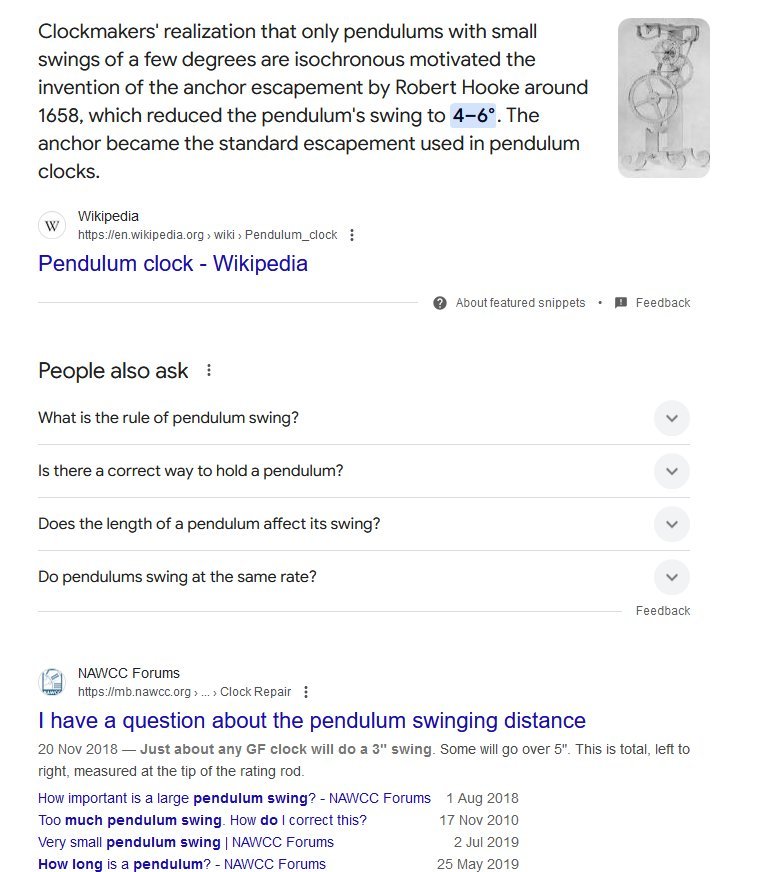
Look at your formula estimate for maximum speed. I make it less than 2m/s or walking pace ie less than 4 miles per hour. How much air resistance do you anticipate at this speed ? Look at this google page in response to a question "how far should a pendulum swing ? Gravity only acts vertically. The string tension has to have both vertical and horizontal components. What hppens if you increase the angular displacement to 90o ? Basically I am encouraging you to think about the mechanics of the setup.