studiot
Senior Members
-
Joined
-
Last visited
Everything posted by studiot
-
Why Wilhem of course. https://en.wikipedia.org/wiki/Killing_vector_field
-
It was a new one on me and it means something different from a prologue which is meant to supply background information to the text, without criticism or appraisal. Prologomena (p) and prologomenon (s) include some form of appraisal or criticism. I am sure you are awae that Joigus didn't mean that, but used arbitrarily in its correct technical sense. A really good one-liner there. +1 One thing about simple principles is that we have a natural tendency to abstract a single simple principle and then try to treat it as if it were an independent variable, whereas often the variables are not (fully) independent.
-
Guesswork is a very inefficient method of learning at the best of times. The less solid and more hocus pocus the background you base your guesses on the more inefficient it becomes. It is no accident that the initials of Harry Potter are H.P. Who is the kid and who is teaching him ? Where do they teach magnetic cooling to kids in Physics ? Electrostatic traps work on ions not atoms. I wonder why ?
-
The Subtle Knife is book 2 in Phillipp Pullman's fantasy trilogy 'His Dark Materials' I expect your students can tell you all about it. https://en.wikipedia.org/wiki/His_Dark_Materials The Ockham quotes came from the prolegomena (what a word!) of Variational Principles in Dynamics and Quantum theory By Yourgrau and Mandelstam An interesting mixture of the Philisophy, and Mathematics of the Calculus of Variations. Sleep well.
-
This is a prime example of why you should stop guessing and listen to some very knowledgeable person who has the patience to listen to you. Alternatively you could actually read a textbook and find such things out for yourself. +1 for your patience.
-
Good question, how many giant's shoulders are our assumptions standing on ? +1
-
Not at all. You picked out a clear cut case where the 'obvious' simple explanation is incorrect. The actual reason is more complicated. In the OP I am posing a discussion question, has the razor been superceded by modern science ? My answer is obviously therefore yes, since there is at least one case where it is unreliable. But it is a good discussion and it is my hope that when (new) members produce outlandish 'theories' and say it must be true because of Ockham's Razor this thread can be pointed to as evidence of that unreliability.
-
If the air pressure inside the balloon was not marginally greater than the air pressure outside the balloon would collapse inwards. Since the pressure is greater, the density must be greater and thus the mass of displaced air is less than the mass of the air inside the balloon, even without the basket and trappings. This is different from a rigid balloon such as a hydrogen or helium one where there is a positive bouyancy force.
-
Are you saying that the razor suggests Archimedes principle - which is of course an incorrect explanation ?
-
Carry on ?
-
Like Pullman's Subtle Knife perhaps ? Thank you so much for introducing a modern area of statistics I had never heard of - off to investigate! +1 Since you are interested his actual words were Which translates as It is futile to employ many principles when it is possible to employ fewer. But he did not say that the extra principles are untrue and all too often it is used as an excuse to reject the (more) complicated, whether justified or not. We are all a bit lazy and like to use the excuse "neglecting (higher order) terms as insignificant" This applies to my favourite engineering formula "something squared over twice something else" , which is not validated by the razor but by mathematics. But I would love to see the razor applied to the theory of flight of eg a human made mechanical aircraft, a butterfly, a hummingbird and a hot air balloon.
-
Translated this reads Things should not be multiplied beyond what is required. Yet no one has found this exact text in his writing that survives. It is true however that much of his writing echoes this sentiment. Howsoever it maybe the question is as in the title How true actually is it ? I posted this because members often appeal to this maxim for support.
-
So how is it 'confined' ? In MRI the water is confined within the patient. What do you think the R stands for in MRI PRI and NMR ?
-
That is not my understanding of the working of MRI or othr NMR machines, nor how it is described in your link.
-
We don't do you homework for you some of us help you to do it ! It is important that you work through as many convertion examples as you need until you can 'do it in your sleep' . There is no other way to proficiency. Please note that new members are only allowed a total of 5 posts in their first 24 hours, to help prevent spammers. After that you can post as many as you like. Go well in your studies.
-
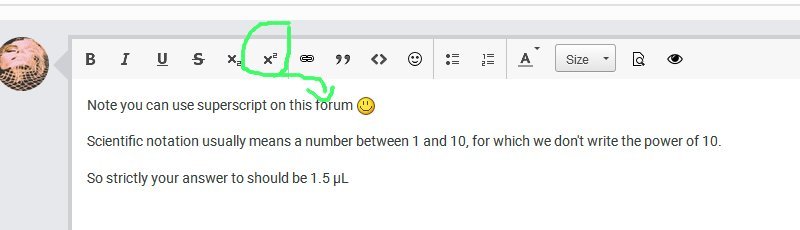
Note you can use superscript on this forum Scientific notation usually means a number between 1 and 10, for which we don't write the power of 10. So strictly your answer to should be 1.5 μL However many scientists also allow or just write 20 as just 20 not 2 x 10, So they are choosing numbers between 1 and 100. Engineers use numbers between 1 and 1000 and that is the basis of using only milli and micro and kilo.
-
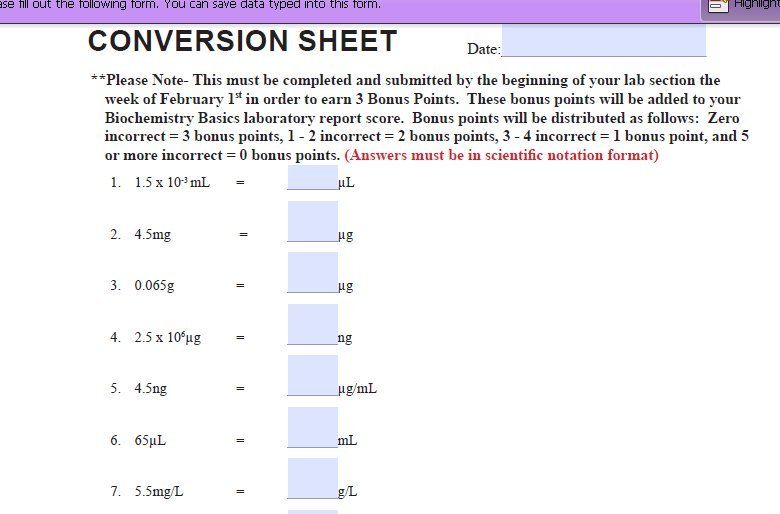
OK thank you it was in biochemistry. And it was one of many general practice questions. I asked about pharmaceutical calculations because some medicines are supplied as a particular mass in a vial to be diluted and then added to an infusion bag of particular volume. Such questions would be almost in the format of mass to concentration by volume. And there was a slip up with question 5. So check that no addendum was posted and inform your academic supervisor. Chenbeier was correct. +1 For others who might be interested here is the excerpt from the pdf.
-
No, please post the complete correct question. Then we can help you with your units. You have posted in Chemistry, is this in fact a pharmaceutical calculation and is it coursework/homework ? +1 to Col for attempting to help.
-
Firstly this post seems to confirm that this is about computer programming so I don't know why you have placed it in Applied Maths, not Computer Science ? But thank you for the reply, +1 , which is much more understandable and would have saved two weeks of floundering discussion if you had posted this in the first place. As to the substance of it. It is interesting that what you are trying to do is an updated version of my (ironic) patented method of passing exams in kinematics from the 1960s. In more modern times (the internet and more recently smartphones) many such 'calculators' have been offered for example Chemists can easily find pH calculators and Doctors/Pharmacists can find 'volume of distribution' calculatiors online very easily. Even more advanced is the Wolfram Alpha and associated site which offers a sort of 'online mathematician' you talk about. But these are just tools that should not be used blindly The user should know and understand the subject to hand. A second thought occurs to me, you have mentioned that some folks find plain English more understandable than a formula or bunch of formulae. I agree. But yet other folks, myself included, find pictures and diagrams even more informative. I had (still have but sadly cannot now deploy it) a program callled DesignView. This was an amazing program for its time, but serious hampered by the limitations of the computers of its day (Windows for Workgroups no less). In essence the user is provided with an entry screen on which she can place directed line segments (vectors) graphically, thus describing say a structure or dynamic system. The computer automatically turns this into an appropriate set of equations and solves them. The user may then play about with the subject either by directly editing the equations or changing the line segments in the graphical model. Non linear equataions such as spline curves may be generated and there was an animation section to the program for dynamical systems. More recently other graphical system modelling programs such as Visio, CircuitMaker, Spice etc have been released. Traditional drawing programs such as AutoCad have added some of this functionality. There are also intermediate programs such as MathCad and Mathematica, ChemDraw and Chemsketch. Many of these require considerable investment in time and effort for profficiency. Alongside this Finite Element programs have become more user friendly with half ways decent GUIs. Yet again the GUI is not the be-all and end-all, that many think. I remember in the 1970s visiting the Hydrographic Office of the Navy where they were starting the mass digitisation of Admiralty Charts. They ahd developed a voice command system for editing the digital chart, so a new wreck, a new or shifted sandbank etc could be added at the speed of light in comparison to the old system (I don't know if you are familiar with the system of 'Notices to Mariners') So it would be interesting to learn where your proposed AI fits into all this ?
-
I see you are still on line so I will try to make this quick, but it may be a bit jumbled as a result. So carry on asking questions. You do not really need vectors or Newton's Laws to understand the Physics of this. The man in the trick is a single bodythat mey be considered as a single entity. He has no direct contact with the ground (or anything other than the truck). So pushing against the truck floor, as well as one side, is the same as pushing against the opposite wall of the truck or any other part of it. The is no overall or net effect on the ouside world. The fundamental physical principle is that internal forces always cancel or balance out. This is illustrated by the following. If you stand a book on a table the book exerts a force on the table due to its weight. If you stand another book on top of the first one then this book exerts a force on the first book which then transfers the extra weight to the table. Internal forces within the book cancel out. Can you draw a diagram to illustrate this ? It would help you to try first, then I will offer one. If you
-
I was going to say why do you not give us an example ? but re - reading I find you already did that but that your example is as obscure and impenetrable as the rest of your question. I agree that is sounds good in principle to ane the variables more meaningfully, but consider this: This was actually the way it was done years ago so Newton would have said, "Distance is proportional to time" (note they did not use equations in his day) This sounds better than s = ut doesn't it ? And further this is what is taught junior school. BUT What about s = ut + ft2/2 How about putting that into words ? Which would you rather learn ?
-
Yet another thought. I was thinking about the usual british house/garage layout with the garage either integral with the house (under a common roof) or adjacent to the house with a common wall. If the garage is actually a separated outbuilding then additional requirements apply, not least an extra isolation switch and the means of routing the supply cable The garage wiring cannot then be part of the house wiring directly. So it would be advisable to plan for the electrical work before the building work is done.
-
A further thought, he should consider adding an electric car charging point. That would add to the value of the property and he may be able to get a grant for it (about £500 I believe). That would definitely have to come off the main dist board as it is nearly equivalent to two ring mains by itself.
-
Now is the need for more information. Most properties have their meters/distribution box('fusebox') in or around the garage if they have one. It would certainly be better (and safer) if your friend could run new wiring from there. Is he proposing to get a board certification of alteration for this ? Sadly beaurocracy is steadily increasing these days, without any corresponding increase in safety
-
Sorry not directly no. You can have more than one spur off a ring main but only to one outlet (remember that can be a double) You cannot extend the spur to another socket. But there are some ways round this as in the hasty attachment.