
studiot
Senior Members
-
Joined
-
Last visited
Everything posted by studiot
-
We are back to the old question What direction does the zero vector point in ? Or. as I said earlier, What are the principle axes of the stress tensor when the imposed load is zero ? until we effectively impose a coordinate system by measuring any which one of the angular momentum components as well as the total angular momentum We cannot do this without an external agent.
-
I think we are saying basically the same thing, with a different emphasis. Perhaps a more formal version of what you are saying might help. https://pubs.acs.org/doi/pdf/10.1021/ed042p397 There is also an interesting discussion about this point on StackExchange. https://physics.stackexchange.com/questions/610064/are-all-atoms-spherically-symmetric-if-so-why-are-atoms-with-half-filled-fille
-
Doesn't the spherical symmetry arise like this: When you choose the actual direction of the X axis you automatically set the diections of the Y and Z axes. Then you can solve (Markus, other atoms have been solved numerically and so called 'hydrogen like' atoms can be solved analytically) you obtain the various wavefunction plots. But your choice of the initial direction of X is arbitrary and has spherical symmetry, because whatever direction you choose you will get the same set of solutions along your particular X,Y and Z axes. It is the whole set of solutions that has 'spherical symmetry'. So in a normal sized aggregate of atoms you will 'see' an average sphere. Note this is not the same situation as the Principal Axes in the stress and inertia tensors where the X, Y and Z directions are set by an external influence such as a load, there are no such principal axes in the solution to the quantum wave equation.
-
Perhaps you mean this ?
-
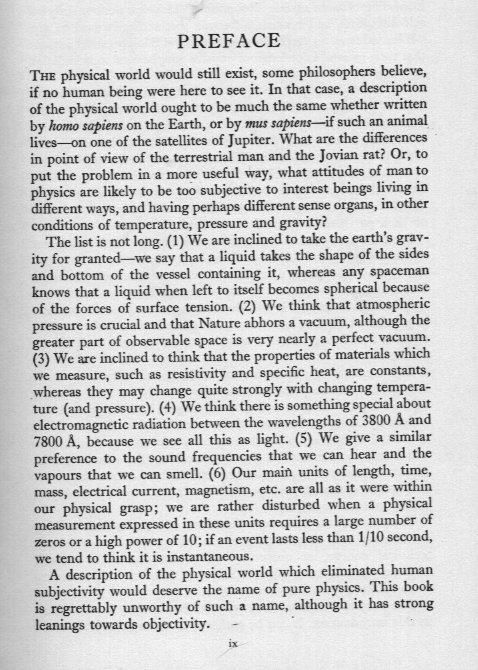
Welcome, scruffymonkey. We are all scruffymonkeys during lockdown as there are no barbers available 🙂 This type of question is common with folks who "love science, but are not scholars". Science for non scholars can be great fun , so ask lots of questions to better your understanding. You need to bear one thing in mind however. In order to be able to work with concepts and quantities, Science has some pretty tight definitions of many common words and ideas. Swansont's answer is a good example of that and it reappears in this book by Dr Meetham "Basic Physics", as does an explanation of Force, Strength, Pressure, vacuums, frequency and many other terms that cause confusion. It is a small old book, but easy to read and easy to find references to explain basic ideas simply but correctly. Such a book is an invaluable companion to finding out more. Here is the preface first page.
-
There is a well respected science fiction story about this by Bob Shaw, based on writings of Thomas Moore. https://en.wikipedia.org/wiki/Light_of_Other_Days 🙂
-
@Dave I now keep messing up an edit (and I see others making the same mistake) This is because I naturally click on the button just below the bottom right of my post. This is now the quote button and I start editing that. Then the automatic merge kicks in when I click save so there is then a double copy. As well as setting a trap for the unwary, like me, It really is an example of inefficient programming. Two clicks where one formerly sufficed.
-
I really don't know about the US, but almost none of this is true in the UK. Consumer choice has been dwindling at an alarming rate over the past couple of decades. There is little more exasperating to a customer than to receive one of the following responses to a request "have you got such-and-such ?" a) No, there is no demand (when I have just asked for it!) b) No, we used to sell those, but we don't anymore. c) No, we had 3 and sold out and we are not getting any more in until next winter. (I received this amazing response in M&S when trying to buy the next size up school raincoat). 3 for a M&S serving an area of half a million people. d) No they were only here for a week's test marketing. We will not be stocking them. (M&S again) e) No, we don't do all sizes. As a result of a basic failure of most retailers in the UK to follow the most basic and elementary rule of selling. Stock things that consumers want to buy.
-
Have you found this ? Voila!


-
Welcome Lucille. Glad you found it interesting. Note you are only allowed 5 posts in your first 24 hours for anti spam reasons.
-
I'm sorry Markus to be pernickety but the OP specified a sub atomic particle not an elementary particle. I admit I introduced bigger particles before John did. But that was to make my point that none of these, neither sub nor atomic sized particles can be 'seen' directly. I introduced the wind as an example of something familiar that also cannot be seen directly. The wind is a good example because it can be felt, and no one is suprised about this. In a similar way we can 'feel' the impact of particles, so we can (and do) sense them.
-
I have not 'denied that the EM field alone' , whatever that means. I have questioned you understanding of the energy of the electric field of an electron. Why have you moved the goalposts ? I really think it goes right back to your understanding of the question what is energy ? And to what 12/13 year old schoolboys learn to regurgitate to gain a mark in an examination. "Energy is the capacity to do work" I certainly didn't appreciate what that means until I was much older or how deep and insightful that definition really is. I would also appreciate you addressing my other points, which are all designed to be helpful to you and your understanding, rather than posting fancy diagram by others that add nothing to the discussion.
-
I would be 'something' if you answered the two specific questions I asked you rather than sidestep the issues. 🙂
-
How is this an answer to my comment on your contention that something is only a geological process if it takes billions of years ? I just don't agree with you. Meteorite impact for instance is a very quick process, as I already noted. Yes the first one was a long time ago, but so what. When the first one struck it was still a very quick process. Since at the time of the first impact it was the only one ever, and given that it was very quick, does that mean it does not count as a geological process ? Ditto for the first volcanic eruption, the first collapse of a cliff into the sea and so on.
-
So do you consider that 'nothing' has no properties whatsoever ? Or do you not consider a property as 'something' ?
-
So why is this thread entitled ? EM radiation, and E fields are entirely different things. For explanation, (radio) photons are produced when a free electron is accelerated. The energy carried by these photons comes from whatever is accelerating the free electrons in the antenna metal. They are being accelerated because they are classically performing simple harmonic motion (SHM) in the metal. Do you understand the mechanics of SHM ?
-
Thank you for your quotations. Do you understand them ? The first refers to Griffiths in the Wiki article you quoted. But it does not tell you where. If you read Griffiths properly (pages 60 - 61) you would see that this 'total energy' is the energy you would have to input or withdraw to move a second charge in the field of of a first charge. I agree that Griffiths, like many before him, call it a test charge. But at least two charges are necessary for the equation to have validity. Griffiths deals with the general case of many charges in the section quoted.
-
You asked specifically about electric field energy. Not any other form of energy. A single charged particle has no electric field energy, nada, zilch, nothing. Electric field energy is a potential energy of a system with more than one charged particle (which is due to the system configuration). So no other particle no energy.
-
Please read the rules you signed up to when you joined here. You would then know that you have posted your speculation in the wrong section and that advertising youtube vids is against the rules. You would also know that you have only 5 posts in the first 24 hours so don't waste them until you can scinetifically back up your hypothesis with evidence and answer scientific questions about it. For instance, the oldest known coal in this Earth is only about 10% as old as the Earth itself. Life has been known to exist for more than 80% of the Earth's history. More interestingly the oldest oil is much closer to the origin of life on Earth date. How do you account for this?
-
In the beginning was coal ? NO. Coal was formed from plant material, which itself is a long way down the evolutionary chain from the simplest organisms. Viruses came before cells ? Again NO Viruese cannot exist (live and replicate) without cells so celss must have come first. Bacteria are not cells ? Really ? You need to seriously revise your chronology and understanding of elementary biology before proceeding to more complicated hypotheses.
-
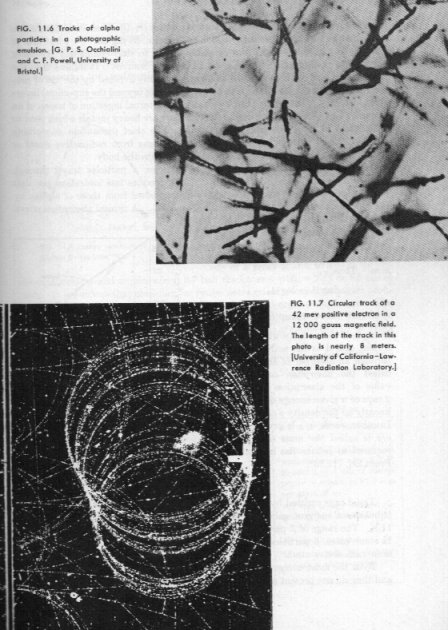
Good morning, Alex. I will keep this short in case you can't be bothered to come back here to look at answers. Why do you expect to be able to see sub atomic or even atomic particles ? Can you see the wind? Do you understand how black and wet photographs work ? The light produces a monochrome image of the scene, we can see but is not the same as if we viewed the scene directly with our eyes. It is possible to see black and white (and yes add 'false colour' as in your opening post) images but suitable techniques. Here are a couple.
-
Driving a car is a process involving the material world. Waste is true of just about any procees you can think of in the material world. So what ? A few examples: Go down to the lumber yard and get some timber to make a table. When you bring it home and cut the pieces to exact sizes there will be offcuts. There will also have been waste in preparing the timbers in the first place trimmin the unwanted bark etc. Say you bake a cake. Some residue will stick to the side of the mixing bowl and baking tin. More waste, along with the shells the eggs came in. Say you grow some wheat to make the flour. The ears grow on wasted stalks, and are covered by wasted sheathes. Waste is just a fact of the natural universe.
-
Yes I noticed a few days ago that they recorded the lowest UK temperature since 1983, in Braemar. Whilst we we having few (slightly) frosty nights. I had actually turned the vegetable patch over, hoping that the frost would break down more of the clay we have round here , but there was not enough frost. Over the last decade there have been a few times when the temperature with my family in Tayside and Aberdeen has been higher than here, but there is an average 4oC temperature difference in our favour. I do like the highlands though. Nearly as good as Lorna Doone and King Arthur country. 🙂 Jack London ? Do you like Robert Service (Songs of the High North amongst others) ? Or Roderick Haig-Brown (Starbuck Valley Winter) ?
-
As you can see, members here are doing their best to help you by interpreting your unusual form of English. +1 to Area54 Your general lack of response to such efforts is making communication unworkable, which will eventually lead to everyone giving up trying.
-
Thank you for agreeing that you were over egging the pudding. You were also failing to report that this larger number of purchasers were being deceived by a much smaller number of people promoting the products. The arguments and revelations on news and social media bear this out. Most folks just didn't know, but there has been a general rejection of such products that is still gaining momentum. I like many things about Americans and the American Way, but not the 'hard sell' techniques that are being perpetrated by Americans on Americans, not by the Chinese on Americans. The Chinese, of course, are trying to cover up what some Chinese are doing to other Chinese. The world is a very inequitable place.