studiot
Senior Members
-
Joined
-
Last visited
Everything posted by studiot
-
There are quite a few new terms here, this article from Nature might be a good place to start. I have not studied this very new area of Science, certainly looks worth investigating. @Prof Reza Sanaye Perhaps a simpler point or two to start with would help us all ?
-
Congratulations. But we don't do your homework for you. We can help you but you must do the work. The better the information you supply the better the help we can offer. I presume you know what integration is and how to perform some simple integrations ? But you need some real life examples. Have you no ideas at all ? How about this: Suppose you have measured a graph of some function, say current or voltage in an electrical circuit or the water flow of a stream or river or the temperature over a day or week or month or......... or take your pick of some physical variable from real life. Ask if you don't know what a variable is it is very important that you do. So you are asked for the average value of this variable and you say OK let me perform the integeration since I know that the average = the integral divided by the interval In maths symbols this is [math]Average(x) = \frac{{\int_a^b {f(x)dx} }}{{b - a}}[/math] Now choose a variable and see if we can generate an f(x) and integrate it.
-
Once again a personal attack. You have no idea what my reasons were for the points I made, so you have no justification whatsoever for choosing to adopt a personal one. I said I was unconvinced by your post. So I note that you 'overlooked or dismissed' the ammonia entirely! The best interpretation I can think off is that it was unclear. I could also take your statement as printed to be untrue as it could be read to mean that you attribute the darkening entirely to the HCL. So I will leave it to you to develop a proper technical response the the less technical OP, leaving me out of it please.
-
And yet here is an extract from my second link; my emboldening. Chemically pure hydrochloric acid (caustic and toxic) is a good neutralizing agent for wood surfaces. It is used to brighten up staining agents and to bleach wood.
-
Hi Dave, just checking if Tex still works. [math]This\quad is\quad a\quad Test[/math] [math]\oint\limits_v {{r^n}dv} [/math] [math]\begin{array}{*{20}{c}} {{a_{11}}} & {{a_{12}}} & {{a_{13}}} \\ {\frac{{\partial \Omega }}{{\partial u}}} & {\frac{{\partial \Omega }}{{\partial v}}} & {\frac{{\partial \Omega }}{{\partial w}}} \\ {\frac{{{\partial ^2}\Omega }}{{\partial {u^2}}}} & {\frac{{{\partial ^2}\Omega }}{{\partial {v^2}}}} & {\frac{{{\partial ^2}\Omega }}{{\partial u\partial v}}} \\ \end{array}[/math] Update since no edit available Still have to use the refresh to get the blighter to display. Also the font is not longer crisp and clear on my screen. Is this an aliasing problem ? Quote function appears to be similar You can use its auto merge function to update as I did until the edit button is restored.
-
If CharonY contradicted themselves, so did you. How does one have both too much Deniven and too little Deniven ? I suggest you slow down and tighten up on your presentation. It is too much ( for pedantic idiots like myseself) to sort out what the actual topic is about. Note this is not an endorsement of what CharonY said as I do not quite agree with every bit of it.
-
Thank you for finishing my calculation. +1
-
https://www.bbc.co.uk/news/in-pictures-56016031 Interestingly there are a couple of photos about the use of solar power in the list and also several other environmental science subjects.
-
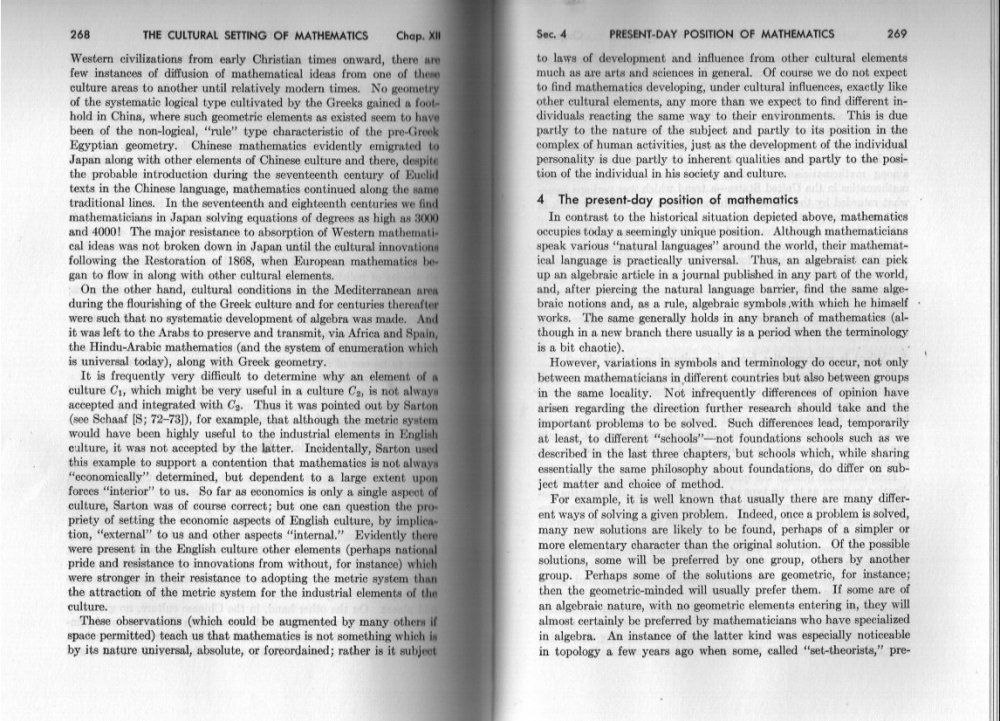
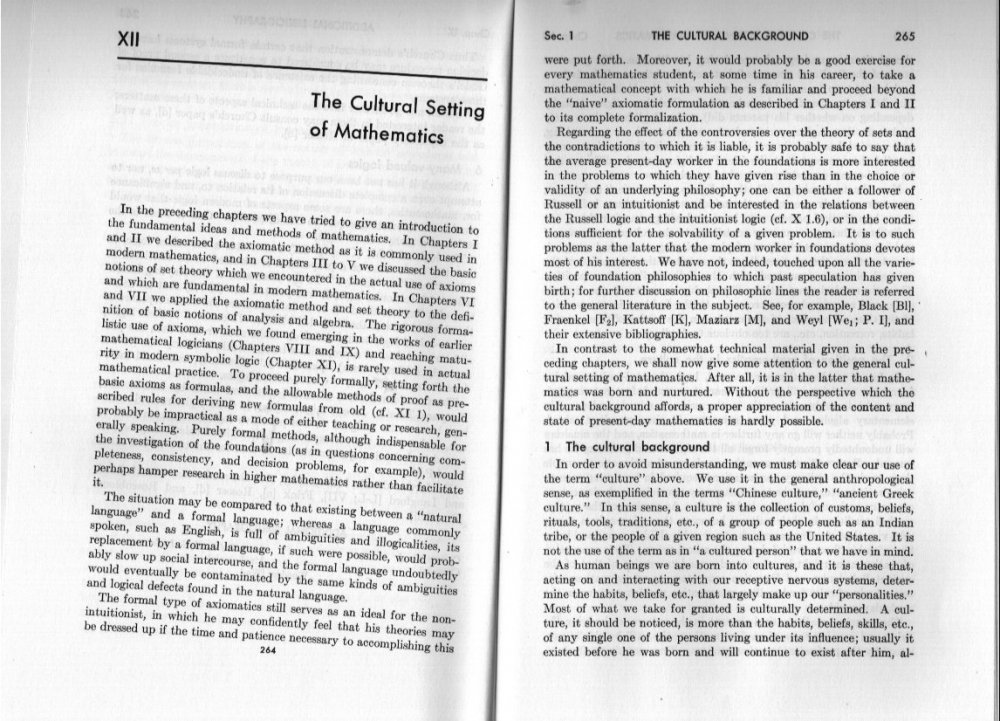
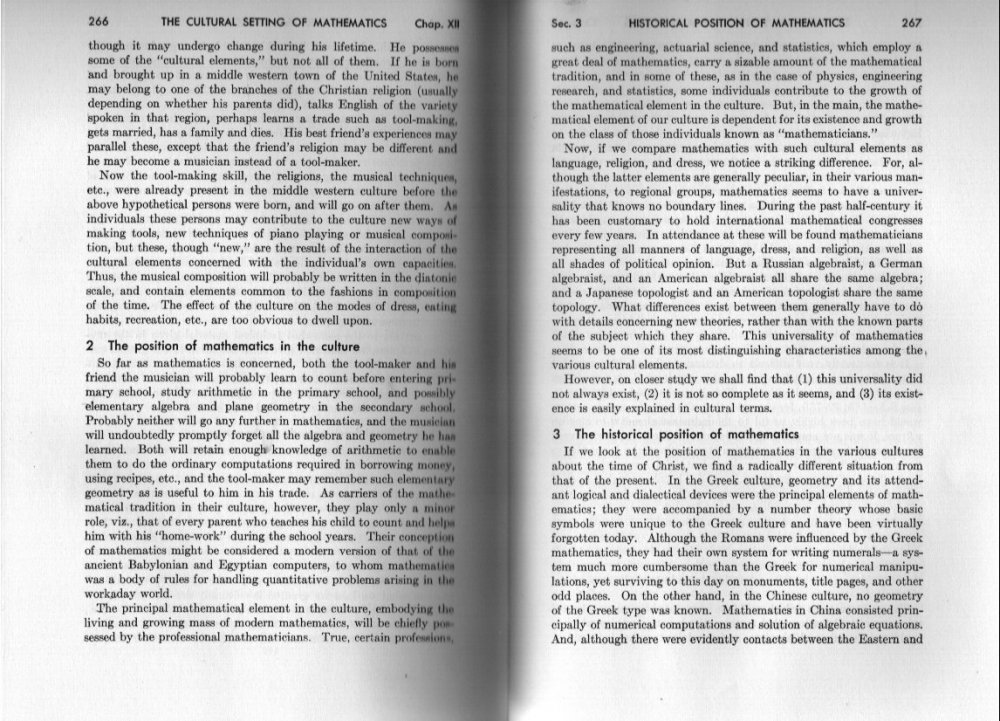
@slomobile I still find the information provided a tad conflicting. This thread is stated to be about notation. Later you say it is about communication. And teaching. Then you introduce Non Standard Analysis, which is noted to be a minority sport. So here is the beginning of one of the last chapters in a book from a well respected mid 20th century Mathematician which addresses all your topics and more that you probably haven't thought about. I commend the book to you. It is also worth noting that there is a good introduction to NSA in chapter V of Thurstons book Differentiation and Integration.
-
Not convinced, about the HCL, I thought that bleached wood ? But certainly it is a dangerous substance to be treated with respect. Ammonia darkening of wood is a well recognised process on the other hand. You can see this just by using ordinary household ammonia and scrubbing a wooden floor. https://en.wikipedia.org/wiki/Ammonia_fuming http://www.nzdl.org/gsdlmod?e=d-00000-00---off-0cdl--00-0----0-10-0---0---0direct-10---4-------0-1l--11-en-50---20-about---00-0-1-00-0--4----0-0-11-10-0utfZz-8-10&cl=CL2.19&d=HASH0151caf30a244bb2ecd8f91b.5.4>=1
-
Hi again. Thanks for explaining your requirements. Sadly, I'm not an expert on higher order logic and it seems unlikely I'll have time to become familiar with it over the next few months. So I'll be bowing out of this conversation. Sorry I couldn't help. But you did help. 🙂 Thank you for picking out an example of the wider scope of English over Maths. +1 Truth values are not the only values in English and even these are not fixed. For instance the apparantly mathematical question "How many sheep are in that field ?" Say the answer come's back as 13. But I didn't include the information that 5 of these sheep about to lamb. Tristan's self referential question also includes (amongst other values) comic value in English.
-
#That is an unsound circular argument. The universe is only finite if there is an 'all' to the hydrogen. Note this condition is necessary but not sufficient. So you can't say the universe is finite because there is a finite amount of hydrogen. But also consider this since you wish to quote thermodynamics: Take the numbers 1,2 and 3 ? Do you consider that each of these numbers contain different information ? But the sequence 1,2,3... is infinite so do you consider that there is a finite (ie limited) amount of information in the universe and so must be unable to contain any number larger than some integer ?
-
Hell yeah! It's a wall against personal demons. +1
-
Don't worry, the good 'Prof' has only one post left.
-
I dunno about always, but this is an incredibly profound yet often overlooked statement. +1
-
Please explain why physical chemistry and what axioms you are proposing. Then it might make some sense to DIm and to others less bright like myself.
-
I can't see how you can learn much engineering without learning and understanding a good deal of Physics. Simple things like the difference between a Force and a Pressure. Simple things like a fluid going round a corner or bend in a pipeline exerts a force that can be sufficient to need thrustblocks. Failure to understand this and use these can have spectacular results as the engineers who flooded Harrow Hill in London with bentonite found out.
-
Not sure that either of those two expressions are coordinate free. Just they are true in all coordinate systems. Is dF the divergence of a field ? In any event I was talking about something much simpler than this. 1) It is fashionable to teach euclidian geometery by vectors these days. This adds a coordinate system, only neccessary because of the use. A parallelogram has the same area whether calculated by Euclid or by vectors. 2) Relativity only requires a metric containing linked interval invariants. Yes both of these can be done by theory using coordinate systems but this is surely going against the idea of the simplest possible theory for the job in hand. Here is an example. Speed v velocity. Speed He was driving at 175 mph He was driving along Pendine sands at 175 mph Both are true and contain enough information to make sense. He sailed from Cadiz at 4 knots This could be true perhaps lacks enough information to make proper sense Velocity He was driving west along Pendine sands at 240 mph He sailed S-SW from Cadiz at 4 knots More information makes more sense So English usage appears to conform to Ockham, and need not be scientific. Once again I refer to what William actually said.
-
Perhaps someone could explain to me why we hang on to Ockham's Razor yet don't apply it to situations in pure Mathematics or Physics such as Relativity where the apparatus we teach and use contains more information and structure than is necessary. I am thinking about the 'automatic' but unneccessary use of coordinate systems in geometry? Ockham was not a scientist. So why confine the razor to something he had never heard of and did not introduce it for ?
-
Can be significant, not are significant. read this realistic american article. http://daytonthermalinspection.com/2017/09/27/the-tale-of-two-comforts-complexities-of-heat-pumps/ One other point to consider with solar PV is the replacement cost of storage batteries, they are not cheap. But batteries are essential in most PV systems as the panel output is low voltage and thus suffers high relative resistive losses if used for directly for heating as it must be high current. One possible future use of PV that occurs to me which makes a lot of sense, but has received little if any coverage would be charging the family electric car. After all, electric cars are the coming thing.
-
Fair enough if you are only considering linear momentum. I'm sorry if I misunderstood, as Fred keeps reintroducing angular motion even after repeated telling that this is irrelevent. Certainly my thoughts are that if you allow scattering before the impact of the photons ther is no point in using a laser You seemed to imply this when you wrote, perhaps I misunderstood again. Further I don't see that scattering after the impact is relevent since any change to the target's momentum will already have occurred. So why is scattering not a red herring ?
-
I like to have my own copy of things. But I also thought you would understand more. I don't know where you found that article, but it is part of the Stanford Encyclopedia, which contains many many articles, with a choice of formats. Paid members may download any of these. Like our member with the cigar, I support Wikipedia with a few dollars a year and thought I would like to support the Standford project with a few dollars more. Neither are greedy unlike some sites. yes, I was going to ask about this. But I don't see any conspiracy background, just a member whose first language is not English struggling with a translator. 🙂 Yes that is also my understanding so far.
-
Thank you for that knowledgable amplification.
-
How do you address my point about two of these being irrelevant ?
-
Glad my reply was of some use. How did you get on with my little quizz ? It was designed to demonstrate something very important. Mathematics uses the + and - symbols for two different things. This sign of something which you asked about - which is a property of that something and addition/subtraction - which is an operation or process on that something Many people get confused about this basic point.