studiot
Senior Members
-
Joined
-
Last visited
Everything posted by studiot
-
I'm gald you found something useful in my offering. However you should avoid this myth that ionic bonds are 'stronger than covalent ones'. Some are , some are not. The hardest natural substance known is a covalent crystal and is used to make special scientific equipment for containing very very high pressures (greater than at the base of the solid part of the Earth) called the diamond anvil. As John and exchemist are noting there are also situations of intermediacy where a bond is mostly ionic (covalent) but a little bit covalent (ionic). As regards your original question, Perhaps you should study the reaction of quicklime with water to produce slaked lime. Although bonding other aspects of physchem are very modern and greeat fun I still urge you to get a good grasp of 'the stuff of matter'. Chemistry is very much about the stuff of matter and how it behaves and the theory follows knowledge of this, rather than the other way round. Yes I know there are advanced chemists who will tell you about nucleophilic reaction sites and so on , but I guarantee they have a good knowledge of 'stuff' and its behaviour to work from.
-
We were either facing the threat of war or at actual war during the 1950s, 1960s and 1970s I was in Hungary at the beginning of the 1956 uprising. So you continue to demonstrate my point.
-
You can't be serious ? The examples of war or the threat of war or the desire to win (or just not loose) a war spawning game changing developments are legion and go right back into antiquity. I already provided some examples, but since you have introduced the tank as an example let us examine its history. The tank was conceived and introduced in ww1 where the primitive originals are said to have made a difference, although late into the war. The tank was a significant factor in the first half of ww2, but by the end had become militarily obsolete by the successful introduction of anti tank rockets onto the worlds most successful military aircraft ever. After the war the company that invented this aircraft attempted to follow it up with a commercial airliner based on it. Not only was this airliner a tragic technological failure, it finally broke the company that made it.
-
Fair enough. Thanks for the correction to my Hector.
-
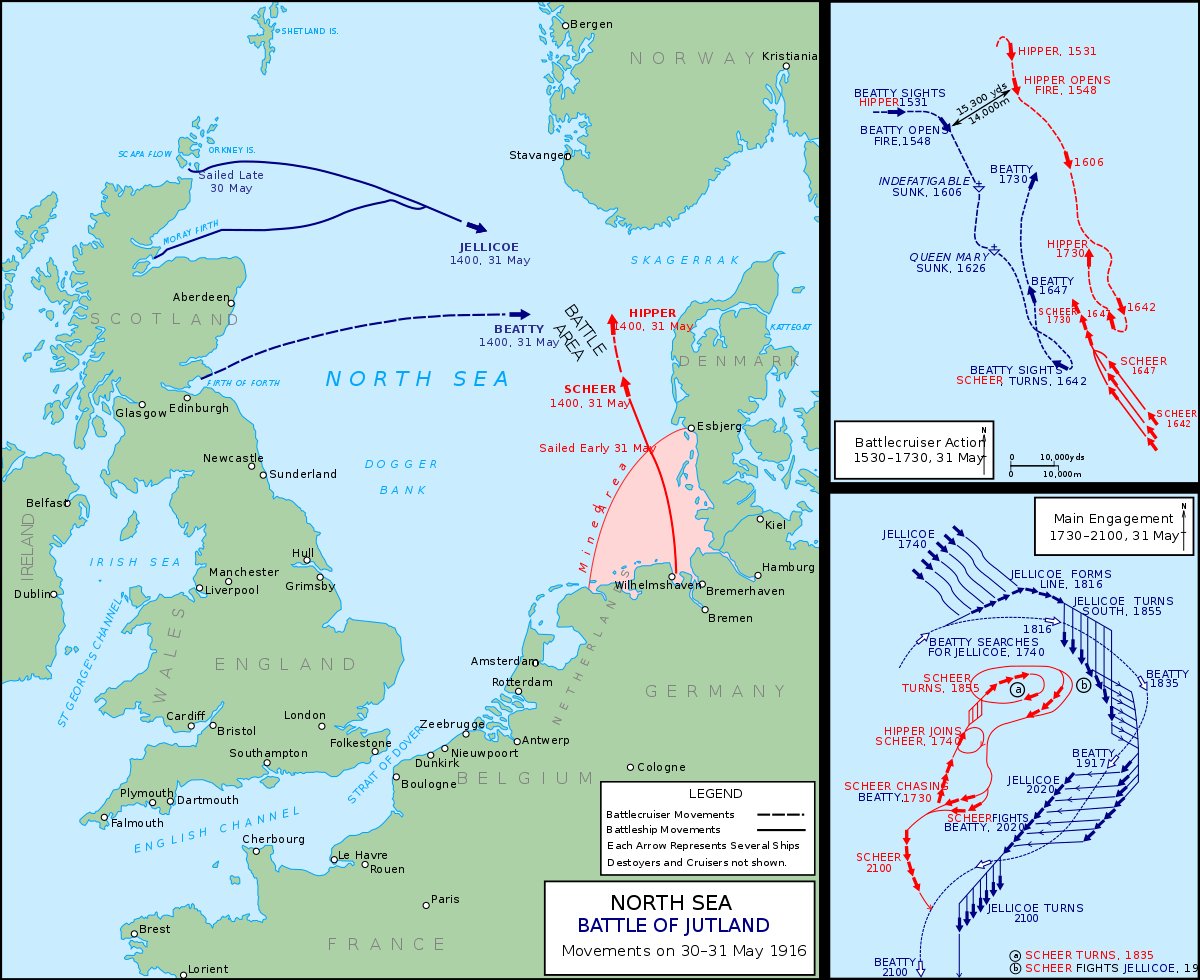
Thank you for the greater detail. +1 As I understand the battle of Salamis, it was the same tactics of 'bottleneck' used by the Spartans at Thermopylae and by Hector at the bridge. Whereas Jutland was an open water manouvering by both sides.
-
So all this discussion of the relationship between ww1 and ww2 is interesting but a bit off topic since the actual OP question was To which my answer is that despite Hans' points supporting the pros of the proposition, he has not weighed them against the cons opposing it. And there is one very strong con. Historically, the periods of rapid technological advance have coincided with military imperatives in many cases. So the canon replaced the trebuchet, the gun replaced the bow and arrow, the rifle replaced the musket, the shell replaced the solid projectile, I have not tried to list con points but the weighing up process should be undertaken.
-
I think CharonY has shown that it was more somplicated than your simplified version. Alos I note that in ww1 Germany had no imperialist ambitions in Europe. That is it did not enter the war to gain terrority but because of its obligations to someone else. This was clearly never true of A Hitler and ww2 who definitely wanted to conquer Europe at least. So it cannot be that ww2 was jjust a continuation of ww1 and the ambitions of an entirely different regime. Sure the Hitler egime used every resentment going to fan the nationalist flames. But they did not continue someone else's lost war.
-
Good job they didn't pass it down the line then. Naval tactics from 1815 consisted of 'line of battle' wooden sail-warships sailing past each other firing broadsides. Successful tactics 100 years later with gun turrets on motorised steel ships were rather different.
-
Thank you for knowing more than I did. +1
-
So experienced that They must have had the oldest admiral ever ! 🙂
-
I don't doubt they did indeed have imperialist aims of their own that carried in into WW2.
-
So how were they able to inflict greater damage than your supposedly superior British fleet ? Since this thread is about Military History and (I suppose) it's place in History more generally it is fascinating to study how often inferior naval forces have won history changing naval engagements as opposed to land engagements, going right back thousands of years to the Perisan Empire and the Ancient Greeks, through the Romans, to Spanish wars, the American War of Independence and the Napoleonic wars and as noted , some sundry far eastern wars as well.
-
You seem to want to focus on Germany ? You also queried my view of Jutland. The Japanese were active long beofore WW1 was declared. Compare carefully the strengths of the fleets (Japan won) despite being at a 5 battleship to 11 battleship disadvantage. But you surely don't consider them a minor player in WW2 ? The point is that in WW2 Germany had imperialist dreams in Europe. In WW1 it did not.
-
Japan entered the war on the side of the Allies on 23 August 1914, The Ottoman Empire came into World War I as one of the Central Powers. The Ottoman Empire entered the war by carrying out a surprise attack on Russia's Black Sea coast on 29 October 1914
-
I seem to remember from my history that more that one of the major combatents were on the 'opposite' sides in WWI and WWII.
-
The German fleet had superior gunnery in both the method of feeding the shells and protection against flashback into the magazines. This is why they were able to inflict so much damage on the British fleet. The British made a similar mistake with HMS Exeter and the Exocet in the Falklands campaign.
-
How do you make that out ? Following the Great War, there was a decade of boom. The depression that lead Hitler into power and eventually to WWII did not happen until the 1930s.
-
I thought you had abandoned this thread. Well actually they did. The german fleet was superior to the british one. And practically they won the engagement at Jutland, but they then ran away. And their fleet mutinied in and refused to fight again.
-
But evolution is a random process, in accordance with the definition I gave if and only if it has generated an outcome. Has this occurred ?
-
And the rest of the post +1. Random by itself is pretty meaningless, it is an adjective and needs a noun to describe as random. A random process is a process which has more than one possible mutually exclusive outcome (ie at least 2). A stochastic process in one in which it is possible to assign probabilities to the outcomes. A process which has only one possible outcome is, by definition, deterministic (or predictable). This is the nearest to the opposite to random I can come.
-
Are you sure ?
-
Yes the authors are quite correct in what they say about the scenario they describe. But it would be statistically quite wrong to apply this statement to evolution. The monkeys are performing the same (statistical) experiment over and over again. That is they are repeating one single experiment. Evolution is about the confluence of many many simultaneous experiments. The statistics of such a process is entirely different. Applied to the monkeys this is equivalent to applying a whole bunch of 'filters' or constraints, themselves perhaps random in some way but maybe also biased. So that for example certain keys are occasionally electrified so the monkey will shy away from them. And another filter is applied so that the resultant electrification shepherds the monkeys into typing the keys for the letters in their order of frequency in the English language. Now apply a very large number of such filters all compounded together. I wish you well in finding out the resultant text the monkeys migh come up with as the possibilities are truly staggering. So much so that you could be studying for the age of the Universe and never see a repeated text.
-
Look around you. Water, alcohol, oil, resins, methane, nitrogen, oxygen, carbondioxide, benzene; These are common liquids or gases. And they are all covalently bonded, albeit some have straightforward covalency some have dative covalency (ie are polar). Compare this with sodium chloride, iron oxide, copper sulphate; These are all common solids. And they are all ionically bonded. This situation represents the very large majority of cases. This is no accident, there are good reasons for this. That is to observe that ionic compounds tend to from solids whilst covalent compounds often appear as fluids. Yes one of these reasons is molecular weight. But there are plenty of examples of ionic solids with a lower molecular weight than covalent liquids, eg sodium chloride is 58 whilst benzene is 78, both from my list. So it is instructive to consider what is different. The difference is that in a fluid the molecules have a degree of autonomy not present in a solid. They can move about as a molecule. And most important you can for instance identify one particular carbon atom with two particular oxygen atoms forming the 'molecule'. However you cannot identify a particular sodium atom (ion) with one particular chlorine atom (ion) in the solid. In fact electric forces link one (each) sodium+ to 6 chloride- The coordination number is said to be 6. So the intensity of the charge difference is distributed that way. https://courses.lumenlearning.com/cheminter/chapter/ionic-crystal-structures/ This is the key difference of importance to your question. The chemical implications of these can be very complex indeed as both John Cuthber and exchemist are trying to tell you.
-
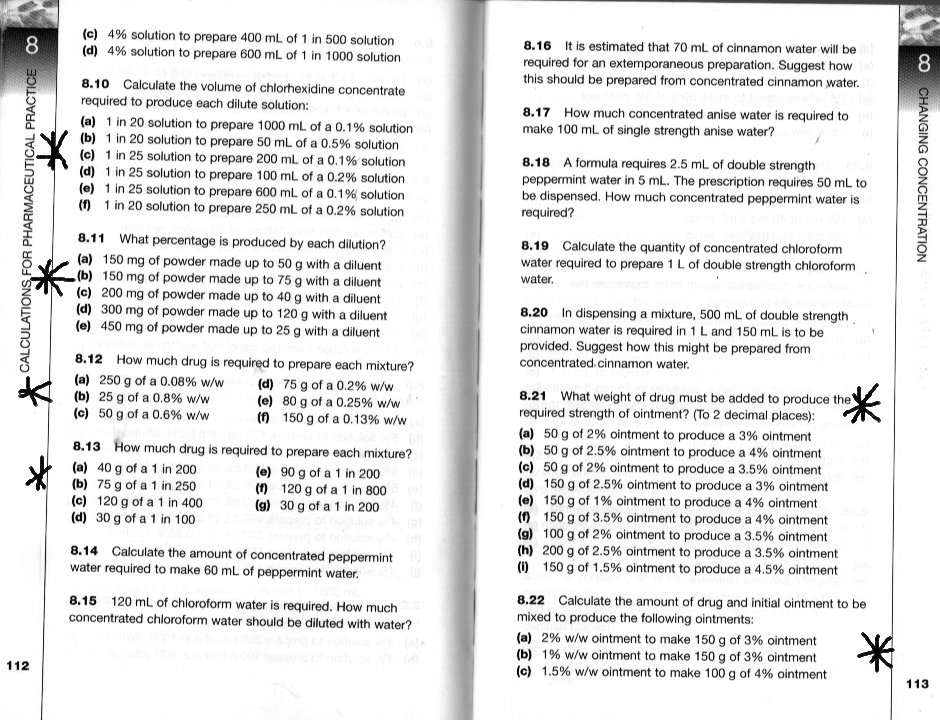
As I see it, @popcornfrenzy has not yet told us the entire question, as it is writen in the book or wherever. How do we know that we have to calculate a number of milligrams ? This was nowhere stated in the supposed complete copy of the question. I have suggested it is of the sort in my attachment, starred to show how common this practice is. So yet again I ask for the full question. @popcornfrenzy If you are not confident with these, there are many books of nothing but practice (drill) questions with answers. Practice makes perfect. And we do want our Baristas and Pharmacists to give us the right cocktail every time don't we ? 🙂
-
From what you have said before, I would think the final objective might be to help you understand the following presentation about dilution and pH calculation in swimming pools. https://courses.lumenlearning.com/cheminter/chapter/calculating-ph-of-salt-solutions/