studiot
Senior Members
-
Joined
-
Last visited
Everything posted by studiot
-
Interesting response. +1
-
Small wonder I've got no idea what you are talking about. I am not a mind reader of short cuts. Please say what you actually mean. This also applies to Science and I have been noticing a resurgance of religion (including creationism) in the younger generations in countries I am familiar with, which excludes Poland but does include many european countries. I wonder if the current lack of clarity and propagaion of woo in Science has anything to do with this.
-
Well there you are then. Perhaps offer some more realisitic figures next time ?
-
If the bots want to have a war or love fest (I'm not sure which) hopefully the increased net traffic generates some income to keep this site going.
-
Fair dinkum +1 I find the bit about joining the dots particularly poignant because that is the exact problem withs et theory that mathematics is still struggling with. I didn't understand a word of that.
-
The question to be answered is in the title. My suggestion is in the spoiler. the best two words are - Free Alcohol The worst two words are Alcohol Free
-
Can't find the spoiler any more.
-
Several members have mentioned 'patterns'. So what are patterns ? What pattern is AI discoverable in the following data 1, 3, 13, 23, 53 ? and is it the same pattern as 53, 23, 13, 3, 1 ?
-
Thank you so much for this information. I had no idea the life scientists had advanced so far, mathematically, but it makes perfect sense. Mathematicians have been busy expanding the notions of measurements and distance so I am glad to see that bearing fruit in the form of real applications. +1
-
Newton was a unitarian. which held his progress back in the Cambridge heirarchy (though not in Physics or Maths) as he could not take Holy Orders.
-
I don't understand why this thread has wandered around so far off topic, whilst introducing many huge topics, each of which should be in a separate thread of its own Further I didn't get much traction when I offerd detailed insights into the original topic. Nevertheless since the OP has now raised the topic of 'what is life' , here are a few thoughts. So, amongst others, Life appears to have some or all of the following characteristics. Ability to absorb 'food' material (including energy) and also to excrete 'waste' material. Ability of cause replication of itself. Ability to grow. Ability to move in some way, in whole or in part. Ability to respond to stimulus. There are others but this will do. It can be said that the dendritic growth of crystal structures exhibits all of these, plus some of the ones I haven't mentioned. Does this make these crystals alive ?
-
Especially as some of us might wish to dispute some of the statements in your opening post.
-
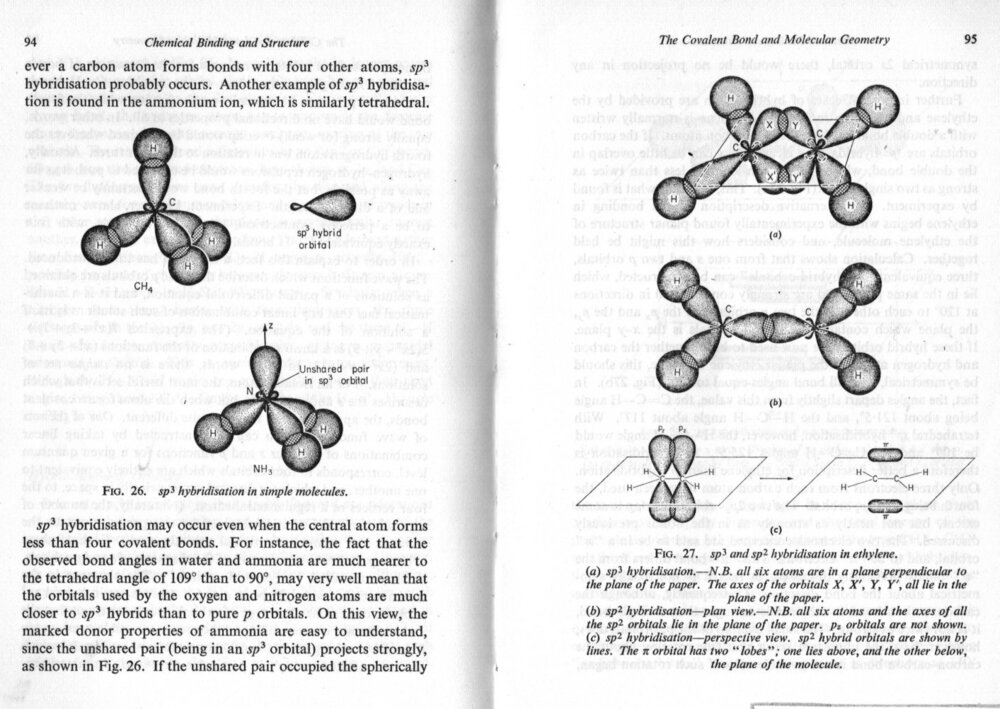
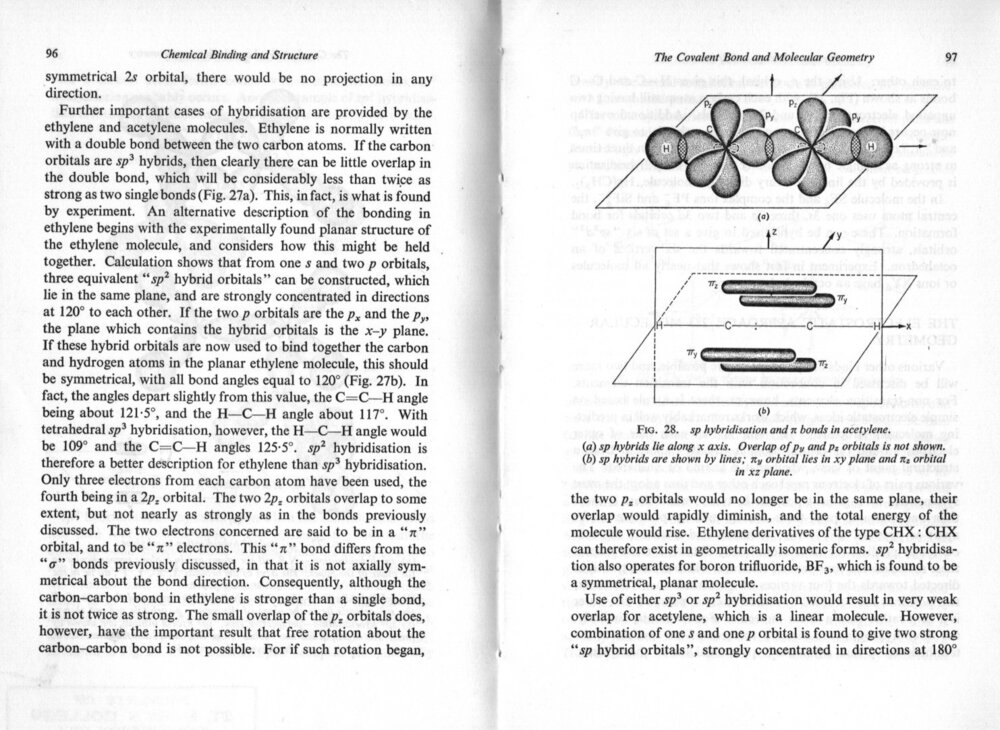
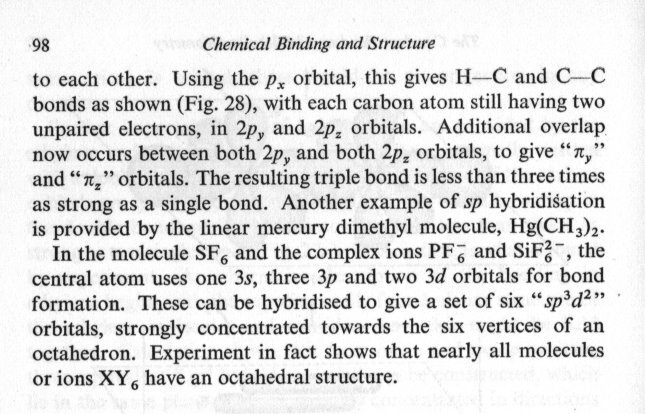
Do you ? I hope so. Here is a more detailed explanation of why the bonds are this way. It is to do with the geometry of the different configurations. Note the double bond has a planar structure whilst the triple bond has a linear structure. So there is only room for the lobes of the Pz orbital to stick out top and bottom in the double bond hence only the z Pie orbital (two separated lobes ) is formed. In the triple bond the Pz orbital sticks out top and bottom and the Py orbital sticks out side to side forming the other Pie bond. So that is what I mean when I say theya re equivalent. The article gives specific values for the effects on bond strength. Clicking on one of the pictures will give a bigger version for ease of reading. This response is more like I would expect to see in a discussion. So do you understand why different configurations with different hybridisations are allowable ?
-
In all honesty there's too much chaff here for anyone who wants a serious discussion to bother. So only those that like verbal fencing or moderators (who have to bother) will step in. I'm pretty sure you will have come across the scientific notion of a model here. Unfortunately too many people throw the word 'theory' about whne they mean model. And the point of a model is that it mirrors only part of that which is being modelled.
-
I don't see the need for multiple threads on this subject. One is more than sufficient.
-
Interestingly I was today reading an article about an AI generated film star, which completely fooled the media, with fake film material and all sorts. I was also listening a spokesperson for the UK Office of The Information Commisioner, who has just issued substantial fines to companies who make a nuisance of themselves by using AI fake humans to make advertising telephone calls. I normally ignore these, but I recognised one of the examples which I had though was a lady enquiring about fibre-glass insulation in my loft, but was really a computer generated simulated human.
-
We used to have a lawyer here who was a damn sight better at Physics than this. But then I think he studied the subject a bit longer and more deeply. I'm sorry to tell you that the used the wrong AI to summarise the laws of thermodynamics for you. Further it should have told you to define your symbols, before you use them in mathematics.
-
It would be good if some of your countrymen would step in here and tell you that it doesn't hurt to respond to those who have genuinely put themselves out to help you.
-
The only thing I would quibble with is this. I would add the words "some politcians......................... some are just inept". Small point, I assume you mean adept not adapt. +1
-
Haven't you got enough threads on this subject ? or have you abandoned the others ?
-
Well I suppose it depends upon what you mean by different. The double bond comprises one sigma bond formed from sp2 hybrid orbitals and one pie bond formed from the remaining p orbital. The triple bond comprises one sigma bond formed from sp hybrid orbitals and two pie bonds formed from the remaining p orbitals.
-
Never trust a Philosopher. 😄
-
Why is it that the unsung part of Science is so hard to get recognised ? Our consciousness and autonmous processing (and that of lesser animals) does so much more than just provide an observer or receiver of our sensory input. Science is just the same, but no one ever like to mention it. I can't think why since the great discoveries would never happen without the bits in between.
-
Yes I've seen that as well. Also I've seen posts that I watched being posted, listed as posted 5 hours ago. Also I find the All Activity doesn't keep up with posters - It can take several minutes and sometimes clicking round the site for them to be added to the list.
-
But this is not the question. The question is should you change your choice ? The answer is yes because there is only one door that Monty can open if your were initially correct, but there are two doors that Monty could open if you were not. So you are twice as likely to be right with the door he did not open as sticking to the door you originally chose. The reasoning follows KJW's method in the spoiler.