studiot
Senior Members
-
Joined
-
Last visited
Everything posted by studiot
-
Perhaps if you could elaborate further we could explain. What sort of line on each representation do you mean ? You realise that the mapping from one to the other may result in a straight line becoming curved and vice-versa ? Also it depends upon just how long the lines are.
-
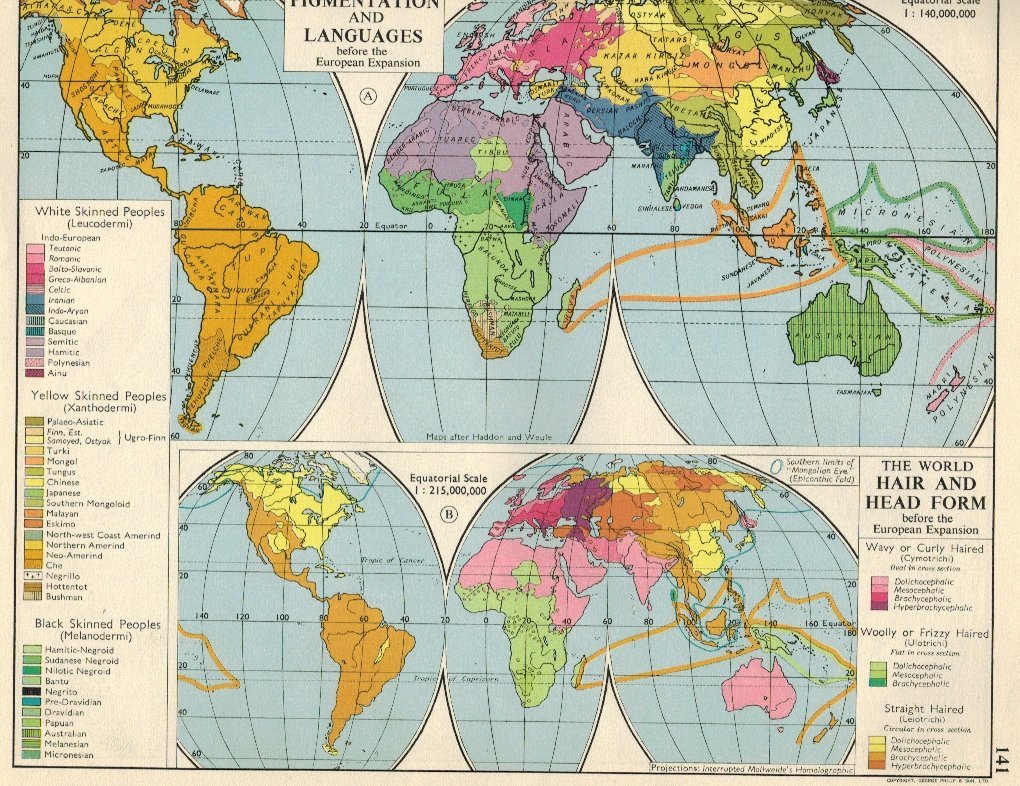
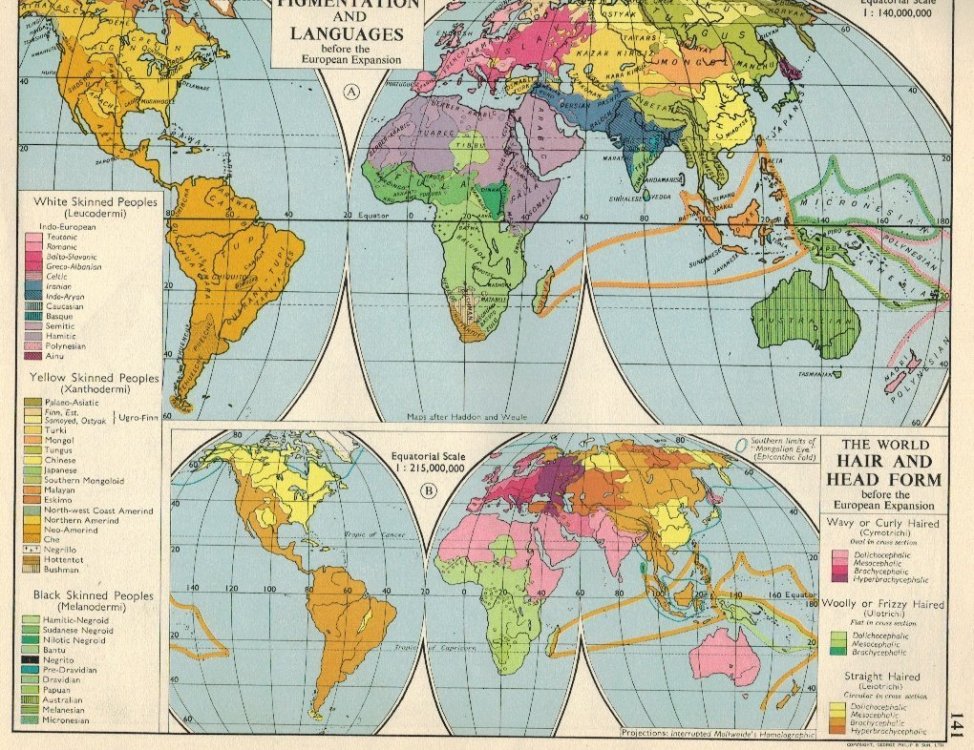
Are you suggesting that the peoples in Australia did not come from 'the African Cradle' ? As a matter of interest you map appears to show that man never reached India ? Only half a mistake really. The nomads of the steppes pushed both east and west, and into south northern India at one time or another. It's just that the older cultures in India and China were stronger and better at resisting that the weaker cultures in Europe.
-
If it doesn't exist, how can you identify it to demonstrate that it doesn't exist ? Further how can you tell that nothing happens there ? These are really similar questions to those Genady has already put. Indeed so, but Riemann has already taken that into account. Translation from German by Spivak, adapted by McCleary. So was the birth of Topology and topological manifolds.
-
I am aware of the work of Prigogine and of Szilard. But I am not aware that anyone has proven the need for either deletion or the actual physical embodyment of mathematics. As far as I am concerned, the Mathematics existes and existed quite independently of any physical use or discovery. I do not support the suggestion that symbols written say 1000 years ago should be erased or deleted, otherwise the equations of entropy that I write today, or even just conceive of but not write down, would somehow become unbalanced. In my opinion they are totally unconnected. But we are getting further and further from the OP question which was about large numbers and my observation that since there are no limits to the number of point in a region of space we can assign a different number to each one without limit. We simply need to follow a Peano curve 1,2,3,4,5... to accomplish this. Since one one the basic tenets of number theory is that we can take any number proposed as the largest and increase it by various means. We can repeat this indefinitely. Each repetition we will uniquely identify a new largest 'number'.
-
I don't follow your objection. Please elaborate, perhaps with an example or two. As regards units, since entroy difference refers to the difference between states in a space it follows that any system that possesses multiple states can have an entropy, defined by multiplying the statistical entropy of the states (which is a pure number) by the units of those states.
-
Thermodynamic entropy is indeed a function of energy (and temperature) It has units (dimensions) of energy per degree K. Information entropy is dimensionless. Probably the most interesting distinction is given by Caratheodory in his version of the 2nd Law. As far as I know, Information entropy admits no such restriction on the states and consequently does not require the second law. Clearly since it it not directly concerned with energy it does not require the first law either. Another commonly mixed up pair of terms is information and meaning. Take the letters in alpha order A D E M N O R S Form one of the 1024 (with replacement) possible 10 letter 'words'and you have a 1 in 1024 chance of getting RANDOMNESS. How many more have meaning ? This is rather like the difference in economics between price, cost and value or worth.
-
I have no quarrel with proper capitalism. But I don't see how your reply to my post you quoted has anything to do with my point. As regard value, here is a parable about value. Due to Stafford Beer. Take 1lb of apples. Something of intrinsic worth in its own right. Give it to a top chef and he will turn it into something worth significantly more. Give it instead to an ill suited work experience person who may well loose all of its original value let alone add to it, in the mess they make.
-
Well as I understand the Aboriginals in Australia they are some of the most (or perhaps longest) undisturbed humans on the planet. Yet the maps show they are quite different from the Polynesians, Maoris and South American indigenous peoples. Yet Australia (the nearest parts) is thousands of miles closer to SE asia than New Zealand or most of the pacific islands. So why did they not get to Australia first or even at all ?
-
I wouldn't until I knew what sort of entropy you were talking about. It is unfortunate that the same word (ie entropy) is used for both phenomena, unlike my example which clearly distinguishes. Beltrami has a good discussion of different sorts of 'entropy' in his book What is Random ? Chance and order in Mathematics and Life.
-
You surely can and I agree Seth deserves one. See below to make your choice of like (blue) or upvote (green) . The only restrictions are that new members are restricted to 5 posts in their first 24 hours to prevent spambombers.

-
NASA considers Pluto to be a Planet and says so many times in this article. https://solarsystem.nasa.gov/planets/dwarf-planets/pluto/in-depth/ There was discussion of the status of Pluto presented in their New Horizon's video, which as I recall, came down on the side of planet, dwarf or otherwise. Of course if we discount dwarf planets as being planets the not only are we not speaking English, but we must also discount giant planets , such as Jupiter. What a daft situation.
-
This doesn't prove anything, but does rule some hypotheses out. I don't think the South American hypothesis is disproven. Note the maps refer to 'before the european expansion'.
-
I note this was moved to Mathematics, not Physics. I have noted before that just because two physical phenomena follow the same mathematical models does not imple any connection between them. For example the voltage transfer characteristic of an FET follows a square law, as does the trajectory of a ballistic object on Earth. Yet I can see no connection between these phenomena. Information entropy and thermodynamic entropy have the same disconnection. I can't agree with that. Phase change at constant temperature is purely entropy drive but the macrostate is definitely significantly affected.
-
Which all goes to show that we have several 'best guesses' about the spread but are finding substaintial new evidence all the time and these guesses are in a state of constant revision. It is important to acknowledge when we don't know enough.
-
Which means they are not subject to energy constraints. How much energy is required to provide a perfect shadow in some region ? Yet every point (and there is an infinity of such points) is 'in shadow'.
-
Nice one Moon. +1
-
OK so they are not planets, they are dwarf planets. How much did the snouts at the trough receive for that leap forward in science ? Can I have a similar amount for reclassifying the tortoise shell as a partial shell ?
-
That was not my understanding from the results of the New Horizon's spaceprobe.
-
Please elaborate. Also our word for planet come from the ancient Greek meaning 'wanderer'. These referred to heavenly objects that did not track nightly across the sky the way the remote stars do, but moved in an apparently erratic way. There are many objects in the sky that do this and in the clear middle eastern skies more can readily be seen. So it depends upon what your poets meant by planets.
-
These are interesting ideas, I hadn't heard of the neadethalis v sapiens comments. But the coastline theory doesn't stand up well to close examination.
-
Well why didn't you say so ? Are you going to participate in your other threads ? +1 to @Genady for the map, I looked for something similar, but couldn't find anything suitable. Not sure I agree with all of it but it shows what pattern is generally accepted. saber was talking about the rep system, not his post count.
-
Scientifically 'events' are defined bu relativity, which is pointwise - the opposite od spread out. Waves and to some extent particles are defined by quantum theory and extend, perhaps forever. Riemann in his world famour lecture of 1863 introduced the 'concept of the n-fold extended quantity'. Sounds posh but it really means the relationship between geometry and real world quantities and enabled us to calculate using graphs of as many dimensions as necessary.
-
As always I am trying to simplify the complicated. All numbers are abstract. Yet I maintain that they exist in our universe, whether man (or any other being) has enumerated them or not. Pi has infinite digits, but its value is not infinite. It's value lies between 3 and 4.
-
No that is not true. Einstein's theories are more detailed than Newton's and cover more situations, but reduce (simplify) to Newton's, when the circumstances (situations) are the same. In other words they extend Newton. This fact has always played a major part in the acceptance and preference for Einstein's General Relativity over other competing explanations of the observed facts. And yes I know that we have now discovered situations where Newton's analysis is inadequate.
-
Yes dates and times are very important, as are locations since saber is thinking globally and there was not just one seat of all this. In fact the two stone ages, the bronze and iron ages occurred at differnt times on different continents. Also as others have mentioned the situation was very complex. It is not known exactly when the peoples of the far north (Siberia) crossed to North America and settled there but it may have been 30,000 to 15,000 years ago so they were definitely stone age and the first peoples the spanish encountered in the 600 years were still using stone age tools. In Eurasia there were early nomadic peoples (herding tribes) who did not have the technology to smelt and work metals so they traded with one seat of more advanced civilisdation in eastern China for metal goods. The nomadic herders spread eastwards and westwards and southwards over several thousand years whenever a series of doroughts cause herd failures. The populated in turn Ancient Greece, the Minoans, The Levant, and ancient Egypt (the Hyksos) but were repelled by the civilisations of ancient india and modern iran and iraq. It is a huge subject.