studiot
Senior Members
-
Joined
-
Last visited
Everything posted by studiot
-
As far as I know 'follow' comes up automatically ie the box is ticked when I start a thread. Perhaps someone with more knowledge of the system might advise you on this.
-
Thanks. How did you get on with the acoustics material I posted ?
-
Very interesting viewpoint. +1 So as I understand you you are saying you can't have the future together with the past because they are using the same energy ?? Also interesting, and brings out the point I have been making repeatedly that space and time are different. +1 One of the difference is that when we draw a graph or plot we are using the properties of space exclusively. We generate virtual surfaces and other complicated shapes in the space we draw in but thay are all spatial. The mathematical geometry of n dimensions is based on this fact eg Kendall 1961. I am still thinking about the situation when we convert them to all timelike.
-
Interesting use of projective geometry. Towards the beginning of your video you spell distortion as distorsion. I see you are Spanish so no bother I mis-spell words all the time but hey you might like to correct this. I have a friend who is an artist and a draftsman. Very non scientifically technical, non computerate. Yet although I can calculate the effect on shapes, and he cannot, I cannot anywhere near match the way he has taken to drawing programs and can produce the most amazing pictures intuitively and takes equally intuitively to the use of the computer to automatically perform the calculations for him. Which brings me to my point that although you have really used your time well, you have not discovered anything new. Sorry. Mathematicians call your infinity point : "the point at infinity" so a good match. This is a branch of projective geometry which was developed in the 19th century. This is not taught much today, but of great use in compter graphics. It is also of great use in cartography, where it is used to take out the distortion that arises in aerial photography and also to provide information in the 3rd Dimension (Height in this case). This branch of cartography is called photogrammetry. Hope this helps and go well. +1 By the way, phi, I liked the embedding of the video as it plays on SF, but my older computer no longer renders YT etc.
-
And just who are you to use abnormal definitions of scientific terms. The term massive refers to those bodies which possess the property of mass and distinguishes it from those that do not.
-
http://gamelab.mit.edu/games/a-slower-speed-of-light/ Have fun folks
-
So what's the big problem ?
-
Can you elaborate on this without employing a circular argument ?
-
Indeed +1 Agreed. +1 is meant to be about or why it is off topic to talk about some aspects of that nature and not others. I still don't know what an opening post that looks more like a blog entitled the nature of time The whole point being that space and time are very different things. I note that at one point responders generally agree that time is not a 'thing', yet returned to treat it as a 'thing' - after all if it it not a thing how can it have properties? "Time is a dimension" So do we take addison's proposal as an invitation to discuss or what ?
-
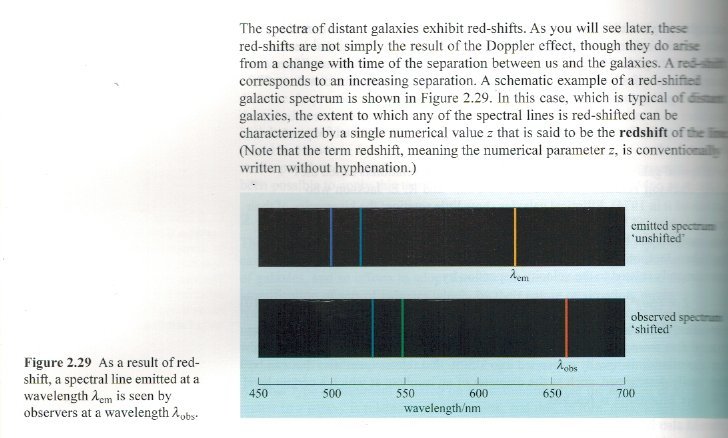
Apart from the insulting remark at the beginning, this is a perfect example of you choosing to argue with things I did not say, rather than ask for clarification about what I did say if you didn't understand it. I said nothing whatsoever about any velocities or atoms. In fact velocity doesn't appear explicitly in GR in the way it does in SR. Not in fact does it care whether atoms exist or matter appears in some other form. I have already explained the how and why effect on GR on the observed frequency of light and given you a reference to a NASA artcle on the subject. Since and I have observed that frequency measurement can be used to measure time, though I did not explicitly say say how it is simply because frequency is the reciprocal of time. I actually credited you with the intelligence to understand this without baby steps. Argument from incredulity is unbecoming from someone who claims to know more than the experts. (I am not an expert in this, I follow them, I don't preach to them) So here is, plain as a pikestaff, what I am talking about It can be clearly seen that lambda emitted is not the same as lambda observed. I suggest a good place to go and study such things would be An Introduction to Galaxies and Cosmology Jones and Lambourne Cambridge University Press You will find plenty of formulae, derivations, explanations and examples such as the one in the attachment.
-
I don't think you want to understand my points since your rendering is so far from what I actually said so how can I help you understand. Your questions have very little to do with what I said. The only question I can answer is I have said more than once there is light from Sol and light from Sirius. Any source of light can be used as a clock in many different ways. So we have two clocks, one on Sol and one on Sirius. Since we can observe both clocks we can compare the two.
-
Yes there are at least three different meanings to the assignment of a probability of 1. I don't think however, that you can apply true/false (ie first order) logic to concepts like consciousness or life or many others. Humans have a propensity to categorize or pigeonhole into preconceived classes and are constantly suprised when the natural world refuses to fit into these neat schemas. We do not have a definition of consciousness any more than we have a definition of life itself. The best we can do is to prepare a list of characteristics of living and non living, conscious and non conscious. But experience shows that these lists have changed considerably over time.
-
I still don't understand why the 'block universe' was moved to another thread since such an idea offers one view of the nature of time. I don't agree with that universe, but rather like the antithesis of it which is Mark Twain's famous statement
-
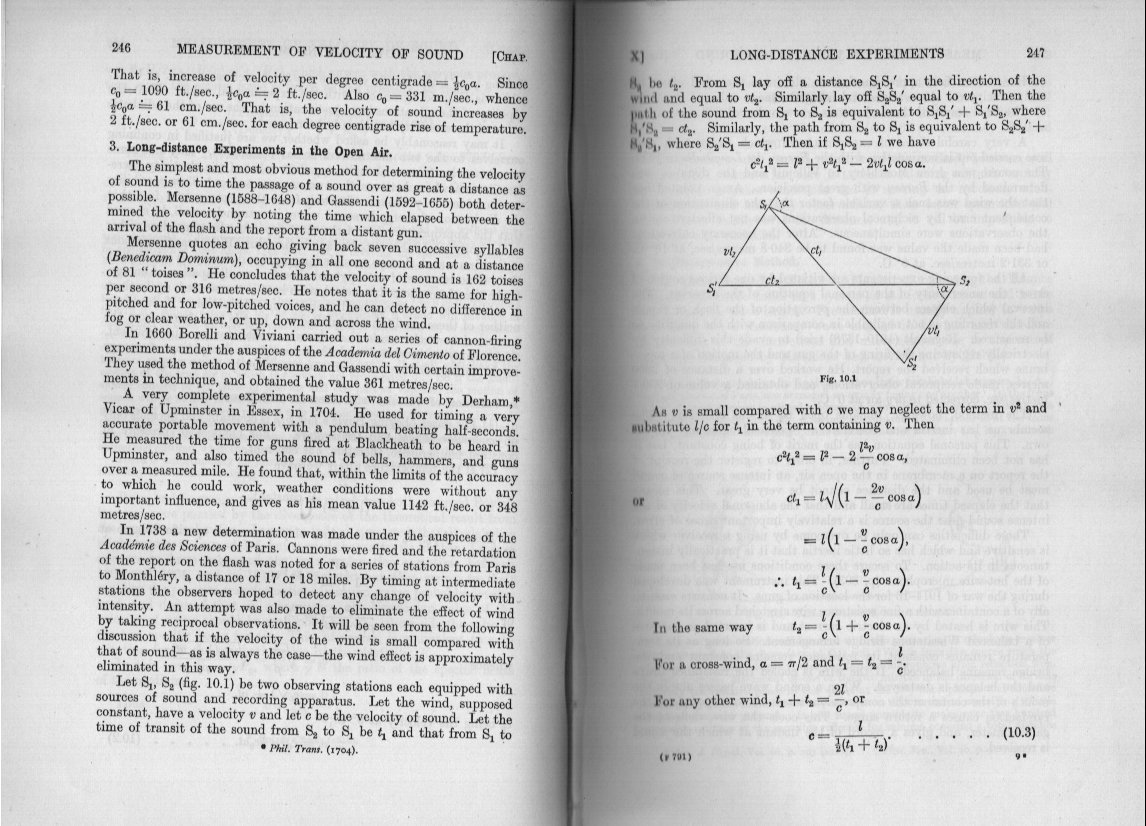
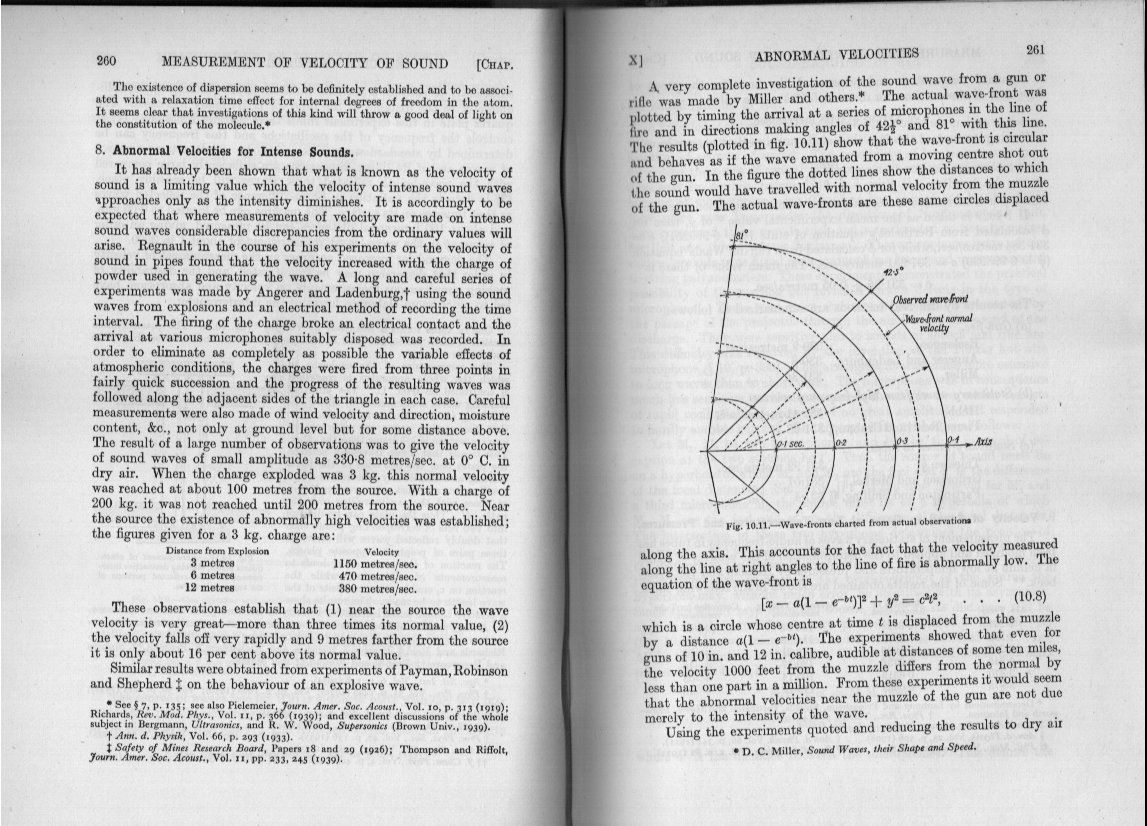
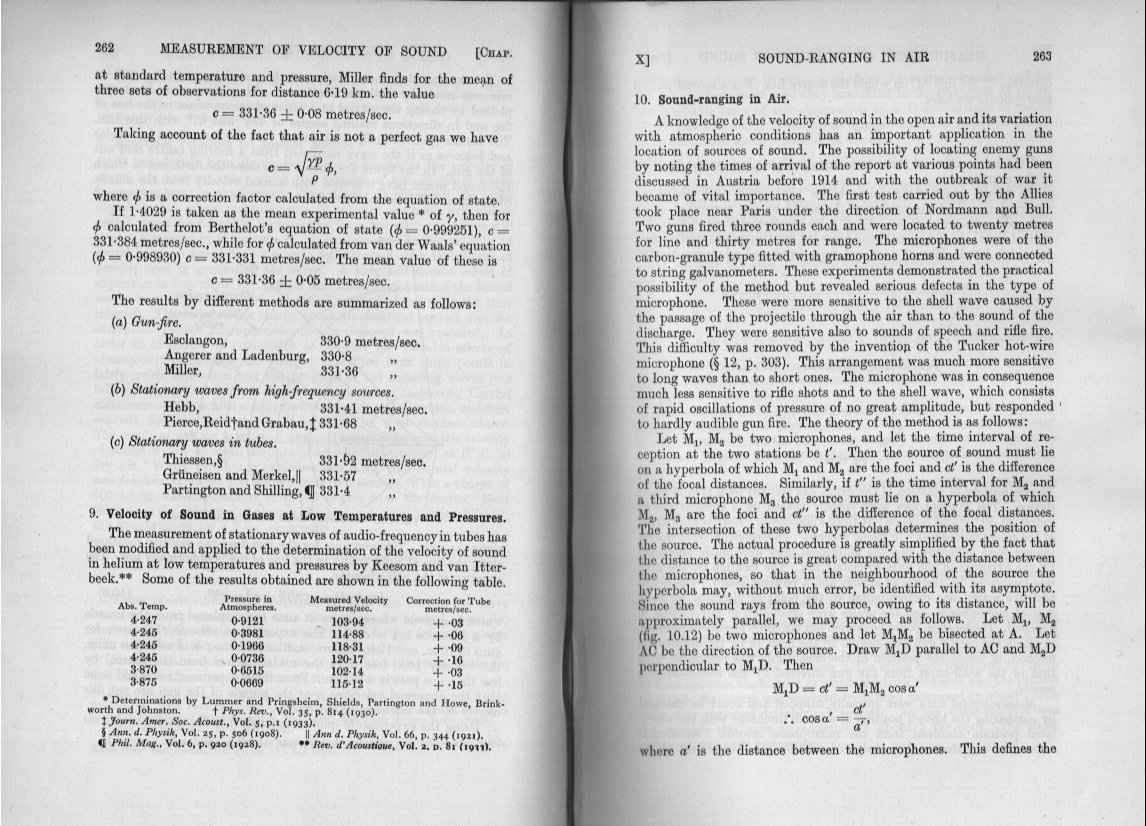
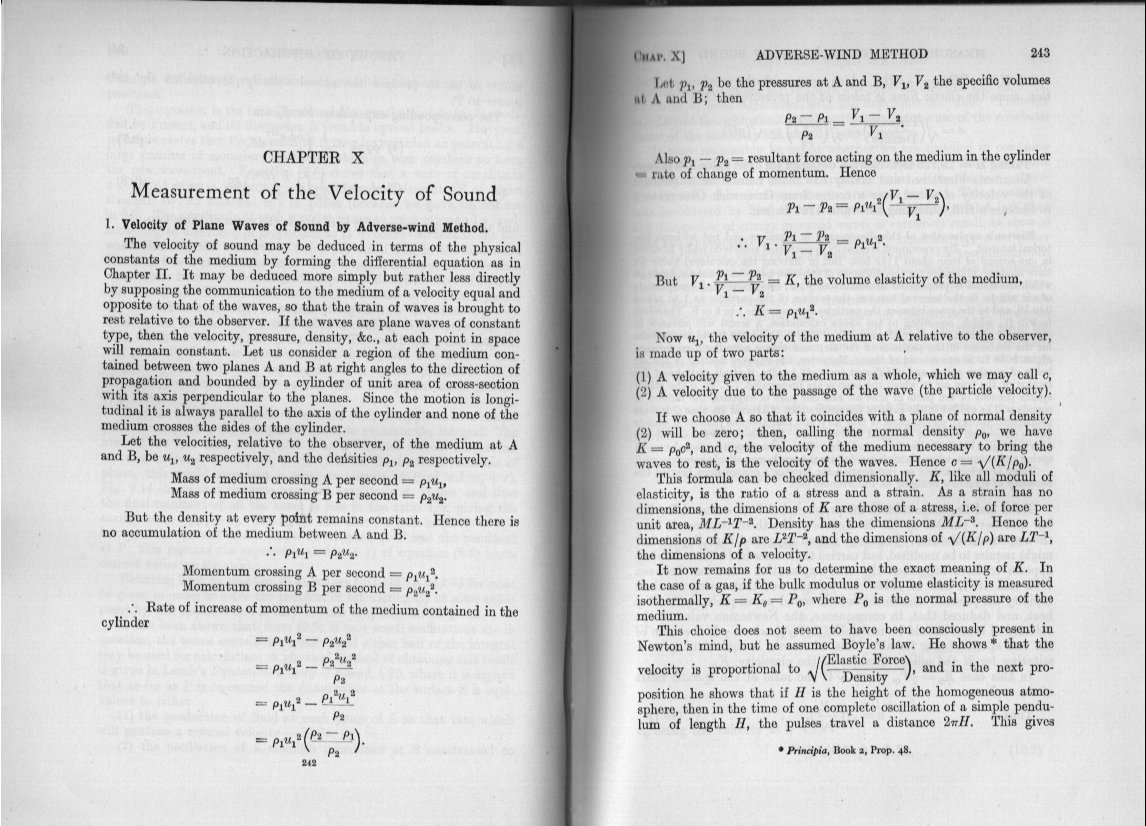
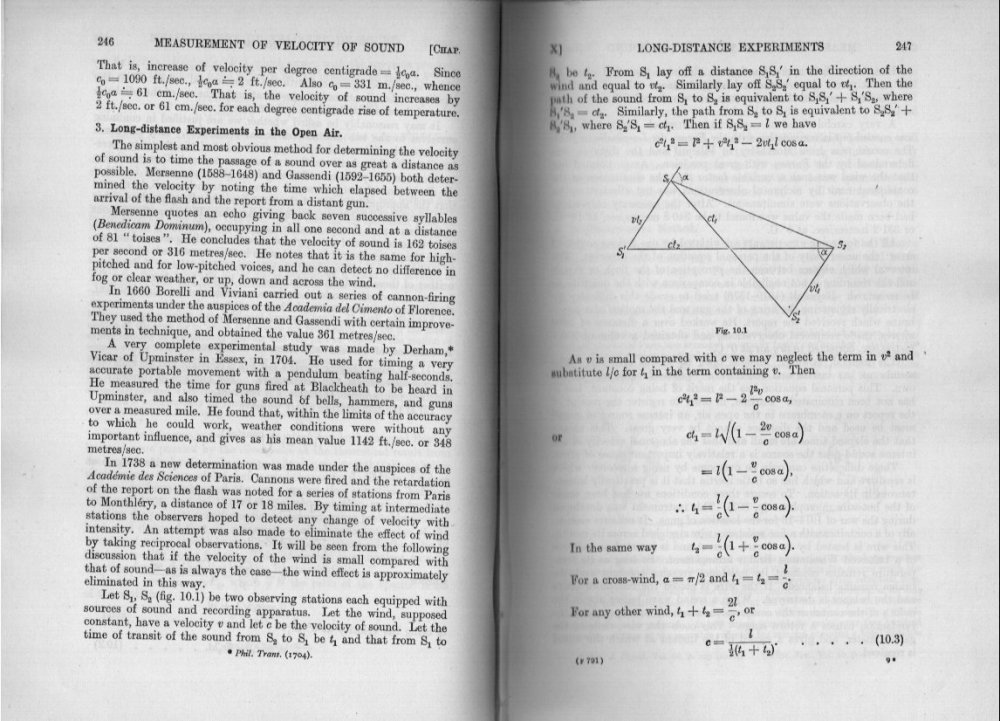
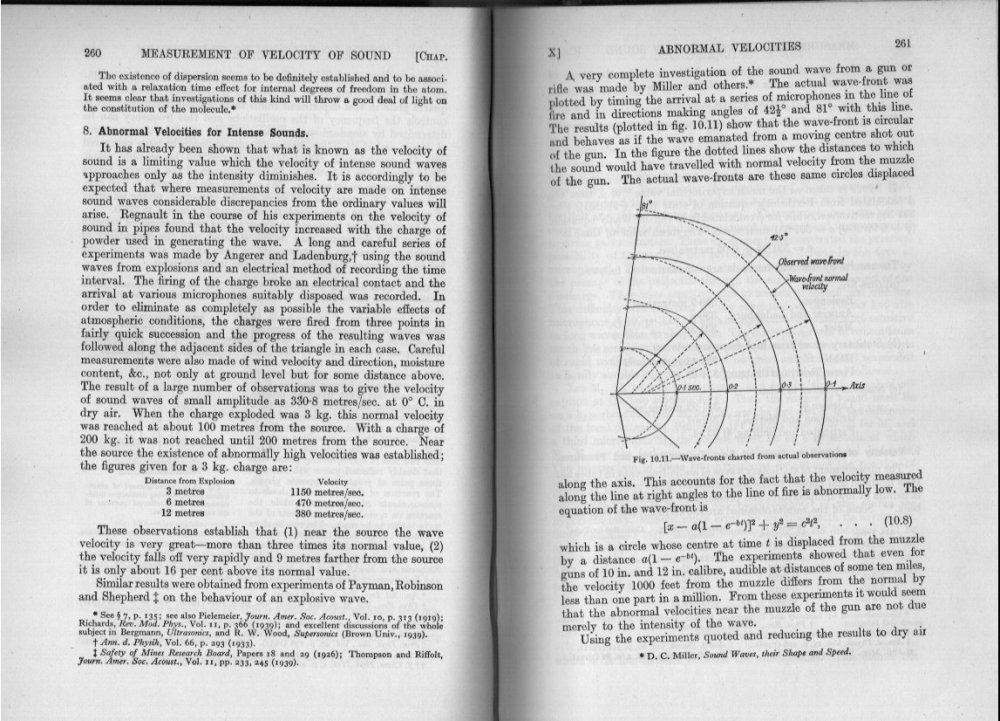
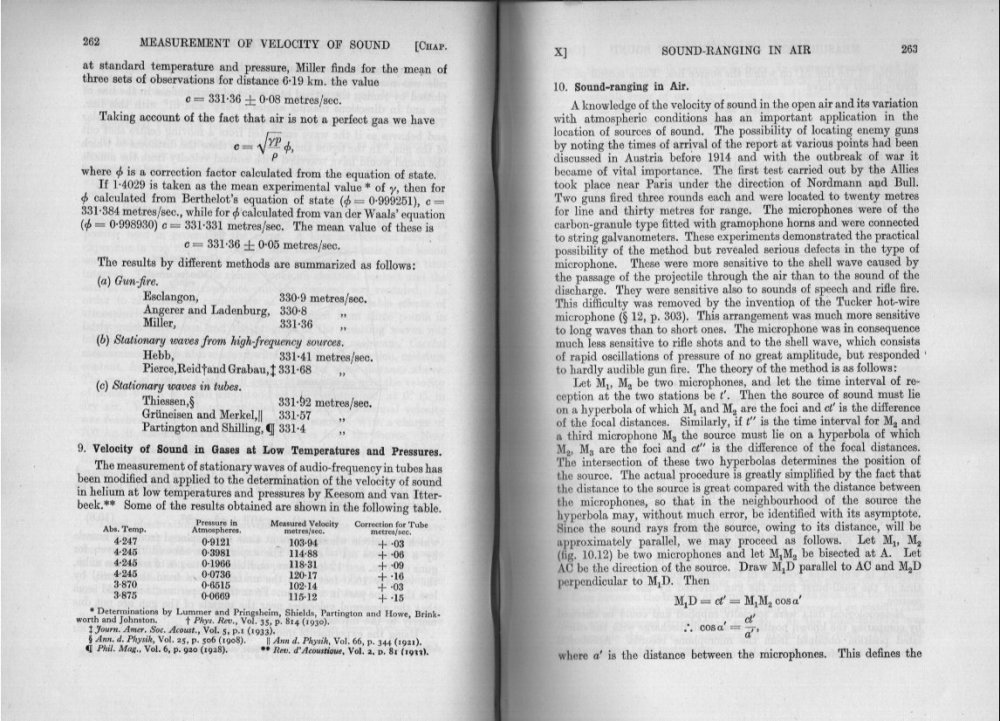
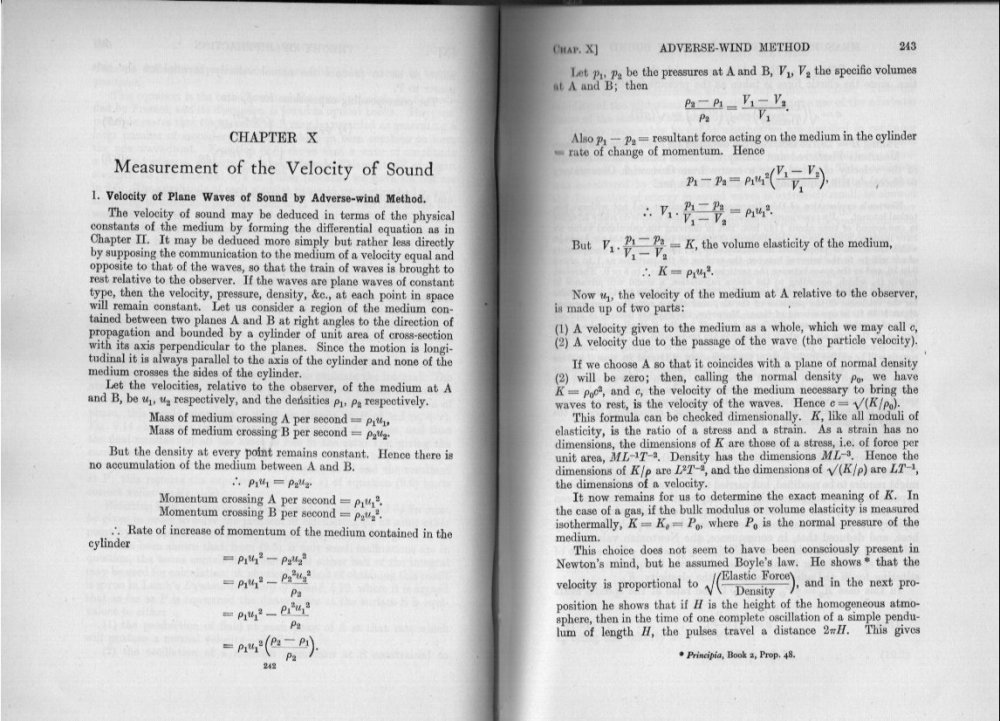
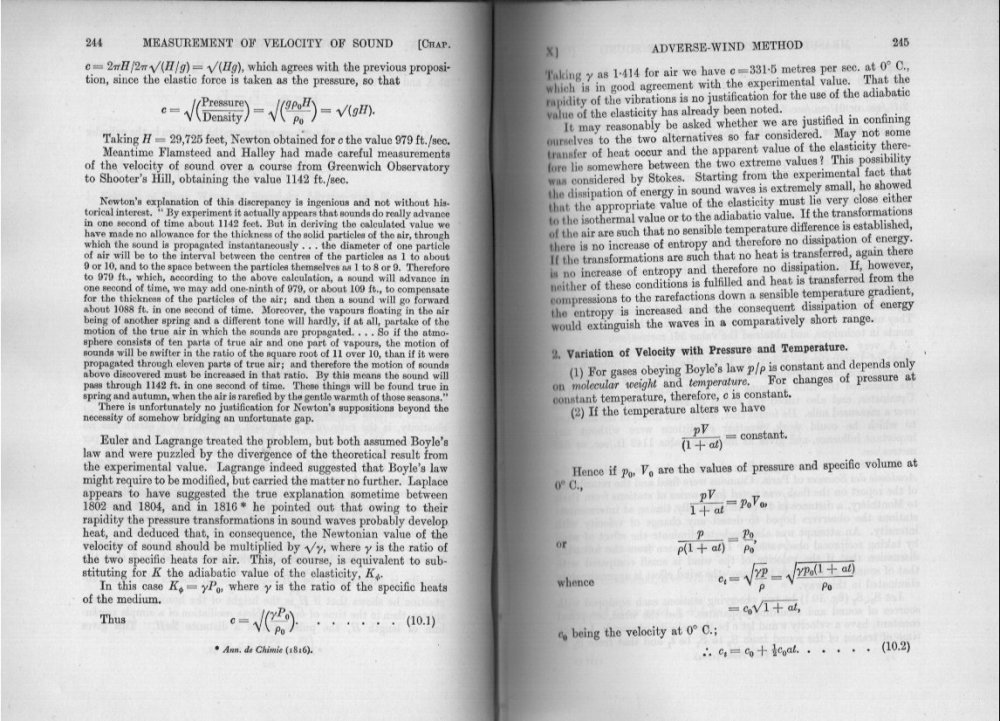
Perhaps you can get a hold of this older degree level book. The Students Physics VolI Acoustics Alexander Wood Blackie. Wood goes into great detail about the subject including lots of experimental material. He treats many musical instruments including brass in general and trumpets in particular and offers measurements on them. Here are some pages from the more basic section involving the velocity of sound, both measured and linked to theory includng corrected gas laws.
-
Or one can say zero time ?
-
I don't know the exact speed of light in Earth's frame ? What rubbish are you trying to blow to obscure the fact that you chose the Moon over a satellite because it is more massive and exerts stronger gravity (whatever way you calculate it) and I have shown you two even stronge gravity wells ? Or are you denying that Sol and Sirius have gravity wells ? Or are you denying that our measurement of time is tied to the frequency of some oscillator ? Or are you denying the fact that we observe a redshift of light from Sirius, compared to Sol by observing the frequencies of certain patterns of spectral lines ? You are just arguing for the sake of it, without any substance whatsoever.
-
My apologies if you have truly not heard of this before. https://www.wtamu.edu/~cbaird/sq/2014/11/03/why-is-time-frozen-from-lights-perspective/
-
You claimed it. Now prove it. No one know for certain what cavemen thought or did not think. We can only give our best guess from very limited evidence. I am reporting this for repetition of unsubstantiated claims.
-
Compton scattering https://aapt.scitation.org/doi/10.1119/1.13648
-
I mean quite simply that I can set the watch on my wrist to zero any 'point in time' I want. But GMT will not be zero at that point, even though my watch is 'in' the frame of GMT. When you have more than one frame the t = 0 and t' = 0 may not coincide. We usually consider the case of them coinciding to make calculations easy.
-
Excellent, clear examples of excellent clear statements. Thank you. +1 Still making unsupportable claims and statements that you (or any other person) cannot possibly know. Seriously I recommend you study Markus' style very carefully.
-
As far as light is concerned, how long does it take for light to travel from A to B ? No necessarily. Think hard about this before you respond reactively. This occurs because there is no absolute time.
-
It's your thread and I'm not playing verbal games all night. So if you can't answer a straightforward question I'll leave you to your own devices. +1 for showing how complicated that simple question about terminology really is. Yeah !! I 've cracked it. Only Jedi Knights can see invisible images. Now I can sign off and go to bed happy. Good Night all.
-
So by images, you are not referring to the pattern (electrical or otherwise) that results from light interacting with our brains through our sensesory organs and optic nerves ? Can you confirm you mean the same pattern formed by some internal process as would be formed if we actually received light from whatever the image was of ? So for instance an artist might hold in his mind the same pattern of a landscape he would experience if he actually looked at it ? Finally if that pattern is invisible how does anybody know it is there ?
-
Not so far as the light we are seeing is concerned it didn't.