
studiot
Senior Members
-
Joined
-
Last visited
Everything posted by studiot
-
I still don't see any reply to my comments, which is a pity because you are travelling down the wrong path, pulling everybody with you. The outline scheme of though in analysing the relativity of the light clock runs as follow. The light clock is a self contained unit the output of which is not tracking the light path but a 1 second 'tick'. This tick measures 1 second when compared against the tick used by the stationary observer's ie the two clocks stationary are side by side. When the clock (and it is the whole clock not part of it) is in motion relative to the stationary observer, the observer receives signals of the number of ticks on the moving clock. When he times those ticks using his own clock he finds that they are longer than those of his own clock. This difference is calculated by relativity using distance information derived from the moving clock's motion. This is why others have said the primary observation is time dilation here. Incidentally you have been stridently claiming that the angle of incidence within the clock does not vary. This is not observationally true. The correct analysis, backed up by experiment, is not normally taught in elementary Special Relativity and leads to a formula for transforming between the angles of incidence observed by a stationary observer, θ, and by a moving observer θ', which are different, just as with the time ticks. The invariant in this case is the number of ticks. [math]\cos \theta = \frac{{\cos \theta ' + \frac{v}{c}}}{{1 + \frac{v}{c}\cos \theta '}}[/math] This formula is also associated with observed frequency changes to the light, known as the radia and the transverse doppler effects.
-
Good question. +1 Think carefully about your definition of bouyancy force.
-
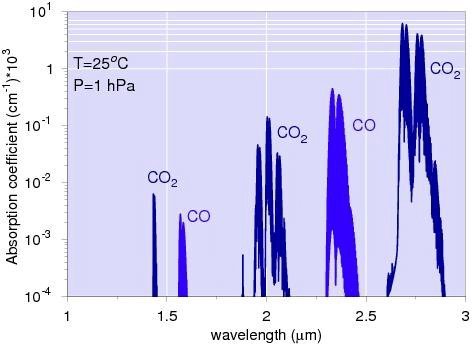
That's exactly what is shown on the graphs I posted. What I actually said was the The absorbtion coefficient of the big carbon dioxide peak is shown on the first graph is shown to be at least two orders of magnitude, (nearly 3) greater than the 15 micron one.
-
Not quite, the hot air ballon is a special case that is more complicated. Lorenz' analysis applies to rigid bodies. The hot air balloon is a deformable body. I can explain it fully if you can do high school maths for science ? But it is basically due to the fact that the pressure inside a hot air balloon must be greater than the pressure outside, except at one point. Can you see why this is true ?
-
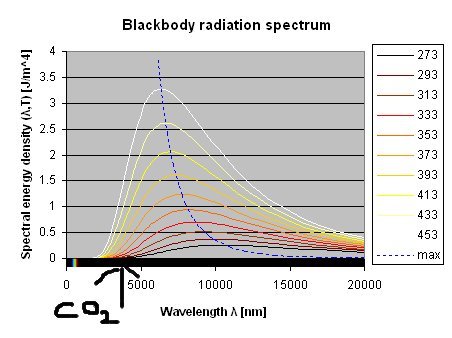
Thank you for clarifying that, it wasn't totally clear. However here are two graphs The first shows the clear big carbon dioxide absorbtion peak at 3000 nanometres. The second shows where that falls on the ground emitted radiation spectrum. As you can see at normal temperatures nearly all the absorbable IR energy is of way too long a wavelength. The bottom black line is 0 C and the second one up (red) is 20 C.
-
@Otto Nomicus I'm sorry you chose not to respond to my offer so I will leave you with these thoughts as some dubious statements have been made on both sides, perhaps you are confusing each other. Firstly if you are going to accept that a light path that measures 1metre between two points in all in the same frame but say 1.3 metres in another frame then you must also accept that the time of transit of that different distance must also be differnt to maintain the principle of constacy of the speed of light in all frames. Secondly the light in a light clock should not be thought of a constant stream of light. There is no way you can observe the time of transit of such a light stream. Light clocks use light pulses which are measured at the source and receiver but not in between.
-
The problem is that you original sketch is fixed in your mind, but it is a flawed depiction of what happens. Thus your text description is also flawed. I will see if I have the time to produce an improved one. By the way you don't need a laser to show this, in fact it is can be less than helpful. Einstein didn't know about lasers back then so he constructed his light clocks using ordinary sources and light pulses. by which he meant the leading edge of the light 'signal'.
-
This fits with a worked example I was thinking of posting, if anyone is interested. The thermal efficiency works out at 19% and the last figure , the work ratio at 0.133 This work ratio figure is useful as it tells us exactly how much work we can get out of such a heat engine at maximum compared to tthe total work done during the expansions and contractions. @Tom Booth Do you understand that Carnot conceived his cycle using equilibrium processes which are regarded as maximal. The stirling cycle is of interest because it is one such that can theoretically approach this maximum by arranging parts of the cycle when no work is done (ie at const volume) and parts at equilibrium (the isothermal parts) ?
-
I sincerely hope it is not too complicated for us since it human input needs to be resolved urgently. I hope you understand the difference between weather and climate. Weather is what happens on a day to day basis at a particular location. Climate is the yearly pattern of weather across large regions of the Earth. You are also correct that human generated pollution has become a major problem in other ways than climate change and also need sorting out. But that is not the topic of this thread and should be discussed in a thread of its own. This also applies to your other geophysical questions, which again merit their own threads. There have been many attempts to explain the Earth's magnetic field and we are getting nearer one that fits all our data as we learn more. Do you have access to library facilities ? If so I can recommend suitable sources from modern researchers. But please start your own thread about this.
-
This is correct and known as Earnshaw's Theorem. https://en.wikipedia.org/wiki/Earnshaw's_theorem This theorem originally applied to electric charges, but was later extended to bodies in other potential fields.
-
Another clear Eise explanation. +1
-
You are correct that the glasshouse warming is more complicated since there is also a conduction and convection mechanism. Radiation still dominates at night however. This article is very readable. https://www.gi.alaska.edu/alaska-science-forum/how-do-greenhouses-work
-
I agree with this statement. But this makes no sense to me. If the lower atmosphere (ie the air directly above the ground) absorbed the incoming IR and only radiated 50% down to the ground as you seem to suggest that surely would result in a cooling compared to what would happen if the absorbing gases were not there so 100% reached the ground ?
-
Surely that depends upon what you mean by macroscopic tunnelling ? It's the electrons that do the tunnelling, and a significant number of them at that. Is that enough to be macroscopic ?
-
Thank you for that, I had never heard of it before today's search. The reference I gave is a US government document dated 2017
-
The basis of the greenhouse effect in greenhouses is worth noting. It is also worth noting that greenhouses come in two varieties. Heated and Cold. That is with internal heaters and those just warmed by the sun's rays. The Earth corresponds to the Heated type as already noted. So the light of the Sun is of a frequency determined by the temperature of the surface of the Sun, by Stefan's Law. Most of it arrives at the glass at a very low angle of incidence, nowhere near its 'critical angle' where it might be reflected. When it falls on the ground or benches inside the greenhouse its energy is absorbed. The ground and benches are at the internal greenhouse temperature and also radiate 'light' as very much longer wavelength EM radiation. It is also known that the critical angle increases with increasing wavelength. So the outgoing radiation strikes the glass at or above the critical angle and is reflected back into the greenhouse. It is also this longer wave radiation that is reflected back to ground in the atmosphere.
-
Since this thread is about Carnot Efficiency and the Carnot Cycle refers to and was conceived as using only reversible processes I thought I would look around and post this link to a modern publication that claims to achieve Carnot efficiency for an irreversible process, notable the Feynman Ratchet. https://pubmed.ncbi.nlm.nih.gov/28878219/ The paper is downloadble as a pdf at 2.9M I haven't had time to study it properly yet, but it doesn't seem to avoid mentioning the standard proof of Carnot via a proposed more efficient engine leading to a contradiction. It is worth noting that there is no such thing as an ideal hot or cold reservoir in the real world. The best we can do it to take something where the heat content of the reservoir is many orders of magnitude greater than the heat being used in the engine.
-
What amazes me is your total refusal to pay attention to important matters others say to you. For instance, what do you actually know about the history of the subject ? Do you actually hate the French ? You have persisted with some incredible slurs upon Carnot. Why slurs ? Because your version is not possible. Carnot published his cycle in 1824, when Clausius was exactly 2 years old. Clausius published his most famous thermodynamic work in 1850, in which he discussed Carnot's earlier work mathematically and indeed provided a mathematical basis for it, replacing Sadi's Physics basis. Do you know either of their reasoning ? This stuff is a matter of Historic record. https://mathshistory.st-andrews.ac.uk/Biographies/Clausius/ https://mathshistory.st-andrews.ac.uk/Biographies/Carnot_Sadi/
-
I'm sorry I still don't understand this or how it is related to my post that you replied to. As a refresher, my post concerned bargaining power. Those under shariah law have exactly zero bargaining power, as I have already noted. Economically speaking, have you tried bargaining lately in Tescos ? It is not a free market.
-
There you go again. Preaching fallacies, to those who know more than you do, Instead of reading properly what they are saying. Seth has told you and I have highlighted what he told you and tried to reinforce that he specified the direction not the amount of heat transferred. And yet here you go again trying to change the subject to the amount. A total waste of others' time and effort.
-
Well I have a major disagreement with the claim I have emboldened. This is a fine example of what two experts (+1 each) have been trying to tell you. You do not know enough to understand exactly what they are saying to you. The energy level has exactly zero bearing on the direction of heat flow. This is a simple case of. If A > then B heat flows from A to B. If A = B no heat flows.
-
I can't see why anyone should give you a negative rep for these questions so I have reversed them. +1 also to exchem for introducing some scientific sanity here. I am suprised you are only offering these oversimplistic responses to someone who is perhaps a youngster trying to understand climate change. @CrystalMagic To answer you questions and offer some further information about the subject. The fundamental driver for the average surface temperature of the Earth is the balance between energies reaching the Earth, energies leaving the Earth and energies being transported within the Earth. None of these three energy flows have ever been constant. As a result there have been periods when the Earth's surface has been warmer than at present and also colder than at present, both on average. Climate is the result of the fact that the average surface temperature is the average of a very uneven distribution of temperature and also the three energy flows. Climate is the response by the Earth's fluid environments (Atmosphere and Ocean) to this uneven distribution towards evening this out. The processes of climate are affected by many factors including the two you have asked about. The last major volcanic eruption, Krakatoa in 1883, cooled the Earth for about a decade becasue the dust released in the atmosphere reflected back some solar energy before it reached the surface. And yes, as sensei says there were bigger and better eruption a long time ago. As to your second question, yes the Earth has warmed and cooled many times before the present as the actual prevailing position of that energy balance shifts. The shifts occur over periods of hundreds of years, thousands of years as well as the millions sensei mentioned. We are currently in a period between two much colder periods commonly called ice ages. Please indicate if you have further interest when you reply.
-
So what about my shadow ? That occupies points where, by definition, nothing happens. And the shadow is made of nothing, again by definition. Also if you are going to claim that the points are but abstract and only come into existence when something happens then you also need to establish whether or not the points and their nature depend in any way upon the something that happens. A real can of worms.
-
Some are some are not. I think Seth was referring to those that are. You should listen to him and answer his questions properly. He is/was a pretty good engineer. I don't any response to his question about the working fluid. The term 'working fluid' has a particular meaning to an engineer and may be imaginary or representational depending upon the configuration of the machine. This is because Carnot and the 2nd Law refer to a working fluid undergoing a cyclic process. They do not apply directly to non cyclic processes This is of fundamental importance and would be asked by any engineer working on a heat engine.
-
So you haven't really shown that they 'don't exist' - whatever that means. I don't know of any human who has tried and failed to move from one 'real ' point to another through the empty space between them, where you seem to claim there are no points. As a matter of interest two different scientific definitions of the word 'event' have been introduced in this thread. One is the Physics (relativistic) definition which means point in space, occupied or not and regardless of 'whether anything happens there ' The other is the statistics definition which seems to fit how you intend to use the word. This does indeed define points in 'event space' as an individual instance of something happening. Event space is by nature discrete, though we postulate underlying abstract continuous spaces in some cases.