swansont
Moderators
-
Joined
-
Last visited
Everything posted by swansont
-
Governments can print money, economies can multiply it, but energy is a conserved quantity. If you can track where energy goes, it will all add up to the same amount.
-
Not all the air; there will be a gradient of density. Similar to how air pressure (and density) near the earth’s surface is higher than it is at some distance above the surface, owing to the affect of gravity.
-
You claimed your post would make sense on this day.
-
If by cynically dishonest you mean “do they think their supporters are this stupid” I think the answer is yes. It’s been obvious for a long time that a large swath of the population are far too credulous regarding lies made by politicians and the “news” channels that amplify them. The issue here is blaming the existence of renewable sources for the shortfall, and using this as a talking point to not “go green” while ignoring the failure of gas and oil. The issue is not having properly protected/winterized the infrastructure. Canada, Norway, Sweden, even Antarctica have wind turbines that work just fine. edit to add link: https://www.newyorker.com/news/daily-comment/blaming-the-wind-for-the-mess-in-texas-is-ridiculous
-
An exploding star is not an analogue of the big bang
-
Ecology more than geology, but...so what? We have a demonstrable impact on the earth. Baldly asserting the opposite isn't based on evidence.
-
! Moderator Note "Eternal inflation is a hypothetical inflationary universe model" https://en.wikipedia.org/wiki/Eternal_inflation IOW, not suited for replies in mainstream science. You can, however, discuss its merits and drawbacks here in this thread.
-
All points. Other than local motion, the expansion is there for every point.
-
I remember a documentary where the claim was injecting you with window cleaner cause the brain to die last, and it could be preserved in a vat.
-
The presence or absence of gravity has no effect here. In a Newtonian view these are forces, and forces add as vectors. Whatever acceleration that's exerted on them via rockets (or whatever) is something they will experience. In any event, a body in orbit isn't at rest. The astronauts are perpetually in freefall, but if one analyzes their motion one would deduce that there is a net force on them, because they are not in uniform motion. Therefore, they are undergoing acceleration.
-
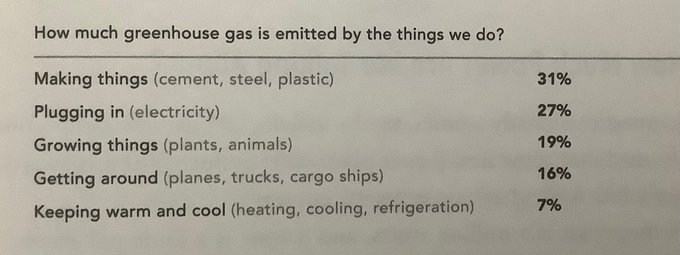
Perhaps these folks could learn what the biggest impacts are. From the recent book by Bill Gates Changing driving habits is only going to have a small effect. It's not nothing but one needs to not overestimate the impact. Going green with electricity production, and cleaner manufacturing, is going to have a bigger impact. You can't choose a product that isn't available. My own experience is that people who boycott meat are convinced that they aren't missing anything. They don't have to. That's based on the claim that the Amazon produces ~20% of the oxygen (some others argue it's less) What, precisely, is the blame you wish to place on them? Because it's a matter of degree, perhaps? Getting a number wrong (20% of the oxygen instead of, say, 10% i.e. a factor of 2) is different in degree in denying that there is any climate change taking place at all, and arguing that no action is required. IOW the price of being wrong is very, very different.
-
! Moderator Note This is insufficient for a science discussion. You need a model and/or evidence to support your claims. Not just this hand-wave.
-
Can you establish that these characteristics have a genetic basis?
-
Conservation laws apply to single frames of reference only.
-
Apologies for not being clear: you mention dark energy, and then measuring the effect of GR on the level of a bond length. Are these connected? If so, how?
-
Is there supposed to be a connection between these statements? If so, what is it?
-
No model, no data, just a video? There's no science here (also, just posting videos in this way is not in compliance with rule 2.7, as you should know). This is not a topic for speculations. Moved.
-
What's the speculation here?
-
Ah, yes. I only read the title initially. But that raises the question of why propose Am as a fuel. That suggests to me this is a bit of a pipe dream.
-
Right. It's easiest for me to evaluate how the US responded, because I witnessed it close-up. The federal response was horrible. Statewide responses were mixed, but their success was also limited by the poor federal response. But this is hardly a proxy for the worldwide response. Taiwan, South Korea, and New Zealand, among others, have done things pretty well.
-
Americium isn't a fission fragment, so the identification as a fission fragment rocket is misleading. The issue, I would think, is how much Am-242 you can make, and at what cost, considering that you need a conventional rector and multiple neutron absorptions to get you there.
-
Who is "we"? There are a number of countries who have weathered this pretty well.
-
! Moderator Note Someday, I hope, you will do your due diligence before you post, and include the necessary citations in your thread-opener. But as they say: the battle does not always go to the strong nor the race to the swift, but that's the way to bet.
-
You’d need a significant half-life for that to work.
-
Books generally aren’t formally peer-reviewed.